Review by Tim Robins
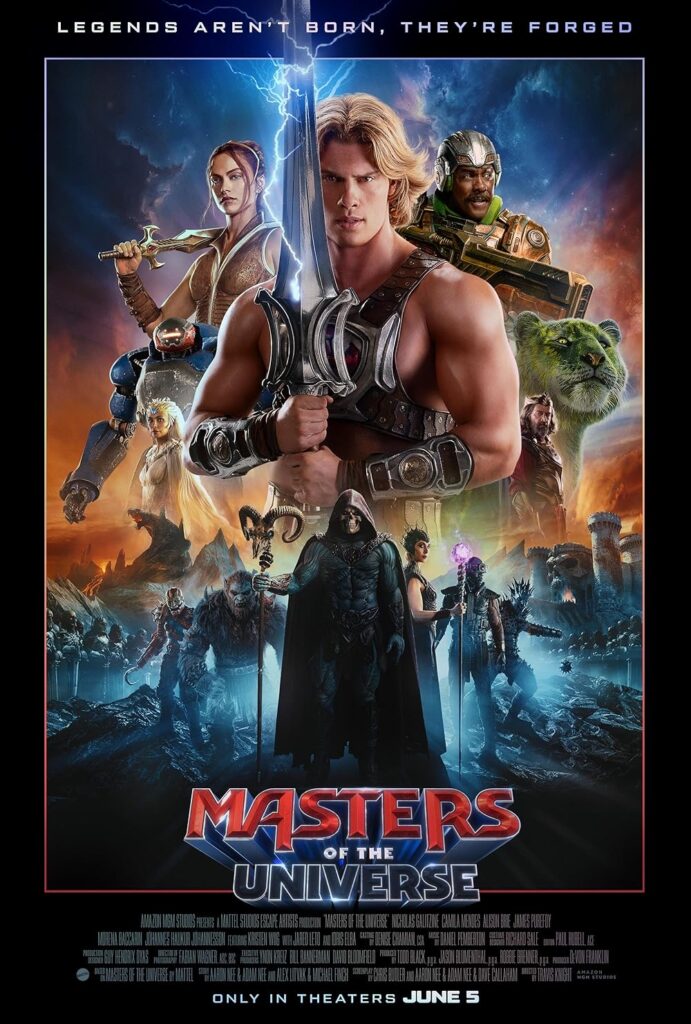
For a franchise built on flogging toys to children, Masters of the Universe (2026) is better than it has a right to be. Particularly fun is watching critics who threw so much shade on the entire enterprise now soft pedaling backwards into the light.
I haven’t had so much campy fun with a film since I first saw Flash Gordon back in the Eighties. Masters of the Universe raises the stakes by reflecting the original cartoon series, and the controversies that surrounded it. A particularly ridiculous moment sees He-Man’s gang of rebels standing in a circle, hands on hips, and stiffly leaning back to spontaneously break into forced laughter – as almost every episode of the cartoon series seemed to end.
The plot focuses on the misadventures of Prince Adam. Escaping from the clutches of Skeletor and his legion of plug-uglies, young Adam (Artie Wilkinson-Hunt) plummets to Earth, losing the fabled Sword of Power in the process. Part of the film involves the now “grown-up” hero, reconciling his Eternia-born ability to rip the arms of villains off their bodies mid-battle with the woo-woo psychology and encounter groups that are part of his Earthly training in Human Resources.

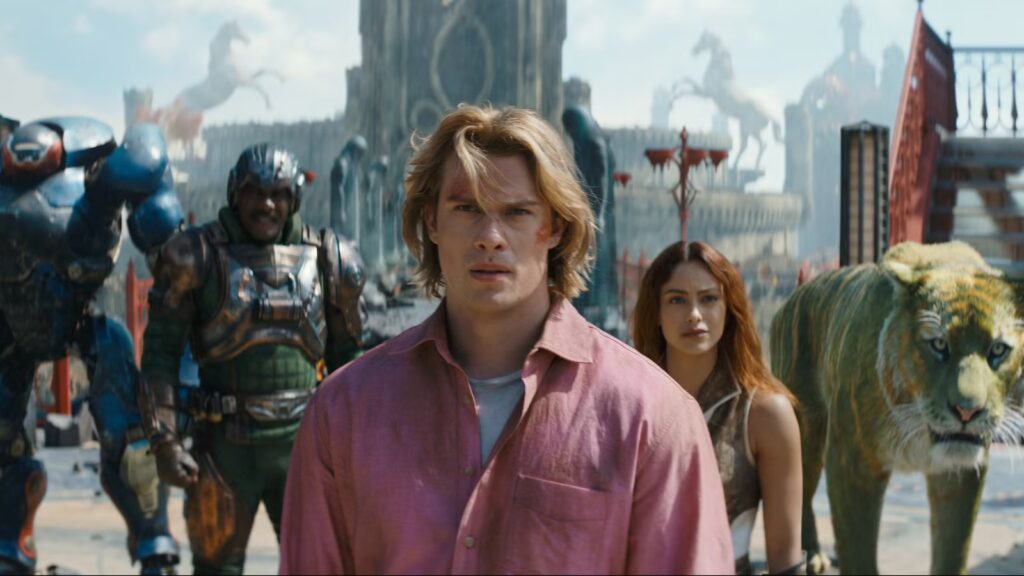
After being told his Sword has been found (yours for $300), Adam drives to a cult TV shop to rescue it from the hand of a display model.
This sequence exemplifies the film’s naughty knowingness, as Adam must approach various men to ask if they are the ones who summoned him. A scene in which Adam stands beside a customer, both staring at an out-of-shot toy cabinet, has the feel of being propositioned at a urinal. Did I mention that Master of the Universe has opened in Pride Month in America?
Brits, with our long tradition of pantomime will take all this in their stride (ooer, Missus!). After touching the sword, Adam is located by Skeletor’s Beast Man (Gary Martin) and Teela (Camila Mendes). After a protracted fight on a freeway, during which all the car drivers run away, the trio return to Eternia, to rouse the opposition and oust Skeletor from the throne of Castle Greyskull.
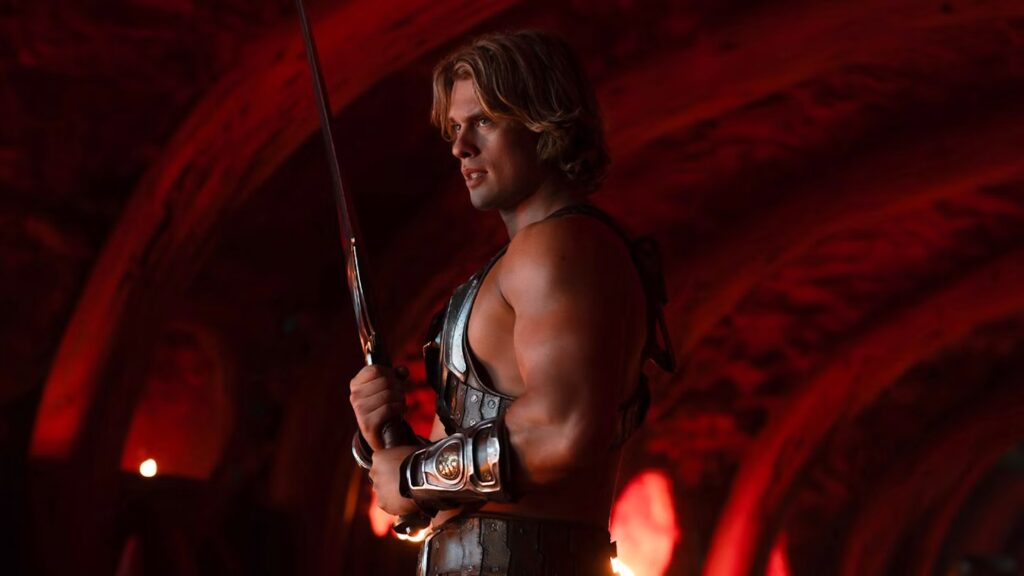
Nicholas Galitzine plays Adam/He-Man as a goofy but likeable himbo. It’s no surprise to find his previous acting roles include teen dramas. He is easy on the eye, seemingly more suited to being a model. Then I learnt he was a global fragrance ambassador for Emporio Armani, and everything made sense. He has the laid back charm of a man who is entirely comfortable in his own body. And a lot of the audience, males and females seemed comfortable with it too. It takes guts to dress as He-Man and Galitzine has abs aplenty.
But, the film asks, what kind of man is He-Man? To some extent he is a hero for the looksmaxxing generation but shorn of all the problematic gender politics, drug misuse and face bone breaking. But he does come across as something of an incel. His love interest, Teela, insists they are friends and, crushingly, will be friends forever. Fortunately, we are not treated to a ‘mogg off’ between He-man and Skeletor.
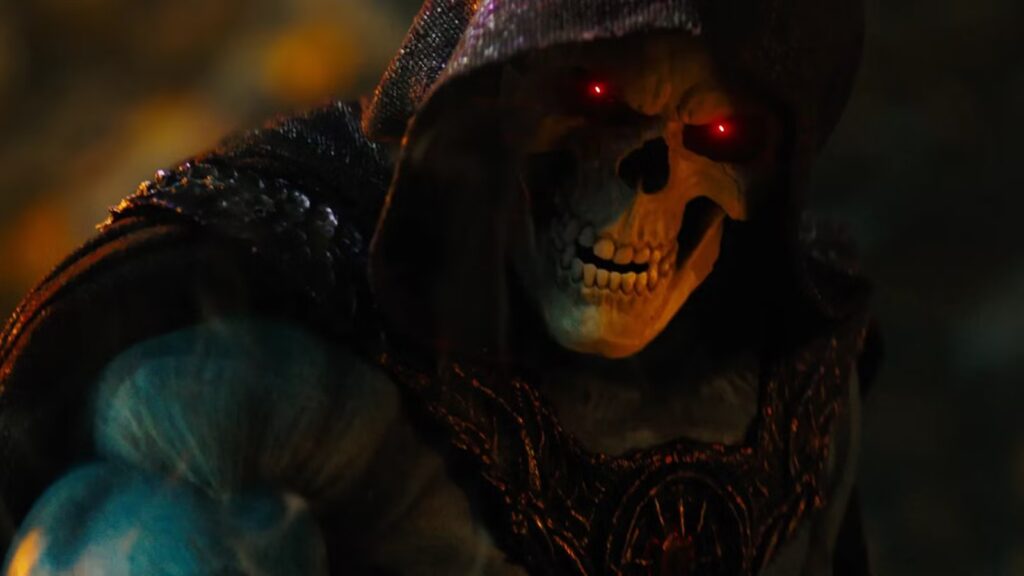
Jared Leto plays the voice of Skeletor – no, I don’t believe he was beneath the costume, but I may be wrong. Leto’s line delivery has been compared to that of Tom Hardy as Bane in The Dark Knight Rises. I hear that but, I feel Leto is just leaning into the posh brit as villain and his Skeletor is a good deal more comprehensible.
The supporting cast manage to keep a straight face to the end. Idris Elba as Man-At-Arms is kind of heart, but as hard as nails soldier to the core. Morena Baccarin manifests the role of The Sorceress, managing to be awesome even in the form of a Kesteral. Comedian Sasha Zamata brings a plausible villainy to her role as Adam’s boss in the HR firm while Alison Brie is just perfect as the villainous Evil-Lynn.
The story is constructed around a not at all disguised Oedipal conflict. The statue of Adam’s father is beheaded and, on his father’s death, Adam grows to claim freedom for his mother. There’s a running, if jokey, commentary on what it means to be a man. This is a film where the line “I have the power to be the best version of myself” can be spoken without making you want to groan.
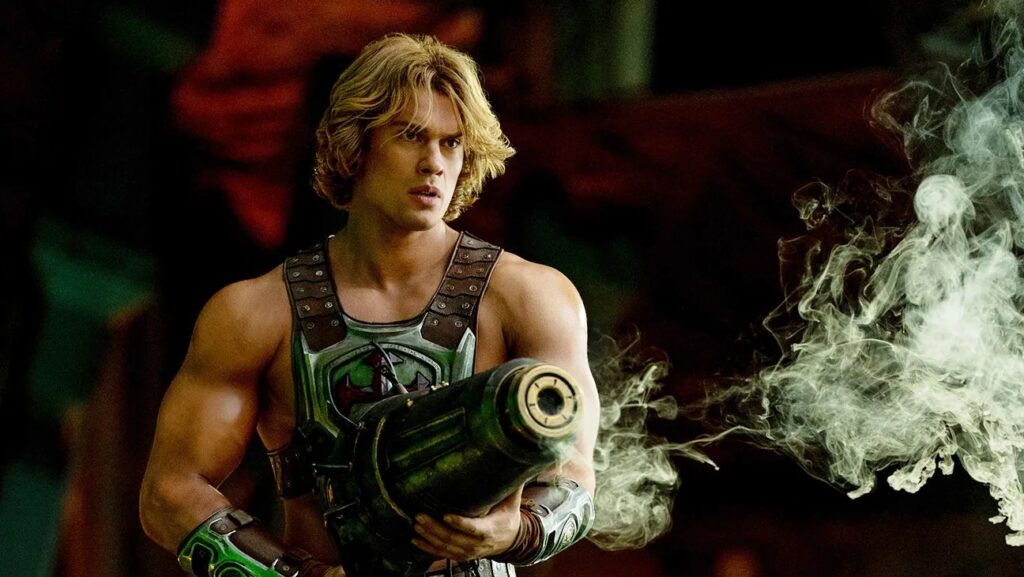
Eternia itself is not even trying to be a plausible use of green-screen. Castle Greyskull is decorated like an explosion in a craft shop while the surrounding land is more florist than forest. But it works. The film keeps things believable enough so as not to detract from the adventure.
The same is true of the innuendo. Laugh-out funny lines such as Skeletor enviously admiring He-Man’s “big long sword dangling between your glorious thighs” are delivered with so much conviction, I began to doubt I even heard them. Another example: Skeletor, “you are but worms beneath my feet!” Man-At-Arms, “He called us butt-worms!”
The original He-Man and the Masters of the Universe cartoon, by Filmation, was developed to sell toys to children in the wake of the success of Star Wars’ merch. It led to children’s TV becoming a wasteland of cartoon commercials. This was aided by changes to Federal Communications Commission regulations in America which had long since banned stories based on toys.
The 1981 inauguration of Ronald Reagan as President of the United States accelerated an already ongoing shift in the FCC towards a more market-oriented stance. That said, companies were already developing characters for the children’s cartoon and/or toy market. These included the short-lived Blackstar (1981) which was only turned into toys after the success of the He-Man toyline.
Another potentially commercial cartoon was Thundarr the Barbarian (1980-81) with character designs by Jack Kirby. Apparently, a much earlier, failed, attempt was the basis for Jack Kirby’s Marvel comic, The Eternals (1976). Sad. I would have loved to have kept a Celestial on my bedroom’s window ledge and a Deviant in my back pocket.
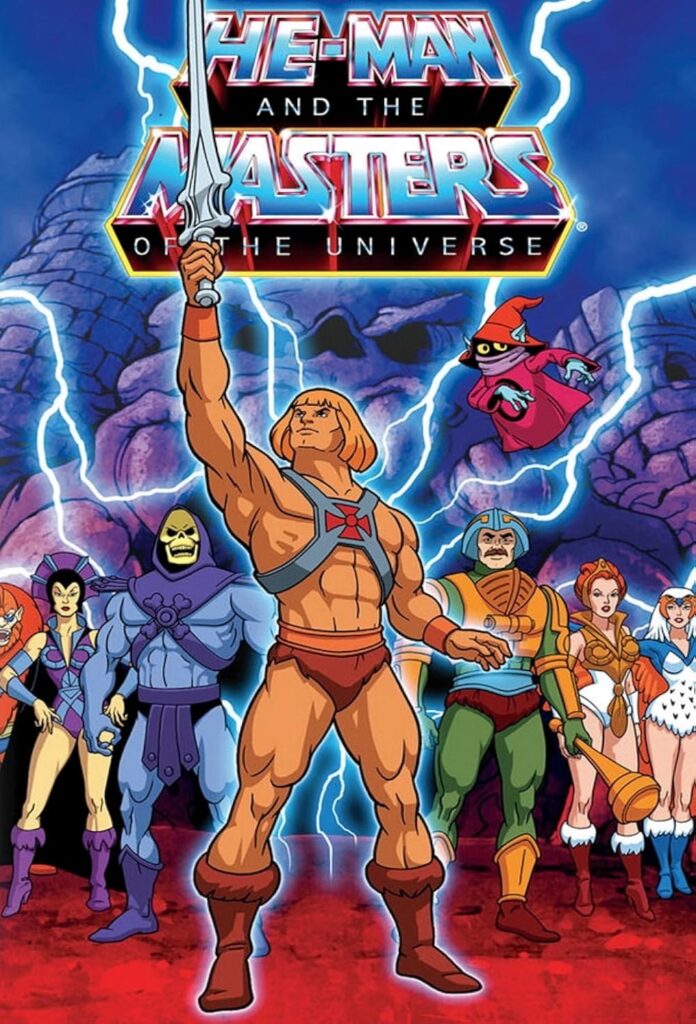
In the event, He-Man and the Masters of the Universe was the first syndicated show to be based on a toy and became the most popular syndicated program with children aged two to 11. But its simplistic division of the world into heroes and villains apparently on the basis of who was good-looking and who looked ugly, raised the ire of parents, certainly here in the UK.
I remember a TV audience confronting some representative of American cartoonery who suggested, without irony, that surely every young girl aspired to be tall, beautiful and blonde? Mothers vocally disagreed. That comment really cut to the heart of the matter. Astoundingly, the new film actually addresses the issue – Why is Skeletor evil? Because he has a skull for a face! Was he bullied as a child? Don’t be silly!
All the toys are here, but nostalgically remembered by Adam who has been drawing them since childhood. He has also named the characters. When Adam returns to Eternia, his gang of rebels are mortified to learn that they are known by names such as Ram Man, Mekaneck and Fisto (I know, the jokes write themselves and none is left unsaid).
I have no nostalgia for He-Man and the Masters of the Universe. The cartoon still bares the toxic taint of commercially exploiting children, the Reagan-era’s Manichaean ideology which bifurcates the world into mutually exclusive categories ‘good’ and ‘evil’. The latter is as unwelcome here as it is in The Lord of the Rings and Star Wars. Children deserve better.
However, Masters of the Universe transcends all that in a witty, silly, exciting story. Seeing Dolph Lundgren dispensing incomprehensible gym bro advice to Adam and Skeletor, turning up at Adam’s workplace wearing an office shirt are worth the price of admission alone. So go to the cinema, see the film and rescue it from box office obscurity – YOU HAVE THE POWER!
Oh, and you have the power to buy the toys.
I hate myself.
Tim Robins
Masters of the Universe is in cinemas now
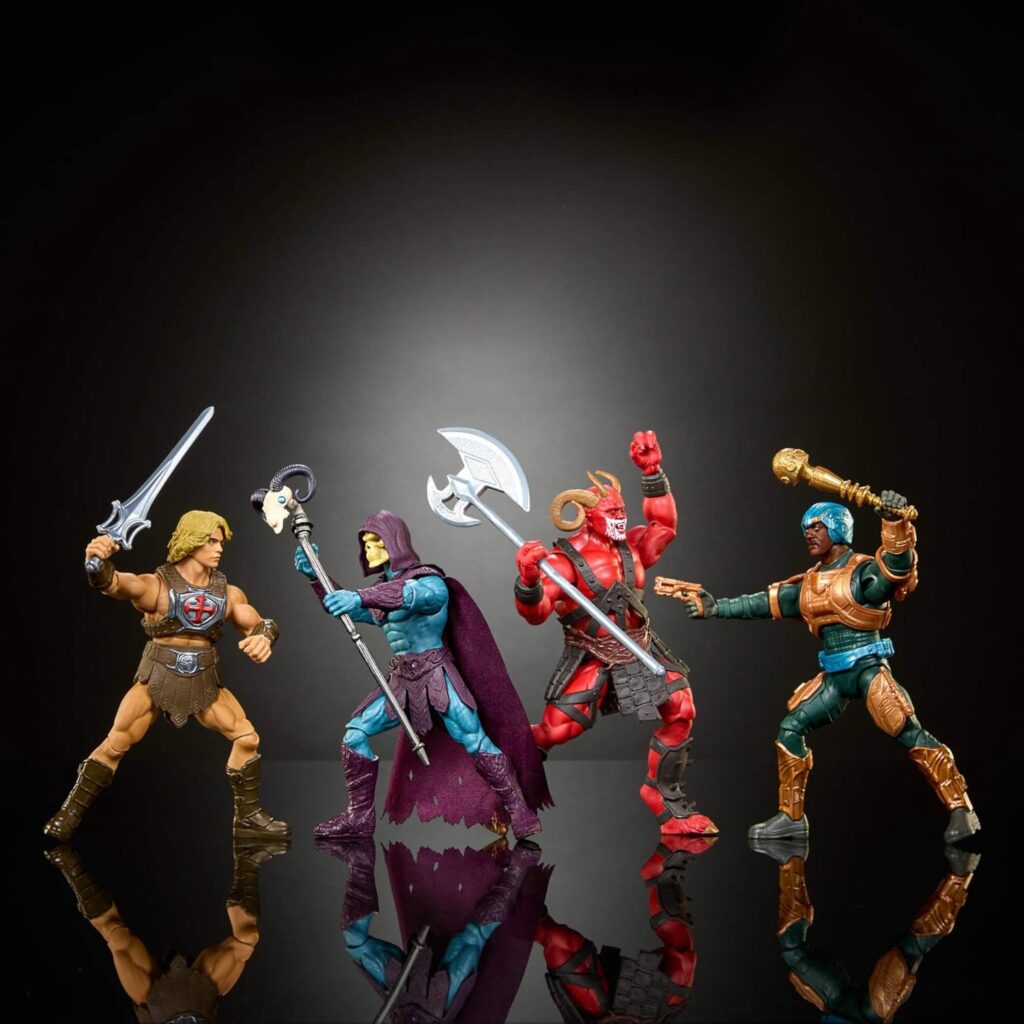
• Visit the MGM Studios Website: amazonmgmstudios.com
• Masters of the Universe Toys | AmazonUK Affiliate Link
• Masters of the Universe Toys | Mattel
- About the Author
- Latest Posts

A freelance journalist and Doctor Who fanzine editor since 1978, Tim Robins has written on comics, films, books and TV programmes for a wide range of publications including Starburst, Interzone, Primetime and TV Guide.
His brief flirtation with comics includes ghost inking a 2000AD strip and co-writing a Doctor Who strip with Mike Collins. Since 1990 he worked at the University of Glamorgan where he was a Senior Lecturer in Cultural and Media Studies and the social sciences. Academically, he has published on the animation industry in Wales and approaches to social memory. He claims to be a card carrying member of the Politically Correct, a secret cadre bent on ruling the entire world and all human thought.
Categories: Features, Film, Other Worlds, Reviews
 In Review: The Backrooms
  In Review: Star Wars: The Mandalorian and Grogu
  In Review: Akira
  In Review: The Magic Faraway Tree (2026)
Leave a Reply