Author, editor, and science fiction archivist Philip Harbottle recently published his 80th video on British Science Fiction, this time exploring the latest release of a single book: John Russell Fearn’s ‘Vargo Statten’ novel, The Catalyst, recently reprinted for the tenth time in Italy by Luigi Cozzi’s Profondo Rosso imprint as “L’oro viene dal cielo”.
Cozzi has produced new, accurate translations from the original English editions, and Phil contributed an afterword to this latest release.
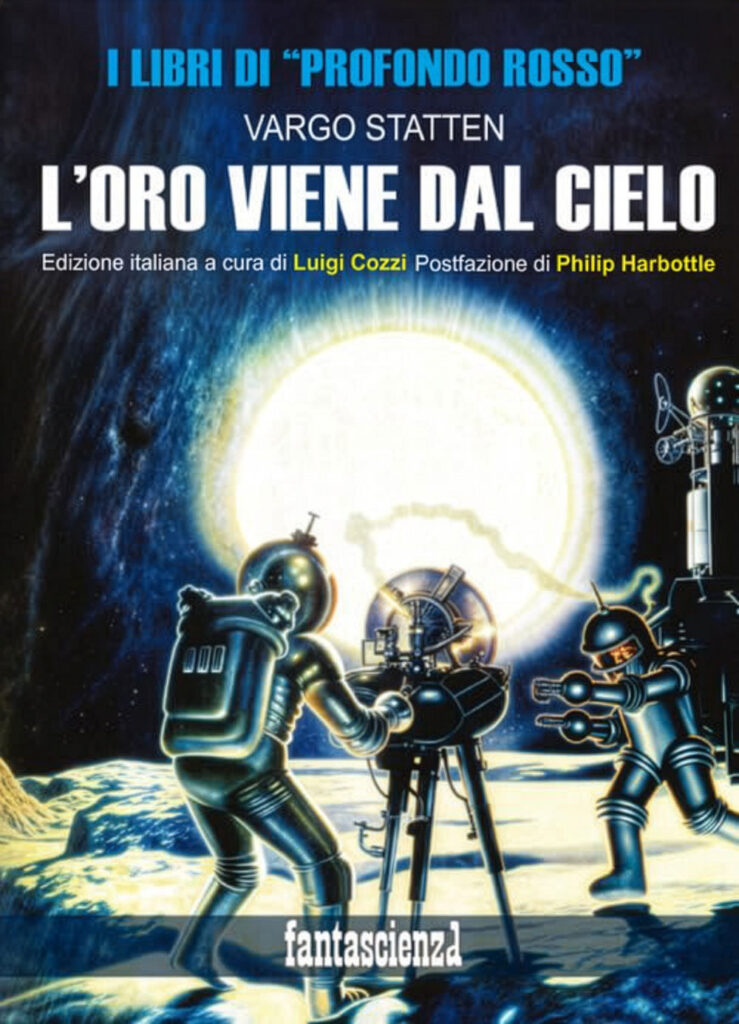
The Catalyst, first published by Scion in 1951, is classic science fiction: explorers bring a mysterious rock from Mercury to Earth, only for it to be stolen, along with Mercury diamonds. The rock’s catalytic reaction with water leads to deadly consequences, including people being turned into gold, echoing the King Midas myth.
Fearn’s premise is rooted in chemistry: Mercury, a waterless world, produces a catalyst that reacts explosively with moisture. In the story, a thief’s perspiration triggers the transformation, turning water – and people – into gold.
“Large diamond fields on the surface of Mercury, along with the catalyst rock, form a central part of the plot of The Catalyst,” Phil notes. “When I first read this novel in the 1950s, I thought the idea of lots of diamonds on Mercury was just a flight of fancy. But astonishingly, modern day scientists are now speculating that Mercury’s surface may well be studded with diamonds.
“They believe that meteorites may have turned much of the planet’s graphite crust into precious gemstones: diamonds may actually litter the surface of the planet. Those diamonds could have been forged by space rocks pummelling Mercury for billions of years. The planet’s long history of being pelted by meteorites, comets and asteroids is clear from its cratered crust. Now, computer models suggest that these impacts may have had another effect: meteorite strikes may have baked about one third of Mercury’s crust into diamonds!”
The ongoing Bepi Colombo space mission – a joint European Space Agency and Japan Aerospace Exploration Agency mission to Mercury – may soon shed light on these theories. It reaches the solar system’s innermost planet in November 2026.

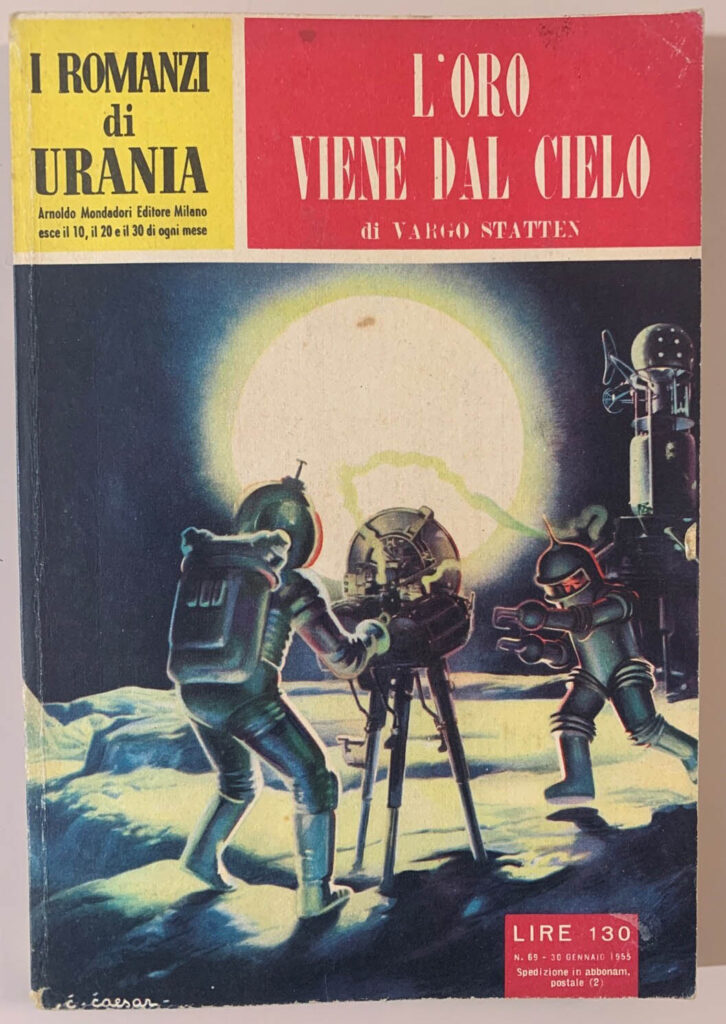
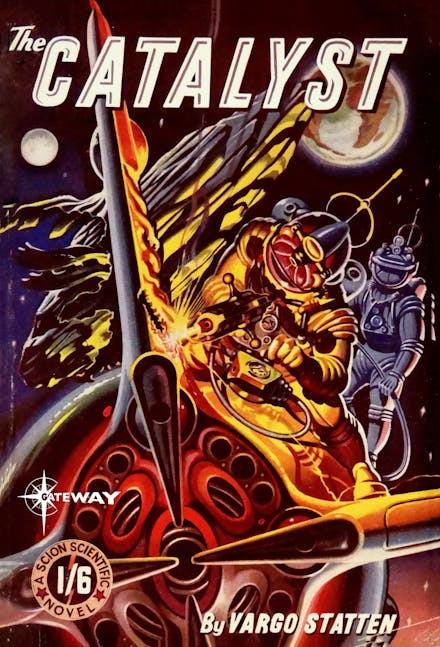
The Catalyst’s core idea evolved from Fearn’s earlier pulp story, “The Man Who Bought Mars,” where a villain is turned to gold by touching a stalagmite. The novel has been widely translated and adapted, including French, Italian, Brazilian, and graphic novel editions, and was even featured on Italy’s most popular TV quiz show, Lascia o Raddoppia.
Check out Phil’s guide The Catalyst by Vargo Statten here on YouTube
Plus, you may have missed his previous release: a tour of the bookshops of Hay-on-Wye, searching for classic science fiction. It proved a fun day out, which, after a few disappointments, and a lack of SF in some shops, eventually turned up some gems…

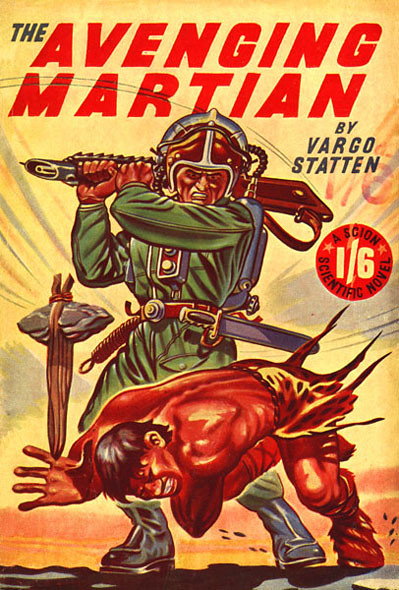
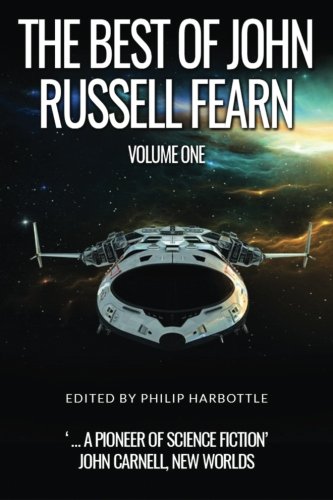
John Francis Russell Fearn was born in Worsley, near Manchester, on 5th June, 1908. As a child he devoured imaginative fiction, beginning to write SF at the age of ten – in imitation of Wells and Verne – on a typewriter he was given for his birthday. Extremely prolific, Fearn used many pseudonyms. During the 1930s he wrote for magazines, including the US Pulp magazines, but during World War Two he switched to books, becoming a central figure in the post-war paperback boom. He wrote numerous westerns, crime stories and romances as well as SF, most of which appeared under the names Vargo Statten and Volsted Gridban (the latter pseudonym being taken over from E. C. Tubb).
Altogether, Fearn published 18 stories in the pre-war Astounding, and went on to write more than 100 other stories in all the leading American pulp magazines through to 1948.
The Encyclopedia of Science Fiction notes that “his best work is vigorous and occasionally vivid’ and the influential British SF agent and editor, John Carnell, paid this tribute: “Fearn was one of the Greats of the earlier ages, and his name should be there with Hugo Gernsback, John W. Campbell, Stanley G. Weinbaum, Murray Leinster, and all the others whose thoughts and works formulated today’s modern science fiction.”
Philip Harbottle: Author and Archivist Extraordinaire

Philip Harbottle is a life-long science fiction fan, regarded as a world authority on the works of John Russell Fearn, whose credits encompass writing “Garth” for the Daily Mirror, and the “Golden Amazon” for Spaceship Away (adapting Fearn’s stories).
He’s also very kindly contributed a number of synopses of early “Garth” stories to downthetubes, which we are adding as time permits.
Back in the 1950s, he adapted some of the Radio Luxembourg Dan Dare radio shows into comics at a young age – the only record of some of these tales known to exist, since very few recordings survive.
• Subscribe to 1950s British Science Fiction YouTube Channel here

• The Fantastic Art of Ron Turner 320pp approx. Large format 11×8.5-format full colour hardback | ISBN 978-1845832353 | Check out our preview feature here
• Available to order direct from Telos Publishing | AmazonUK Affiliate Link | Available to US-based customers through Bud’s Comics and Art |
• Vultures of the Void: The Legacy by Philip Harbottle (AmazonUK Affiliate Link)
Philip Harbottle presents a fascinating guide to British science fiction publishing history
• Buy Across the Ages by John Russell Fearn, adapted into comics by Philip Harbottle here from Lulu
A vintage comic strip by Philip Harbottle, adapting John Russell Fearn’s much admired SF novel Across the Ages, has finally been published – some sixty years after the now renowned author and publisher drew it (Read our news item about this here)
• Books edited or published by Phil Harbottle on AmazonUK (Affiliate Link)
• Check out books by E.C. Tubb published by Wildside Press here
- About the Author
- Latest Posts

John is the founder of downthetubes, launched in 1998. He is a comics and magazine editor, writer, and Press Officer for the Lakes International Comic Art Festival. He also runs Crucible Comic Press.
Working in British comics publishing since the 1980s, his credits include editor of titles such as Doctor Who Magazine and Overkill for Marvel UK, Babylon 5 Magazine, Star Trek Magazine, and its successor, Star Trek Explorer, and more. He also edited the comics anthology STRIP Magazine and edited several audio comics for ROK Comics; and has edited several comic collections and graphic novels, including volumes of “Charley’s War” and “Dan Dare”, and Hancock: The Lad Himself, by Stephen Walsh and Keith Page.
He’s the writer of comics such as Pilgrim: Secrets and Lies for B7 Comics; “Crucible”, a creator-owned project with 2000AD artist Smuzz; and “Death Duty” and “Skow Dogs”, with Dave Hailwood.
Categories: Books, downthetubes News, Other Worlds, Science Fiction
 Profile Books completes sale of 2000AD publisher Rebellion’s SFF and horror imprint, Solaris
  David Brilliance’s TARDIS Treasury out now
  Herne Books offer new Doctor Who works exploring show’s many themes
  In Memoriam: Doctor Who Author and Editor Justin Richards