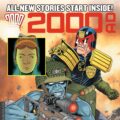
Scarlet Traces may be set just after the end of The War of the Worlds… but that doesn’t mean we aren’t going to see any alien activity in 2000AD, Prog 2435 on sale today!
Things ratchet up a notch in this week’s instalment of Ian Edginton and D’Israeli‘s astounding series – but they’re not the only ones raising the stakes! Rogue Trooper’s problems keep getting worse in Tides of War, while Baroness DeSilva is suffering all kinds of torture in Silver!
Plus – can you tell the Galaxy’s Greatest Comic is heading towards a round of finales? Wednesday 18th June will see a bumper-issue of 2000AD land in stores, and it’ll be bringing a whole new set of Thrills to the Galaxy’s Greatest – so sit back and enjoy the ride!
Plus – read on for some Rebellion book release schedule changes, with some titles pushed back to 2026 release, and a new The Spider title coming in December!
Oh, and we can’t let just Guardian readers see this ad, right Squaxx dek Thargo?
2000AD Prog 2435 UK and DIGITAL: 4 June £3.80 NORTH AMERICA: 30 July $25.99 (Prog Pack) DIAMOND: APR251621 COVER: Toby Willsmer
In this issue:
JUDGE DREDD // THE FIRST 100 by Dan Abnett (Writer) Colin MacNeil (Artist) Chris Blythe (Colourist) Annie Parkhouse (Letterer)
Mega-City One, 2147 AD. Home to over 250 million citizens, this urban hell is situated along the east coast of post-apocalyptic North America. Tensions are on a knife-edge, crime is rampant, and only the Judges — empowered to dispense instant justice — can stop total anarchy. Toughest of them all is JUDGE DREDD — he is the Law! Now, Judge Gable is relating the time she partnered Dredd…
ROGUE TROOPER // TIDES OF WAR by Andi Ewington (Writer) Paul Marshall (Artist) Pippa Bowland (Colourist) Jim Campbell (Letterer)
Nu Earth, site of a galactic war between the Norts and the Southers, where the atmosphere has been rendered poisonous. So the Southers created the Genetic Infantrymen, immune to the pollutants — G.I.s like ROGUE TROOPER, the last of his kind. He and his biochip buddies Helm, Gunnar and Bagman have gone AWOL, hunting for the Traitor General that sold them out. Now, he’s joined a patrol-boat crew…
GHOSTED // BOOK ONE by Guy Adams (Writer) Megan Huang (Artist) Simon Bowland (Letterer)
Kinshasa, capital city of the Democratic Republic of the Congo, the far future. One of the fastest-growing mega-cities in the world, the metropolis is now a walled city-world, so vast and divorced from the rest of the planet that it’s virtually its own realm. Rich and diverse, it prides itself on being the perfect place to live — but for Benu something strange is going on in her head, a mental connection to a soldier…
SILVER // PERFIDIOUS by Mike Carroll (Writer) Joe Currie (Artist) Simon Bowland (Letterer)
Earth, the year 2001. A group of armed survivors sought out the resting place of a five hundred-year-old vampire, who may just help them against the alien Sepsis, who invaded the planet a few decades earlier. The vamp, called Baroness DeSilva, has proved powerful in battling the extra-terrestrials, and now, having aided the rebels in destroying Sepsis infrastructure, has been given a new mission to undertake…
SCARLET TRACES // EMPIRE OF BLOOD by Ian Edginton (Writer) D’Israeli (Artist) Annie Parkhouse (Letterer)
England, the late nineteenth century. Earth has come under attack by Martian war machines, devastating huge swathes of the country with their heat rays and harvesting enormous numbers of people. Finally struck down by the planet’s viruses, the Martians’ assault collapses. Now, humanity is picking up the pieces and coming to terms with the aftermath, but there appears to be vestiges of the aliens left…
• Available in print from: 2000AD webshop, WHSmith, key supermarkets, book hops, Amazon, and comic book shops via Diamond | Available in digital from: 2000AD webshop, 2000AD app for Apple & Android
The Complete Rogue Trooper series continues to collect every adventure of one of 2000AD’s most popular characters, originally created by Gerry Finley-Day and Dave Gibbons (Watchmen), this second volume features the work of veteran artists Cam Kennedy (Star Wars: Dark Empire) and Brett Ewins.
The hunt for the Traitor General, who betrayed Rogue and caused the deaths of his fellow soldiers, comes to a conclusion, bringing to an end the first phase of Rogue’s storyline.
After the death of Malcolm Kinniburgh, who had previously kept the Thistlebone legend alive, the local Harrowvale constabulary find clues that lead them to investigate the abandoned film production of a 1970s folk horror film, The Dule Tree. Based on a harrowing account from the seventeen hundreds where thirteen innocent women and one man were hanged during the witch trials, the film itself ran into production problems, the source of which has remained a mystery for fifty years.
Tom Eglington began writing for 2000AD in 2010, his first work being on a Steve Yeowell illustrated “Future Shock”, “Universal Masterchef”. Since then, he has gone on to create scripts for numerous “Future Shocks”, “3rillers”, “Time Twisters” and “Mega-City One Tales”. He has created original series “Outlier”, “Blunt” and “Thistlebone”. His run of scripts on “Judge Dredd” have seen him work with Boo Cook, Brendan McCarthy, Colin MacNeil, and Staz Johnson. His work beyond the Galaxy’s Greatest Comic includes two children’s novels, and he is known as an artist, with work appearing in galleries as far afield as New York, LA and Australia.
Simon Davis divides his time between comic work and portrait painting and is a member of the Royal Society of Portrait Painters (RP). Davis began working in comics in the early 1990s but has also worked as a storyboard artist and magazine illustrator. Among the many characters that he has drawn for 2000AD, he is probably best known for his work on Sinister Dexter with Dan Abnett, Stone Island and Ampney Crucis with Ian Edginton, and Slaine: The Brutania Chronicles with Pat Mills.
From the pen of acclaimed Judge Dredd creator John Wagner (A History of Violence) comes the origin story of 2000AD‘s most enduring villain. Includes “Young Death”, with art by Peter Doherty (Shaolin Cowboy), “Tea With Mrs. Gunderson” by artist Dean Ormston (Black Hammer) and the classic “My Name Is Death” and “The Wilderness Days”, with art by Frazer Irving (Batman & Robin).
US publisher Fantagraphics are reprinting The Eternaut, the seminal Argentinian science fiction graphic novel by Héctor Germán Oesterheld and Francisco Solano Lopez, taking full advantage of the series high profile following the launch of the TV adaptation streaming now a on Netflix.
“The Eternaut he called me…to explain my fate in just one word…”
A gathering of neighbours in suburban Buenos Aires is interrupted by an eerie, phosphorescent snowfall. When those outside exposed to the “snow” start dropping dead, it becomes clear that the harmless-looking “snow” reflects the vanguard of an alien invasion, and a story of survival, cunning, and armed struggle against them unfurls…
The Eternaut was written by the Argentine author Hector German Oesterheld, famous for opposing the military junta in the late 1970s, and disappeared, along with his daughters, in 1977, and drawn by Francisco Solano Lopez in an appropriately pulpy, representational style. The story, originally serialised from 1957 to 1959, holds a mirror to Argentine politics, reflecting an era of paranoia, military juntas, and Cold War geopolitics.
Encounter the gripping tale that remains a symbol of resistance in Latin America to this day…
Héctor Germán Oesterheld. Image: The Oesterheld Estate / Fantagraphics
Héctor Germán Oesterheld (HGO) (born July 23, 1919; “disappeared” by the military and presumed dead 1977), was a pioneering Argentine graphic novel and comics writer. Notable works include his science-fiction series El Eternauta, as well as Life of Che, a biography of Che Guevara.
Francisco Solano Lopez (1928-2011) was an Argentinian comic artist who created a number of works about corruption and repression in his home country. As a result, he was forced to produce many of these works in exile. Later in his career, Lopez focused on erotic comics, winning First Prize for “Best Erotic Author” in the Barcelona Erotic Salon and the Diario de Aviso’s Prize for “Best Realistic Cartoonist”.
Congratulations are deservedly due to comic creator Bryan Talbot, who has just won the 2025 Prix Graphique at Le Prix ActuSF de l’Uchronie for his brilliant Grandville series, awarded the “Prix Graphique“.
This French literary award celebrates the very best in alternative history and speculative fiction. The prize will be presented at the Hypermonde Festival in Mérignac later this year.
Grandville, published in the UK by Jonathan Cape, is an acclaimed steampunk series by Bryan, exploring an alternate art-nouveau world populated by intelligent animals, a human underclass, and wondrous technology. A prequel to the saga, The Casebook of Stamford Hawksmoor, will be published later this year.
“I’m delighted to be chosen for this award,” Bryan told downthetubes, “especially as I’m being acknowledged in France, the home of many of the Bandes Dessinées that I’ve enjoyed over the years. I’ll be there to collect it in September!”
Massive congratulations to Bryan — an incredible creator, the first British creator to create comics in “graphic novel” for with The Adventures of Luther Arkwright, also known for his work for 2000AD, and much more.
Prix Graphique (Graphic Prize) Bryan Talbot’s Grandville series (Delirium)
Prix Spécial (Special Prize) The Hervé Chopin editions of 14 volumes of Jodi Taylor’s Chronicles of St Mary (as Chroniques de St Mary, translated by Cindy Colin Kapen) – available here in English (AmazonUK Affiliate Link)
L’Atlantide by Didier Graffet
Honorary Award of the 15th edition Didier Graffet for his steampunk graphic work
Didier Graffet has been exploring retrofuturistic worlds for nearly three decades with striking technical precision and visual richness. With this Honorary Award, the jury recognises an iconic work and artist who have shaped the aesthetic representations of steampunk
Beware the Badger! The acclaimed steampunk series from graphic-novel pioneer Bryan Talbot explores an alternate art-nouveau world populated by intelligent animals, a human underclass, and wondrous technology. Within this rich fantastical milieu, the relentless Detective-Inspector LeBrock of Scotland Yard pursues shadowy death squads, psychotic killers, dark political conspiracies, ruthless crime lords, and bloodthirsty cults through the streets of London and the centre of the greatest empire on Earth, the Belle Epoque Paris known as Grandville.
Grandville L’Intégrale collects all five Grandville novels in one deluxe hardcover volume accompanied by voluminous author notes never before in print.
With top-hat and cane in hand, Detective Inspector Stamford Hawksmoor shadows the murky backstreets of London on the hunt for a sadistic serial killer.
In the dying days of the French occupation of Britain, through gaslit, cobbled streets and squalid alleyways, stalks the great eagle Detective Stamford Hawksmoor in search of the homicidal maniac whose killing spree claims dozens of seemingly unconnected victims, from random murders to targeted political assassinations.
The deeper he delves, the more he puts himself in mortal danger, pitting himself against unknown antagonists whilst under the scrutiny of the feared anti-terrorist squad, and the more he is forced to resort to working outside the law.
The Casebook of Stamford Hawksmoor is an intriguing, labyrinthine stand-alone mystery set in a world of hansom cabs and pea-souper fogs, where explosive violence can erupt at any second – and does!
“Dickie and Vicky Go Wild”, an exhibition of cartoons by Pieter de Poortere opens this week at RedWillow Macclesfield, as part of this year’s Macc-Pow! comic festival in the town, the exhibition running Wednesday 4th June until Friday 1st 2025.
First exhibited last year at the Lakes International Comic Art Festival last September, Macc-Pow are thrilled to now have chance to bring Pieter De Poortere work to Macclesfield.
“Dickie”, known as “Boerke” in Europe, first published over 20 years ago, tells the story of a loser who is constantly betrayed by his own shortcomings, desires and naivety, crushed by the indifference of the world, in one-page silent comics.
The exhibition features Farmer Dickie and his partner Vicky and some of their best adventures, plus some very special landscape paintings with unexpected cameo appearances.
Pieter De Poortere’s Natural Born Loser comic will be available to buy at Macc-Pow! on 28th June.
Macc-Pow! takes place in the heart of Macclesfield in Cheshire later this month, bringing you the very best in comic art from around the world, supported by Macclesfield Town Council. This year, the event will be taking over three rooms in the glorious Macclesfield Town Hall, with two rooms exclusively for a fantastic market place. Rub shoulders with fellow creators, first-timers, and legends from the world of comics all under one roof.
Pieter De Poortere is a Flemish comic strip author, known to the general public mainly for the comic strips and the animation series “Boerke” (Dickie). His work combines cynical humour with an innocent graphic style.
De Poortere started his career in 2000 as a freelance illustrator and was first published in Humo and, later, in Focus Knack. Pieter de Poortere made his debut in 2001 with the album Boerke, which immediately won the prize for the best Dutch-language album of the year. The cynical humour and the innocent graphic style are De Poortere’s clear signature.
Several Boerke albums have been published since, and the series has been translated into seven languages and the animation series, based on the books and produced by De Hofleveranciers, can be seen in more than 10 countries. The success of this first series led to a quick decision on a second season, to be aired in 2023.
The wordless comics of De Poortere have an international potential, as shown by the success of the permanent exhibition of his work in the Brussels Comic Book Museum. But there is also a lot of interest abroad in Boerke, where our amiable loser stumbles through life as Dickie. In 2011, for instance, a wall of Boerke designed by De Poortere was inaugurated in Paris and in 2019 he published the album Super Mickey, in the Mickey Mouse homage series published by Glénat.
Pieter De Poortere has also created several children’s books over the past 20 years. For the Van Eyck Year, he created the book Lam for the Museum of Fine Arts in Ghent, in which he depicts the figures of the ‘The Adoration of the Mystic Lamb’ in his native city of Ghent.
Pieter De Poortere is chairman of the board of directors of the Belgian Comic Strip museum in Brussels.
• “Dickie and Vicky Go Wild” Wednesday 4th June – Friday 1st August 2025, Redwillow Macclesfield, RedWillow Brewery Ltd, The Lodge, Sutton Garrison, Byrons Lane, Macclesfield, Cheshire SK11 7JW | Free | Suitable for ages 12 and above
Commando Issues 5859 – 5862 are on sale this week (from 5th Thursday June) in all good newsagents and via some digital platforms, featuring another new “Falken” tale starring the classic Warlord hero, U-boats… and a cowboy in the British Army!
As is usual, two all-new tales are on offer, the first “HMS Garnet”, the first sea war story from writer Suresh for Commando, with art by Jaume Forns; a tale of top-of-the line U-boats versus under-resourced British ships, with a nod (blink and you’ll miss it) to Flash Gordon, to boot! It’s an entertaining tale, although I did feel keeping track of which ship was attacking their U-boat foe wasn’t always as clear as some might prefer.
Also new this set is another smashing “Falken” tale, as the Warlord hero returns in a story titled “Russian Roulette”, from writer Dominic Teague with both art and cover from the brilliant Manuel Benet. Definitely not an adventure to miss, as Falken returns to stick it to both Russians and the Germans alike.
The represented tales in this set couldn’t be more different: you could see the star of “Cowboy in Khaki”, Kit Larson, easily make a return to the war title today, just like the Warlord characters now featuring in some issues of Commando. An unlikely tale of derring do set in North Africa during World War Two, it has a comedic charm to it that’s worth a read.
“When Time Runs Out” is a darker tale, set in occupied wartime Holland, where collaborators are often more dangerous than the Nazis. Writer CG Walker delivers a taut tale, as a traitor with a passion for clocks causes the resistance a major threat. But time is ticking for the greedy spy…
Commando 5859 Home of Heroes: HMT Garnet Story: Suresh | Art: Jaume Forns | Cover: Marco Bianchini
Who would come out on top in a battle between a sleek, deadly U-Boat, armed with the latest German technology, and an antiquated fishing trawler with a deck gun scrounged from the last war? Bet you think you know the answer, don’t you?
Well, the unlikely story of the HM Trawler Garnet might just surprise you! You won’t want to miss the boat on this one, there’s nothing fishy about this classic underdog story!
“It’s not always smooth sailing for our heroes, but this issue doesn’t drop anchor when it comes to action and adventure!” say the Commando team.
Commando 5860 Gold: Cowboy in Khaki Story: Gentry | Art: Galindo | Cover: Penalva First published as No. 641 in 1972
Meet Kit Larson – the toughest, fastest-shooting, two-fisted cowboy in the British army.
Wait a minute… a cowboy? In the British Army?
You said it, pardner!
Be ready for action in Africa, as two unlikely heroes take on the enemy behind the ever shifting lines in the desert sand…
Commando 5861 For Action and Adventure: Falken – Russian Roulette Story: Dominic Teague | Art and Cover: Manuel Benet
Major Heinz Falken is playing a dangerous game of chance. His life and those of his men hang in the balance as they fight for survival. The battle on the Eastern Front between German and Russian armies has become a war of attrition, with both sides lacking resources. When their supplies are hijacked by the Russians, Falken is forced to recover them by systematically searching Soviet stronghold bunkers. But guessing which one is the right bunker is like playing a game of Russian roulette – and they’re running out of bullets.
Commando 5862 Silver: When Time Runs Out Story: CG Walker | Art: Carrion | Cover: Ian Kennedy First published as No. 1782 in 1984
The Dutch Resistance had no room for traitors. Yet, with every day that passed, someone in their midst was giving information to the enemy. Who was he, and how did he operate if the group seemed so united?
They were soon to find out. Time was running out for that man, and in a very peculiar way indeed…
They say time flies when you’re having fun, so reading this issue should take no time at all… Another timeless classic!
Rebellion, publishers of 2000AD and Judge Dredd Megazine and one of the world’s most successful independent video game developers, launches Wicked Isle, a story expansion for its hit survival action title, Atomfall today, Tuesday 3rd June. The expansion adds a whole new location to the game, with its own set of characters and enemies as well as additional leads, weapons, skills, items and multiple new endings for the main game.
A UK-based post-apocalyptic survival-action game, Atomfall is inspired by the real life Windscale nuclear incident in the 1950s. Players will embark on a fictionalised adventure meeting a cast of weird and wonderful characters as they try to uncover the mystery and escape the quarantine zone.
So far over 2.5 million players have jumped into the world of Atomfall, and a prequel comic strip has been running in issues of Judge Dredd Megazine.
Drawing on the folk horror elements of the game for inspiration, the story expansion is set on Midsummer Island. To cross to the island players must talk to the boat-keeper who can be found on the jetty in Wyndham Village. He will give you information about the island as well as your first Lead.
“Midsummer is located close to the Windscale Atom Plant and as a result the levels of infection in both the people and environment are higher than on the mainland,” explained Ben Fisher, Head of Design at Rebellion. “You are going to meet new enemy factions including pirate bandits and infected druids.
“To help you survive there are new weapons to be found on the island including a devastating Blunderbuss shotgun, a new bow, cutlass, daggers and the Beekeeper’s Staff. You will also be able to acquire new skills which will aid you on your quest as well as an upgraded metal detector which will enable you find even more loot caches.”
The Leads you uncover in Wicked Isle will open a variety of story treads, some of which create new potential endings for the main Atomfall® game.
Included in the Deluxe Edition and in the Deluxe Upgrade Pack and available to purchase separately when released (£14.99, €19.99, $19.99), Wicked Isle will be available from June 3rd on Xbox Series X/S, Xbox One, Windows PC and PC via Steam, Epic Games Store, PlayStation 5 and PlayStation 4. Game Pass subscribers will benefit from a 10% discount.
Atomfall® is available now on Game Pass, Xbox Series X/S, Xbox One, Windows PC and PC via Steam, Epic Games Store, PlayStation 5 and PlayStation 4. Atomfall® is Certified on Steam Deck.
• For the latest news and updates, please visit Atomfall.com and be sure to follow Atomfall on these social channels: Twitter,Facebook, Instagram and YouTube
James Bacon and Richard Sheaf report on the recent Lawless event in Bristol, which was absolutely crammed with comics and their creators…
Lawless 2025 – let comic creators and comic fans collide!
Lawless, an annual 2000AD-inspired comics gathering, the latest event held recently in Bristol, continues to exceed expectations. Not only in terms of its panels, but because there was just so much incredible comic art available to purchase, too.
Comic creators are very tuned into sharing their work, and making it available for sale to fans – and it was clear at Lawless that this was not only appreciated, but based on how busy the event was, such sharing is a major part of its ongoing continuing success.
Colin MacNeil, for example, had a wonderful stack of “Judge Dredd” pages and to see the detail, especially large splash pages featuring his incredibly well drawn architecture, capturing the essence of Mega City so well, was amazing.
Colin MacNeil
Brian Bolland had a large amount of items available for fans: posters, graphic novels, prints, and even of his own contributor copies of Camelot 3000 from the 1980s, which looked to be in mint condition. He also had a lovely selection of preliminary covers and some sketches that were done prior to the con, and as one might expect, his Joker sketches just keep selling.
Alan Davis also had a lovely selection of sketches and preliminary work available, and the event was just an incredible opportunity for fans to meet an artist who, at an American con, would normally have a very long line of people in his queue.
To find a piece that one hadn’t anticipated on finding or seeing one’s favourite artist do a rendition of a character that resonates and being able to purchase it, it’s superb.
Dylan Teague was doing some incredible coloured work. He is so dynamic, and a Nemesis the Warlock themed triptych he’d advertised on Facebook didn’t last long once the doors had opened. John Higgins, who is so affable and pleasant, was continually busy and creates phenomenal sketches but has a fab system!
Dylan Teague
Patrick Goddard had both “Nina Petrova” pages from Battle and “Rogue Trooper” pages for sale, while Henry Flint had “El Mestizo” from Battle and “Judge Dredd” pages from 2000AD. Like a number of creators, Henry was also drawing sketches, that were very reasonably priced, and I was very happy to take away an “El Mestizo” sketch for £20.
David Roach not only had an incredible selection of his own artwork, but he had brought some other pages to sell, including some Carlos Ezquerra “Strontium Dog” pages which created a considerable amount of interest. Like other creators, David was also selling original art that hasn’t even been published (or announced!) yet so this really is your best opportunity to get in first for this art.
Lawless 2025 – Art on Display
There was also time made to chat, of course. A great time was had in the bar on both Friday and Saturday nights, affording ample opportunity to talk to favourite creators. All the artists and writers were engaging: I especially found Deborah Tate, talking about her time at Marvel UK very interesting to hear about, and Alan Davis is, as ever, both erudite and so thoughtful. But having spoken to so many, all were a delight. I never expected to talk about lambing so much with a comic artist, but that’s the joy of Lawless!
The Lawless panels always offer an interesting mix of creators, talking about a range of subjects. This year, to make up for not having an exhibition of original comic artwork, the space given for panels doubled! Truly there is too much to do at Lawless.
The main panel room continued to be its traditional large space with big name guests. The smaller panel room offered a smaller, more intimate space without the traditional “long form” interview: instead, it offered fans an opportunity to ask more questions themselves. It was definitely a good approach to offer different formats in the different rooms, but it also meant talks/panels clashed.
Hunt Emerson
It’s always good to see new attendees amongst the familiar faces and this year was no different. Hunt Emerson made his debut appearance and put his ace cartooning skills to good use in the “draw off’”competition, on Saturday afternoon – congrats to Hunt for winning! Aly Fell was a name that was very familiar to me, but I’d never met him in person, so it was great to see him. He seemed to be very busy, and blown away by how much importance all the attendees placed on the actual art, a proper ‘comic con’!
A shout out, also, to some new inductees into the Lawless hall of fame – Simon Bisley, Glenn Fabry and Alan Davis.
The trader room was also busy all weekend – again, there was vintage British comic art for sale, Clint Langley and Henry Flint were signing and sketching furiously, Dave Broughton was selling copies of the latest issue of the always brilliant Shaman Kane, Time Bomb Comics were there, Zarjaz was there, and there were dealers selling 2000AD comic, back issues and merchandise from the last (nearly) 50 years.
David BroughtonLawless 2025 – John Higgins and roving downthetubes correspondent James Bacon
All of this is just a flavour of what’s was going on the weekend, but it’s also worth a shout out for just how friendly and welcoming Lawless feels. It’s always good to meet old friends but I always come away having added about five new friends to the list of people I’ll be looking forward to seeing next year.
One learning that’s come from the weekend was the importance of clear signage in regards to prices for signatures! The fans who attend these events are happy to spend their money, and when one is buying art, or a sketch, enquiring is natural, but a single artist surprised fans by charging for signatures, a new departure that occurred for the first time at Lawless. No one begrudges that; indeed all the surprised fans paid up, but the price needs to be clear before said comics or Con Programme are signed, to avoid unfortunate awkwardness and embarrassment.
Art by various artists: Henry Flint, Simon Bisley and more
Lawless is a smaller con, and so full of spirit, kindness and well meaning, fans flock here to find art, original pages, covers, sketches, prelims, prints as well as getting their comics signed and meeting, listening and when socialising with some of the greatest comic artists and writers in the land.
I can’t wait for next year, meeting fans annually here is superb, although it was good to learn that many are going to be going to Enniskillen Comic fest, and then the next Commando Swap meet in Stoke and London Comic Mart, hoping to connect sooner. The calendar is definitely full, but discerning fans recognise stellar guest lists when they see them!
Su Haddrell and the team did a superb job. This is a smooth running con, the cosplay, the panels, the overall atmosphere, it was all very well done.
Back in 1994, Pete offered The Sun newspaper a new daily science fiction strip, “Psycops.”, inspired by television shows such as The X-Files, The Fugitive and Starman. Although, just like “Striker”, Pete both wrote and drew the early episodes of the strip, he later shared art duties with John Cooper, who’s perhaps better known for his work on strips such as “Johnny Red” for Battle.
John M. Burns unused cover for the “Psycops” collection by John M. Burns, who drew many episodes of the strip, and the final “3D” cover, in the style of Pete Nash’s other property, ”Striker”. With thanks to Colin Brown
Ultimately, Pete felt that while Cooper’s drawings were excellent, he felt they were a little too cartoony for the strip, and 2000AD and Look-in artist John M. Burns took over art duties and continuing until the strip’s end in 1999. Regardless of who was drawing the strip, it was always credited to “Wilbur”.
There are only a few copies of the 304-page Psycops collection now available direct from Planet Striker, collecting all the published stories, its cover the only element reflecting the style of Pete’s hugely popular Striker football strip.
So if you’re a John M. Burns fan, you may want to grab your copy now!
A charming annual cover by Lawson Wood is currently among other artwork gems for sale from American dealer Graphic Collectibles, spotted by artist and comic archivist David Roach.
Lawson Wood (1878 – 1957) was an accomplished cartoonist, illustrator and poster designer. He gained great popularity with his humorous illustrations of animals, including dinosaurs and monkeys. His ginger ape, Gran’pop, proved a particular favourite on both sides of the Atlantic.
Up for sale, priced at $1100, is an artwork titled “Everybody’s Feeling Bucked“, the cover of the Lawson Wood’s Annual, published in the early 1950s. Measuring 11.5 x 17”, the signed art was created in pencil/ watercolour/ gouache on illustration board. A copy of the book is included.
The cover of Lawson Wood’s Annual, published by by Dean & Son (1951), via Bear Alley, and two artworks by Woid offered for sale through the Chris Beetles Gallery
A smashing-looking anthology of indie British comics, SHIFT Presents… Pulp! goes on sale next week in a hardback deluxe version format, followed by newsstand release in July.
Published by the team behind the SHIFT anthology, SHIFT Presents… Pulp! is a call back to old black and white UK comics, featuring strips by Chris Geary, John Charles, Tom Newell, Rob Jones and more.
Art amended for wider consumption
“We wanted to make a little ‘catalogue’ of some indie titles we love… so started compiling this, and got a bit carried away!” says publisher Adrian Clarke.
Bursting at the seems at 160 pages, SHIFT Presents… Pulp!features full chapters of varying genres, and interviews with the creators so you can get to know more about them and their creations – but still as affordable as possible.
Produced in A5, black and white, running to over 130 pages of strip and eleven pages of interviews, the newsstand edition cost £7.99.
The more “deluxe version” features colour strips and will be on sale soon, offered in a larger format, and in hardback, only available from the SHIFT store.
“About two thirds of the strip pages are colour and converted for greyscale for the main release, the rest were made in black and white,” Adrian notes.
• Shift Presents… Pulp! contains approx. 135 pages of comics and 11 pages of interviews | Preorder your copy here
Featuring…
• Serraq by Chris Geary • Bete Noire by Andrew Clemson and Kris Wantowhy • Technofreak by John Charles, Barry May and Tom Newell • Past Futuremann by Charlie Etheridge-Nunn and Lane Lloyd • Griff Gristle by Rob Jones, Michael Sambrook and Rory Donald • The Troll by Oisin Roche • Flesh & Blood by Simon Lewis and Chris Geary
LDComics is celebrating 15 years, and to commemorate this anniversary, they’ll host an Online Comics Fair in July.
Back in 2009, Dr Nicola Streeten and Sarah Lightman launched Laydeez Do Comics to champion comics work based on life narrative and the drama of the everyday. Streeten and Lightman shared an interest in comics and graphic novels that were not about superheroes, but were focused on “the domestic and autobiographical.”
Since then, Laydeez Do Comics has turned into LDComics, become a Community Interest Company, hosted an annual festival from 2018-2020 in conjunction with a prize for graphic novels in progress, set up a mentoring programme and residencies, delivered an international British Council project and delivered workshops and talks. Most importantly, they have continued to host monthly events hosting guests’ illustrated presentations, welcoming everyone to attend free of charge.
There’s a lot of love out there for Fleetway’s Sonic the Comic, launched 32 years ago this week, and it’s good to know there are dedicated fans still celebrating the title.
Marking the anniversary Sonic the Comic‘s 32nd birthday, the Kintobor Computer database/repository cataloguing the Sonic the Hedgehog multiverse has updated with twenty six new reviews, covering every Sonic and Tails adventure from the comic’s first year.
The fan site not only documents Sonic the Comic stories, but features a nostalgic cover gallery, too, provided by the STC Archive 3 scanning project and Coby Sevdy
Launched in 1993, Sonic the Comic was an anthology comic that initially featured Sonic in the lead strip and a revolving cast of Sega Superstars in the back-ups. Before long, however, the Sonic-focused content grew to surpass anything else until, eventually, the Sega Superstars were phased out to give more page space to strips which highlighted Sonic’s friends and foes, primarily Tails, Knuckles and Amy.
Along with a new Sonic the Comic Zone archive section, fan dedication to the title continues with a not for profit tale “Sonic the Comic: All Good Things…”, a story picking up after issue 281 of Sonic the Comic Online that will take the comic up to a conclusion at issue 300.
The Kintobor Computer, which is not affiliated with Sega in any way, aims to be a complete repository of all things Sonic the Hedgehog. From the games to the comics to the cartoons and beyond, our goal is to chronicle it all. Check it out now!
Brixton Library will host another Readers and Writers Zine Fair as part of Lambeth Literature Festival next month, with several comic creators, including Ignatz Award Nominee Dominique Duong, Hannah Lee Miller and Alex Moore, and indie publisher Colossive Press.
A fair will host 20-plus stalls of fanzines, magazines, publications, artists, readers and writers with the best of the latest in small press. There’s a communal zine table, too, so you can bring along a zine you have made and the Library team can sell it for you too.
Brixton Library | Image: Lambeth CouncilPrevious zine fair in full swing!
Brixton Library in the heart of Brixton, on Windrush Square is a beautiful Grade II listed building, open seven days a week. On the ground floor there is the children’s library, adult fiction and a gallery room that can be hired for events. On the first floor there is a large non-fiction library, quiet study space and a reference library.
The fair will be located across two rooms in the library: the first, the gallery, is on the ground floor at the front of the building, the second is in the basement events room, which can be accessed by the lift or staircase. There is a ramp accessible entrance to the right of the library on Rushcroft Road, the library has an accessible toilet opposite the lift also.
• Brixton Library Readers and Writers Zine Fair 12 noon – 4.30pm Saturday 7th June 2025 | Free | Tickets from EventBrite | Facebook Event Page | Brixton Library, Brixton Oval London SW2 1JQ
A1 and Deadline are to return as one great comics magazine, with a stacked lineup of visionary talent who pushed the edge of comics forward.
Producer, designer and writer Chris Northrop of Magnetic Press, co-owner of Horrible Future, and more, has been developing this with Dave Elliott, co-founder of A1, the graphic novel anthology series published by Atomeka Press created in 1989 by Garry Leach and Dave Elliott. It restarted in 2004, publishing new and old material.
Created by 2000AD artists Brett Ewins and Steve Dillon, Deadline, published between 1988 and 1995, featured a mix of comic strips and written articles aimed at adult readers. It sat at the forefront of the wave of British comics anthologies for mature audiences of the time that included Crisis, Revolver and Toxic!, and had a cultural influence beyond the comics world, most notably via its breakout star Tank Girl.
Inside the new comic anthology, you’ll find the groundbreaking artwork and stories from legends the world just wasn’t ready for, but maybe the world is ready now! Plus, there’s even to be a dose of Horrible Future, for extra flavour!
Be ready for material from talents such as Steve Pugh, Mark Nelson, Bill Sienkiewicz, Rufus Dayglo, Ron Marz, Shaky Kane, Rhoald Marcellius, Toby Cypress and Kevin Eastman – each bringing their unique magic to the page. And this is just the beginning…
“We’re glad to have you join us at the beginning of a new and wild ride as we get rolling,” say the team. “Updates, sneak peeks, interviews, and more are on the way.”
The first issue of Greann, one of the earliest known Irish comics, was released in 1934, published in Drogheda by Irish patriot, Joseph Stanley, and made available across Ireland. James Bacon investigates…
1934 was a good year for comics internationally. In the United States, comic readers enjoyed the debut of strips such as Alex Raymond’s Flash Gordonand Lee Falk and Fred Fredericks’ Mandrake the Magician, among others, both distributed by by King Features Syndicate in US Sunday newspapers, and Famous Funnies #1 published by Eastern Color Printing, an early American comic sold on newsstands, in the same format still used today by major US comic publishers. In mainland Europe, Le petit Vingtième published the first episode of the Tintin story, “The Blue Lotus”, by Hergè, while in Italy, he first issue of the Italian comics magazine L’Avventuroso was published, which survived until May 1943.
Into the widening world of comic books came Ireland’s own Greann, making its debut on with an issue cover dated Friday 6th July 1934. Its simple masthead shows two children and a dog reading a comic next to the title. Its fictional editor Uncle Seamus soon tells us that “Greann is pronounced like the first half of Granny and is the Gaelic word for ‘Fun’.”
“Barney the Bawk”, an adventurous young baker, is the front cover text comic, and, as with British comics of the same period, such as Comic Cuts, the sequential images have the narrative underneath them.
The weekly 16-page black and white comic, released every Friday and costing One Penny (No Tax), contains a variety of text comic stories, including: “Barney the Bawk”, “Bid’s Butterfly Bothers”, “The Frightening Fate of Fergus the Face-Maker”, “Taispeanann Luirgna Fad Do Seamus Conas Tomadh Do Deanaimh” (“Long Shanks Shows Seamus how to Dive”), “The adventures of Daithi and Nuala” (the tales of a pair of anthropomorphic mice), and “The Cats – whose adventures we follow”.
These are children’s humorous stories of the time: simplistic fun, that present a full story, some would continue with fresh episodes each issue, others are one off. The single page “Taisbeánann Luirgne Fada do Sheámus Connus Tomadh do Dhéunamh” shows a youngster being shown how to dive, although it is to comic effect and it is in Sean Chló, the older typescript for Irish, and credited to Doiminic mac Uidhir.
Also included in each issue are a selection of puzzle challenges and entertainments such as “Can You Discover Where Our Crazy Artist Went Wrong?”, “A Corner For Grown Ups” and an “Unfinished Drawing and Colouring Competition”.
The Origins of Greann
The first issue includes a long editorial introduction from Uncle Seamus, which establishes an element of kindhearted fun and helps us understand the genesis of the comic and the editor’s mission:
UNCLE SEAMUS TO THE BOYS AND GIRLS OF IRELAND. HOW YOU CAME TO HAVE “GREANN.”
Some time ago I noticed a little Dublin boy looking into a newsagent’s shop window.
He was acting very strangely. First he would look in the window then he would go to the door and look into the shop. Back he would go to the window, go down on one knee and twist his head on one side in a funny way.
I went over to see what he was looking at. I found it was the front page of a comic picture paper that had fallen down and was lying crumpled up at the bottom of the window.
“Why don’t you buy the paper?” I asked him “Then you could read it all.”
He searched his pockets, all seven of them. At last he produced two half-pennies one of them from the lining in a far away corner of his coat
That’s all I have,” he he said, “and they’re twopence now – with the tax” “I used to buy that one (pointing to the paper in the window) every week but sure I can’t now”
I gave him the extra penny and you should see how happy he was as he dashed into the shop and proudly demanded his favourite paper.
“Then and there, I decided that it ought to be possible to let Irish boys and girls have an Irish picture paper at a penny the same as and girls of other countries.”
“And that’s how you come to have GREANN. GREANN IS OUT FOR FUN.”
This is quite a thoughtful introduction, demonstrating generosity and charity, but also mindful that foreign comics cost more, and that Irish children deserve an Irish newspaper at the same cost that English children would pay. The editors also remind the reader that “Greann (pronounced like the first half of Granny) is the Gaelic word for Fun – as I need scarcely tell most you who are learning Irish at School.”
This is clever stuff, clearly noting the cost – an issue relevant to many readers – as well as promoting national pride.
Reader engagement was always important with comics, and indeed, could change the direction and influence editorial decisions,and Uncle Seamus encouraged people to get in touch:
“WRITE TO UNCLE SEAMUS – So don’t be shy about sending me a little letter to say if you prefer Barney the Bawk letters to “Dathi and Nuala.”
There is the element of word-of-mouth as readers are asked:
And there’s another way you can help. Tell all your friends and playmates who may not have seen it about Greann. Get them to buy it every week, and spread the news about it to their friends and playmates.” Uncle Seamus further presses the nationalist angle noting, “together-we can make Greann better and better. And Irish children can have an Irish picture paper which they will be proud of as their very own.
Returning to the example of kindness, Uncle Seamus also mentions “that there are lots of little Irish boys and girls that haven’t even a penny to buy Greann – and they’d love to read it just as much as you.” and he encourages children to be kindly, and generous, and suggests that “You can pass on your copy of GREANN to some boy or girl when you have finished with it.”
A contact address is supplied, post welcomed to “Greann” 31/32 Fair Street, Drogheda, with a telephone number of Drogheda 70, and printed by the Drogheda Independent, located at 9 Shop Street, Drogheda.
In Issue 3, we have some new stories, another single-page story as Gaeilge, “Dearmhad Bhráin” – Bran’s Mistake – by Sean Óg, “Mickey Gets Muddled” and “Sean’s Birthday Present.”
The seed that was sown in the first issue bears fruit and in Issue 3 features lists of winners of the picture painting and unfinished design competition with commendations, as well as a thank you editorial from Uncle Seamus.
In Issue 4 we see a story as Gaeilge, which is problematic for a modern reader as it contains an outdated portrayal of a black child and relies on skin colour for humour; “Páid Dubh Fiosrach – Inquisitive Black Patrick.” For clarity, the story follows the following structure and narrative:
We see a depiction of a black child walking, in football gear and the text tells us:
Panel 1: Inquisitive Páid is walking one day
Panel 2: He sees a ladder against a wall (with some builders’ scaffold)
Panel 3: He interfered with it, (we see a bag of white powder fall) and instead of being black he was white
Panel 4: He was sorry, but he learnt a lesson
Panel 5: He saw black things in a bag on the same day (might be coal)
Panel 6: He rubbed his face and hands with them, and now he is delighted.
Such racially-based humour would be considered racist today, just as with the African prince in the first The Story of Doctor Dolittle by Hugh Lofting, first published in 1920, which was later re-edited by his son, Chris Lofting, to remove its contentious passages.
Such casual racism, anathema today, isn’t an isolated event. In a later issue, Barney the Bawk is at a fancy dress in a “Red Indian” costume which is the cause of “humour” when he returns to work. There is also a “Cats” story, where they are playing games in old coal bags and all the cats end up being black and cannot tell the white cat Lilly apart from them.
“The Greann League” is launched in Greann No. 6, cover dated 17th August 1934
Issue 6 sees that the mail has caught up with publications and we have a slew of Uncle Seamus replies and the launch of “The Greann League”, with its own merchandise and badges. Subsequently, offices of the League are opened, located wherever readers offer to host them.
Some of the comic strips in Greann were imported. “Moloney Falls”, a stand-alone cartoon in Issue 8 for example, has the signature of A. G. Badert, aka Albert-Georges Badert, who at this time had been drawing illustrations for Offenstadt publications such as Parisiana.
“The Adventures of Daithi and Nuala” are the work of Dutch artist
In Issue 9 we see “Daithi and Nuala” is signed by G. Th. Rotman, aka Gerrit Theodoor Rotman (31st January 1893 – 23rd October 1944), an acclaimed early Dutch comic pioneer, much respected today, who initially learnt his craft by following a written course in Illustrative Drawing by Harry Rowntree.
The Lambiek Comiclopedia notes that Rotman’s first comic, then called a ‘picture-story’ was “Snuffelgraag en Knagelijntje”. Telling the adventures of a brother and sister mouse the series, written by Arie Pleijsier, first appeared in the Dutch socialist periodical Voorwaarts in 1924, and soon became very popular, not only among the very young readers. For reasons unknown, Rotman fell out with Voorwaarts in 1927, moving to the Christelijke Nationale Dagbladen, and the comic was continued by Albert Funke Küpper.
Above: Examples of “Snuffelgraag and Knagelijntje”, as originally published in Voorwaarts, by A. Pleijsier and Gerrit Theodoor Rotman
Irish elements permeate Greann, however, so we get “Dan Donovan from Ballymacwhack”, and the prose story “The Monster of Lough Lurgan,” and “Na Liopracain,” while we also have the creation of Mad Meehaul, the artist, who features as a humorous relief that is utilised to engage with children.
““Na Liopracain” from Greann No. 6, cover dated 24th August 1934
That the comic stories were coming from elsewhere is often more obvious. In one issue, we see a group of anthropomorphic animals, Seamus, Sean and Saoirse, who are a regular strip in Greann, albeit the strip just starting with just Seamus and Sean. The outline of speech bubbles is visible, and actually look like clouds, except in Issue 10, where one set of words was missed, leaving a speech bubble with “moi!” in it.
By Issue 17, children are being offered “over 200 pages of fun for a shilling,” in volume 1, number 1 to 13 collected and available for a shilling from “Greann” in Fair Street, Drogheda, or 1’2 by post.
The paper had changed in Issue 15, and again in Issue 18, being more pink and also larger, and now states “The Only Irish Comic” on its front page; this was still 1d on the issue cover dated Friday 2nd November 1934. With this new format, some comics changed size, increasing, while others, such as ‘Seamus, Sean and Saoirse’, are centred, allowing the page to be shared, and the margins containing the “Uncle Seamus Replies”, results of competitions and new league offices. Noticeably, the increase in page dimensions brought a decrease in page count, and the comic is now only eight pages! Quite a reduction down from sixteen.
Issue 25 advertises Greann Christmas Cards, 12 for 6d, another method to generate income. But signs of trouble are there – fewer pages for the same amount, cheaper printing, etc. Comic book readers of today will know the signs, and indeed, on Friday 1st March 1935, Volume 3, Issue 33 we get the sad news:
UNCLE SEAMUS TALKS – THIS IS LAST ISSUE OF GREANN
Uncle Seamus is more sorry than he can say to announce the bad news to his nieces and nephews that this is the last issue of Greann. Uncle Seamus had earnestly hoped that it would have been possible to continue Greann as a fortnightly.
But unfortunately, the sales have not been sufficient to meet the expenses of continuing our little paper. It is a great pity because Uncle Seamus is convinced that it would be better for Irish children if they had an Irish paper of their own.
To the many loyal nieces and nephews who supported Greann and the Greann League, Uncle Seamus, sends his very best thanks: As he said before, it is not their fault that Greann cannot continue.
He has had so many letters from them expressing their sorrow that Greann was not being supported that it would be impossible to reply to them all. But each and everyone of them will always have a warm spot in the heart of
UNCLE SEAMUS
Bringing to an end – until we find an earlier one – Ireland’s first comic.
Sinn Fein Connections
With thirty-three issues in all, these Volume 1, Issue 1 from the 6th July, 1934, to Volume 3, issue 33, 1st March 1935, are bound into a single volume in the National Library of Ireland. The first issue is incomplete, suffering some damage at some stage, but these comics are available to see and read, which is incredible.
The perennial issue of comic book printing and distribution, an issue continued today with the bankruptcy of Diamond Comics in 2025, triggered legal action being taken in the courts in 1934. This event offers considerable insight into the operation of Grann, as reported in the Drogheda Independent on Saturday 22nd December, 1934:
PRINTING ACCOUNT AND COUNTERCLAIM. Printing: of Irish Comic Weekly. Owen J. (Belton,. Receiver, and ‘The Examiner,’ Press Ltd., 68 Clanbrassil St., Dundalk, Printers, were plaintiffs and Joseph M. Stanley, Fair Street, Drogheda, Publisher, defendant in a civil bill for £17 15s. balance due for printing, work and labour done by plaintiffs.
This legal matter, while unfortunate, helps us understand a considerable amount about the publishers, as it centred on the printing and distribution of Greann. The issue at hand was that:
Defendant owed £17 15s. to the paper for the printing of “Greann” a weekly Irish comic for children as well as for letter-heads, certificates and things like that.
Joseph M. Stanley, Fair Street, Drogheda, brought a civil bill against Owen J. (Belton, Receiver), and the ‘Examiner’ Press Ltd., Clanbrassil St., Dundalk, for £25 for damage for breach of contract… the defendants… contracted with the plaintiff to print weekly the issue of a paper called “Greann” and to deliver some in accordance with the plaintiff’s instructions. They failed to carry out these instructions with regard to issue number 3 of the said paper resulting in loss and damage to the plaintiff. The defendants without giving proper notice to the plaintiff refused to print issue number 10 of said paper resulting in loss and damage to the plaintiffs.
The Examiner was engaged to print the comic, but with issue No 3, things went wrong, being sent by rail as “Returned News” instead of the correct form and “An incident like that would have a terrible effect on a new publication starting off, and showed great negligence on the part of the ‘Examiner’ officials.”
Joseph Stanley, the plaintiff, swore he was proprietor of Greann, which started publication in July of this year. Number 2 issue was the first one printed by the “Examiner.” The “copy” was to be supplied on a Thursday and the paper was to have been printed and delivered to the wholesalers on the following Tuesday. There might have been a little latitude until Wednesday morning. The paper was then sold to the children on Friday. The papers were to have been dispatched by the quickest service which would obviously be by passenger train to places like Limerick, Cork, Galway and Belfast.
Returned news is a cheaper rate of transportation, and also less prompt, and Stanley had to pay the difference, and there was subsequently an issue with the fourth edition, which was about to go by goods train only for an intervention. The court reporting includes some sales data:
In the number 3 issue there were 6,500 copies printed, and the returns were 3,140. Fifty per cent of the issue was unsold as a result of the late delivery. This would, of course, affect the subsequent sales of a newspaper especially when the readers were children. It lies largely with the wholesalers to make or mar a paper and wholesalers having the impression that Irish publishers do not keep to schedule, he was trying from the beginning to disabuse that idea by keeping to schedule.
We also learned that “Mr. Stanley said that he had a paper in Dublin known as the ‘Gaelic Press’ that had been broken up three or four times and witness suffered a loss of £3000 or £4000. He then got into a libel action and was driven into the bankruptcy Court.”
This is a stunning connection. The Gaelic Press was a nationalist press and this means we are dealing with Joe Stanley, who was Padraic Pearse’s press officer during the 1916 Rising. Another issue with Greann was the cancellation of printing, and the clarity of communication and instructions, and there seems to have been some issue in regard to transportation between printers and railway:
The Justice then reviewed the evidence and gave a decree in the second civil bill, Stanley v. Examiner Press, for £12 10s. In the first civil bill, Examiner Press v. Stanley a decree by consent was given for the full amount sued for. viz., £17 15s.
Joseph M. Stanley had made mention of owning the “Gaelic Press,” which was a radical publishing company established on Liffey St in Dublin and it printed many of the 1916 Rising documents, including the Proclamation of Independence and the Irish War News. Stanley was himself a Republican activist.
The witness statement of Captain Sean Prendergast, Captain of the Dublin Brigade Irish Volunteers shared details:
Joseph Stanley, proprietor of the “Gaelic Press”, been interned in Frongoch after Easter Week.” He continues: “Joe Stanley, through his printing press had and was rendering important service to the republican cause in turning important out seditious literature and publications, song sheets and pamphlets, and because of that was not very much in the good graces of the Dublin Castle Authorities. Joe Stanley was proprietor of the “Gaelic Press”, Upper Liffey st and its printing establishment in Proby’s Lane adjacent thereto. He also carried on a shop “The Art Depot” in Mary Street for the sale of Irish literature, publications, photographs, song sheets etc.”
That shop was raided by police on Castle orders on at least one occasion… Joe became almost one of the first recruits to the auxiliary unit attached to our Company…
After release from Frongoch, Joe Stanley was promoted to Lieutenant in September 1917 as confirmed by Captain Prenderghast: “Joe Stanley joined the became at a later date a Lieutenant of ‘H’ Company.”
Captain Joe Stanley, who served as Press Agent to Pádraig Pearse during Easter Week 1916 at the GPO. He printed the first documents of the newly proclaimed Republic of Ireland
Joe Stanley was a volunteer, who travelled to and delivered printed items to the GPO during the Easter Rising. Joe Stanley said: “This work involved my attendance at the GPO for two or three hours each day on Tuesday, Wednesday and Thursday in addition to dangerous penetrations through the British corr dons which were drawing in around the Post Office from Wednesday.” (Joe Stanley – Printer To The Rising by Tony Reily, Page 47). Pearse also handed Joe a letter for his mother.
Joe Stanley wrote later that “one month from the Rising of 1916 my printing plant valued at over £2,000 was dismantled and removed to Dublin Castle…two and a half years later, nearly £5,000 worth of plant and machinery was again seized and removed under similar circumstances.” The full correspondence is published in Riley’s book.
That such a person is subsequently the publisher of Greann is quite astonishing.
In 1929, Stanely moved to London, to work as a Sub-Editor for the Daily Mail, while supporting the family in Hacketts Cross, Clogherhead. The cinema business was managing itself, and he desired to earn money and seems to have been a determined entrepreneur. At this time Greann came to mind.
An image of an October issue of Greann and a mention of the comic appear in Tony Reilly’s excellent book, noting: “Joe spent the following six years in London. Even from that distance, he tried another business venture when he started one of the earliest Irish comics. He called it An Greann (The Fun), but it had limited success.”
It is notable in the court case that he at one stage stated he had to go to London, so he must have delegated a considerable amount of the tasks to Greann to others, which is quite an accomplishment. Joe Stanley went on to purchase the Drogheda Argus and Advertiser and again according to Riley “restored it to its former glory, assembled a staff and was soon operating from the original Argus premises at 6 Peter Street, Drogheda. He was up and running in the printing business again. He pushed ever onward and soon added the Monaghan Argus to his publication portfolio, and his printing empire began to blossom once again.”
The Boyne Cinema, on Fair Street in Drogheda, County Louth, date of photo unknown. The Boyne Cinema was opened by Joe M. Stanley, on 27th January 1919 with a screening Fred O’Donovan in “Rafferty’s Rise”. Initially powered by a steam engine, around 1930 it was equipped with a British Talking Pictures (BTP) sound system. Photo via Cinema TreasuresAll that remains of the cinema at 31/32 Fair Street today. Photos by James Shields
31/32 Fair Street as advertised in Greann seems to have been at the time of publication the Boyne Cinema, which makes total sense. Riley notes that the Drogheda Independent reported on the 27th January 1919, that the cinema was under “Irish-Ireland management”, belonging to Joe Stanley. Controversy was to follow soon enough, with the showing of The Sinn Fein Review on the 14th, 15th and 16th of April, with British forces raiding the cinema on the 16th April.
Joe Stanley had a garden named after him in 2016, which features a flagpole and Tricolour, a life sized replica of the Proclamation and seven trees representing the seven signatories.
As the Meath Chronicle reported on Thursday 21st April 2016: “The Garden is named after Drogheda native, Captain Joe Stanley, a former Alderman of Drogheda Corporation. He served as Press Agent to Pádraig Pearse during Easter Week at the GPO. He printed the first documents of the newly proclaimed Republic: the iconic Irish War News, along with the Proclamation to the Citizens of Dublin and The Irish War Bulletin 3. These were the only documents issued by the leaders from the GPO during Easter Week.”
That Ireland’s first comic was published by someone as singularly fascinating as Joseph Stanley, who had such a varied and crucial part in Irish history himself through his publishing, is amazing.
Images of Greann reproduced with permission of the National Library of Ireland.
I am indebted to the staff at the National Library of Ireland, where a lovely bound volume of these comics exists for all to enjoy. My thanks to Frances Clarke, Nikki Ralston and Sinead McCoole for support and all those at the Library who have helped with research
Uncle Seamus is spelled “Seumas” in the early volumes and it switches to Seamus, we spelt it “Seamus” in all cases here, taking it to be an early error.
• The Drogheda Independent of Saturday 22nd December 1934 reported on the court case.
Joe Stanley was a young printer who flouted the laws suppressing free speech under the noses of the Dublin Metropolitan Police.
His crucial role came during the Easter Rising – as the rifles cracked around the GPO, he acted as Pearse’s press agent, getting word out that Ireland was rebelling once again. Numerous iconic documents passed through his hands, the most significant of which are reproduced here.
After the rising, Stanley was imprisoned in Frongoch, where he fraternised with Michael Collins.
The Stanley Collection, now in the ownership of the Irish Government, provides and unprecedented insight into Ireland’s struggle for Independence. A living history of the period from a prominent propagandist of the national cause, who published the Irish political and cultural views of the day. A history saved and handed down directly over ninety years through generations of his family to the electronic age when it has finally been reproduced for the first time and digitally saved for posterity.
Many thanks to Pádraig Ó Méalóid for his assistance with the translation of séan chló, agus Allison Hartman Adams. Photos of Fair St by James Shields with thanks.
James Bacon found himself reading Greann while conducting research for his forthcoming book Rebellion, Nazi Spies and the Troubles; Irish Conflict in 20th Century Comics and welcomes any information on this subject, Irish Horror Comics, early Irish comic book publications, and welcomes corrections and correspondence to irishconflictincomics at gmail dot com.
This is Rebellion’s annual search for the next generation of great new comics talent – withthe prize of paid work with 2000AD, where legendary creators such as Alan Moore, Grant Morrison, Mark Millar, Jock, Brian Bolland, Frazer Irving, Charlie Adlard and many more got their big break.
This is the only Talent Search of its kind anywhere in the World, in partnership with Thought Bubble UK.
Previous winners including Rory McConville, Laura Bailey, Tom Foster, Honor Vincent and Will Morris, have all gone to regular work with the Galaxy’s Greatest Comic and beyond – and you could be joining them. Whether you’re into science fiction, horror, fantasy or anything in between: everyone is welcome, and Rebellion are especially looking for pitches from women and creators from marginalised communities.
For artists, Rebellion have a published script from 2000AD writer James Peaty called “Face Shopping“, for you to download and draw (read the guidance here). Bring your pages to the 2000AD booth at Thought Bubble on Saturday 15th November and you’ll be able to receive a short portfolio review from the publisher’s editors.
The shortlisted entrants will then be invited to attend the Artist Talent Search Panel on Sunday 16th November, where the winner will be decided by our ace panel of judges.
For writers, Rebellion would like you to pitch us a two-minute idea for a “Future Shock”story. As regular 2000AD readers know, this is a five-page story which has a twist on the last page – and has been a foundational part of the title since the its early days, launched in Prog 25 a single short story written by Steve Moore, who also created the format.
Register your name on Saturday 15th November at the 2000AD booth and on Sunday 16th November we’ll hold our Writer Talent Search Panel, where we’ll select as many entrants as possible through random ballot to stand up before a team of judges and pitch their story LIVE!
THE ULTIMATE VISION OF THE FUTURE! From Alan Moore to Al Ewing, Kevin O’Neill to Jon Davis-Hunt, Future Shocks have been a staple of the UK’s best-selling comic 2000 AD! This exciting first volume takes us back to the earliest days of the strip and showcases the burgeoning, immense talents of such luminaries as Steve Moore, Alan Moore, Brett Ewins, Brian Bolland, Dave Gibbons, John Cooper, Carlos Pino, Jesus Redondo, Steve Dillon, Peter Milligan and many, many more.
THRILLPOWER OVERDOSE! The complete collection of mind-bending one-off sci-fi stories from The Galaxy’s Greatest Comic continues into the 1980s with the second volume of Tharg’s Futureshocks! Featuring early work by creators that went on to engrave their names into comics history, including Alan Moore, Brett Ewins, Colin Wilson, Dave Gibbons and Mick McMahon.
There’s a little time left to grab yourself a The Complete Collection of Striker multi-buy – including a complete set of the massive 300-page plus 26 hardback volumes of the football strip, collecting every episode of the strip since its launch in The Sun back in 1985.
Fork out £280, and you’ll also a free copy of Psycops, most of those strips drawn by the legendary artist John M Burns.
“Nine years after the release of the first book in the 40-year Striker Collection, all 26 volumes have now been published,” creator Pete Nash explains. “We always printed a surplus of 50 books in each volume for latecomers and fans who were unable to buy a new one every quarter, but storage costs are now exceeding revenue, so we’ve launched a clearance sale.”
The remaining collections will be sold on a first come, first served basis and will be available for four weeks or while stocks last. The sale is exclusive to the Planet Striker online shop. Any books remaining after 6th June 2025 will be sold at higher prices through Amazon and eBay.
Some of the Striker Complete Collections
All individual books will have price reductions (except the final volume, Volume 26, which is in short supply) but there will also be multi-buy discounts – so the more books bought, the bigger the saving.
Only a very small number of complete sets will be reserved for anyone wishing to buy the entire collection in one purchase.
For those who came on late [that’s enough football jokes – Ed] Striker first appeared as a daily comic strip in The Sun, Britain’s biggest-selling newspaper, on 11th November 1985 and is owned by its creator Pete Nash, a former Fleet Street journalist. Pete drew the initial had drawn strips, followed by John Cooper, before, in 1998, Striker became the first ongoing comic strip in the world to be created entirely in 3D animation software.
The strip has followed the adventures of its hero Nick Jarvis from his debut as a 20-year-old footballer to his present day role as the billionaire owner of fictitious football club Warbury Warriors, its characters ageing in real time.
The move to the use of 3D animation software was done with the intention of laying the foundations for a transition to full animation at a later stage and enabling multiple artists to work on it without changing its style. The new realistic look, in conjunction with its core football theme, also made it commercially viable to attract corporate sponsorship – and in 2001 Richard Branson’s Virgin Mobile became Striker’s first sponsor, paying to have its brand on the Warbury kits seen in the strip and on the printed strip in The Sun.
Virgin Mobile described it as one of their most successful sponsorships ever and renewed their option to extend for a second year. Other sponsors have included Talksport and Gillette.
From late 2003 to mid-2005, Striker was published as an independent weekly comic, helped by the support of fans who raised nearly £200,000 to keep it running.
In 2013 Striker’s increasing popularity was reflected by The Sun increasing both its size in the paper to nearly half a page and its frequency from six to seven days a week.
The strip ended in The Sun in 2019, but the entire Striker Collection archive is now available as a box set of 26 A4 hardback books, available from the Planet Striker online shop – which can also be purchased in digital formats.
Pete Nash was also the creator of the science fiction strip, Psycops, part drawn by John Cooper, but most strips drawn by John M Burns. Inspired by television shows such as The X-Files, The Fugitive and Starman, it ran in The Sun from 1994 to 1999. All 18 episodes have been collected into a monster 304-page book, physical softcover copies now in short supply (the hardcover has sold out completely). It’s also available as a digital edition.
Publisher David McDonald looks back at 20 years of bringing classic British comics back into print through limited run books that are, today, regularly rapid sell outs…
20 years ago, I released Doomlord, the Deathlords of Nox!
I was long a fan of British comics and was frustrated by the lack of any collections of these, so green as I was, I set about publishing the first Hibernia collection- the aforementioned Doomlord.
Doomlord was a financial disaster, but a fantastic learning ground, and a few years later I dipped my toes in again with the first The Thirteenth Floor collection, licensed from Egmont who held the rights.
The 2000AD message board at the time was a fertile ground for creative types, all inspired by the resurgence of the Galaxy’s Greatest Comic. Finding people with similar interests inspired all sorts of interesting self-published projects. This led to my first collaboration with Richard Pearce, who offered to design the cover to the The Thirteenth Floor, Inspired by the articles in Warrior, which I always thought were a great addition to that comic, I asked Ed Berridge to do an article for the collection.
The global financial crash and my young family led to a pause in publication, but a side project not under the ‘Hibernia’ umbrella was born, again from the 2000AD message board. Titled Tales from the Emerald Isle, the first issue was centred around Irish 2000AD characters, and the second, was a more general Zine ( and good luck if you have it, only 50 were printed!)
Designed by David Withers, with contributions from Michael Carroll, Al Nolan and the much-missed team of Dave Evans and Richmond Clements, among others. They were great fun to do, but my sights turned to something I had been working on in the background but not quite sure what to do with.
I was a fan of The Eagle Flies Again, published by Ian Wheeler, latterly designed by John Freeman, and as said above, the Warrior articles. With these in mind, the “something” I had been working on ended up as the first Comic Archive, titled One Eyed Jack and the Death of Valiant, published in 2012. Richard Pearce was back on board on design, and was the first full title we worked on. The response was great. In the intervening years we have released further “Comic Archives”: Beyond 2000AD, It’s Ghastly, The Fleetway Files, Fantastic Adventures, Blazing Battle Action, and the brand new The Editor’s Cut, out now. These books are all brim full of interviews, articles, and rare and unpublished art, all wonderfully designed by Richard.
As followers of Hibernia probably know, I am a fan of José Ortiz, and the ‘new’ Eagle, this led to a collection of The Tower King by Alan Hebden and Ortiz, licenced from The Dan Dare Corporation. Richard was on board again, and this time, as well as design, he handled all the reprographics on the book – and has done on all subsequent Hibernia titles. This was our first “complete” collection too, our previous ones had been part of a larger series. The Tower King led to further collections from the Eagle – The House of Daemon and The Eagle Adventure Special.
In 2014 We returned The Thirteenth Floor, with Volume 2, and an extremely limited reprint of Volume 1 (50 copies IIRC) with a redesigned cover to match Volume 2. This resulted in further collection licensed from Egmont – Baker’s Half Dozen, The Dracula Files and The Library of Death (Which has my favourite cover design by Richard).
Changes were afoot in the ownership of the old Fleetway Back catalogue, with 2000AD owners Rebellion buying the Fleetway archive from Egmont and IPC. This led to a sea change in collections of British comics. Rebellion have published a fantastic range of books under their Treasury of British Comics. We got a chance to work with Rebellion by publishing Cosmic Comics – a collection of Kevin O’Neill’s lesser seen work from the Fleetway Archive. This was a tremendous success. Kevin enjoyed it too, and he suggested a second edition, with extra pages curated from his own collection. We published this second edition in 2021.
Both editions of Cosmic Comics
Recently, we have started a series in collaboration with Look and Learn Ltd., called ‘Lost Treasures.’ The first features artwork by Jesus Blasco and John M Burns, and the second, out later this year will have artwork by Ron Embleton, Don Lawrence, and Jesus Blasco.
Also, in collaboration with Rebellion and the Treasury of British comics we currently publish ‘The Fleetway Files’ a part work style collection of comics from the Fleetway archive. Those are The Angry Planet by Alan Hebden and Massimo Belardinelli; The Indestructible Man by Scott Goodall and Jesus Blasco; Captain Condor by Frank Pepper and Brian Lewis; Sergeant Strong by Scott Goodall and Eric Bradbury; TimeQuake by Chris Lowder, Ian Kennedy, and others; and Slave of the Screamer by Tom Tully and Jesus Blasco.
The Running Man, the sixth in the series by Steve MacManus (from an idea by Pat Mills) and Horacio Lalia, will be available mid-June.
Looking back over all these titles, Richard and I have put together, there is a certain sense of satisfaction in representing these classics, and looking forward to the future, we hope to be still doing this in another 20 years!
While most of the Hibernia’s output has been produced by Richard and I, we have had a lot of help over the years. Paul Scott, Mike Carroll, Mike Donachie, Dave Evans, Ed Berridge, Mary McDonald, Richard Sheaf and Steve Earls have all contributed to the “putting together” of Hibernia’s books.
To all the artists, writers and editors who have given permission to use art and taken the time to answer questions and have generally been extraordinarily helpful, a big thanks!
To everyone who has bought, reviewed, or shared any of Hibernia’s titles, thank you and keep doing it, and a big thanks also to John Freeman and Lew Stringer who have consistently championed our books.
The fifth issue of the Lakes International Comic Art Festival’s Between the Lines online magazine, available now, edited by John McShane, includes an interview with comic creators Philip and Shelly Bond, guests at this year’s Festival in September. Find out more about Geezer, a terrific new series about a rock star who hasn’t quite made it yet.
Also, Finn Miles explores the connections between author Ayn Rand her influence on Steve (Spider-Man) Ditko and other comics and film creators; explore the story behind the Festival’s latest book, Safaa and the Tent; cartoonist Martin Rowson talks about moving his work online. after “cancellation” by various elements of the media; the dedicated work of Avery Hill Publishing is put under the spotlight; and John McShane picks out his favourite comics, incldung the 1963 Beezer Annual and Judge Dredd America, to take with him to a desert island.
Plus – don’t miss the chance to test out your knowledge of LICAF Festival, Cumbria and all things comics by solving the special interactive crossword puzzle! Send your completed crosswords to the Between the Lines editorial team with your chance to win free passes for this year’s festival, signed artwork and much more.
You may also find some hints to this year’s guests in your answers… Good luck!
• Between the Lines #1 on Issuu First Issue! Your guide to Lakes International Comic Art Festival 2024 guests, comic insights and more
• Between the Lines #2 on Issuu Your guide to Lakes International Comic Art Festival 2024 guests, comic insights and the Festival’s year round creative projects
• Between the Lines #3 on Issuu The third issue of the Lakes International Comic Art Festival’s “Between the Lines” magazine, offering background on Festival guests, projects and more
• Between the Lines #4 on Issuu The fourth issue of the Lakes International Comic Art Festival’s “Between the Lines” magazine includes interviews with artist and patron Lucy Sullivan, Mohammad Sabaaneh and more
Two smashing pieces of Slaine: Kiss My Axe original prelim art by legendary artist Glenn Fabry are currently up for sale on eBay, from an American seller.
On offer from Stevo’s Collectibles are original preliminary art for a Slaine: Kiss My Axe illustration featuring Slaine, the supernatural warrior Glenn drew in thirty issues of 2000AD, from 1985-1988.
The art was penciled by Glenn Fabry and both items are original, hand drawn piece of Slaine: Kiss My Axe prelim art – not a print, copy or facsimile – measuring 7.5 X 10 inch piece of illustration board.
Check out the items here and here on eBay – do note the art will ship from the US so additional postage costs will apply via eBay’s Global Shipping Program – which can be large!