Review by Graham Baines
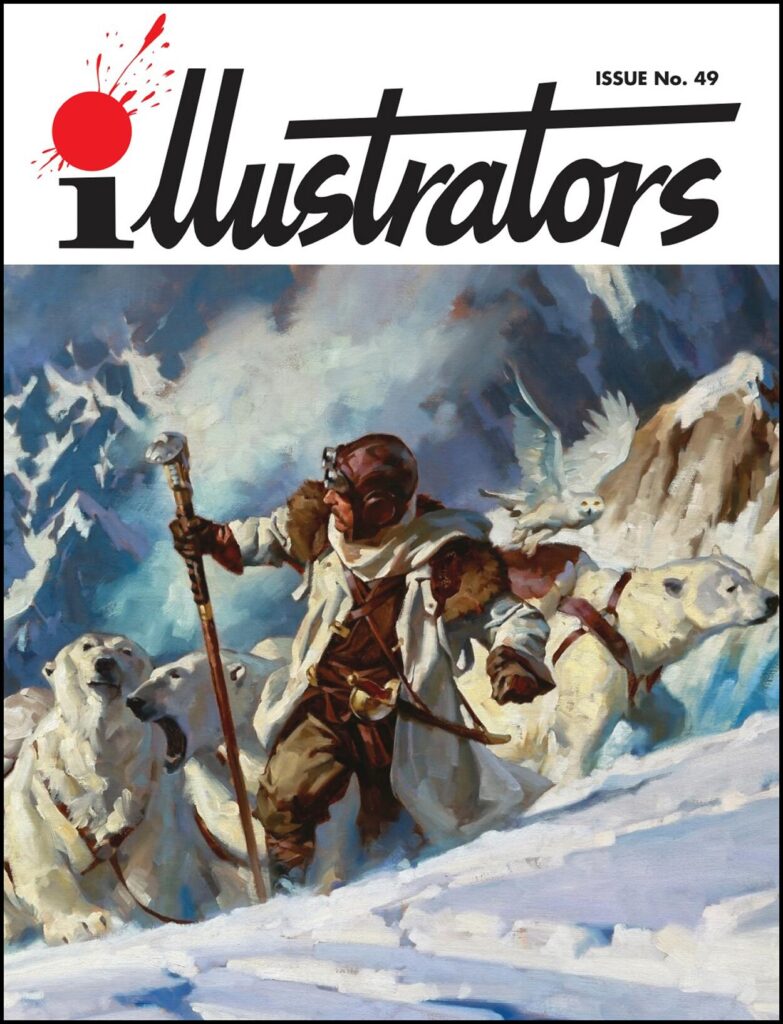
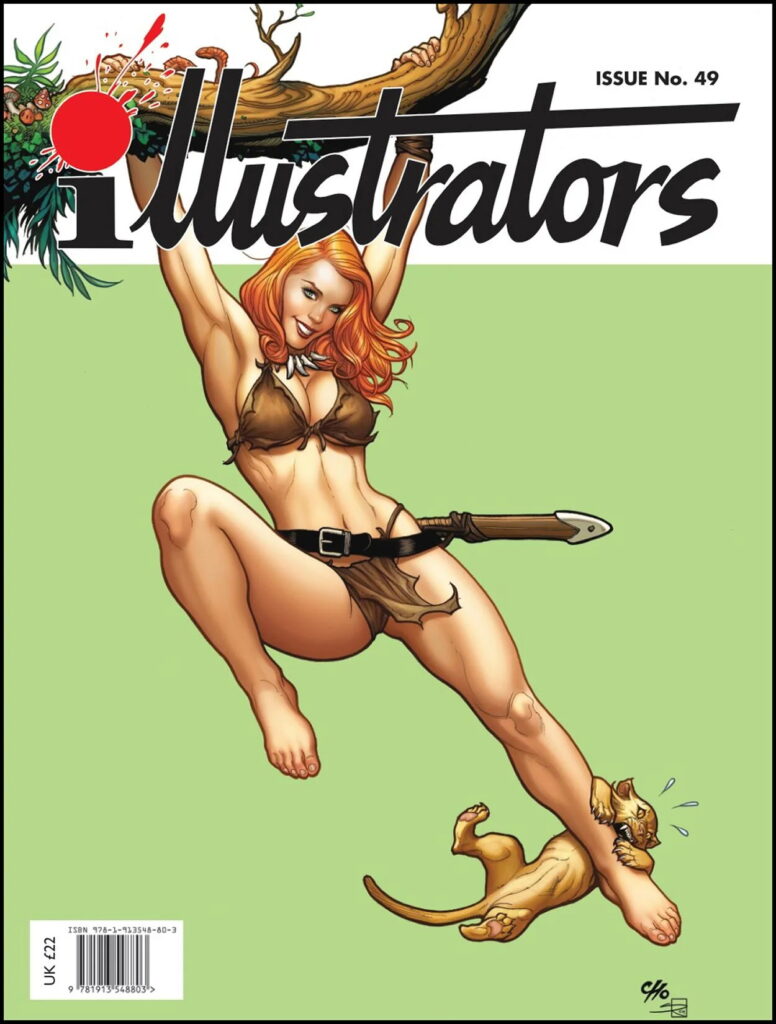
illustrators periodical is a magazine from the premier league. With a long history (published since 2012 in this format) that enables the publication to engage with the best illustrators in the world, and Issue 49 is no exception. The title covers a wide range of material, from different flavours of the world, diverse media and a spectrum application back into the culture that we consume. And that has always been what illustration does: it visualises what we see in the world, forming image around word, story and, transforms movements and meaning into mark.
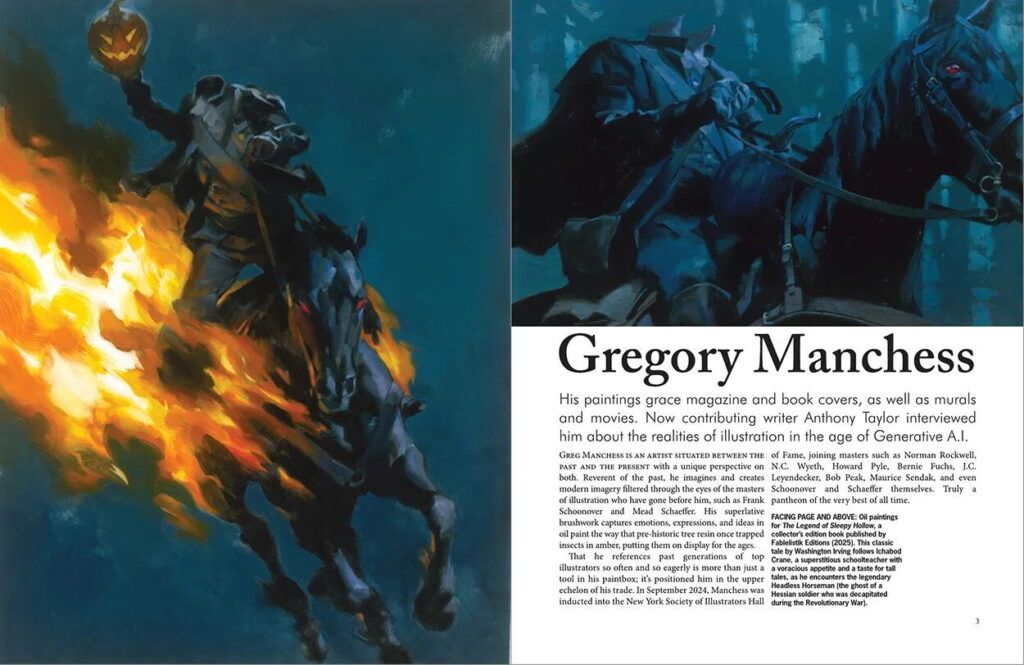
We start with Gregory Manchess, who is a painter of some stature, with work gracing the covers from Conan The Barbarian through to Alice In Wonderland and many other book covers, magazines, too many to list. His work is spectacular and as is often the case, elevates to a level that stands sovereign from its original narrative application as a piece of fine art.
The illustrators format is one of artwork examples, detailed interview and analysis. We are introduced to Macnhess through a wide range of questions that illicit interesting and revealing responses from the artist, as we journey through his work – beautiful striking and painterly – you can really feel the dynamics leaping out of the page.
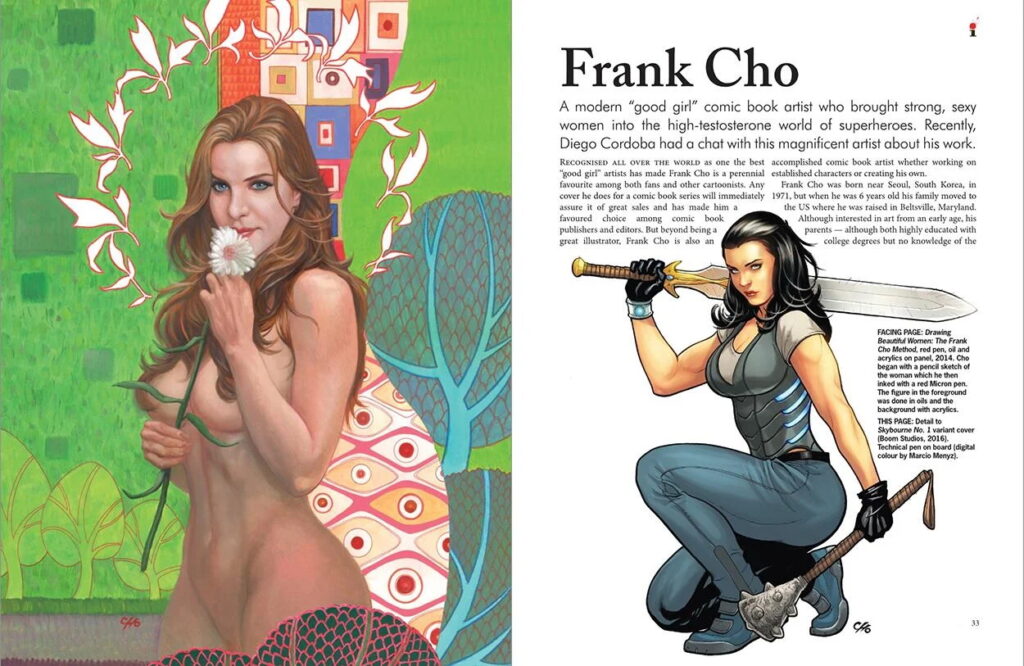
Next up, we have comic creator Frank Cho, a radical shift of art style and one that more easily aligns with contemporary commercial illustration – although Cho is no young upstart, the work remains distinctly fresh. Cho is a connoisseur of the female form, with work that would probably “trigger a trigger” in many social media platforms and some consumers. Yet the work is vibrant, honest and celebratory, and to me, a hallmark of authenticity and genuine artistic enquiry. His work stretches across graphic novels, with a multitude of knowing internal breakouts of containers, boxes, pages, and ultimately the fourth wall.
Delivering art that has a distinct style – working across DC and Marvel, with Harley Quinn, Liberty Meadows and the Hulk, he more than warrants inclusion in the periodical, and again an in-depth and wide-ranging interview adds detail and analysis to his distinct style.
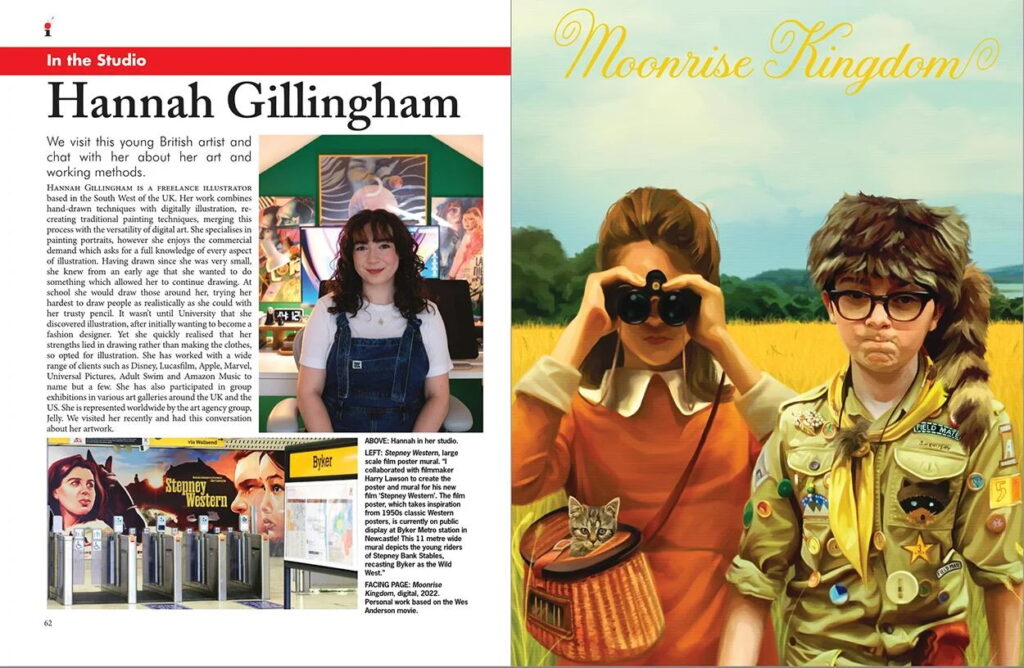
Hannah Gillingham is a new young generational talent from the UK. Gillingham’s work was borne out of training as a fashion designer. Yet her commercial illustrations drove her passion and a slew of clients followed Disney, Lucasfilm, Marvel and Apple, and others. Gillingham’s material is nowadays all created in Photoshop, yet it remains resolutely painterly and illustrative in its technique. Her excellent work is featured in wide ranging diverse field from film promotional work, to personal exploration of other films.
A more human focus and painterly approach adopted into modern film showcases a desire for film studios and marketeers to still place hand-drawn art front an central in a digital world, of which they have access to HD-anything. This says something to the core truth of illustration and art as enter the AI revolution.
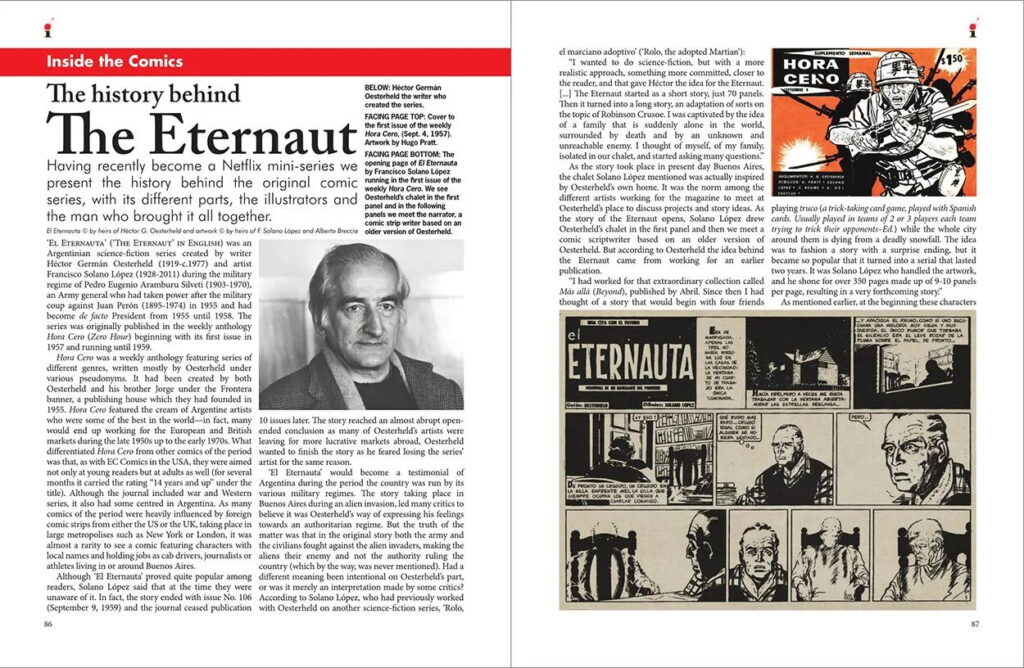
Writer Héctor Germán Osterheld and artist Francisco Solano López are of particular interest to myself, having watched the Netflix series of The Eternaut, and wanting to know more about the original story. Here, we discover a world of material created by Osterheld and López back in the annals of time 1957-59. The concept of the protagonists suddenly being abandoned when it starts snowing (a rare treat in Buenos Aires) as Osterheld recalled, “like Robinson Crusoe” but set in Argentina. With unknown forces happening to the group of ordinary middle age ensemble.
He added the ‘them’ or ‘others’, as in aliens, to become a later central theme when the series was expanded, the short-run strip published in the periodical Hora Cero. During this time reprints were underway its popularity increasing and the political system noticed under the guise of a military dictatorship across Argentina. Osterheld was under pressure to wrap up by his publishers due to a hostile reception to the invasion storyline. He did, but despite going into hiding and becoming heavily involved in a political resistance group, managed to smuggle out new scripts and further material created in the 1960s. The material was post apocalyptic after the “alien” event and the main characters became resistance and a barely concealed political allegory.
Artist Francisco Solano López became increasingly concerned about the direction of the material and while in hiding in 1976, Osterheld was taken from the streets. His four adult daughters had previously been captured and he was never seen again, “dying” in captivity. A text book example of the power of the comic form to bring truth to power. López himself had to flee Argentina to Spain leaving the original work for Osterheld’s widow to try and make some money. The rights were eventually sold and a third story without López was created in 1981.
López made a final return with an offshoot story based on the protagonists time travels (akin, perhaps, to Michael Moorcock’s Elric, or themes in the comic strips he drew for British weekly titles) and this new millennial original work was created in digital colour.
López passed in 2011, having seen the Eternaut finally increase in stature globally. Netflix acquired the rights and a series adaption was created. Confirmation if anyone needed it, of the staying power of the comic-form, as both entertainment and the visceral voice for social and political machinations of any age.
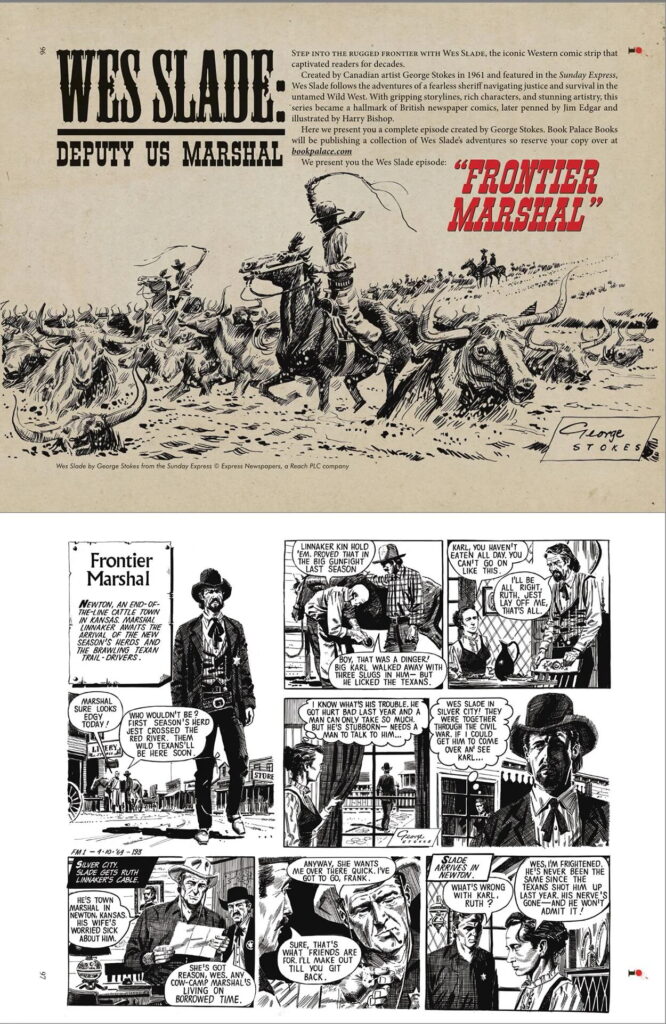
We finish with an excerpt from the western comic strip “Wes Slade”, now being collected by illustrators publisher Book Palace, drawn by artist George Stokes and first published in the Sunday Express, back in 1961. A beautiful loose drawing style, a rip-roaring yarn and a taste of the work advertised for sale in full, in the back of Illustrators.
illustrators Issue 49 has been quite the collection and a joy to consume and review.
Graham Baines
Author: Diego Cordoba | Artists: Gregory Manchess, Frank Cho, Hannah Gillingham, The Eternaut | Publisher: Book Palace Books, November 2025 | Number of pages: 112 | Format: Soft Cover; Full Colour illustrations | Size: 9″ x 11″ (216mm x 280mm) | ISBN: 9781913548803
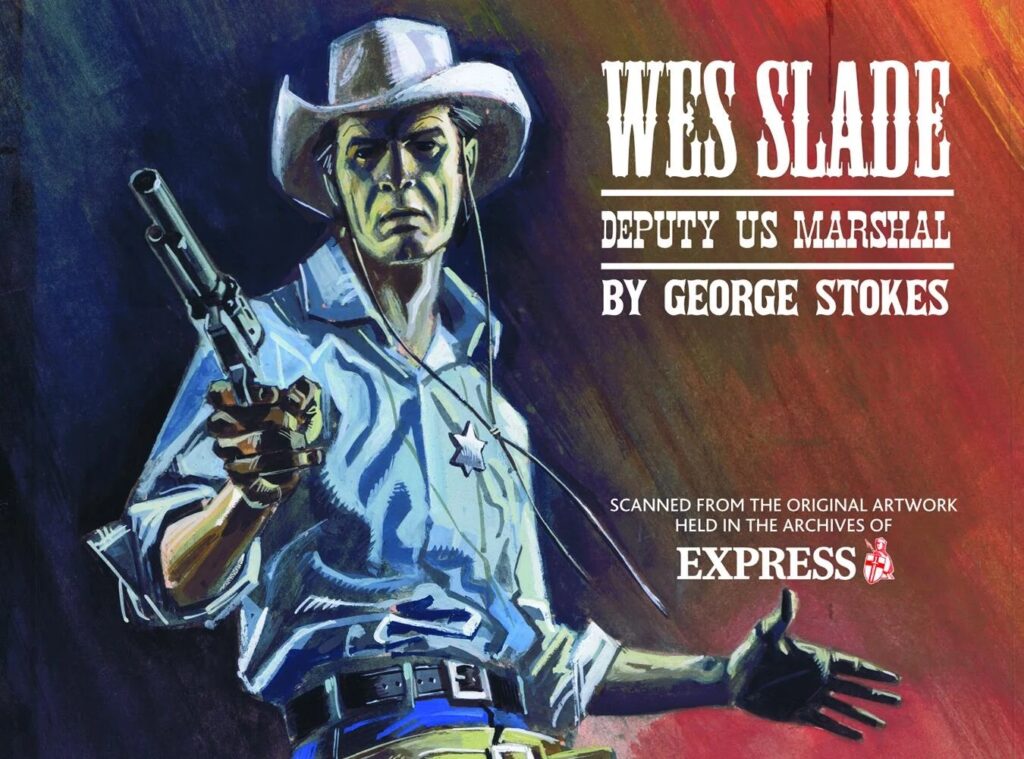
• Wes Slade – Deputy US Marshal is available to order here from Book Palace Books
Author and Artist: George Stokes | Publisher: Book Palace Books, November 2025 | Number of pages: 160 | Format: Hard Cover; Black & White illustrations | Size: 13″ x 10″ (330mm x 254mm) | ISBN: 9781913548865
Limited Edition of 400 copies worldwide. This is the very first time these stories have been reprinted in English since first appearing in the 1960s and 70s.
Regarded by comic aficionados as the finest western strip ever published, Wes Slade ran from 1961 until 1981. Written and drawn by George Stokes, the artwork is very special. All the stories show a fresh and authentic treatment of the role of the Native Americans in the West.
Here we present 10 never-before reprinted tales of Wes Slade written and drawn by George Stokes between 1962 and 1974 and scanned directly from the original artwork held in the Express newspaper archives.
Not only does it portray the plight of the various tribes at the hands of the encroaching white settlers, it does so with some of the most accomplished Western artwork ever to grace a newspaper on both sides of the Atlantic.
George Stokes was born in 1934 the son of a British officer serving in the Indian Army. He returned to England in 1948 and completed his education and became a commercial artist. Travel in Canada and the United States deepened his interest in the West and in 1960 he jumped at the opportunity to draw a newly created western strip for the Sunday Express, Wes Slade.
He drew Wes Slade weekly for the next 20 years until his untimely death aged 47 in 1981. We are very pleased to be able to offer this supreme collection of Western stories and artwork with the very finest reproduction from the original artwork.
- About the Author
- Latest Posts

Categories: Art and Illustration, Books, Comic Art, Creating Comics, downthetubes Comics News, downthetubes News, Magazines, Other Worlds