Norman Boyd delves into the creation of a much-hoped for comics anthology in the 1970s that, sadly, lasted but a few issues, but included some incredible art by the likes of Frank Bellamy, Harry Bishop, Hunt Emerson, Keith Page, Keith J. Luck and others…
This article was first published on Norman’s Frank Bellamy Checklist and Blog and is reproduced here, with some small additions, with his kind permission…
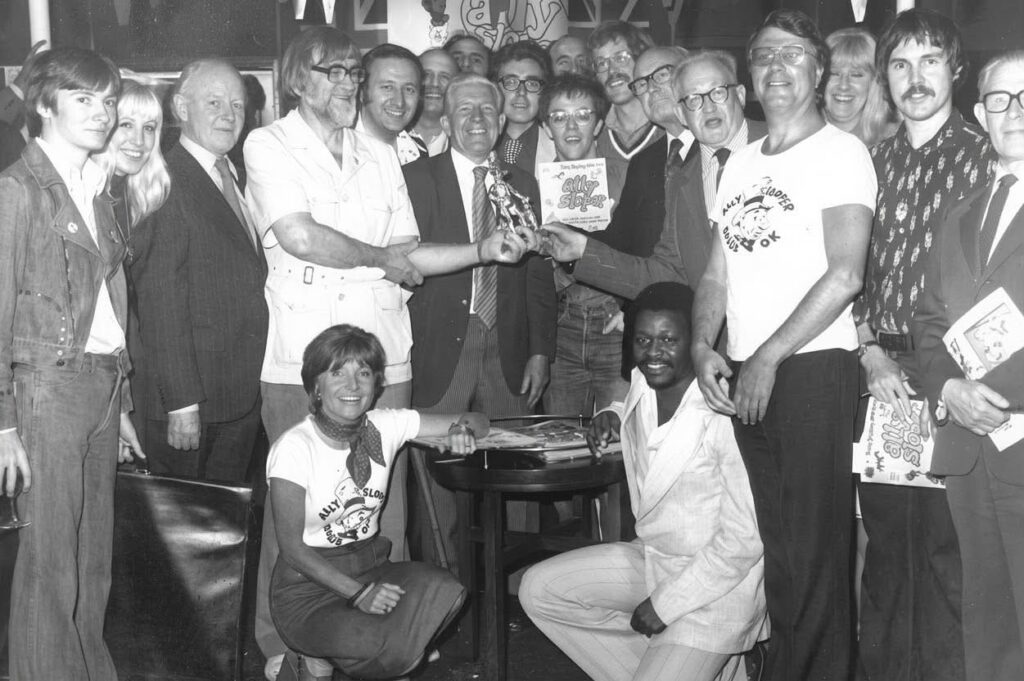
Did “Garth” and “Thunderbirds” artist Frank Bellamy ever meet Frank Hampson, the creator of “Dan Dare”? Did Frank Bellamy attend the launch of a new comic in 1976? John Freeman provided me with these questions – and a copy of a recently discovered photograph of that launch, featured below, found in an old book by artist Keith Page, which was, I remembered, reproduced in a comic magazine called Ally Sloper (#2).
At the time, I could identify a few people in the photograph, but who are the rest? And what’s this got to do with Frank Bellamy? Bear with me, as I record in one place all my notes on this subject.
Frank Bellamy had attended some comic conventions – see my previous article on the artworks produced, and editor Dez Skinn‘s reaction – including Comiccon ’71, where I suspect Bellamy drew a few images using the idea of a convention logo, not expecting them to be used. (But they were – as that article shows).
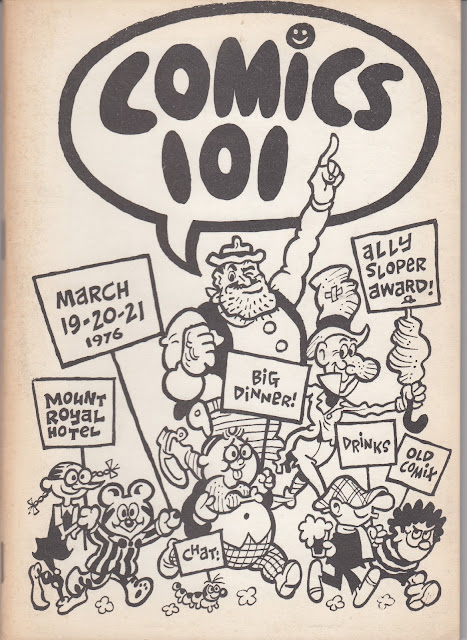
Comics 101 (19th – 21st March 1976)
 1976. Leo Baxendale receives the Ally Sloper Award at “Comics 101” from Bob Monkhouse and Denis Gifford. (via Cartoonists Pics)
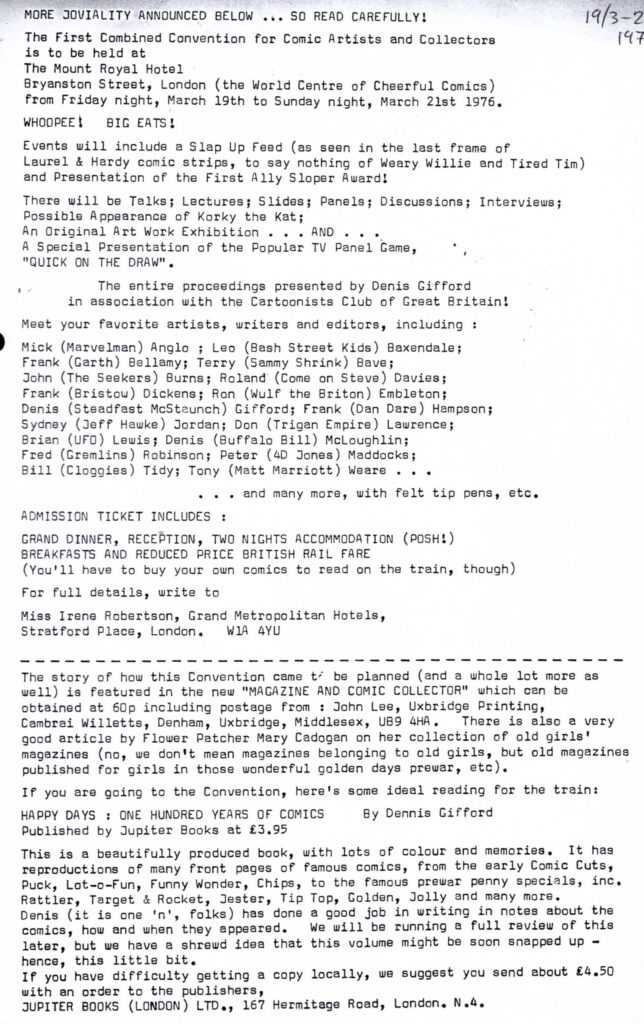
In amongst papers that Nancy Bellamy owned, there was a leaflet – an A4 type page which appears to be about the Comics 101 convention.
COMICS 101 ran from Friday to Sunday 19th to 21st March 1976 at the Royal Mount Hotel in London. The occasion, according to the organiser, author and comic archivist Denis Gifford, was the anniversary of the birth of British comics. Having many contacts in TV, Film and, of course, comics, he pulled together a programme of extensive original art by many well-known cartoonists and artists. You can read Richard Sheaf’s blog entry on this, with pictures accompanying the article, for more details. It was also the event that saw the launch of Gifford’s Ally Sloper Awards, Leo Baxendale one of the first recipients.
Bellamy’s contribution was of Garth who he’d been illustrating, at that point, for almost five years as a strip in the Daily Mirror. The illustration accompanied a three-page article on “Steve Dowling: Father of Garth”.
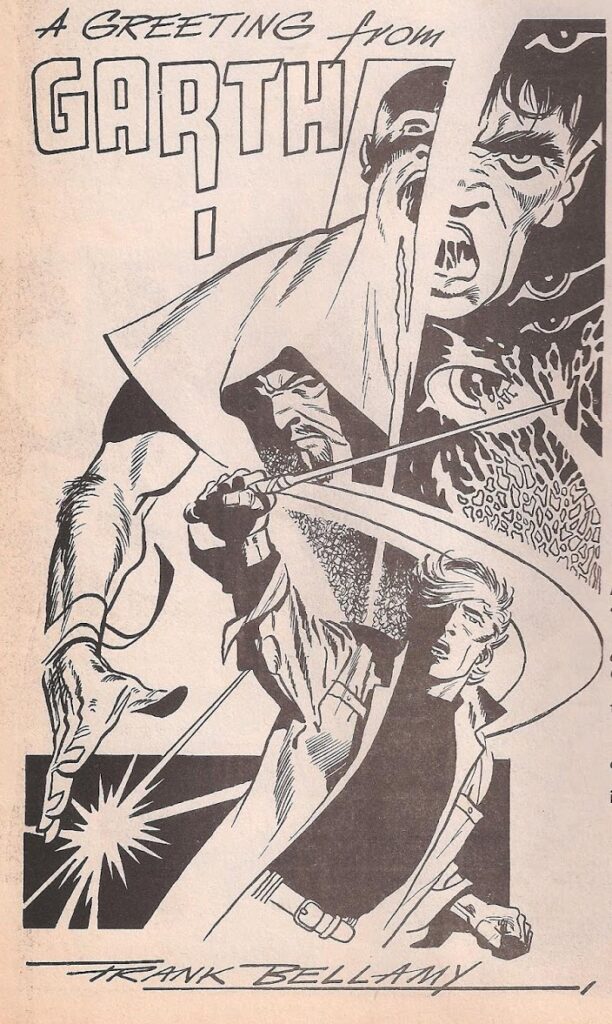
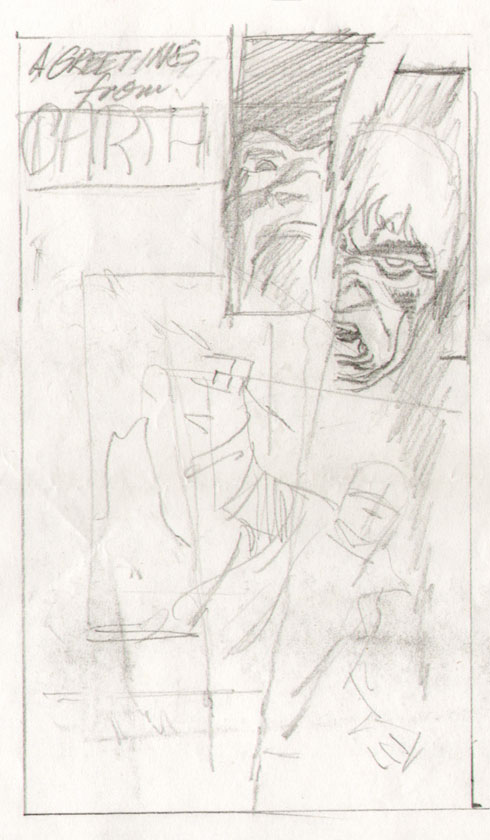
“A Greeting from Garth” – Comics 101 programme 1976, and the draft artwork, via artist Alan Davis
Gifford named it “101” to indicate the start of the next century of comics in the UK. As he explained in issue 1 of Ally Sloper comic magazine: “Why do we call ourselves ALLY SLOPER — well, why not? Ally was our first British comic strip hero, created over a century ago by Charles H. Ross and Marie Duval on 14th August 1867.” My maths says that’s 110 years not 101, but there we are. In the first issue, we get a two page tightly packed review by none other than Keith Mackenzie (the strip editor for the Daily Mail and the Evening News. He gives us lots of detail, but unfortunately for me, omits any mention of Frank Bellamy!
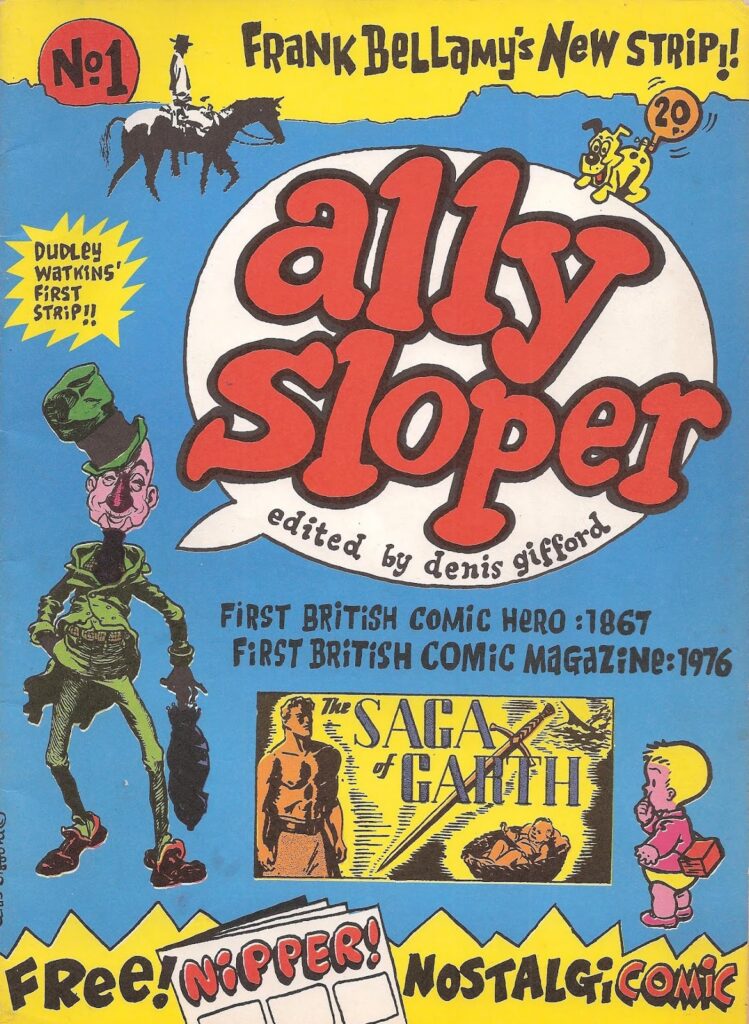
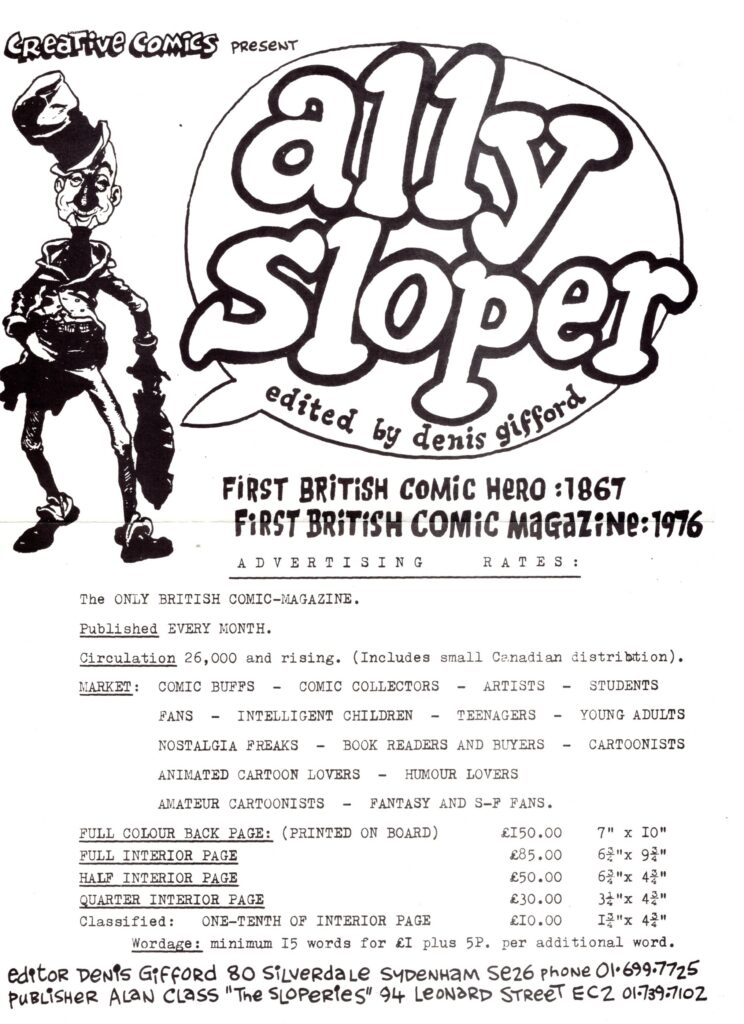
Ally Sloper
As stated, Denis Gifford went on to create a comic later that year and got Bellamy to draw his own comic strip for Ally Sloper #1. The launch in September 1976 was also a big event, as seen by the photo provided by Keith Page. Before I found the actual launch date, I asked Terry Hooper, who announced he was to interview Alan Class (Ally Sloper‘s publisher) if he could jog Alan’s memory and ask if Bellamy attended as I knew he was invited. Terry posted the interview with Alan Class back in August 2007 and with Terry’s permission, here’s Alan’s reply:
TERRY: In the early 1970s you and Denis jointly [?] published the ALLY SLOPER magazine and I believe the great Frank Bellamy was invited to the launch – did he make it? And, biggest question of all: why did it get cancelled?
ALAN: ALLY SLOPER was launched in a blaze of publicity aboard the Steam-ship Tattershall Castle, which was berthed on the Thames near Blackfriars Bridge. There were badges, T-shirts and other mementoes. The master-of-ceremonies was a lovely man and great British comedian Ted Ray.
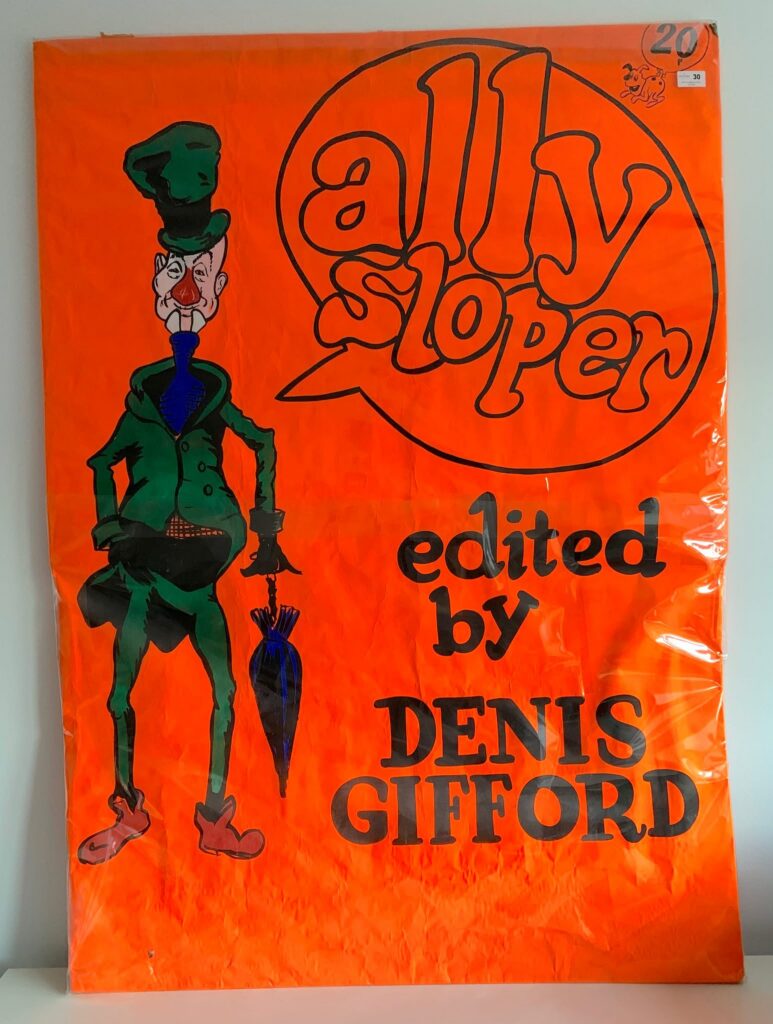
Many British illustrators of the time were invited including Frank Hampson and Frank Bellamy. Hampson made it, sadly Bellamy didn’t. On arrival most [not all] the artists were asked to sign-in by drawing their own special character or doodle on a very large hanging sheet of paper. It made a focal point for the occasion, and it is still in my possession.
Although we received plenty of good publicity from our launch, including some highly favourable reviews for ALLY, regrettably we couldn’t get the required support necessary for this new and different publication – it just didn’t sell, and after persevering for nine or ten issues, I’m afraid ALLY sloped off into the night taking our losses with him!!
Alan’s memory was playing tricks on him – there were only four issues published, although, of course, more would have been planned out. That aforementioned illustrated sheet of paper has been shown on Richard Sheaf’s blog, and photos appeared in Ally Sloper #2. The piece measures 125cm x 92cm and was sold at auction in 2022. Unfortunately with no Bellamy artwork, as he passed away in July.
Bellamy must have woken up Denis Gifford one evening (who, at the time, had also been busy working on his book, published in September 1976, Victorian Comics), as it prompted him to write an undated, hastily typed, letter:
Dear Frank,
Many thanks indeed for your phone call last night. Even if it did fetch me barefoot from me bed, it was worth it! I’ve checked on the page size, and our paper trims down to 8 wide by 11 deep, so a reasonable margin around would give us a drawing area of 6¾ wide (rather than 7) by 9½ deep. You can burst out of this here and there as befits your design, but not right to the edges. I don’t think we can have a full bleed. Looking forward very much to seeing the work, and hopefully over a lunch. Alan Class would be pleased to meet you, too.
Yours in a rush,
Alan Class also wrote to Bellamy:
Dear Mr. Bellamy,
I was certainly delighted to have had the opportunity of meeting and chatting with you today. I would just like to reiterate my thanks and appreciation, not only for your help and co-operation in undertaking to assist our new venture, but also notwithstanding great pressure of work, the speed with which you kindly supplied your strip.
As mentioned, for our pre-release party and other publicity it is possible that we should like to borrow and exhibit the original drawings for the above, but I will telephone you about this when the time is ripe. The only other point I would mention is that though I anticipate our printers will be quite satisfied and able to work from the photostat copies provided, should they require to have the originals for a few days, I trust you will have no objection. Should this necessity arise, I will telephone accordingly.
As arranged, I am pleased to enclose herewith our cheque for £75.00 in settlement of your account.
So we know Bellamy got the job done fast and that he was paid £75 for the three pages. How do we know this? Alan dated his letter 11th June 1976 – so after the Comics 101 work which was commissioned by Gifford and not Alan Class.
The Launch of Ally Sloper – Wednesday 1st September 1976
If there was ever any doubt about the launch date, in Ally Sloper #2, Gifford states:
TED RAY was our Guest Star at the Launching Party for ‘Ally Sloper’, which we held aboard the old Paddle Steamer ‘Tattershall Castle’ on the first of September.
Dennis Barker wrote a piece in the “London Letter” section of The Guardian (2nd September 1976) with the title “Formidable Ally Sloper”:
[…] I had been invited to meet a man 109 years old, with a large nose, hardly any shoulders, a decayed green frockcoat, a battered top hat and an inability to keep his mouth shut. Now that, I thought, is more likely to be one of my forebears. I found him on a paddle steamer on the Thames, persuading the elephant he was riding to squirt water from its trunk over Mr Denis Healey, which seemed to enhance the genealogical possibility. The gentleman was Mr Ally Sloper He was born in 1867, a ‘cad and a monster’ said my mother, and died in 1922 when, as now, there was a great demand for people whose behaviour more sophisticated persons might disapprove of. He was the first ever comic paper for adults called Ally Sloper.
I asked Mr Ted Ray, who was guest at the launching party on the Tattershall Castle why Sloper was so engaging. ‘He is a thin Pickwick,’ said the comedian. ‘He has the air of being a bit of a villain, but he wouldn’t really hurt anyone. He is impecunious and a bit of a boozer. I dare say he lives in a less salubrious spot of London. A lovable rogue. There are not many of them today. Of course, if you strike out the word lovable, there are plenty.’ A very possible ancestor.
Mr Walter Bell, the man who drew Sloper on the elephant for the first issue of the new comic, worked as a young man with Thomas, the man who drew him in the 1920s. He is now in his 80s in retirement in New Barnet. Sloper reacted to every public scandal, reflecting the life of ordinary people a Punch with the rest. He could have a great time.
Another enhancement of the genealogical possibility. Ally Sloper has newly created companions, including one [who] tries to take over the world, a sort of Captain Marvel in reverse. He is called Kaptain Kween, the Man with the Golden Hair-dryer. Absolutely no relation.
As strip writer Les Lilley notes in his book, It’s all Here in Black and White: The history of the Cartoonists’ Club of Great Britain, “The Tattersall Castle is a brilliantly restored paddle steamer, used as a gallery and moored on the Thames near Hungerford Bridge and Charing Cross Tube Station.
“The 41-year-old ship plied its trade as a ferry across the Humber. On the 14th February 1975 the ship’s owners (the Childs family who bought her for £27,000) applied to Westminster Council to make changes to the external appearance of the ship moored at Victoria Embankment – most likely reinstating the funnel that had to be removed to get it from its mooring in Immingham to the Thames. On Monday 23rd February 1976 the PS Tattershall Castle opened her gangplank for the first time after a £400,000 make-over in a ‘launching’ ceremony and visitors could see the floating art gallery two days later. One of the first exhibitions was a road safety poster competition put on by children’s TV programme, Magpie. From 29th June to 4th July, an exhibition of Sir William Russell Flint artwork was on display.”
So let’s have another look at the three-page wordless strip which Bellamy created…
Swade


Bellamy always cited Sergio Leone’s westerns as an influence – and the lead in his strip certainly has close-ups on his eyes. One can see he really enjoyed this job – writing his own material, visualising as he wanted and the subject – his favourite!
Sadly, with his passing on 5th July 1976, there was to be no more…
“In The Beginning” No. 2: Frank Bellamy
In the second issue of Ally Sloper (October 1976) Gifford mentions in his editorial introduction that Harry Bishop’s strip, noting Frank’s passing before the title’s launch:
[…] is the kind of strip FRANK BELLAMY would have loved, the kind you will read more about. Frank, whose death cast a sad shadow over our first issue, is remembered with respect by some of the men who worked with him. Their tribute, ‘Farewell to Frank’, is combined with our regular feature ‘In the Beginning’ which brings you Frank’s first ever strip cartoon.

The two strips shown are the first “Commando Gibbs” toothpaste strip, alongside the first Garth strip. The “men who worked with him” are Clifford Makins and Dennis Hooper. I have taken the liberty to contradict them where necessary, correcting facts.
CLIFFORD MAKINS editor of “Eagle” and “Swift”
Frank Bellamy’s first major contributions to Swift were double spreads in black and white “The Story of Robin Hood”, and “The Knights of the Round Table” (1955) [Actually he drew single pages for other strips before these for The Fleet Family, Swiss Family Robinson and Paul English – Norman]. As the writer, I was immediately struck by the sensitive yet robust style of Bellamy, his fastidious attention to detail and eagerness to portray the intentions of the writer who had plotted the sequences. He was the best of colleagues and collaborators and insisted always, but always, in doing the lettering for the balloons. For Bellamy this was merely an extension of his art work.
He reached his peak, in my view, with two major projects for Eagle, both in colour – “The Happy Warrior”, the story of Winston Churchill (1956) [Actually 1957-1958 – Norman], and “The Great Soldier”, the story of Montgomery of Alamein (1962). [“The Great Soldier” was the sub-title used in a couple of the “Montgomery of Alamein” strip – Norman] Both these stories ran for a year and I cannot recall Bellamy taking a day’s holiday! Certainly he spent most of his spare time in the Imperial War Museum. These are examples of his finest work. Later, [actually in between these two assignments ~Norman] he was persuaded to take on “Dan Dare”, but apart from the shadow of Frank Hampson, Bellamy, though immensely gifted, was never a man who ever cared for the assignment. He was never a space man, he never ‘got’ Dan Dare.
Apart from establishing himself as one of the finest strip artists of our time, he was absorbed in the animals and the tribes of Africa and represented them both with great fidelity and affection in his “Frazer of Africa” (1960), [common error in spelling “Fraser” – Norman] in which he pioneered the use of limited colour.
DENNIS HOOPER editor of TV21 and TV Comic
Who could pretend that they really knew the man, for like so many of his kind, life was a solitary affair. As art director of TV21, I first met Frank Bellamy in the latter months of 1965. Eagle was showing geriatric symptoms, and it didn’t prove difficult to entice him away with our more exciting prospects. During a four year run, I came to understand this complex man as well as any. Above all else, I am convinced that Frank Bellamy was an artist in the truest sense of the word.
The fact that strip cartoon claimed him is purely academic. Given different circumstances, Frank’s individual spark would still have manifested. He was driven by some inner compulsion that had him constantly striving for visual perfection. How close he came to succeeding is best recorded by those numerous innocents who would pick up a Bellamy original and remark, “But isn’t this the printed job?” In other words it is my belief that Frank’s subconscious always resented the printer’s intervention. Why else would he have taken such lengths to give the camera no excuse?
Without doubt he brought a new dimension to strip cartooning. Can his mastery of the pen and ink techniques ever be matched?
Much wrangling will take place over the finest vintage. Like Ernest Hemingway, Frank had an interest that bordered on obsession, relating to man’s virility. Bull-fighting, the Old West and tribal Africa he studied in some depth. Indeed, one of his own favourites, “Frazer of Africa”, made him something of an authority on the Masai. In the case of “Dan Dare” and even “Garth”, who can deny that contrary to his character Frank was following in another’s footsteps.
However well he drew Garth, I think the limitation of area and lack of colour strangled him. Not surprisingly, outside the accomplishment of “Heros the Spartan” (1962) I rate “Thunderbirds” (1967) [15 January 1966-18 October 1969 – Norman] as something on its own. To me, “Thunderbirds” demanded all the special qualities of Frank’s unique ability. Discounting the puppet characters, what other subject offered the scope to display his genius of geometric invention? For he was a draughtsman of the highest order and “Thunderbirds”, scripted by Alan Fennell, used his utmost skills. Frank Bellamy rewarded us with an imaginative outpouring of the future that would have done credit to Arthur C. Clarke.
Of one thing I am positive, in ten, twenty, thirty years time, Frank Bellamy’s remarkable talent will be hanging on walls, appreciated for what he wrung himself dry of — art!
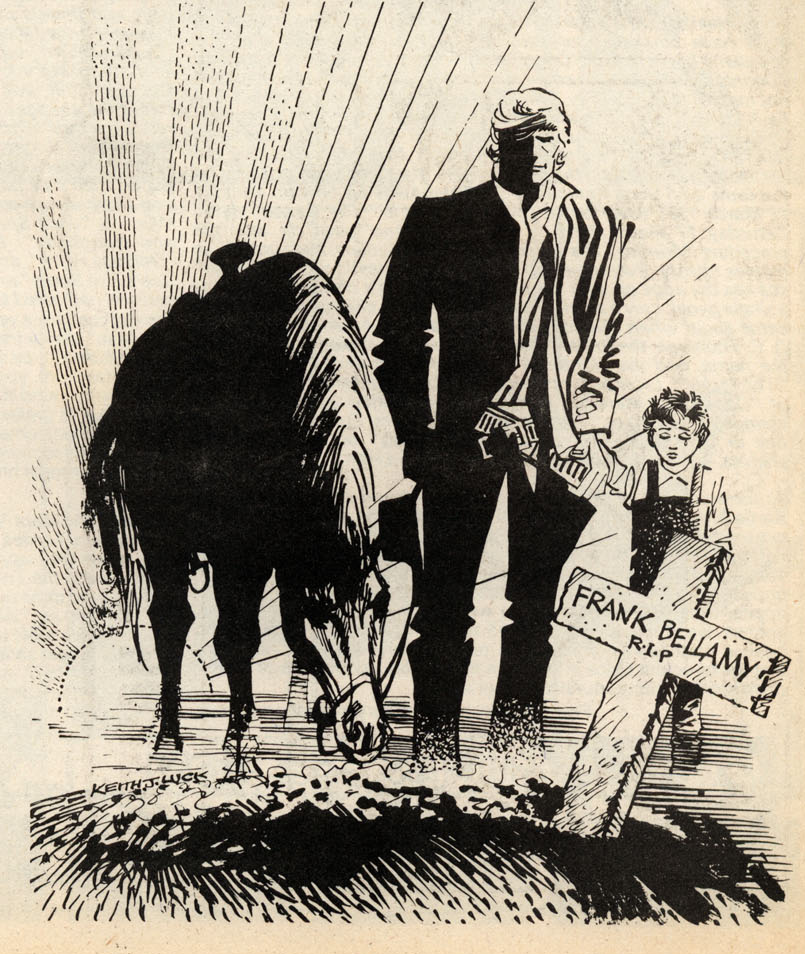
Keith J. Luck (what did happen to him?) drew a lovely image for the column which I’m reproducing below as I feel certain the ‘Shane’- like pose with Garth would appeal to Frank’s love of westerns.
I remember John Freeman musing:
“You also have to wonder, had Bellamy survived and made it to that star-studded launch for Ally Sloper, would he have had a chance to talk to Frank Hampson? What might have two greats of British comics discussed if they had?”
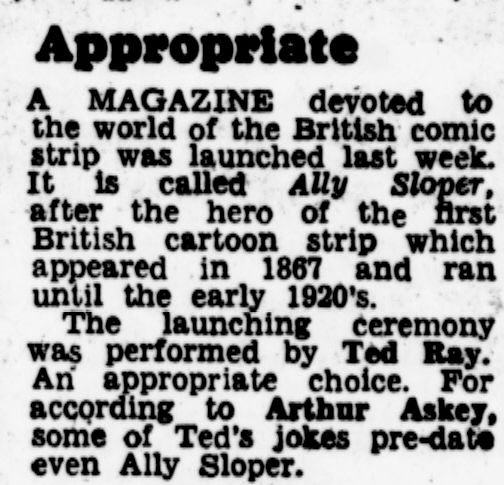
So before we leave it there here’s a review of the launch of Ally Sloper that might make you laugh by Michael Watts, from Sunday Express 5th September 1976:
By the way, Keith Page, who sent us the photo featured in this column, currently working on an adaptation of Three Men and Their Boat by Jerome K. Jerome, drew a lovely four-page strip in Ally Sloper #2, riffing the master himself very well, in my opinion…


This article was first published on Norman’s Frank Bellamy Checklist and Blog and is reproduced here with his kind permission…
Head downthetubes for…
• Frank Bellamy Checklist and Blog – compiled by Norman Boyd
• The Boys Adventure Comics Blog – compiled by Richard Sheaf
Denis Gifford
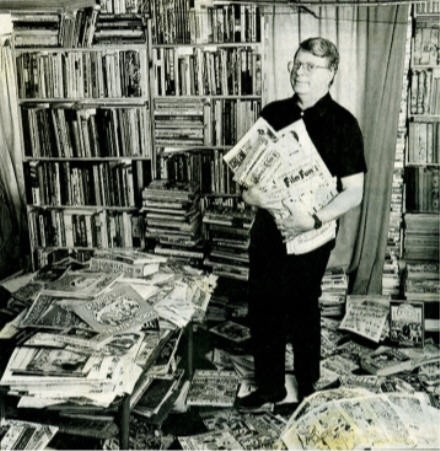
Denis Gifford (26th December 1927 – 18th May 2000) was an author, scriptwriter, film historian and comic-strip artist who began collecting comics when he was three, and produced his own publications while attending Dulwich College at the same time as future TV star and raconteur, Bob Monkhouse. They published their own comic and, at only 14 years of age, Gifford was drawing for The Dandy and then Beano. He worked as a freelance artist and writer for radio after serving in the RAF towards the end of World War Two, and eventually devised and compiled panel games, and worked on the the last three episodes of Running Wild, the first television series starring Morecambe and Wise in 1954. It led to much more TV work including on shows such as Witch’s Brew, The Laughing Policeman and The Generation Game. He also devised Quick on the Draw, a game show for cartoonists, but an obituary in The Stage by John Martland notes his most satisfying small screen achievement was almost certainly Looks Familiar.
His works on comics and genre film and TV, laying the foundations of specialist reference works by many others included his comprehensive The Complete Catalogue of British Comics (including a price guide), published in the 1980s; Discovering Comics, Monsters of the Movies, The Best of Eagle, and biographies of stars such as Charlie Chaplin and Boris Karloff.
In the last years of his life, between 1998 and 1999, he partnered again with Bob Monkhouse to write and perform A Hundred Laughs for a Ha’penny and Sixpence for a Superman, two Radio 2 programmes that traced the history of the comic paper, and up until his death, he was providing knowledgeable obituaries for The Independent. Martland notes that when famous comic character Billy Bunter was killed off many years ago, Gifford even wrote his obituary for the newspapers.
• Wikipedia: Comics art and writing of Denis Gifford
• Comic Creators UK: Denis Gifford: a Source of History
• The Guardian: Denis Gifford Obituary, 26th May 2000, by Steve Holland
- About the Author
- Latest Posts

Norman Boyd has been working on a Frank Bellamy checklist of all his work – published and unpublished – since 1976. Visit his blog at http://frankbellamy.blogspot.co.uk
Categories: British Comics, Comic Art, Comic Creator Spotlight, Comics, Creating Comics, downthetubes News, Features, Other Worlds
 Comic Creator Spotlight: Pat Williams, EAGLE and TV Comic artist
Bellamy, £25 per page? The mind boggles. Frank lived opposite my Uncle in Kettering and my late Mum’s late friend’s younger brother (still extant the last time I checked) knew Frank through his early studio work. The assertion that Ally Sloper magazine “just didn’t sell” is evidenced by the fact that I was well tuned-in to Gifford’s work by the late 1970s, but saw Sloper at my local newsagent and still didn’t buy it; the shop assistant later revealed that it hadn’t sold well at all. While, in retrospect, it clearly had direction, this was not evident on the shelves. One illustrator listed in this article, still working (no clues, but he was Birmingham-based and wore specs) said to me on the phone in the mid-1970s that (paraphrasing) part of the reason Ally Sloper magazine failed was that “Denis Gifford had too much ‘say’ in the look of the whole thing”; and I agree. Afterwards, I suggested to Denis that issues 1 to 4 “looked better” when viewed together, and he agreed.