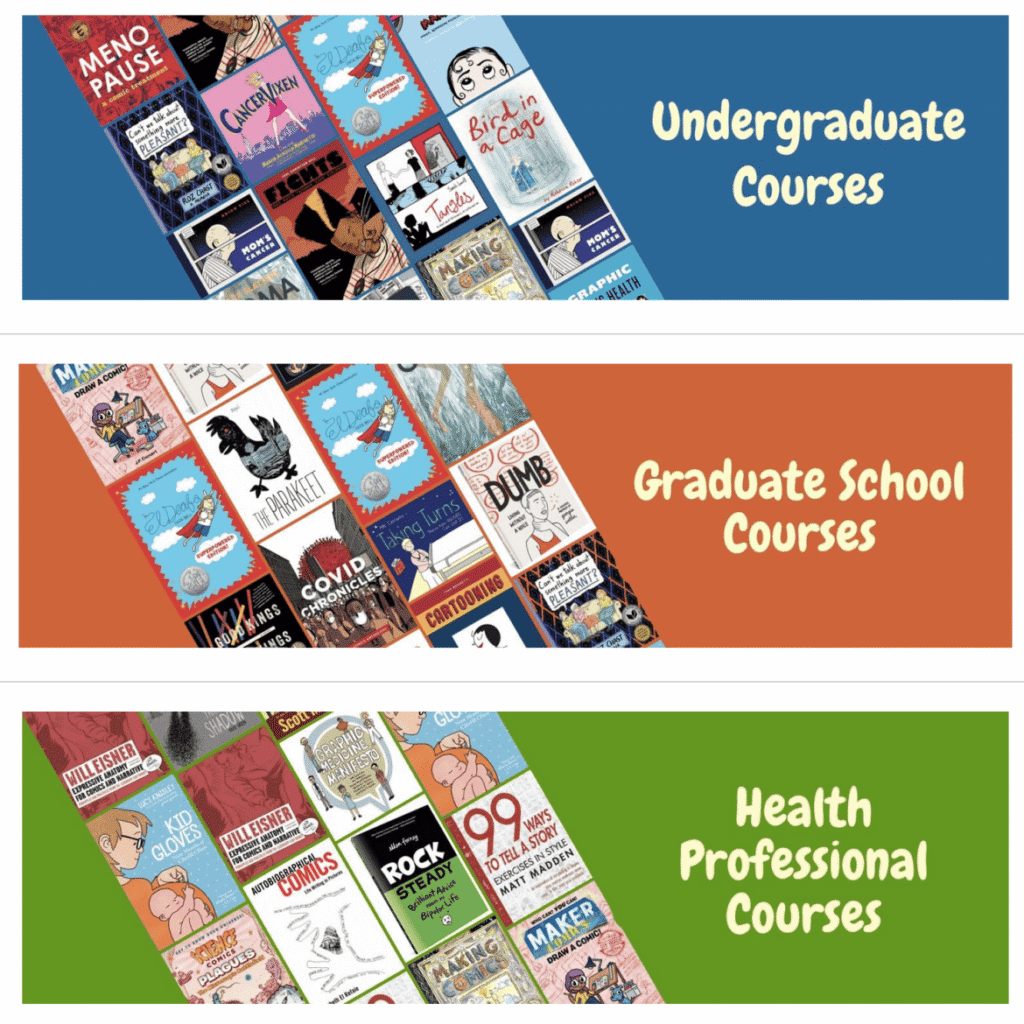
Are you looking for ideas on integrating comics into your teaching about health and illness, or for examples of curricula on Graphic Medicine topics? You can gain inspiration for your syllabus and gather classroom activity ideas with free resources from the Graphic Medicine International Collective (GMIC).
Check out the GMIC online Syllabus Repository and Drawing Together archives, where you can download materials for free and can contribute by sharing your own syllabi.
The Graphic Medicine International Collective is dedicated to the intersection of comics and healthcare. They guide and support the use of comics in health, and we believe in the power of comics as storytelling to enhance understanding, foster empathy, and promote health literacy across diverse communities.
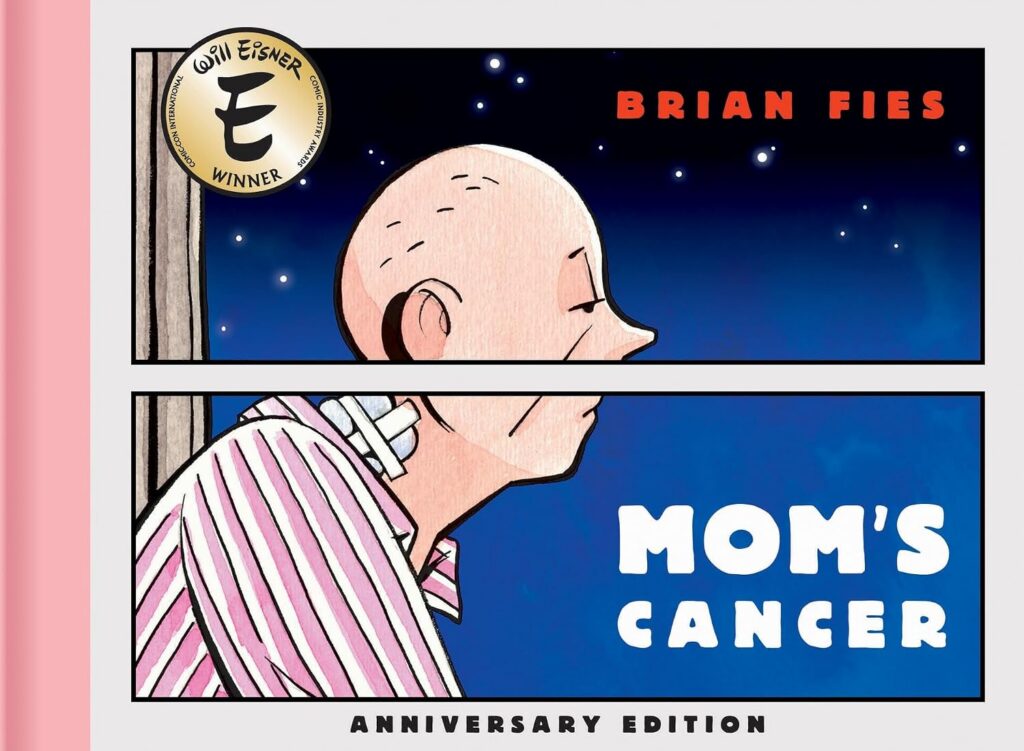
Inspired by Brian Fies’s graphic memoir Mom’s Cancer, re-released in an anniversary edition by Abrams ComicArts this year, Doctor Ian Williams coined the term ‘graphic medicine’ in 2007 for the name of a website, graphicmedicine.org. He intended this site to catalogue comics that included as their subject issues of physical and mental health, illness, disability, and caregiving.
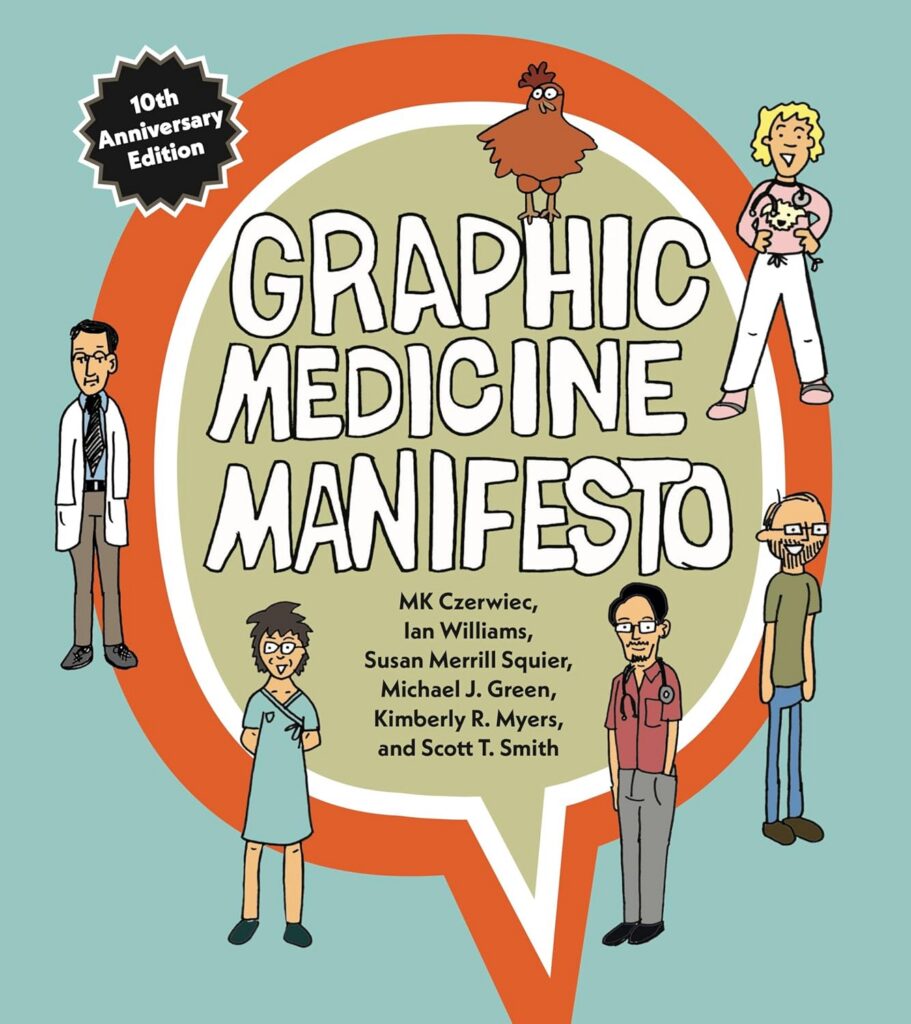
The term took on a more formal definition in the Graphic Medicine Manifesto, first published by Penn State Press, in 2014, re-released in a tenth anniversary edition last year. to mean, “the intersection of the medium of comics and the discourse of healthcare.”
Ian also began to use the term as a way to denote the role that comics can play in healthcare. Over time, the term “graphic medicine” has been adopted as an accepted term for this area of study and practice.
“My use of the word ‘medicine’ was not meant to connote the foregrounding of doctors over other healthcare professionals or over patients or comics artists,” he outlined on the Graphic Medicine website, “but rather the suggestion that use of comics might have some sort of therapeutic potential – ‘medicine’ as in the bottled panacea rather than the profession… I wanted to keep the definition purposefully broad, as, to my thinking, the discipline could include graphic memoirs of illness, educational comics for both students and patients, academic papers and books, gag strips about healthcare, graphic reportage and therapeutic workshops involving comic making, as well as many other practices and source material, both fictional and non-fictional.”
The first graphic medicine conference was convened in London, in 2010. The intention was to examine the viability of graphic medicine as a serious topic in health, and to perhaps learn from practitioners in various arenas how they were using comics in health and medicine.
Events have followed annually informally for several years, most recently this past July, with former and future hosts of conferences being offered a position on the ongoing conference organising committee. In 2017, after eight successful conferences, serious conversation began taking place about formalising the group to allow for increased ongoing programming beyond the conferences, to help fund, support, and grow the website, as well as to provide a more stable foundation for the future of the community.
After much deliberation, debate, and research, an organising committee gathered in Harrisburg, Pennsylvania in autumn 2019, to develop a strategic plan and formally incorporate the group into a 501(c)3 not-for-profit organisation in the United States.
• If you would like your syllabus to be included in the GIMC repository, please send it to Michael Green atmichaeljgreen15@gmail.com
• Graphic Medicine International Collective Official Website
• If you’d like to support their vital work, you can make a donation via PayPal here with your one-time or monthly donation to support graphic medicine resources online
GMIC is a 501(c)3 nonprofit; US donations are tax-deductible
- About the Author
- Latest Posts

John is the founder of downthetubes, launched in 1998. He is a comics and magazine editor, writer, and Press Officer for the Lakes International Comic Art Festival. He also runs Crucible Comic Press.
Working in British comics publishing since the 1980s, his credits include editor of titles such as Doctor Who Magazine and Overkill for Marvel UK, Babylon 5 Magazine, Star Trek Magazine, and its successor, Star Trek Explorer, and more. He also edited the comics anthology STRIP Magazine and edited several audio comics for ROK Comics; and has edited several comic collections and graphic novels, including volumes of “Charley’s War” and “Dan Dare”, and Hancock: The Lad Himself, by Stephen Walsh and Keith Page.
He’s the writer of comics such as Pilgrim: Secrets and Lies for B7 Comics; “Crucible”, a creator-owned project with 2000AD artist Smuzz; and “Death Duty” and “Skow Dogs”, with Dave Hailwood.
Categories: Comics, Comics Education News, Creating Comics, downthetubes Comics News, downthetubes News, Events, International Comic News, US Comics