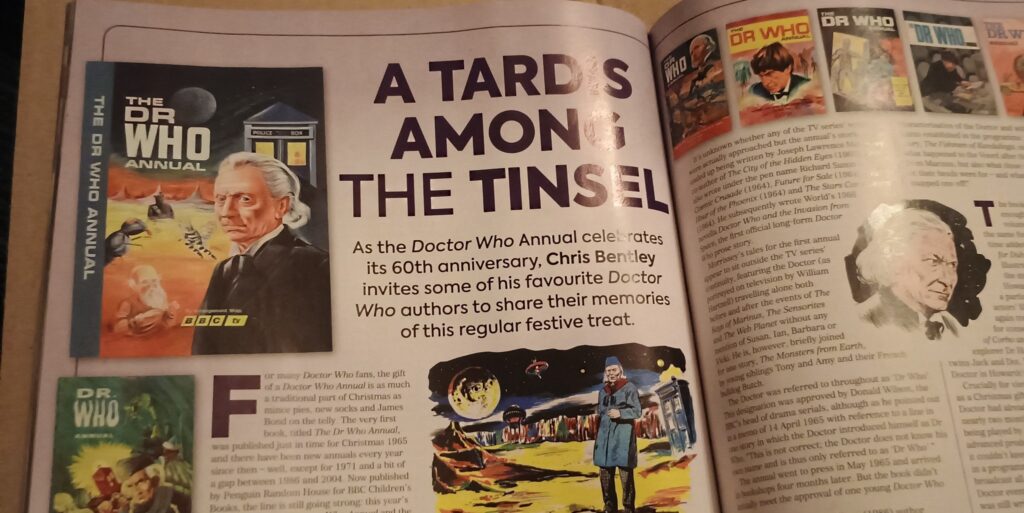
The latest Doctor Who Magazine, Issue 624, features a six page article on the 60 year history of Doctor Who Annual by Chris Bentley.
One aspect of the early days of the publication continues to ignite fan discussion: who painted the cover of The Dr Who Annual 1965/66?
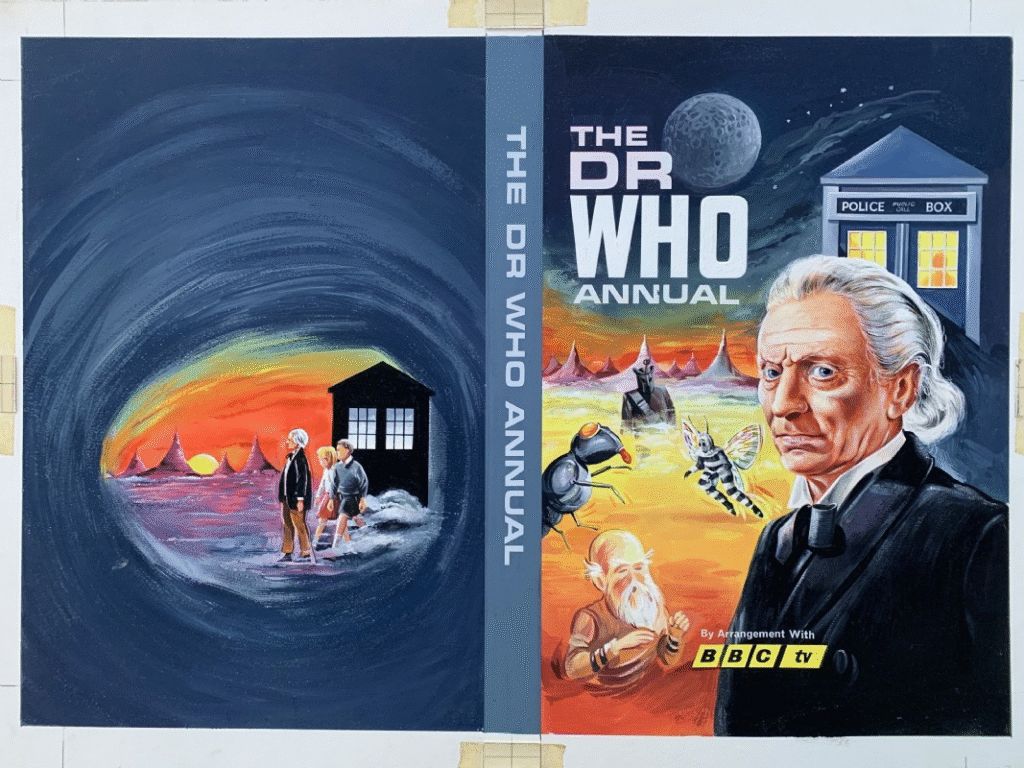
In the past it has been incorrectly attributed by some to Walt Howarth, whose work included work for the Doctor Who, The Lone Ranger, Dempsey and Makepeace and Bonanza annuals and illustrations for Bolton Wanderers programs in the 1950s. He died in 2008.
(Walt repainted some covers in the 1990s, including the cover of the 1971 annual, which he also didn’t do the original of. The signed prints were indicated as “re-paints”, but it’s probably one reason for some confusion on artists).
However it was Stanley Freeman, who actually designed and completed the finished art for both the first “Dr Who” (Doctor Who) annual front and back covers published in 1965, whilst employed by World Distributors Limited, who published the Doctor Who annuals under licence from the BBC.
After education at the Liverpool Institute High School for Boys between 1948 until 1952, Stanley, now retired, himself notes on his inactive LinkedIn profile how his working life began with a five year apprenticeship at a large Liverpool printing company, Brown, Bibby and Gregory, later to be Metal Box Co. in Speke, working as a lithographic designer alongside about 15 senior highly skilled artists, for ten years.
He then moved to World Distributors in 1961, the company later known as World International Publishing after it was acquired by News Of The World.
“I commuted daily from my bedsit in Liverpool 8 via Lime Street or Liverpool Central stations to the WDL building in Lever Street, Manchester,” Stanley recalls. “After enforced sickness absence for a year I returned and took up residence in a bedsit in Crumpsall Lane, Manchester, where I was burgled in the first week, losing my father’s watch, his war medals and even my knives and forks!”
He worked for WDL between 1961 and 1967, and other childrens book publishers on a self employed basis for many years until retirement in 1995 following a stroke. His many credits include art on licenced character properties such as Yogi Bear, Bugs Bunny, and others.
“I was also the artist who designed and completed the finished art of the first Doctor Who annual front and back covers whilst employed by the publishers in the 1960s,” he confirms, as well as puzzle books featuring William Hartnell portrait on each cover.
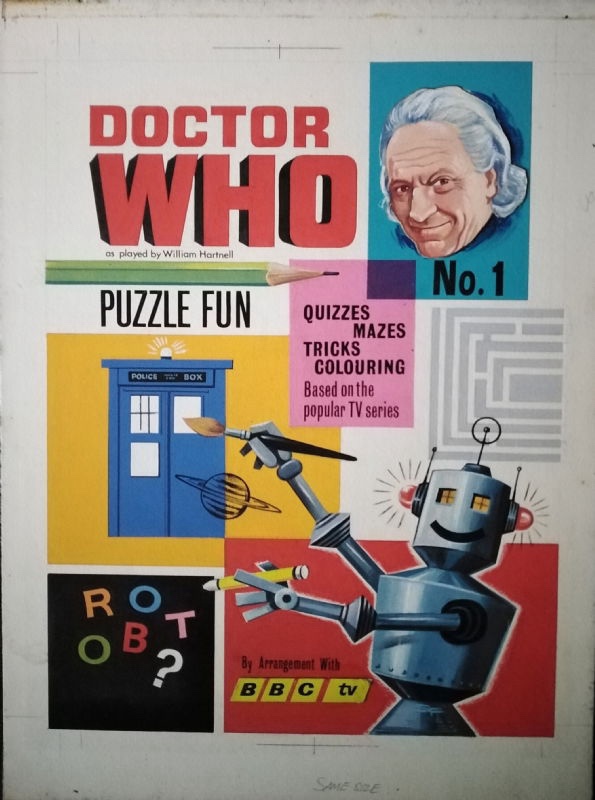
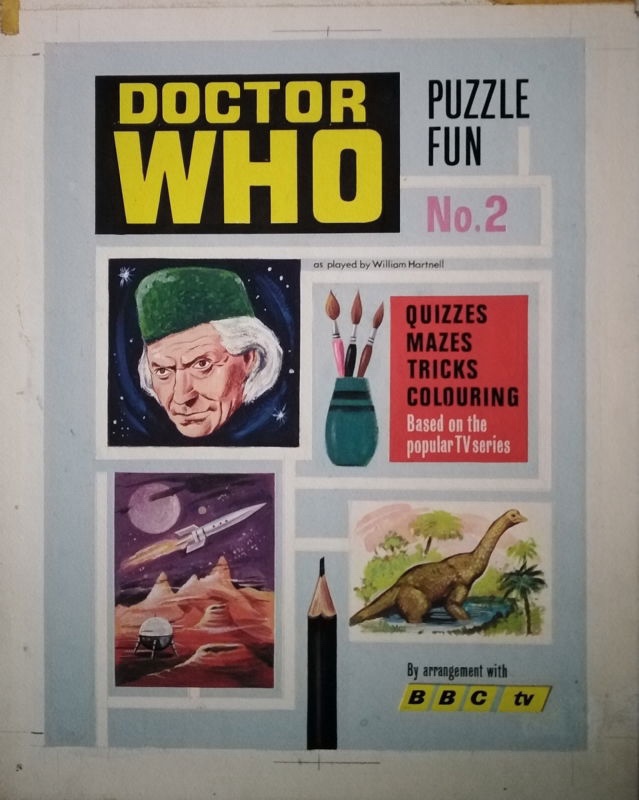
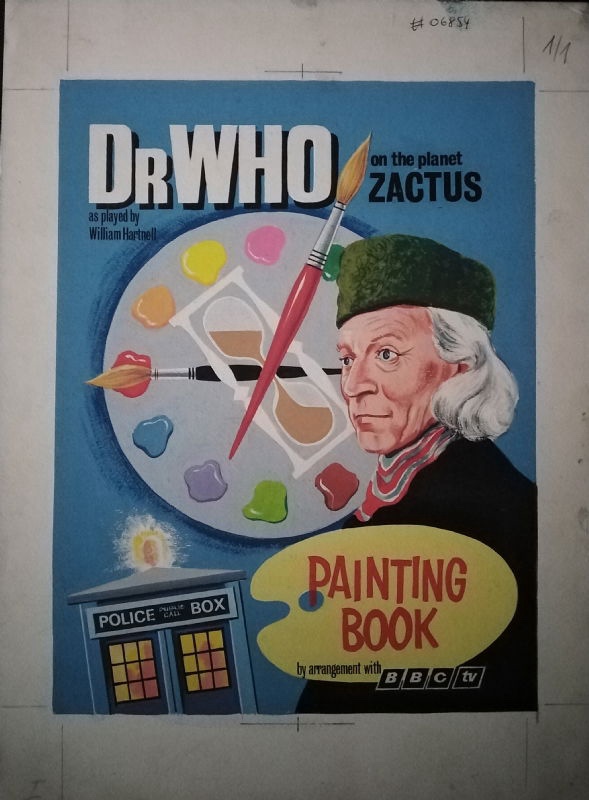
“No credit was assigned for the artist because I was an employee, but I managed to sneak my initials onto the puzzle book cover (SF),” he notes.
After working for WDL, Stanley returned to Liverpool after a while and joined the Liverpool Echo for several years and then Dobson and Crowther printers in North Wales for a year. He then worked freelance from Liverpool for many publishers including Wm Collins, Holland Enterprises, Brown and Watson, Stafford Pemberton and World International and others.

Interviewed by Paul Magrs for his book, The Annual Years, the Obverse Books edition still available, Stanley recalls he created the cover art in early 1964, recalling an initial chat about the commission discussing “a new programme called Doctor Who, consisted of mention of a time machine in the form of a police box, some robots and Menoptera (half butterfly-half man).” A photo of William Hartnell followed in the post.
“I must admit my memory is a bit woolly on the sub-cast on the cover,” Stanley told Paul. “I don’t think, at that time, the Beeb had actually started filming [stories with some of the figures on the cover] and there may have even been a ‘chicken or egg situation’. I am certain I invented the Menoptera from the phrase ‘half man, half butterfly’ in that phone call with nothing else to go on. I never did see the creature later, as I didn’t have a television. They were all kept vague and small in the artwork without much definition because of lack of info about their looks or function. I’ve never heard the other names [of the Zarbi and the Voord].
“This would be in early 1964, and I spent the next few lunch times looking for pictures of a police box in the back street book shops of the city of Manchester, before putting together a largely guesswork annual cover artwork.”
(The actual date of this conversation is in dispute, since Australian writer Bill Strutton did not pitch his idea for what would become “The Web Planet” to Doctor Who producer Verity Lambert until September 1964).

Via a thread on the Mighty World of British Comics Facebook group, British comics archivist Philip Rushton notes that the art used to hang on the wall of the company Directors office at World Distributors, but an order was given when the company ceased in 1990 to skip all the artwork archive.
Group contributor Claire Collins, who worked at WDL, picks up its fate, revealing it was in fact “dumped in the art store with everything else.
“The company didn’t cease in 1990, they moved to new offices in Handforth in Cheshire,” Claire continues. “They ceased trading and were absorbed in Egmont Publishing in 1999. I worked for them between 1977 and 1982 and left when the company was being restructured to become World International.
“When we left we rescued lots of art from Stingray, Space: 1999 and the 1970s Dalek annuals. As I mentioned in another thread, the art was not looked after very well. This also seems to have been to case with art stored by City Magazines and IPC.”
“In my opinion, the stories are much better written than those in any other Doctor Who Annual,” Philip Rushton opines of this early Who tie-in, “lending credence to the claim that the author was none other than the TV show’s original story editor David Whitaker. As a kid I loved this and read it over and over again. I couldn’t wait to receive the second annual next Christmas but found the stories curiously disappointing in comparison.”
Fellow archivist Shaqui le Vesconte notes that research by the Vworp Vworp team suggests at least one other writer contributed stories to the annual.
Doctor Who Magazine Issue 624 is on sale now from all good newsagents, and some run by Zarbi
Head downthetubes for…
• Doctor Who Magazine Official Site
• Comic Art Fans: Matt Carter Collection
• Comic Art Fans: Chris Howarth Collection – Stanley Freeman
• “Doctor Who illustrator dies” by Jane Lavender (This is Lancashire, 15th March 2008 – Wayback Archive Link)
• downthetubes: In Memoriam – Walt Howarth
• Bear Alley – Walt Howarth 1928 – 2008
• Blimey! by Lew Stringer – Walt Howarth R.I.P.
• Mighty World of British Comics Facebook Group
• Doctor Who Comics and Art: A Voyage Facebook Group (run by John Freeman with considerable and appreciated support from Paul Scoones)
Stanley Freeman and John Freeman, publisher of downthetubes, are not related
Thanks to Nick Reiss for added information on Walt Howarth’s “re-paints”
- About the Author
- Latest Posts

John is the founder of downthetubes, launched in 1998. He is a comics and magazine editor, writer, and Press Officer for the Lakes International Comic Art Festival. He also runs Crucible Comic Press.
Working in British comics publishing since the 1980s, his credits include editor of titles such as Doctor Who Magazine and Overkill for Marvel UK, Babylon 5 Magazine, Star Trek Magazine, and its successor, Star Trek Explorer, and more. He also edited the comics anthology STRIP Magazine and edited several audio comics for ROK Comics; and has edited several comic collections and graphic novels, including volumes of “Charley’s War” and “Dan Dare”, and Hancock: The Lad Himself, by Stephen Walsh and Keith Page.
He’s the writer of comics such as Pilgrim: Secrets and Lies for B7 Comics; “Crucible”, a creator-owned project with 2000AD artist Smuzz; and “Death Duty” and “Skow Dogs”, with Dave Hailwood.
Categories: Art and Illustration, Comic Art, Comics, Creating Comics, Doctor Who, downthetubes Comics News, downthetubes News, Licensing, Merchandise, Other Worlds, Television