American independent publisher Comic Strip Appreciation Group has recently published two collections of little known American newspaper strips. Flyin’ Jenny and Ella Cinders, joining its growing catalogue that now includes three Scorchy Smith titles.
Originally on Facebook, the Comic Strip Appreciation Group has grown to an archive of over 100 different rare, obscure or forgotten comic strips from the 20th century. While Stefan Wood has done a bulk of the research, compiling and digitally restoring many of the strips, there are many other contributors to the project.

A 1920s comic strip sensation, Ella Cinders is a jazz age Cinderella who struggles against her mean sisters and tyrannical mother. But with her poorer sibling Blackie, they go from poverty to wealth and back to poverty agains through a series of events and misadventures that define Ella’s life, as she strives to rise above her station and find true love, yet never attaining it.
The strip has previously been documented online by Barnacle Press, Steve Smith describing it as “a female comic strip character with genuine character,” on Panels & Prose, “no small thing in an era of flappers, housewives and career girl stereotypes.”
Some of the strips have also been previously republished by Golden Age Comics, curated by Kari A Therrian, including reprints of some of the Ella Cinders colour comics.

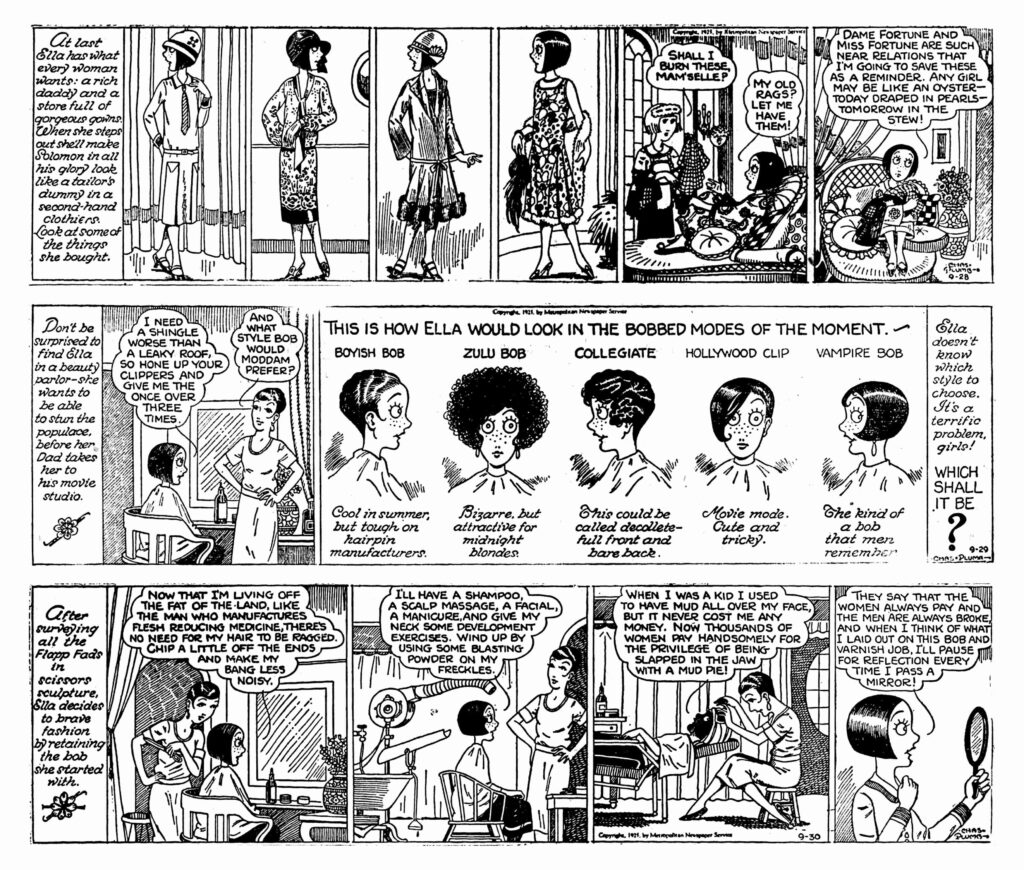
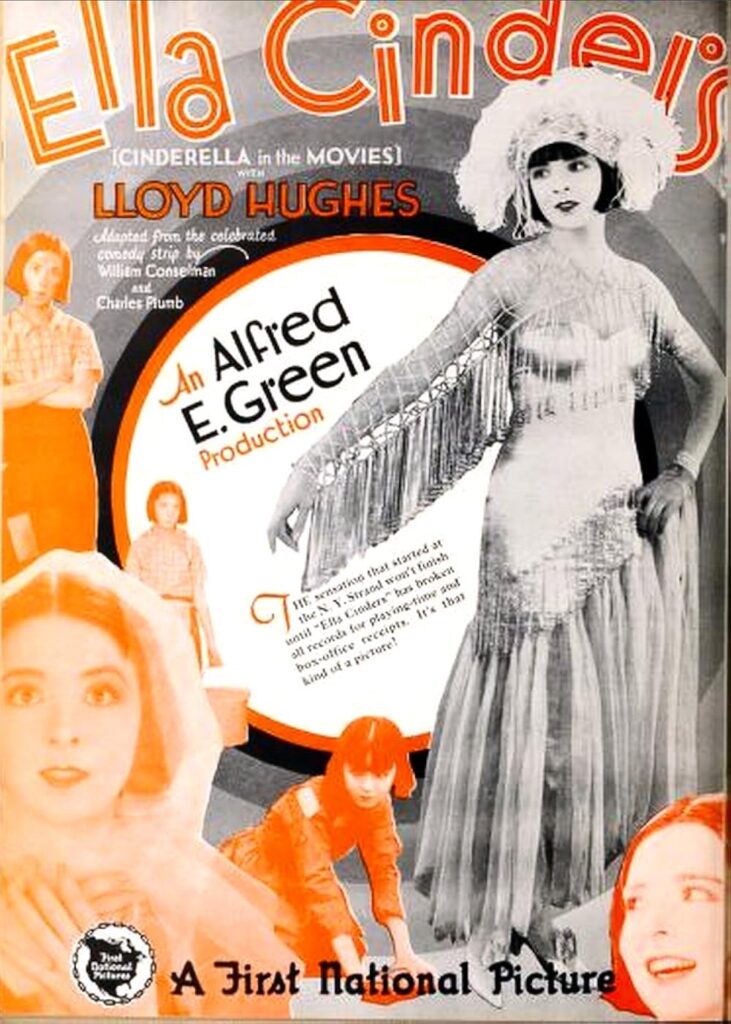
The strip was created by screenwriter William Marien Conselman (10th July 1896 – 25th May 1940, who wrote comics as Bill Conselman) and Charles Plumb (13th November 1899 – 19th January 1982). It proved such a popular feature in newspapers that within a year a movie was made, the first live action feature film based on a comic strip.
The silent film starred Colleen Moore, voted America’s number one box office attraction in a poll of motion picture theatre owners in 1926, directed by Alfred E. Green and produced by her husband John McCormick.

In Ella Cinders 1925 – 1927 Dailies & Sundays, follow her trials and triumphs in this long forgotten strip that was once one the premier strips of its time.
Lambiek notes Charles “Charlie” Plumb co-created “Ella Cinders” together with Conselman, with Fred Fox (26th August 1902 – 27th August 1981) taking over the writing of the strip anonymously in 1940 after Bill’s death that year; who assumed complete control between 1945 and 1961, leaving the artwork during the final year of his tenure to Roger Armstrong.
On 6th October 1930, TIME Magazine reported a close call for the newspaper strip, under the headline “Cinders to Cinders”, noting how the character not only had adventures as a character, but as a being of lines on bristol board as well, Ella has weekly adventures.
“Every seven days she leaves Artist Plumb’s studio in San Gabriel, Calif, and flies with the airmail to Metropolitan Newspaper Feature Service’s distribution office in Manhattan,” the magazine reported.
“Last week Ella had an uneventful flight until she started crossing the Alleghenies. Suddenly, as the plane nosed through a night fog, flames started licking around the bottom of the cockpit. The pilot quickly picked out a pasture, alighted, struck a telephone pole, turned over. By the time Ella was rescued from her charred mail sack, her comic strip was partially destroyed, its wrapper in cinders.
“Shrewdly, Metropolitan released the damaged strips along with the story of Ella’s close call.”
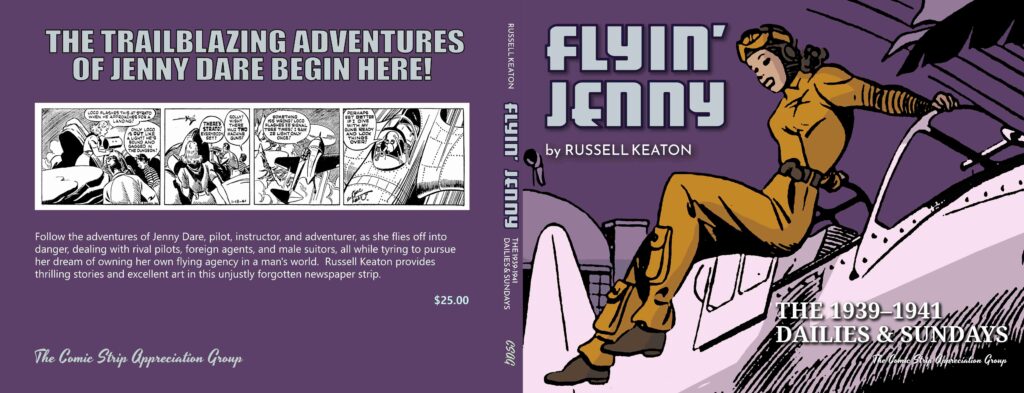
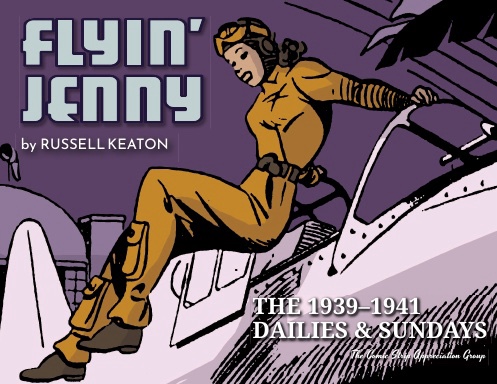
Flyin’ Jenny by Russell Keaton (15th May 1910 – 13th February 1945) follows the adventures of Jenny Dare. Pilot, instructor, and adventurer, she flies off into danger, dealing with rival pilots, foreign agents, and male suitors, all while tyring to pursue her dream of owning her own flying agency in a man’s world. Russell Keaton provides thrilling stories and excellent art in this unjustly forgotten newspaper strip, now collected in Flyin’ Jenny 1939 – 1941 Dailies & Sundays.
Lambiek notes Russell Keaton’s many credits include the Buck Rogers‘ Sunday page from 1930 to 1933. He created Flyin’ Jenny for the Bell Syndicate in 1939 after gaining his pilot’s licence, later handing over the writing of the strip to writer Frank Wead and artist Glen Chaffin. In 1943, when he became a full-time flying instructor, he turned the art duties of the strip over to his assistant Marc Swayze.
Keaton died unexpectedly of acute melanoma, at the young age of 35, on 13th February 1945.
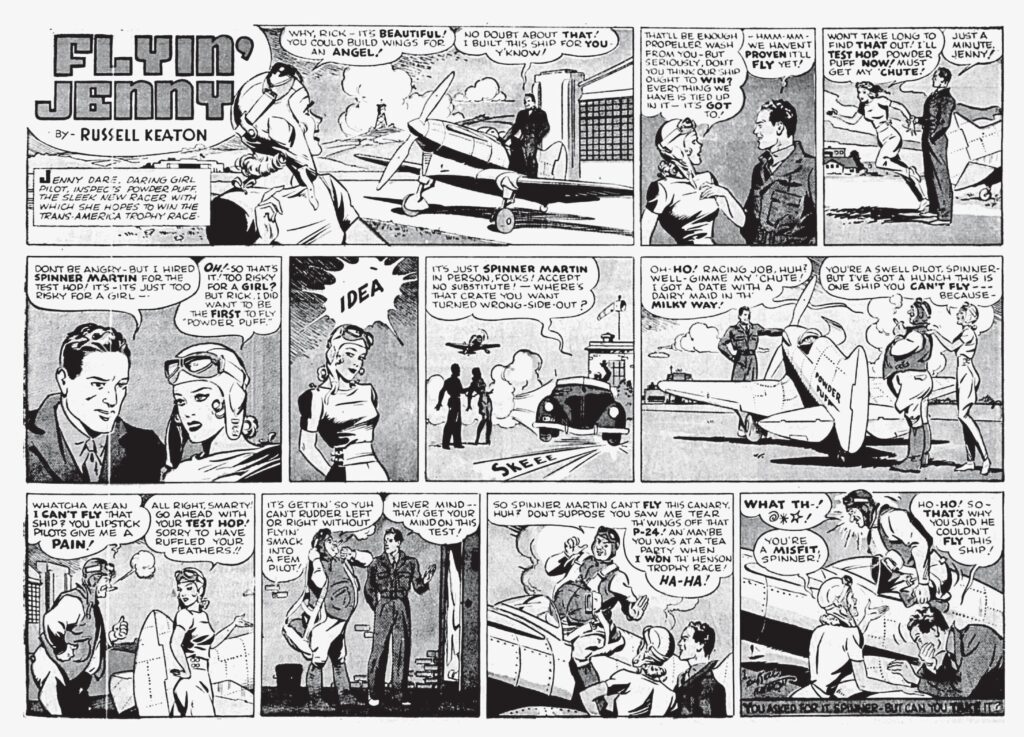

Editor Stefan Wood has been much praised for his dedication to these archive collections, unearthing some strips so obscure they’re almost unknown to comic fans today.
Not unknown is Scorchy Smith, which ran from 1930 until 1961, but later adventures, beyond those drawn by the much admired Noel Sickles, they haven’t gained much attention.

Library of American Comics / IDW Publishing released Scorchy Smith and The Art of Noel Sickles, the work of Dean Mullaney and Bruce Canwell, back in 2008, copies hard to find. Stefan Wood has now published three Scorchy Smith collections to date, also all available via Lulu.com; Scorchy Smith 1936-1938 Newspaper Dailies, featuring art by Bert Christman; and Scorchy Smith 1939-1940 and Scorchy Smith 1941 – 1943, both featuring art by Frank Robbins, who we recently profiled here.
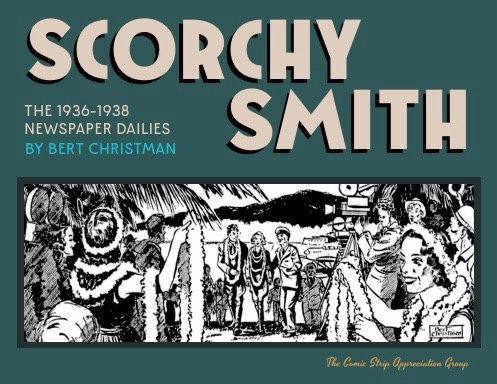


These three collections pick up from Sickles tenure on Scorchy Smith, Bert Christman drawing it for two years, collected in Scorchy Smith 1936-1938 Newspaper Dailies, before leaving to join the Navy and become a pilot, later becoming a member of the “Flying Tigers”; and, sadly, killed in combat.
Concluding his run in 1939, Bert Christman handed the Scorchy Smith reins over to the very capable Frank Robbins.
With an emphasis on action, Scorchy’s adventures run towards the wild and unusual in the stories featured in Scorchy Smith 1939-1940 Newspaper Dailies, from mutiny on a ship, marooned on a deserrt island, pre-World War Two intrigue at home, and even discovering a lost medieval world.


The stories in Scorchy Smith 1941 – 1943 Newspaper Dailies, published last month, find Scorchy in Latin America, trying to disrupt a ransom plot. After a thrilling air duel, he then discovers that a friend is involved in an Axis plot to acquire an advanced aircraft.
Finally, Scorchy enlists, entering the Pacific theatre of World War Two, where he and the native locals fight the Japanese.
These collections are a great opportunity to discover the stories and art from this little-known period of the popular long-running newspaper strip.
Head downthetubes for…
• The Comic Strip Appreciation Group on Lulu
• The Comic Strip Appreciation Group – Blog
• Warbird Forum: Remembering Bert Christman
In need of a replacement for the departing Noel Sickles, management searched their staff of artists for a likely successor. On 23rd November 1936, Bert Christman became the writer and artist of Scorchy Smith…
• On downthetubes: Let’s Hear It For… Artist Frank Robbins
• Panels & Prose: Ella Cinders Deserves Her Moment by Steve Smith
• Barnacle Press: Ella Cinders
- About the Author
- Latest Posts

John is the founder of downthetubes, launched in 1998. He is a comics and magazine editor, writer, and Press Officer for the Lakes International Comic Art Festival. He also runs Crucible Comic Press.
Working in British comics publishing since the 1980s, his credits include editor of titles such as Doctor Who Magazine and Overkill for Marvel UK, Babylon 5 Magazine, Star Trek Magazine, and its successor, Star Trek Explorer, and more. He also edited the comics anthology STRIP Magazine and edited several audio comics for ROK Comics; and has edited several comic collections and graphic novels, including volumes of “Charley’s War” and “Dan Dare”, and Hancock: The Lad Himself, by Stephen Walsh and Keith Page.
He’s the writer of comics such as Pilgrim: Secrets and Lies for B7 Comics; “Crucible”, a creator-owned project with 2000AD artist Smuzz; and “Death Duty” and “Skow Dogs”, with Dave Hailwood.
Categories: Comics, downthetubes Comics News, downthetubes News, US Comics
 Marvel teases pages from upcoming Captain Britain 50th Anniversary Special
  Italy’s Fumettomania Factory celebrates 60 Years of Star Trek
  This Week’s UK Graphic Novel Releases – 7th September 2026
  Star Trek 60th Anniversary Celebration Comic soars into Local Comic Shops this week