A report launched today lays bare the challenges facing creators of comics, revealing a landscape of financial instability and chronic overwork, even as the sector itself enjoys increasing commercial success.
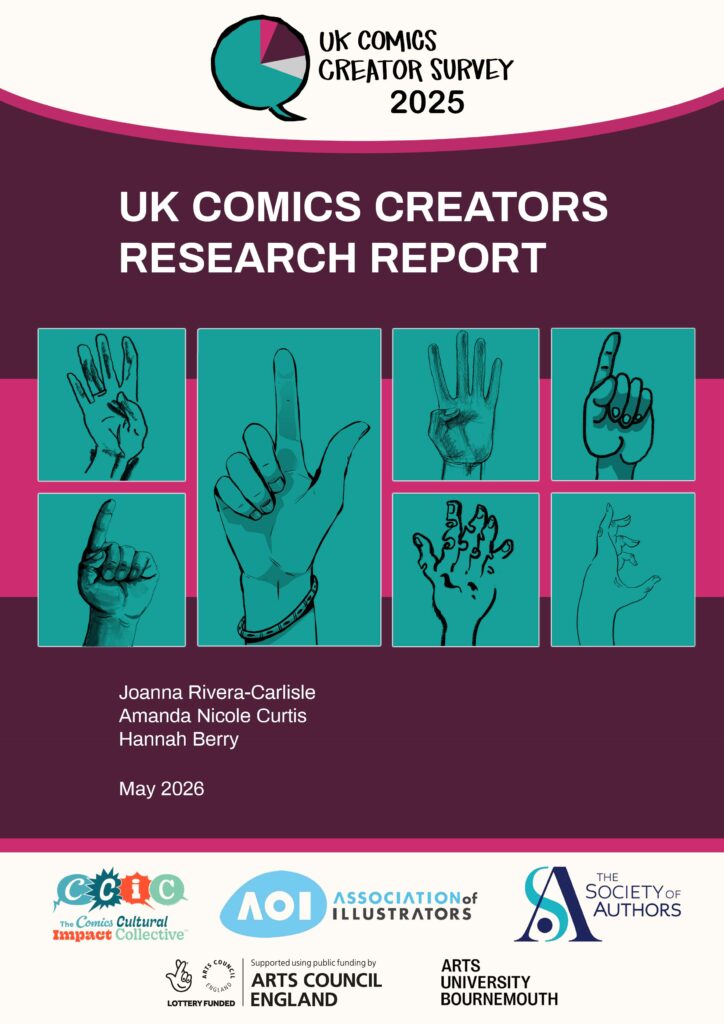
The UK Comics Creators Research Report presents findings from a survey run last year by the Comics Cultural Impact Collective, the Association of Illustrators and the Society of Authors, that indicates many comics creators who responded are struggling to make a living from their art.
689 members of the UK comics community aged over 16 who produced or were producing work for public audiences were invited to participate in a digital survey that was used to provide the data for the Report.
Of the respondents, 166 indicated they intended to have a career and actively seeking opportunities to earn money from their comics work (24%): 201 were at the “emerging stage” of their career, earning some money from their comic work (29%), 162 had and established career, the majority of their income coming from their comic work (24%), while 95 were amateur/hobbyists, not intending to earn money from their comics work (14%). 45 were other careers based (7%), and 19 other non-career based (3%).
The opinions represented in this survey largely reflect those of professional comic creators, over two thirds of respondents,, with some perspectives of publishers, university lecturers, and community organisers offering insights into other parts of the industry.
The findings indicate almost 90 per cent of those respondents who earn an income from traditional publishing do not earn the national living wage from their comics work, and 13 per centare relying on state benefits.
This is set against a picture of an industry which is gaining cultural visibility and seeing a dramatic increase in sales.
The report includes figures from the NielsenIQ BookScan, showing that in 2025 the UK comics market reached its highest-ever total sales, making £78.7 million, an increase of 13.9% from 2024.
Children’s comic strip fiction and graphic novels hit £25.9 million – a 28.7% increase on the previous year, and the biggest sales year the category has ever recorded in the UK.
As comics and graphic novels have become increasingly popular, the organisations involved in the survey note there has also been a growing recognition of their role as an accessible and welcoming way into reading. 2026 is the National Year of Reading and comics play a key part in the campaign, providing a vital tool for engaging children and young people.
But while the sector is booming, the landscape for creators is increasingly precarious, the report suggests. Alongside low pay, comics creators are experiencing rising pressures on their time, as they juggle multiple jobs and administrative tasks, as well as rising costs. Other challenges include the threat from AI and the lasting impact of Brexit.
And, despite their growing status, comics still receive negligible public investment compared to other art forms in the UK.
As the report puts it, the medium is thriving but “the people who make comics thrive are, more often than not, struggling to survive”.
To address this, the report makes seven core recommendations for funders, policymakers and industry bodies, including developing comics-specific vocational training and apprenticeships, creating practical guidance resources, and recognising comics as a cultural art form in UK policy.
“The results from this survey provide insightful data into the working conditions and pay of comics creators.”
– Anna Ganley, Chief Executive of the SoA

Hannah Berry, an award-winning comics creator and former UK Comics Laureate, who led the project, said: “This is an industry that needs urgent attention, and finally — amid an exciting artistic gold rush, glittering with potential for shiny new works to reach delighted new audiences — it might just receive it.”
Anna Ganley, Chief Executive of the SoA, said: “The results from this survey provide insightful data into the working conditions and pay of comics creators. This report is valuable and timely as improving contract terms is a current high priority area for the SoA. Comics creators aren’t spared by the AI threat, and this report is another reminder that urgent action is needed from Government to protect our world-leading creative industries.
“Comic creators are a core part of our creative industries and should be recognised and supported as such by being provided with access to funding. Tailored support from DCMS and Arts Council England would help to ensure that comics creation is a sustainable creative career.”
Josie Dobrin OBE, Chair of the AOI, said: “Comics are a rapidly growing part of our creative industry, yet this report clearly demonstrates that many creators are not sharing in the success of this growth. We urgently need to address the gap between a booming market and the reality of low pay, insecure work and increasing pressures experienced by many comic artists.
“By bringing these experiences together, the report strengthens the case for meaningful action – from fairer funding and recognition, to targeted support to make comic creation a sustainable career. Comics are playing an increasingly important role in engaging readers and reflecting our society, so it’s time that the people behind them are properly valued and supported.”
• Read the report in full here Home – UK Comics Creators Survey
• Over the coming weeks there will be a series of online roundtable discussions, open to everyone working in and with comics, to work out next steps. To be kept notified of upcoming events, join the CCIC mailing list
UK Comic Creators Research Report 2026: Key Findings
- Comics creators are significantly more diverse than the UK population and creative industries in several areas: 13% are non-binary; 42% are LGBTQ+; 25% are disabled; 44% are neurodivergent…
- …Except for ethnicity, where 89% are white (compared to 82% nationally);
- Only 1/5 of respondents who want comics to be their career earn the majority of their income from comics;
- 89% of creators earning from traditional publishing make less than the UK National Living Wage;
- 72% rely on employment outside of comics (freelance, temporary, fixed-term or permanent);
- 13% are relying on UK state benefits (up from 9% in 2020);
- 63% of respondents cited ‘lack of financial income’ as a key challenge (being the main challenge for 28%);
- 57% cited ‘lack of time to create’ as a key challenge (being the main challenge for 25% of respondents);
- Only 4% of creators use GenAI in their comics production, but 36% believe or know they have lost work or income due to GenAI;
- Only 6% of respondents received public funding from arts councils; 4% from Arts Council England, 2% from Creative Scotland, and none at all from Arts Council Wales or Arts Council Northern Ireland.
• Read the report in full here Home – UK Comics Creators Survey
- About the Author
- Latest Posts

John is the founder of downthetubes, launched in 1998. He is a comics and magazine editor, writer, and Press Officer for the Lakes International Comic Art Festival. He also runs Crucible Comic Press.
Working in British comics publishing since the 1980s, his credits include editor of titles such as Doctor Who Magazine and Overkill for Marvel UK, Babylon 5 Magazine, Star Trek Magazine, and its successor, Star Trek Explorer, and more. He also edited the comics anthology STRIP Magazine and edited several audio comics for ROK Comics; and has edited several comic collections and graphic novels, including volumes of “Charley’s War” and “Dan Dare”, and Hancock: The Lad Himself, by Stephen Walsh and Keith Page.
He’s the writer of comics such as Pilgrim: Secrets and Lies for B7 Comics; “Crucible”, a creator-owned project with 2000AD artist Smuzz; and “Death Duty” and “Skow Dogs”, with Dave Hailwood.
Categories: British Comics, Comics, Creating Comics, downthetubes Comics News
 Tube Surfing: British Comic Kickstarters, Our Latest Top Picks
  Cosmic Lighthouse “Murderbot” graphic novel tie-in smashes crowdfunding target
  Whatever Happened to Amalgamated Press Art Editor Lionel Morgan?
  Young Comics Maestro 2026 Winners: Full Details