The fate of the free world hangs in the balance as Gen. Dwight D. Eisenhower and Capt. James Stagg face an impossible choice – launch the D-Day invasion or risk losing World War II altogether.
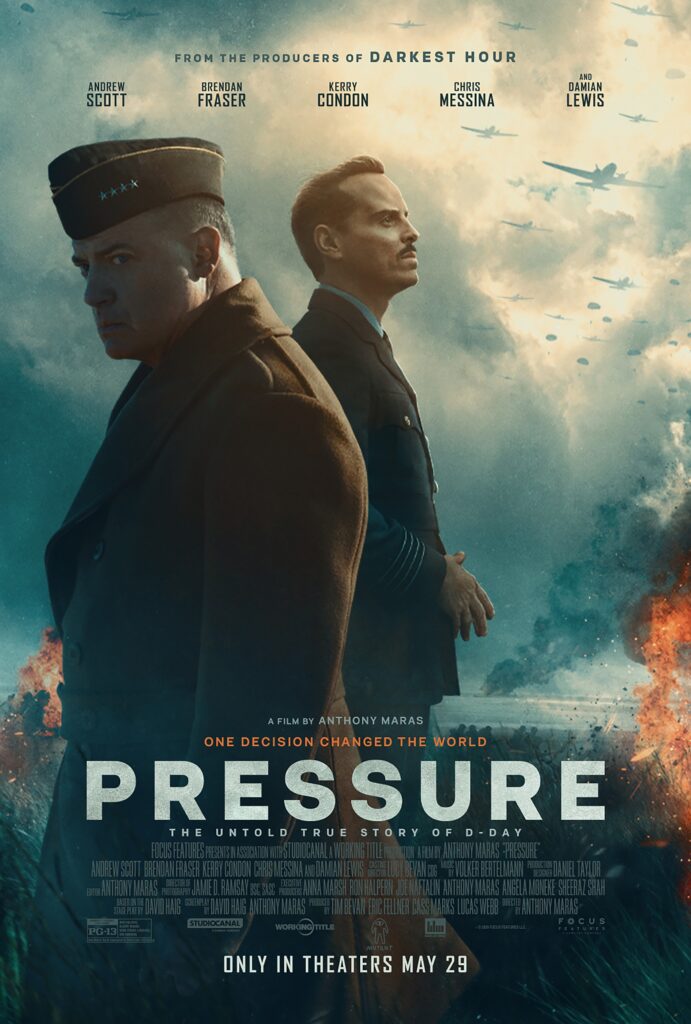
Review by Tim Robins
Of course I saw Pressure. Why wouldn’t I? The film combines two national obsessions – World War Two and the weather. The titular ‘Pressure’ refers to the forces bearing down on those responsible for green-lighting the invasion Nazi Occupied France – the ‘D-Day’ – while also alluding to the crucial importance of barometric pressure in forecasting the weather.
With mere days before the intended date of June 5, 1944, an American weathercaster, Colonel Irving P. Krick, predicts the day will be good to go, but the British weathercaster-in-Chief, group Captain James Stagg, is not so sure. Although Stagg was recommended for his position by Winston Churchill, he is, nevertheless, under the command of US Army General Dwight D “Ike” Eisenhower, the Commander for Operation Overlord – the allied invasion of German occupied Western Europe.
As a physical geographer once told me, “Winds blow from High to Low” Stagg notes that incoming data suggests a Low Pressure front is about to drag two enormous storms over the Channel. He predicts that the landing force will be devastated if they set sail on the proposed date. His American counterpart disagrees, predicting the low front and its attendant storms will dissipate as it has done many times in the past. Pressure is, therefore, a battle on many fronts.
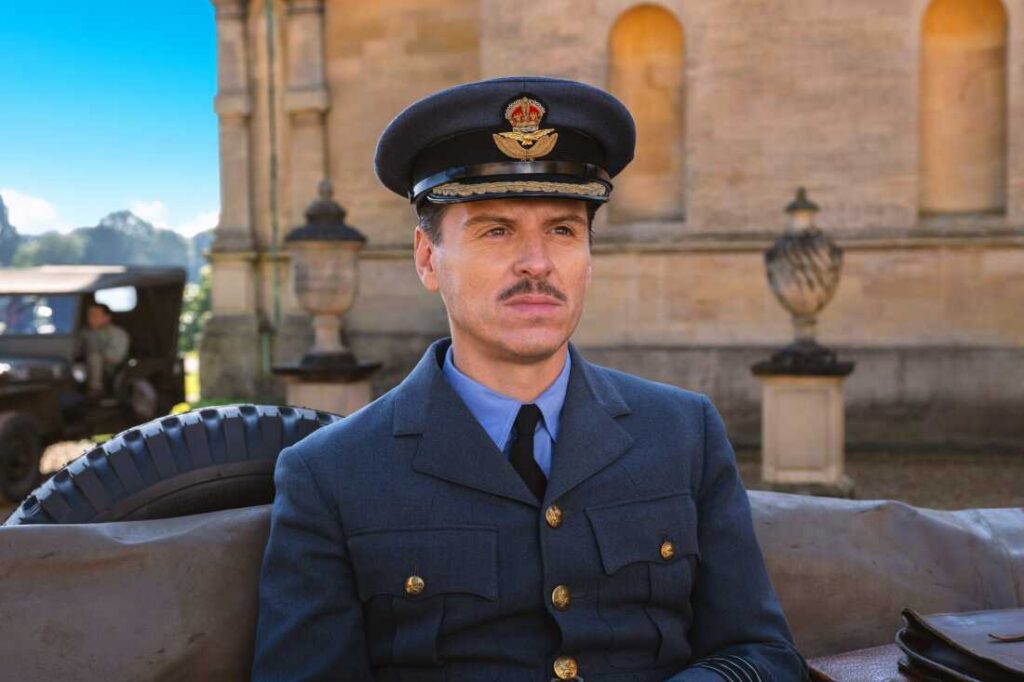
The film is co-written by its director, Anthony Maras and David Haig. The latter wrote the original, 2014, stage play and it is easy to see how it would work on the stage. It is not hard to imagine Haig’s play would work on the stage. That said, the play has been sensitively extended for film with the use of pertinent locations.
Mentmore Towers of Batman Begins, Eyes Wide Shut, The Mummy and Johnny English fame stands in for Southwick House, a 19th century manor house located several miles north of Portsmouth, whose owners were recently served with a Repair Order. Southwick House became the Headquarters for the Supreme Headquarters Allied Expeditionary Force (SHAEF), after their base was damaged during the bombing of Portsmouth Harbour.
In the film, Camber Sands, East Sussex, stands in for the Normandy beaches. Interestingly, the three mile beach was used for training exercises during World War Two. Slapton Sands in Devon were actually used as the site of rehearsals for D-Day.
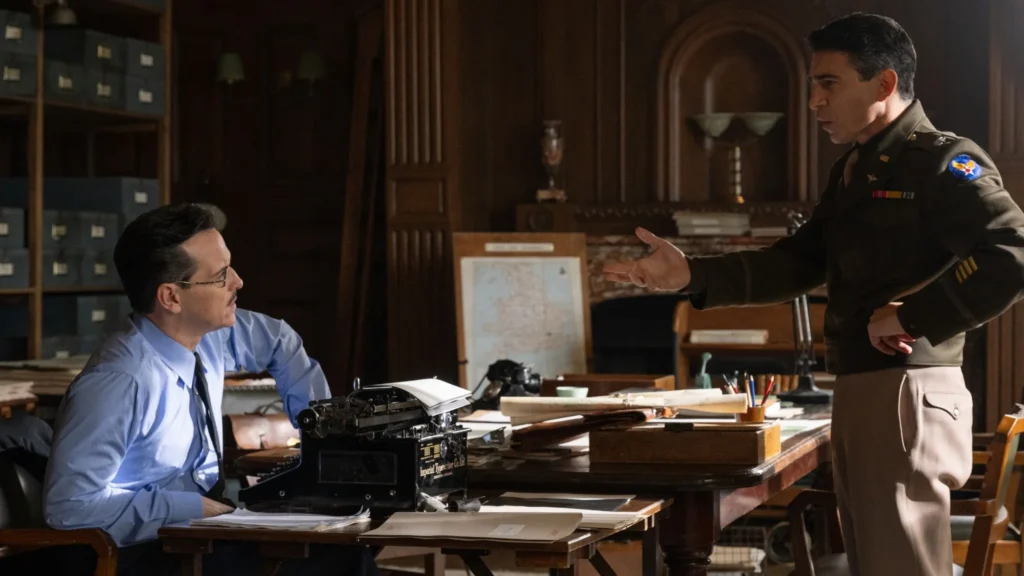
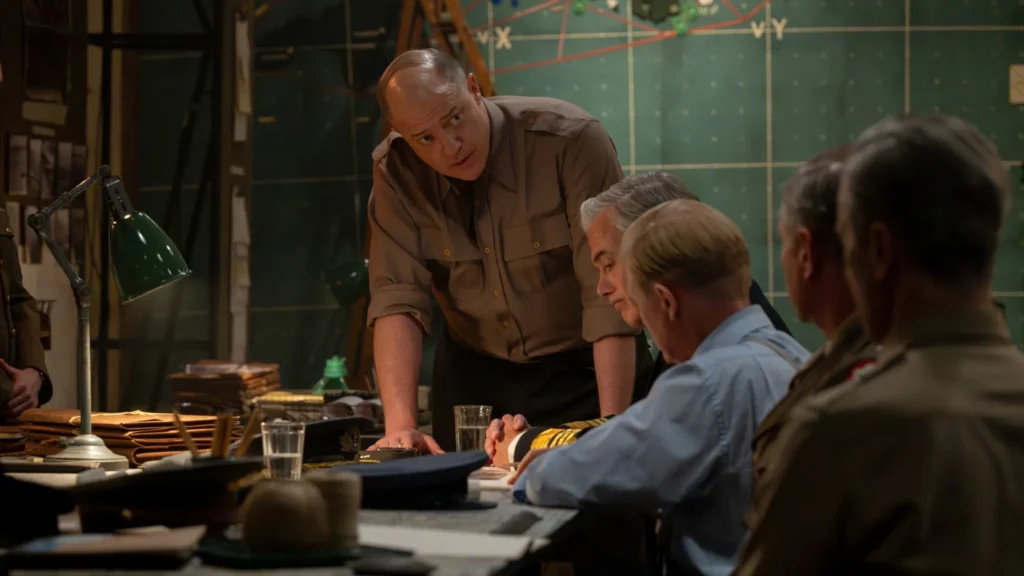
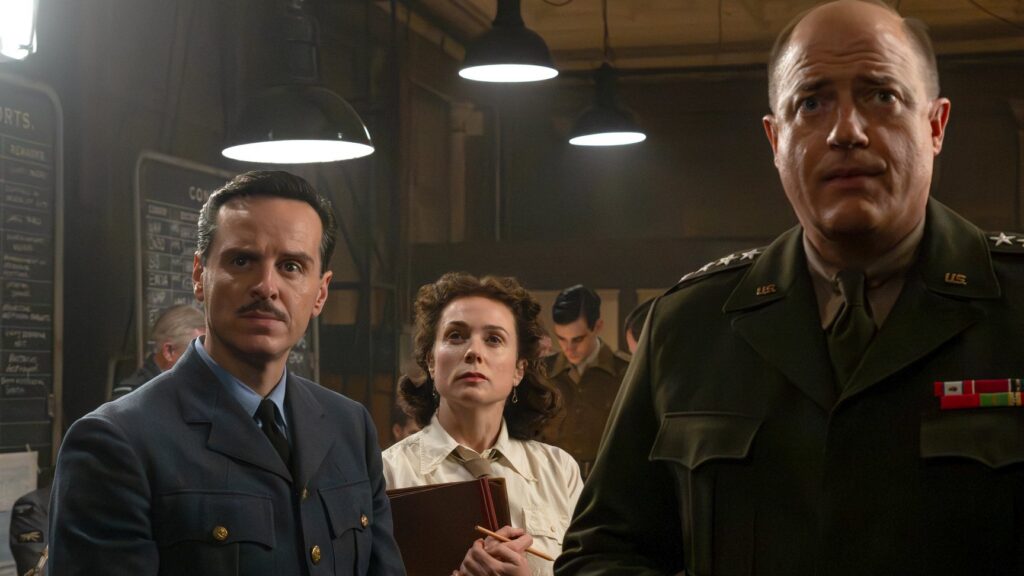
The final decision to invade lay with Eisenhower who found himself faced with competing forecasts. No Pressure then. For the film, Eisenhower is played by Brendan Fraser, making a welcome return to the big screen. BAFTA award winning Andrew Scott, of Sherlock’s Moriarty (2010-17) fame, plays Group Captain Stagg. Chris Massina plays the American meteorologist, Colonel Irving P. Krick.
Scott and Messina play up to National types – Scott’s Stagg is a loner, Messina’s Krick is brash, over confident and very much one of the boys. Stagg arrives to find the base of operations is awash with ill-considered revelry and an optimism he can only read as sheer hubris. Their performances embody National stereotypes but without being cartoonish.
Between the meteorologists and Eisenhower, stands First Lieutenant Kay Summersby, as played by Kerry Condon. The actress is probably best known for her stage work which includes two stage plays by Martin McDonagh, The Lieutenant of Inishmore and The Cripple of Inishmann, and Ophelia in Hamlet for the Royal Shakespeare Company.
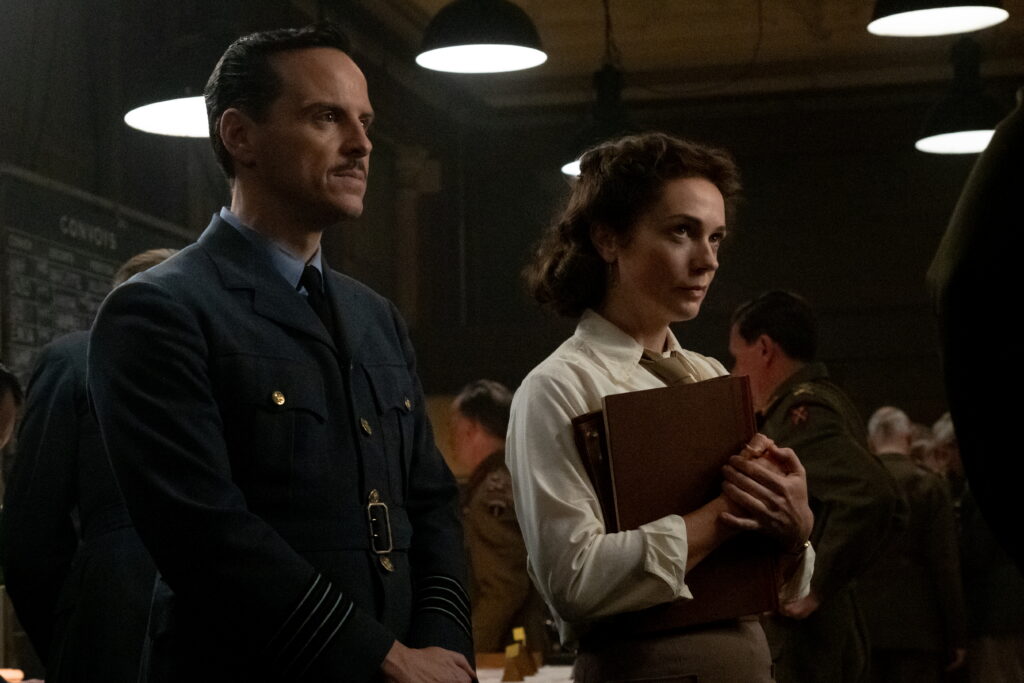
At first, Condon’s role, as Eisenhower’s private secretary and confidante, seems only to demonstrate that the macho world of meteorology, let alone planning an invasion, has no place for a woman – at least in the eyes of the male officer class. In the end, her importance lies in being a good listener, although her special pleading to Eisenhower on behalf of Stagg seems to fall on deaf ears.
At the edges of the picture is Stagg’s pregnant wife, Liz (Tamsim Topolski). Her function in the script seems to be to add to be a source of emotional pressure. Early on, Stagg gets stick for trying to phone her from the strictly enforced seclusion of Southwick House.
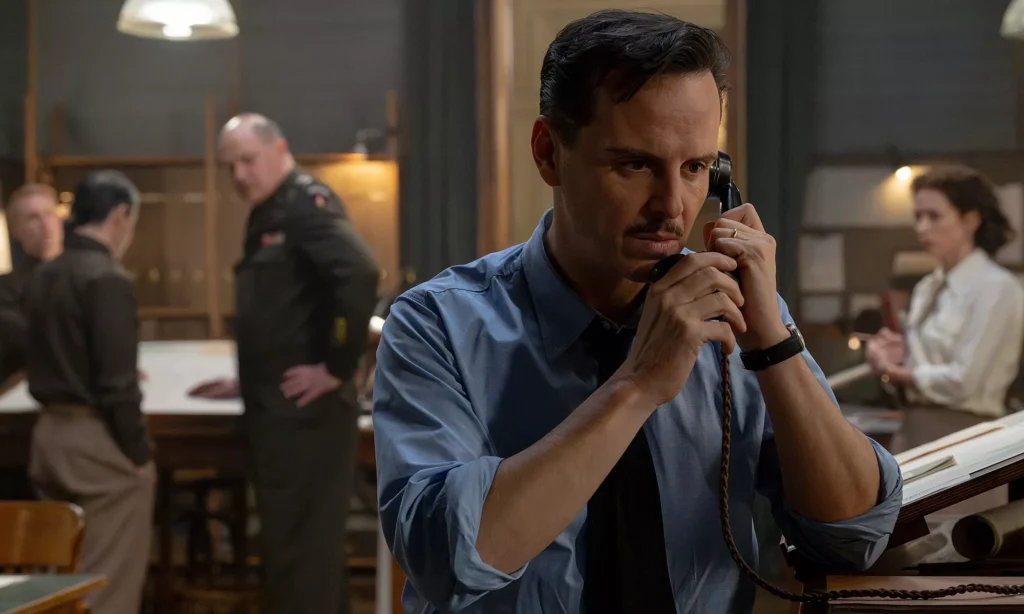
In the film, women are, among other things, represented as agents of potential chaos. So, in the middle of a crucial meeting, an incoming phone call informs Stagg that his wife had to be moved to a hospital that ended up being bombed. There is no news whether or not she survived. Stagg, standing in front of top brass, takes the call, but has no choice but to dismiss the contents of the phone call.
Reflecting on this predicament, I can well imagine that, if Stagg were to acknowledge the news, its potential impact might well be seen to undermine his ability to make rational decisions, at least in the eyes of the attending officers. This predicament is made worse by the fact, as Stagg acknowledges, the officers don’t actually like him.
The quiet stoicism that defines Stagg’s personal and domestic life also serves in deliberate contrast to the noisy, boisterous letchery of the American troops. We see them dancing and singing along to, for example, The Andrew Sisters’ Boogie Bugle Boy and Cab Calloway’s ‘Hi-De-Ho’. Sadly, the latter is the main contribution people of colour make to the story, sad too that it serves as a sign of licentiousness.
Pressure is also a memorial to the war and a celebration of the defining qualities of being British. Wresting a story from the chaos of history needs more nuance than often seen here, particularly because D-Day serves as a defining moment in the history of Britain and definitions of Britishness itself.
It is important to recognise the ways Pressure’s story has been constructed, what and who the film includes, marginalizes and excludes. For example, following the stage play, the drama omits the contribution of Charles Douglas, a senior civilian meteorologist with the British Met Office.
The play also neglects the work of the distinguished Norwegian meteorologist, Sverre Petterssen By 1944, his career had included being invited to be MIT’s Head of the Meteorology department at MIT and he had already served as a weather forecaster for bombing raids and special operations. Crucially, Pettersen is most remembered, but not here, for actually persuading Eisenhower to change the date of D-Day and giving much needed gravitas to the judgement of Stagg.
I recognise historical dramas are selective and otherwise invented traditions, but today’s cinema is more than capable of including a wide variety of people, times and places. Where I am happy to simply dismiss a biopic such as the God awful Bohemian Rhapsody (2018) for its many, many inaccuracies, I wanted Pressure to be fit for purpose, not in need of mitigation.
Where the film succeeds is in being a clever drama about, for example, the nature of science. Colonel Patrick is shown to use an inappropriate method for predicting weather over Europe. His forecast extrapolates the predicted weather on D-Day by comparison with the past, a method challenged by British Empiricist David Hume, for whom the past is not a guarantor of the future so that day does not inextricably follow night.
The American is shown as guilty of confirmation bias by excluding years when the weather contradicted his predictions. On top of this, the accuracy of his predictions mistakenly rests on a failure to compare like with like: the weather systems around North Europe are more unstable than those of North Africa, where he gained his reputation for accurate predictions.
The film also touches on a conflict between Faith and Science, albeit very lightly. As the entire command spends Sunday at prayer, Stagg sits under a tree some distance from the church. The central role of these scenes is to dramatise Stagg’s distance from the military. He stubbornly refuses to engage in peremptory celebration. Science speaks to him in a voice louder than the pressure to conform. Hymns are not different to Stagg, than the popular songs beloved of the American troops.
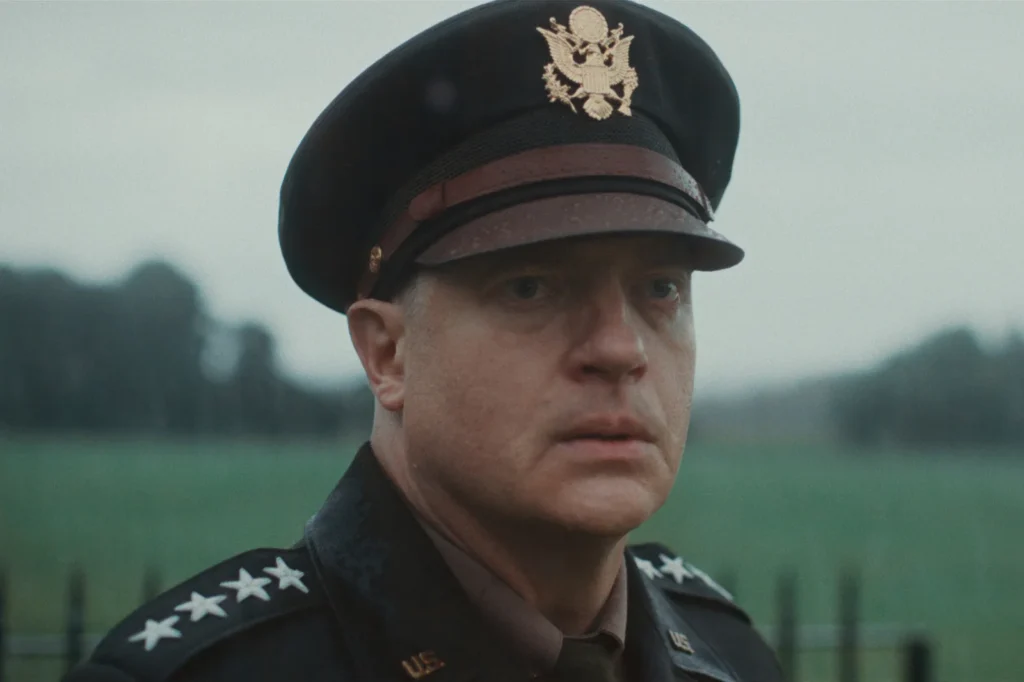
Then, during the service, the Heavens open up. Now outside the church, Eisenhower stares at Stagg through the sudden downpour of rain. The storm Stagg predicted has come to pass, but the distance between the two men stand, physically dramatises the tension between experience, authority, status and country. As for God, he seems to favour English Empiricism over American enthusiasm.
What Stagg hasn’t seen is the price for any mistake, but Eisenhower has. He witnessed the cost of his disastrous decision to authorise the use of real bullets for the Operation Exercise Tiger, a D-Day training exercise that led to injuries of many of those involved. Worse, an Allied convoy preparing for the mock landing was attacked by Nazi E-Boats. At least 749 American servicemen were killed. The incident was, of necessity, kept secret.
So Eisenhower knew full well that, as a Supreme Commander, he held a tiger by the tail. No matter what the meteorologists told him, he has the ultimate responsibility to go or not go. Fraser’s performance is one of the film’s subtler achievements. We may start by seeing the officer as a blowhard pragmatist, but by the end we see him as a man deeply troubled by the weight of experience and the lives he holds in his hands.
Pressure arrives at a time when Portsmouth has again been a location where definitions of Britishness are being contested. For all its difficulties as a work of social memory, the film provides a resource for hope in recalling a time when we triumphed over the invasive force of the Far-Right.
Tim Robins
Pressure is in cinemas now
Head downthetubes for…
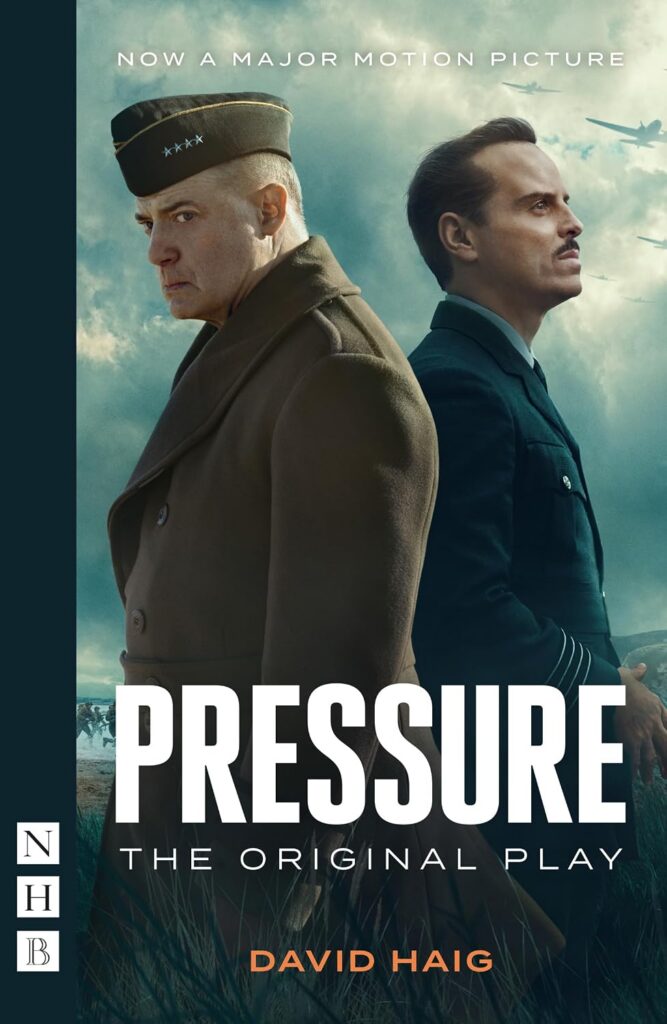
• Pressure: The Original Play by David Haig (AmazonUK Affiliate Link)
A special tie-in edition published alongside the film’s release in 2026. Featuring David Haig’s original play, along with an exclusive introduction from him about the play and film, insights from the filmmakers and colour production photographs.
• Sverre Petterssen is the writer of two important books there: Weather Analysis and Forecasting (first published in 1940) and Introduction to Meteorology (1941)
- About the Author
- Latest Posts

A freelance journalist and Doctor Who fanzine editor since 1978, Tim Robins has written on comics, films, books and TV programmes for a wide range of publications including Starburst, Interzone, Primetime and TV Guide.
His brief flirtation with comics includes ghost inking a 2000AD strip and co-writing a Doctor Who strip with Mike Collins. Since 1990 he worked at the University of Glamorgan where he was a Senior Lecturer in Cultural and Media Studies and the social sciences. Academically, he has published on the animation industry in Wales and approaches to social memory. He claims to be a card carrying member of the Politically Correct, a secret cadre bent on ruling the entire world and all human thought.
Categories: Features, Film, Other Worlds, Reviews
 In Review: Terminator 2: Judgement Day
  In Review: Leviticus
  In Review: The Dog Stars
  In Review: Coyote vs Acme
Leave a Reply