An isolated border village in Hope Harbour, South Korea, near the Demilitarized Zone, faces an unfolding extraterrestrial invasion. The narrative shifts perspectives to make the alien invaders the protagonists.
Review by Tim Robins
SPOILERS AHEAD
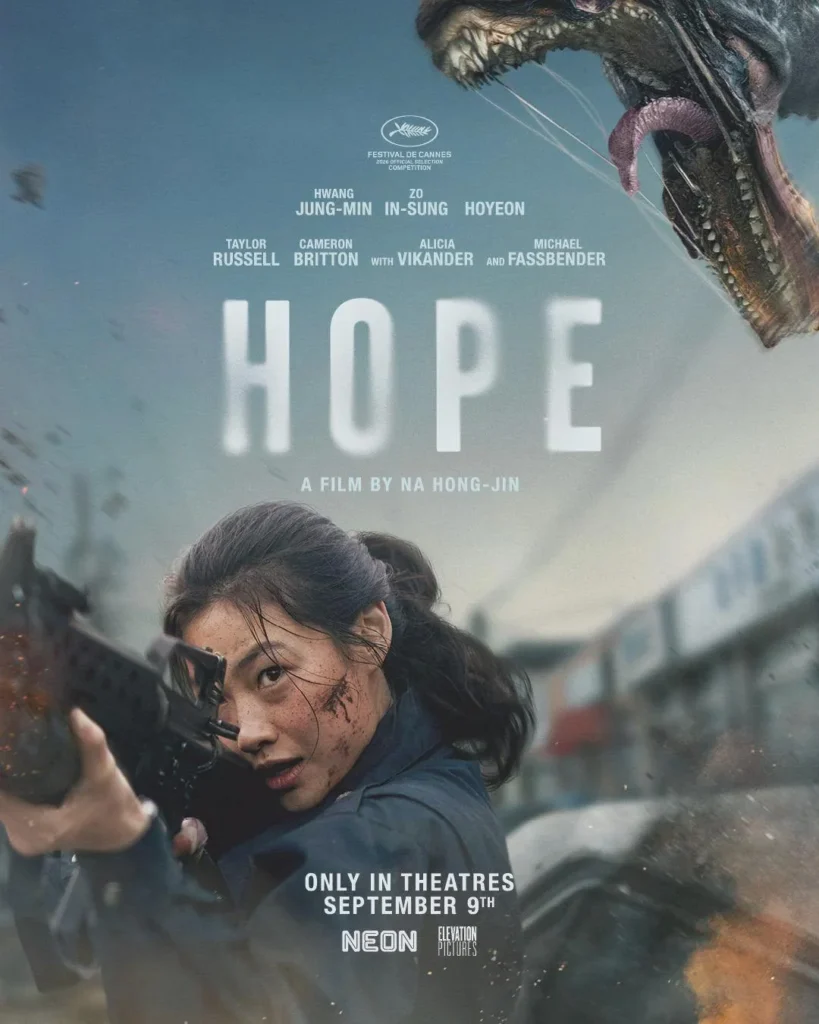
Hope? Nope. I’d like to leave it there, but I expect you want more. And there certainly is more, so very, very, very much more.
The first thing you have probably learnt about Hope is that, with a budget of around $46m (KRW70bn), the film is, to date, the most expensive to be made in South Korea. By Hollywood standards the money is not that great, but what money there was is certainly up there on the screen.
Hope is written, directed and co-produced by Na Hong-Jin, whose accolades include The Yellow Sea (2010) and The Wailing (2016), the latter gaining him Best Director at the 37th Blue Dragon Film Awards, Seoul. This year, Hope (2026) was screened at the main competition section of the Cannes Film Festival. So the film comes with a weight of expectation and flamboyant aspirations to take on the international film marketplace.
In the West, there is an enthusiastic following for South Korean cinema. I saw Hope at a Picturehouse cinema, the Duke’s at Komedia, that often screens fairly popular fayre. Since booking tickets (thanks to Piper Murray), the film had been moved to the larger of the two screens and even then the screening was packed. And hot. So very, very hot. It was exhausting, and, by the end, I was told that I had become visibly irritated.
The story opens with a gathering of huntsmen around a mutilated corpse of a cow. Suggestions for the attacker include a bear or, even a tiger(!), as a gullible police chief, Ko Bum-seok is led to believe by sniggering locals. Of course, mutilated cattle are a sure sign of alien activity.
Bum-seok’s main concern is bureaucratic – none of the hunters who called him, including his second cousin, have permits for their guns. This becomes a running joke. As the film progresses, Bum-seok constantly meets members of various ad-hoc militia all armed with more and bigger weapons, all similarly without permits.
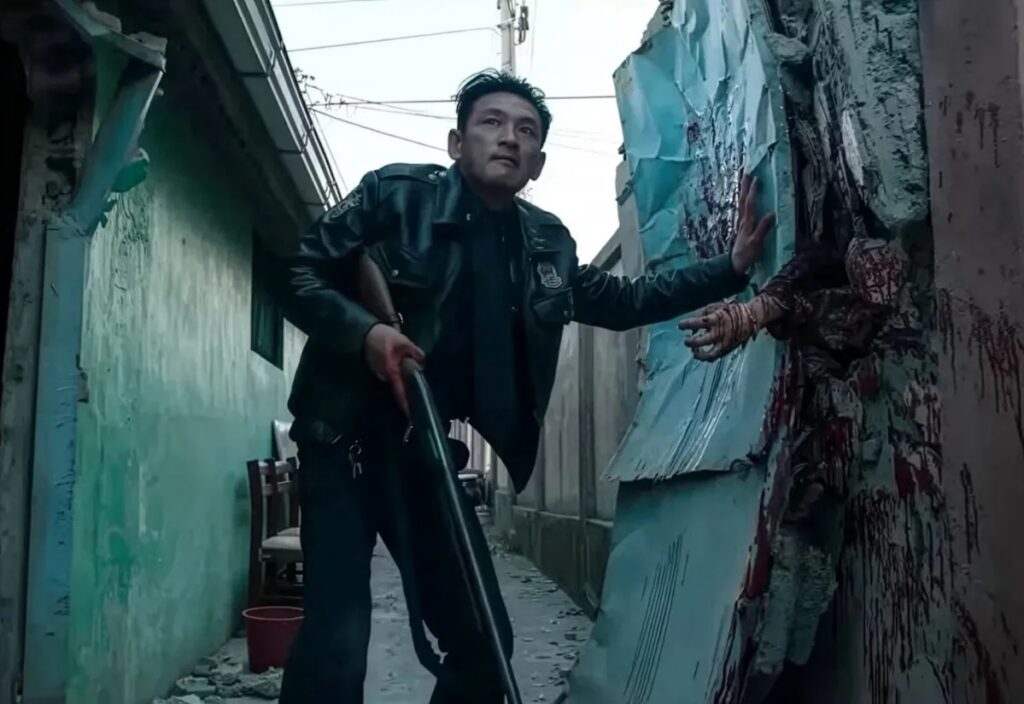
Returning to Hope, an isolated port with a local industry based around fish and cattle (think Newhaven, East Sussex, but without the cows and cabbages), the Police Chief finds it besieged by a monstrous something that is crashing its way through the walls of buildings.
Whatever the force is, it is kept out of sight: just over walls or in distant side streets. There’s a whole lot of running going on – away from something, towards something and, eventually, along the side of something. Bum-seok finally gets to look the creature in its eye, only to see it is crying.
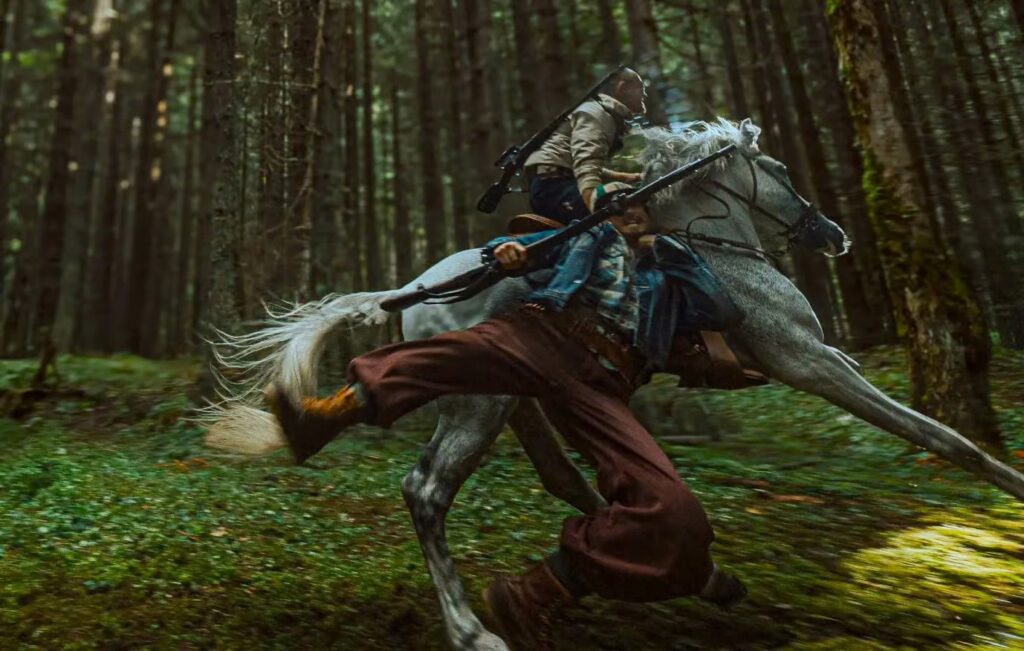
A break in the running around, gives us a chance to learn something of how the creature came to town and there are others of its kind, outside of town, in a forest. Soon, we’re ducking and diving among the lush flora of what looks to be a temperate rain forest – lots of big leafed, deciduous trees and lime green mosses, typical of Korea’s southern peninsula.
After a run and shoot-’em-up between a human posse and the monstrous whatever-they-are, we discover all may not be as it seems. The attack on Hope may have been provoked by one of the town’s residents. Whatever the plot twists, the outcome is the same – more running. I was reminded of Alice Through the Looking Glass – you need to run really fast just to stay still.
The film has been described as “gonzo” in style and content (The Guardian said of the film that it is “non-stop gonzo alien battling is top-quality entertainment” and Empire as “The most gonzo film of the year”). The term may have originated from the Italian ‘gonzo’ meaning foolish, but, in the 1970s, gonzo was applied to a style of fictionalised, exaggerated, subjective journalism exemplified by the articles of, in particular, Hunter S. Thompson. Does this really describe Hope? Maybe. But maybe the context is being missed.
Much like the new Resident Evil (2026) movie, Hope evokes the experience of playing video games. But this time out, what’s replicated is the sheer length of time it can take to move from one level to another. The film indulgently takes time exploring the ruined town. When shoot outs take place, they go on and on. The monstrous adversaries sponge up bullets and bombs alike.
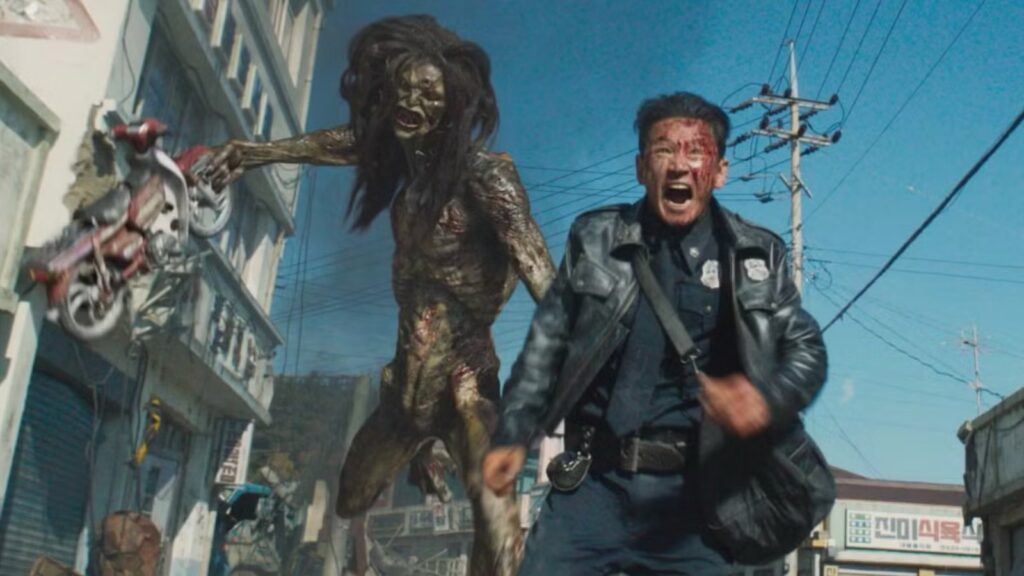
I found the tone of the film frustrating. Many of the characters could best be described as goofy. Hwang Jung-min plays the hapless Police Chief who must gather a posse on the run. He is the best fleshed out character in that he has a story arc based on him trying to figure out the nature of the town’s adversaries. But we only get rare moments to grasp his role in events and then, like many in the cast, his character is whisked into the distance by running or caught up comedic bumbling around.
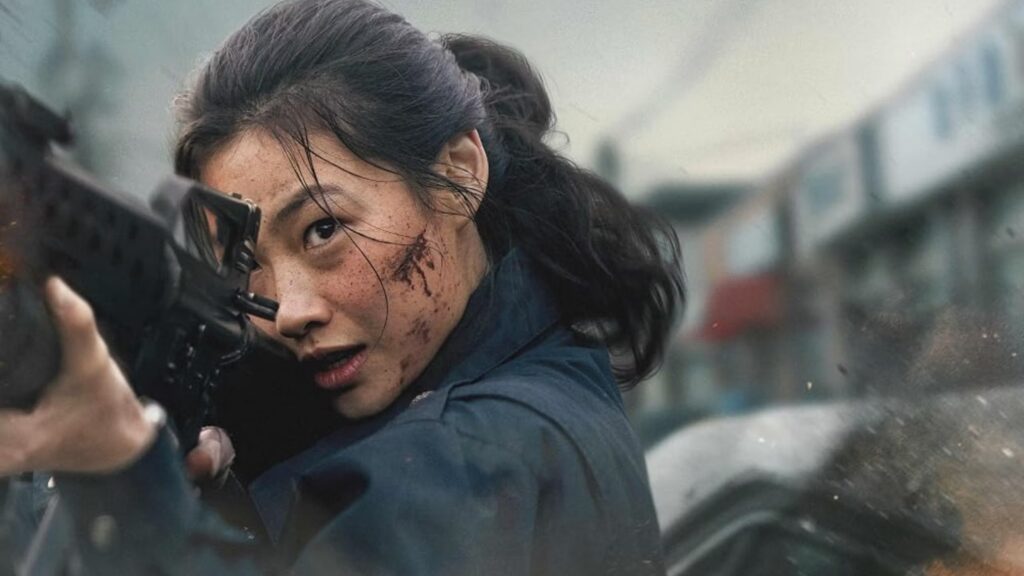
Jung Ho-yeon plays Im Sung-ae, a rookie cop who becomes a make-do-and-mend nurse to the injured citizens of Hope. Sung-ae’s big moment comes when she decides to make notes of a local’s story about first meeting the creatures (plural). The patients’ lengthy account is wincingly detailed. Sung-ae squirms as she takes notes and the audience squirm along with her.
The scene is funny up to a point – reminiscent of Christopher Walken’s excruciating story in Pulp Fiction (1994) about how a gold watch, a family heirloom, was preserved up his ass. But, in Hope, the point of interest is surpassed and I was left wondering what else was going on. In the end, the young woman endures being covered in slime and goo, even if only metaphorically so.
More obvious comic relief is provided by Lee Sang Hee’s Ahn Nak-yeon, an old army general who has adopted a Rambo mode of resistance against the town’s intruder. His bickering is a counterpoint to Bum-seok. I say comic relief, but the characters, no matter who they are, are broadly comedic. Much of the humour arises from our reading of them as just bumbling yokels. Too much of the audience’s tittering at the start of the film seemed to come from the cast’s vocalisations – “awwr”, “ahhhhhh”, “ooowah”.
Fortunately, there are some lovely visuals. The aliens themselves reminded me of some of the creatures in Alex Garland’s, 2018 adaptation of Annihilation. There are nods to the interior designs of H.R. Giger and the horror of John Carpenter’s The Thing (1982). An alien autopsy carried out with a chainsaw wielded by a “surgeon” standing on its corpse is challenging fun.
Robert Daniels, for Roger Ebert.com, describes Hope as becoming a stress test for audiences. In which case, I failed. I even struggled to discover what the film was trying to say. Was the subtext, “look out North Korea! We’ll defend our land to the very last civilian!” Perhaps,not.
Hope is 156 minutes in its theatrical cut, four minutes shorter than when exhibited at Cannes. What was cut? I don’t know, but I think the film could have done with a good deal more cuts to bring it closer to Resident Evil’s (2026) 94 minutes. Just as you reach the climax of a seemingly endless road chase, Hope jerks you in an unexpected direction.
I appreciate the way Hope develops its alien creatures, the way hope becomes applied to their aspirations, and the late in the day appearances by Taylor Russell, Alcia Vikander and Michael Fassbender. But, by then, my body and mind were screaming for the film to end. There’s bound to be a sequel, but I honestly hope there won’t.
Tim Robins
- About the Author
- Latest Posts

A freelance journalist and Doctor Who fanzine editor since 1978, Tim Robins has written on comics, films, books and TV programmes for a wide range of publications including Starburst, Interzone, Primetime and TV Guide.
His brief flirtation with comics includes ghost inking a 2000AD strip and co-writing a Doctor Who strip with Mike Collins. Since 1990 he worked at the University of Glamorgan where he was a Senior Lecturer in Cultural and Media Studies and the social sciences. Academically, he has published on the animation industry in Wales and approaches to social memory. He claims to be a card carrying member of the Politically Correct, a secret cadre bent on ruling the entire world and all human thought.
Categories: Features, Film, Other Worlds, Reviews
 In Review: Avengers: Endgame Encore
  In Review: Resident Evil
  In Review: Raiders of the Lost Ark
  In Review: Pressure