Review by Tim Robins
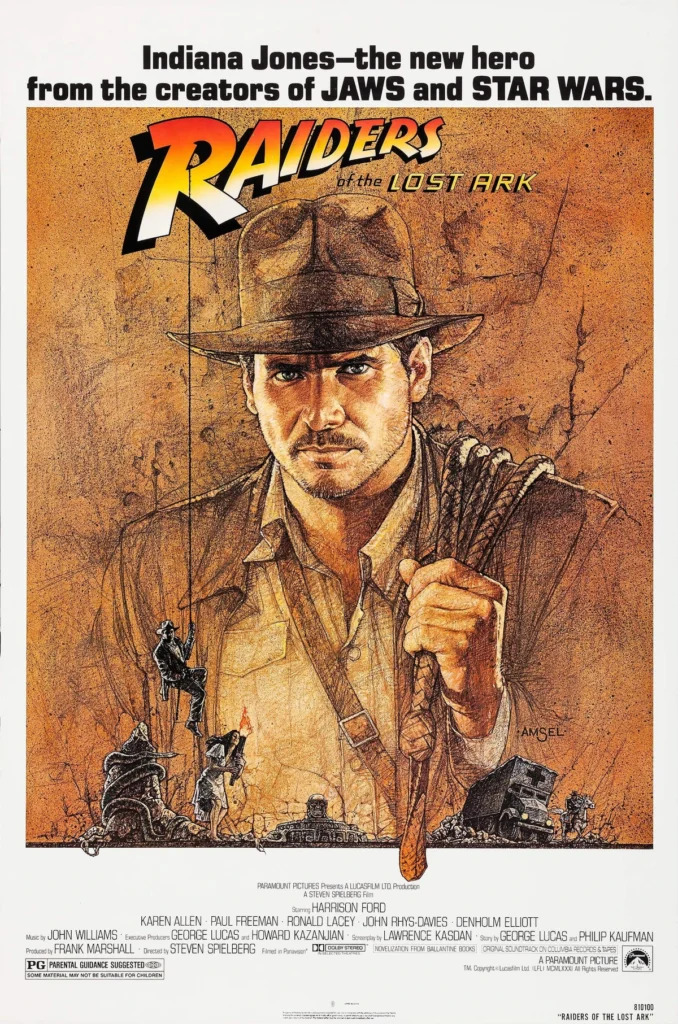
It’s back! 45 years after Raiders of the Lost Ark was first released, the Stephen Spielberg directed action adventure has returned to the big screen and even bigger, BFI IMAX screen where the film will be shown with the first two of its sequels in a special, “blink and you’ll miss it” event. Oops, you blinked! And so did I.
Never mind. All the Indiana Jones movies are available on 4K Blu-Ray Indiana Jones released in 2023. The new theatrical release made use of the 4K editions. The action adventures star archaeologist, Indiana Jones played with sly conviction by the handsome Harrison Ford, who was cast after his successful appearances in American Graffiti (1975), and as Han Solo in Star Wars (1977) and The Empire Strikes Back (1980), although Tom Selleck and Jeff Bridges were among others considered for the latter role.
Ford was to star as “Indy” in all of the sequels that followed the film’s success: Indiana Jones and the Temple of Doom (1984) Indiana Jones and the The Last Crusade (1989), Indiana Jones and the The Kingdom of the Crystal Skull and, most recently, Indiana Jones and the The Dial of Destiny (2023). The sequels are of variable quality. As of now, my favourite is the first.
A new Blu-Ray collection was scheduled for the 18th September this year, but I went to see the 45th Anniversary release of Raiders of the Lost Ark at my local Odeon. The 4K digital image was as clear as a crystal skull. I hope the anniversary buzz will inspire people to give the film another look and there’s a new generation who have never seen the film for the first time (Yes, Jude, I’m talking about YOU!).
If nothing else, the re-release gave me a chance to re-evaluate the film at the cinema. I say ‘re-evaluate’ because, back in 1981 (gulp!) I thought Raiders of the Lost Ark was vacuous tosh. That’s right, nowhere in my mind was the thought that I had watched “One of the greatest films ever made”. Back in The Eighties, only Orson Welles’ Citizen Kane topped that list.
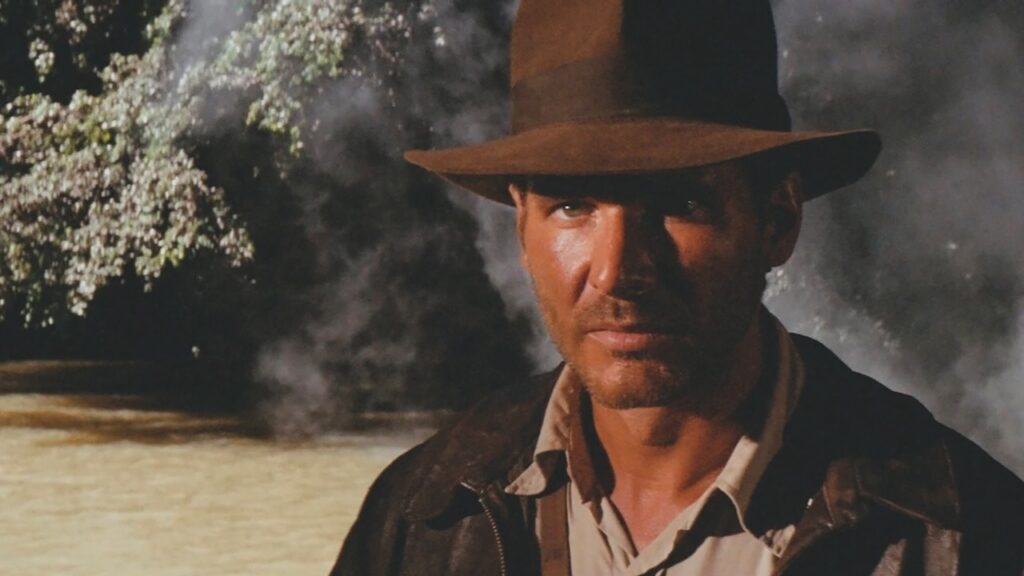
‘Raiders’ is still candy for the eyes and slop for the mind. The story, set during World War Two, sees the American Government task archeologist and treasure hunter, Indiana Jones (Harrison Ford) with finding the Arc of the Covenant, before it falls into the hands of Nazis and gives them the awesome power of God Himself (zoom in on an illustration of the Ark frying congregates with laser beams!).
“Indy” doesn’t need much persuading, so off he goes to the lost city of Tanis, Egypt, where the Ark is said to rest. Along the way, he is reunited with former fling, Marion Ravenwood (Karen Allen), and René Belloq (Paul Freeman), a rival archeologist now working for the Nazis. A chase for the Ark ensues, and after one set piece leads to another, the sacred object, which contains the remains of the Ten Commandments, is opened. Suffice to say, God is not happy.
Ford is perfect as the, at times, morally ambiguous treasure hunter. A piece of dialogue from his rival, the Nazi serving Belloq, captures this.
“You and I are very much alike. Archaeology is our religion, yet we have both fallen from the pure faith. Our methods have not differed as much as you pretend. I am a shadowy reflection of you. It would take only a nudge to make you like me. To push you out of the light.”
The single best character moment in the film, is a close-up shot of Jones’s face, staring in the tomb at the city of Tanis thought to contain the Ark. Jones is glistening not just from the heat of the sun, but from sheer excitement. From this fleeting scene we can see desire, even greed, in the glint of his eyes. Looking back, we suspect that Belloq may well be right.
The film has a sustained atmosphere of suspense and menace. Whenever the Ark is near, threatening clouds and rolling thunder. But Spielberg also has an eye for humour. There’s a scene in which Marion has been captured and must face interrogation by the Nazi General, Arnold Toht.
Toht smiles when he is handed what appears to be nunchucks. We fear the worst, but he simply folds them into a triangle. They turn out to be a collapsible coat hanger. Toht is played by Ronald Lacey, a brilliant piece of casting. He looks like a Nazi from your nightmares, although I’m still not sure he deserves his fate.
The film’s pace is breakneck, the editing and storytelling brisk and breathtaking without leaving me exhausted. The physical effects, no CGI here, command admiration. The craft skills on show here seem to be rapidly fading into time. Of course, CGI requires skills but hundreds of hands taping out code fail to generate the fascination of set dressers, costume departments and the delicate assembly of practical props.
I was left with some questions about the plot. The first line in the film comes when one of “Indy’s” jungle guides, Satipo (Alfred Molina) spots a poisoned arrow in a tree stump. He tells Indy, “The Hovitos are near. The poison is still fresh. Three days. They’re following us.” Er… if the poison is three days old, surely they’d be there waiting for them.
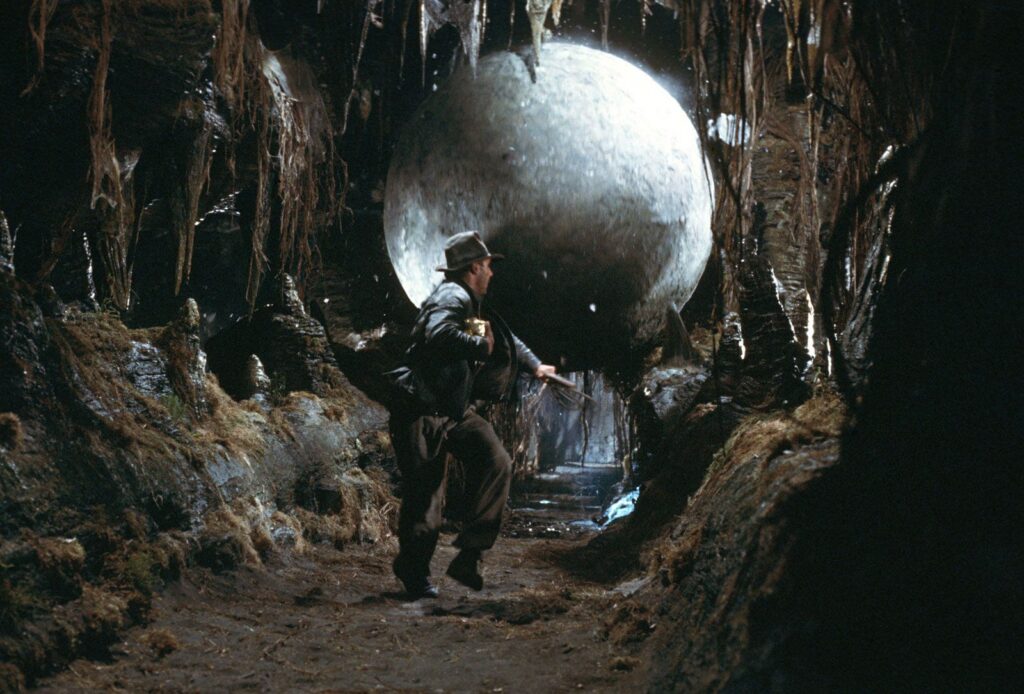
When Indy triggers a trap in the temple’s altar room, we see the huge face of its god begin to explode outwards and crumble away. I can’t help thinking that something – a large rolling boulder? – was intended to break through. Nothing does. The iconic boulder that bears down on him – surely the film’s most famous sequence – comes from somewhere else, somehow.
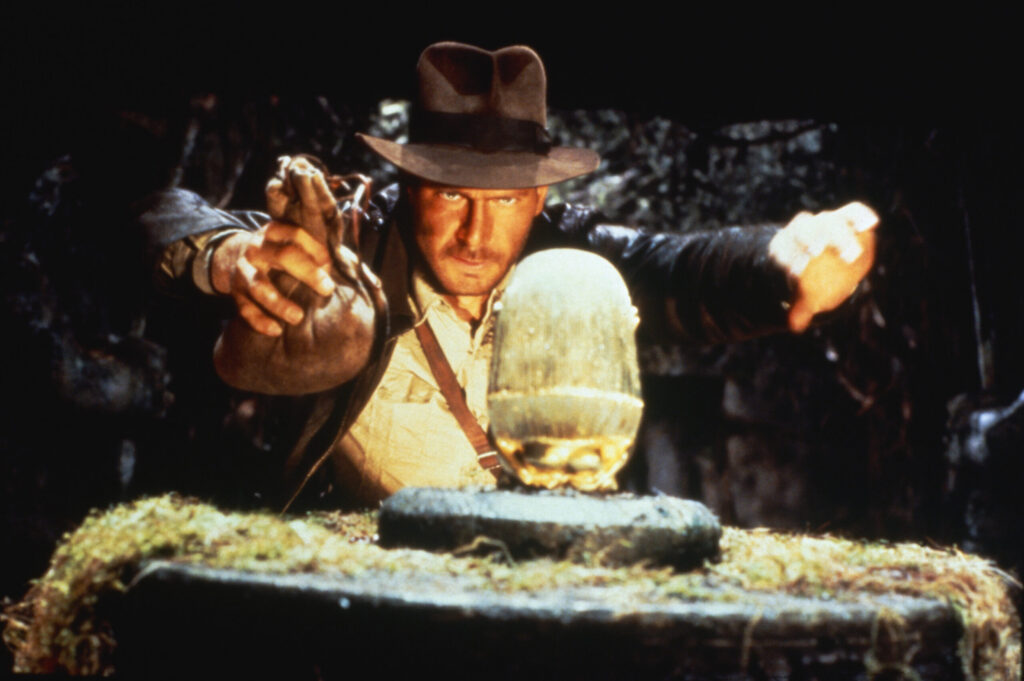
In another scene, “Indy” jumps on the top of a Nazi submarine in which the Ark is being carried to a nearby island. But, despite this being wartime, the U-Boat submerges. Lucky Indy, lucky too that he evades the sub’s periscope or the eyes of any lookout on deck (curiously, there is no lookout in sight).
The illustration of the Ark that we see near the start of the film is the script’s ‘Chekhov’s Gun’. But, to me, it isn’t enough information to, later, motivate Indy to instruct Marion to look away from the open Ark. Of course, there are examples of Biblical tales in which people risk terrible fates for looking where they shouldn’t: for example, as God commands, “You cannot see My face, for no one can see Me and live” (Exodus 33:20). And it’s reasonable to suppose “Indy” remembers that passage from the Old Testament. But I still feel that I am doing a lot of my own expository work at a crucial moment in the film.
There are a couple of really silly moments. One where Marion is surrounded by jingling, screaming corpses in the tomb. Again, I tried to reason that the screams were some kind of wind effect designed to scare away intruders. Again, I don’t feel like doing Spielberg’s work for him. Couldn’t we just hear multiple screams from Marion? But the funniest moment for me comes when Indy begins to crawl through a gap in the chamber’s wall. We focus on Indy brushing away the dry bones of bodies, but behind him, hanging from the ceiling, is what appears to be a tiny toy rubber skeleton.
Between them, George Lucas and Philip Kaufman, (who wrote the story), Lawrence Kasdan, (script) and, of course, Spielberg (direction) try and succeed in creating a loving evocation of the days of ‘B Movie’ cliffhanger serials, that were screened before the main movie and whose task was to bring audiences back to the cinema week after week. Therefore, Raiders of the Lost Ark has an unashamedly episodic structure. The story moves from location, each offering an opportunity to stage fisticuffs and breathtaking stunts.
Spielberg had other influences from the history of cinema. The very final scene, which sees The Ark being put in storage, echoes the fate of Kane’s beloved ‘Rosebud’ at the end of Citizen Kane. Raiders was also influenced by Spielberg’s love of Tintin’s globe trotting adventures. Hergé’s comic strip creation was well into exotic locations, gun play, and menacing atmospheres. Spielberg directed an animated film scripted by Stephen Moffat, but I recommend you pick up the graphic novels by Hergé and others working in his studio.
Where Flash Gordon and Buck Rogers clearly inspired Lucas to make Star Wars (1977), Raiders of the Lost Ark drew on another genre – jungle adventures. As Sam Wigley, writing for the BFI, notes, “In the 1930s, Hollywood furnished the world with colonial-era fantasies, full of pith-helmeted explorers making their way through soundstage wonderlands of dappled light, pendular vines and menacing menageries. Crocodiles, toucans, elephants and tigers shared space with Tarzan, King Kong, dubiously portrayed ‘savages’ and a creeping morass of vegetation”.
Today, commentators are quicker to call out Raiders inherent racism. For example, the opening scenes see “Indy” stealing a golden artefact from a temple in the jungle. Today, taking an indigenous artefact because it, as Indy says, “belongs in a museum”, is open to question. And the scenes of poison dart blowing natives aren’t acceptable in any decade. As Star Wars prequels were to show, Lucus’s nostalgic imagination is casually racist.
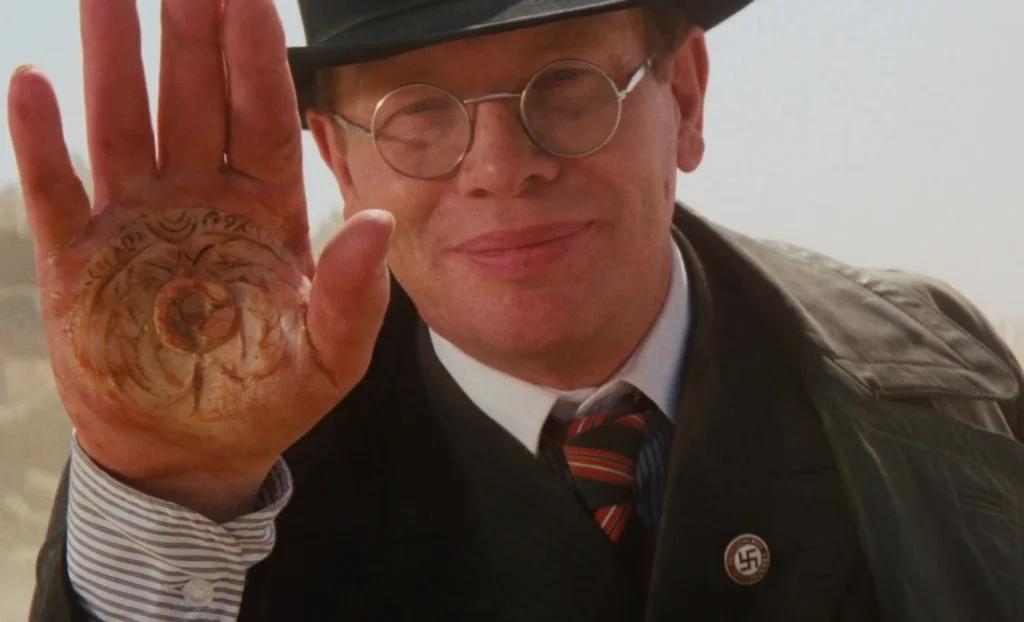
Reading reviews of the time, you wouldn’t know that anyone raised an eyebrow at the film’s cloying cultural appropriation. Here’s what film critic, Vincent Candy, writing in The New York Times, 1981, had to say: “As Mr. Lucas’s Star Wars helped itself to all sorts of myths, folk tales and characters from children’s fiction and fused them into a work of high originality […] Raiders of the Lost Ark refines its tacky source materials into a movie that evokes memories of movie-going of an earlier era but that possesses its own, far more rare sensibility.”
In 1981, critic Roger Ebert enthusiastically burbled, “Raiders of the Lost Ark celebrates the stories we spent our adolescence searching for in the pulp adventure magazines, in the novels of Edgar Rice Burroughs, in comics — even in the movies”. He concluded that the film “wants only to entertain. It succeeds”.
Critics were quick to catch on to Spielberg’s penchant for nostalgia and the “knowingness” that accompanied his films. The car chase is Raiders at its most Bondian. If you smile at “Indy” forcing a villain’s car off a cliff road, you are probably not taking pleasure in the deaths of those in the car, but because a car plummeting off a cliff is exactly what you expect, nay, want, from a chase along a narrow, cliff top. And, if you watched any of the ITC action adventures that followed in the wake of Bondmania, the car plunging to its doom would invariably be a white Jaguar.
It took Marxist scholar Fredrick Jameson to point out the dark side of Eighties nostalgia. He saw Lucas’s American Graffiti (1973) as exemplifying the “nostalgia mode” of postmodern culture. Such films drew on a ‘culture of quotations’, a style of film making in which fragments of the past were recycled without belief in their reality and, therefore, without the possibility of giving rise to historical consciousness. So there. I doubt Lucas or Spielberg were ever included in Jameson’s WhatsApp group, “People to call when the communist revolution comes.”
Some commentators have seen a radical politics in Raiders, interpreting the film as a young Jewish director’s revenge fantasy. Maybe. If so, the film is a useful reminder of the past. A recent think piece in The Quietus points out that, today, “Confidence that everyone in North America and Europe agrees Nazis are evil and need to be defeated can no longer be taken for granted”.
Raiders of the Lost Ark, has a wide ranging legacy in popular culture. The climactic deaths of the Nazis, clearly inspired the melting effect used during the death of the villainous Kane in the Doctor Who story Dragonfire (1987). Most amusing of all, it has inspired a plethora of internet “Punch Nazi” memes.
For all its difficulties, I’m glad I saw Raiders of The Lost Ark at the cinema again. It is a fantastically effective action adventure, unequalled by its, admittedly entertaining, sequels and other films that sought to cash-in on its success.
Punch Nazis!
Tim Robins
• All the Indiana Jones movies are available on 4K Blu-Ray Indiana Jones released in 2023 (AmazonUK Affiliate Link)
Head downthetubes for…
• WhatCulture.com: Raiders of the Lost Ark IMAX Review: Unmissable Indiana Jones Experience
• Steven Spielberg’s thoughts on IMAX (Interview from 1990) tannu28 r/imax
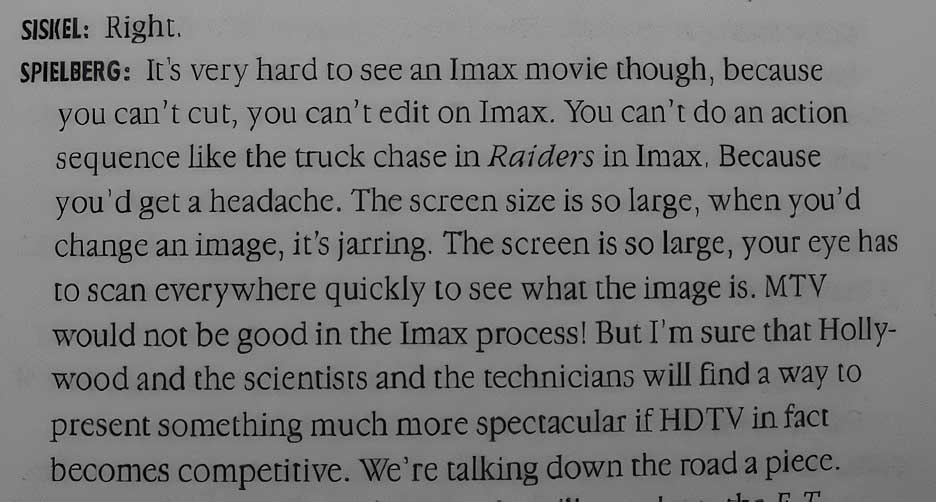
• ISPR: Spielberg on IMAX rerelease of Raiders of the Lost Ark
• The Ethics of Archaeology: Who Owns the Past? (thearchaeologist.org)
• Borrowing Blockbusters: The Best, Worst and Weirdest Indiana Jones Knock Offs
• The history of the ITC white Jaguar Mk I, recovered (jackyan.com)
• The Quietus: otes on Anti-Fascism And Frivolity In Raiders Of The Lost Ark At 40
Get nostalgic with the following copyright free jungle adventures….
- About the Author
- Latest Posts

A freelance journalist and Doctor Who fanzine editor since 1978, Tim Robins has written on comics, films, books and TV programmes for a wide range of publications including Starburst, Interzone, Primetime and TV Guide.
His brief flirtation with comics includes ghost inking a 2000AD strip and co-writing a Doctor Who strip with Mike Collins. Since 1990 he worked at the University of Glamorgan where he was a Senior Lecturer in Cultural and Media Studies and the social sciences. Academically, he has published on the animation industry in Wales and approaches to social memory. He claims to be a card carrying member of the Politically Correct, a secret cadre bent on ruling the entire world and all human thought.
Categories: Features, Film, Other Worlds, Reviews
 In Review: Avengers: Endgame Encore
  In Review: Hope
  In Review: Resident Evil
  In Review: Pressure