Did the original Eagle really get accused of holding Christianity up to ridicule in a complaint to the Irish Minister for Justice in 1950?
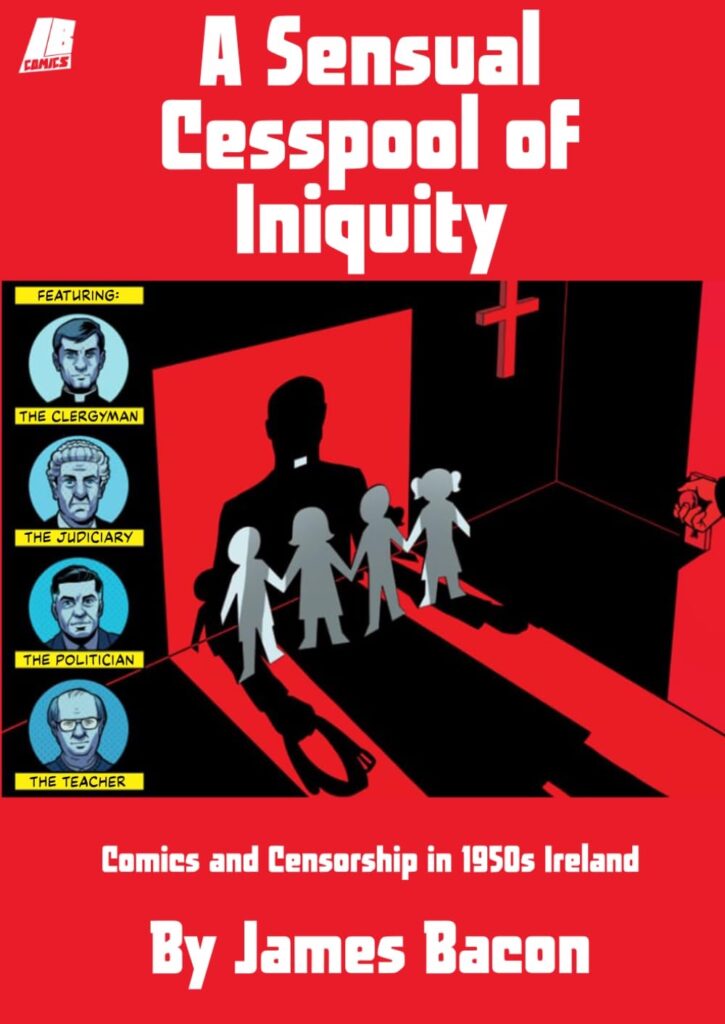
A Sensual Cesspool of Iniquity: Comics and Censorship in 1950’s Ireland by our own correspondent, James Bacon, is released today at Dublin Comic Con, and we have an extract from the huge book, weighing in at over 360 pages and some 275,000 words on the comics that were banned, investigated, seized and complained about.
We see that there was one complaint, which may surprise readers, and downthetubes is delighted to have some edited extracts to share with readers as we see that there was a complaint made about the Eagle comic.
In 1950 some 410 books and 49 periodicals were, astonishingly, banned in Ireland, a system for banning books and periodicals had been in place from 1930. This is something that clearly sets Ireland apart from America and Britain, although both countries have, in previous times, had their fair share of moral panic about the stories and themes some comics presented.
But it seems incredible that Eagle, itself born, in part, in response to those concerns, raised, [as downthetubes has previously noted], at the highest levels of the British government, would be a target for moral censure. In the world of comic books, there are many comics which hold a warm and loved sensation, and are thought of well, and one of these comics is the Eagle. The vision of Marcus Morris, who was working in Southport as a vicar, along with a parishioner, Frank Hampson, who had amazing art skills, they came up with “Dan Dare” and the Eagle, launched in April 1950. The comic was hugely popular.
On the 15th of April 1950, shortly after the first issue was published, a letter was typed up and sent to the Minister of Justice, in Dublin.
MacCarthy, 29 Lower Abbey Street
Solicitor Dublin
April 15th, 1950
General Sean MacEoin, T.D.,
Department of Justice, Merrion Street, Dublin
Dear Sean,
I have been handed to-day a copy of “The Eagle” No. 1 issue dated 14th April 1950 which is proposed to be published every Friday at 3d. I am sending you this production for your perusal. It is printed by Eric Bemrose Ltd. of Long Lane Liverpool for the proprietors and publishers, The Hulton Press Ltd. of 43/44 Shaw Lane London E.C.4.
It will be observed that this of course is for juvenile consumption, and it will be seen that as such as it is quite good value for the money. This of course follows the usual line but tucked away on the last page you find the piece dealing with “THE GREAT ADVENTURER”. I do not of course know what the trend of this narrative is going to be like in subsequent issues but it is very obvious that the thing tends to hold Christianity up to ridicule.
My informant is an Englishman who appears to have some knowledge of the people at the back of this thing, and another person to whom I have shown the production holds very strong views about the matter.
I am sure you will give it all due attention.
With Best Regards
Yours Sincerely
Signed Richard
There is a Roinn Dlí agus Círt stamp on the letter. This is dated and confirms the receipt of the letter on the 18th of April 1950. This letter sits in the National Archive of Ireland, in the Justice Department file 90/102/138, in the first of three folders.
There is then a reply also in the National Archive from the Minister of Justice, General Sean MacEoin, of the Fine Gael party, a man of considerable bravery, who had fought in the War of Independence, and Civil War. It is interesting that the Minister himself replied on the same day the letter was received and how he replied.
102/182. 18th April 1950
Dear Dick,
I have received your letter of 18th instant forwarding a copy of the magazine “The Eagle”.
I am afraid I have no power to intervene in this matter. I cannot prohibit the circulation of a periodical. The Censorship of Publications Board can do so, but under the Art they have power to prohibit a periodical only if a complaint is made to them and if they are satisfied that recent issues of the periodical have usually or frequently been indecent or obscene or have advocated birth control or have devoted an undue proportion of space to material relating to crime.
Yours sincerely,
Gen Sean MacEoin
I would like to suggest that the prompt reply, the use of the informal name, and the cordial helpfulness of the minister himself is of interest. Generally at this stage, complainants were encouraged to take the matter to the Censorship of Publications board, so this letter is unusual. It should be noted that, whatever General MacEoin thought of the comic he was perhaps advising the solicitor, that there was “nothing to it”, as one might say.
To accuse the Eagle of “holding Christianity up to ridicule” is utterly astonishing, and the intelligence gleaned from the “informant” is not at all good, for, it was a vicar who was behind the Eagle with a desire to publish works that were positive towards Christianity.
It is obviously a request to ban the Eagle. The idea that one of the cleanest and most pious comics in existence at this time could not only cause offence, but be traduced in such a way is incredible.This is the Eagle, which was founded by English Anglican priest John Marcus Harston Morris, and it is seen as a good comic with Christian values and standards at the time and historically. For sure it was a British comic, and there were no doubt many British views, ideals, championing and triumphalistic moments within its pages. Who this informant was is unclear, but to allow Morris to be maligned in such a way is very unbecoming of an officer of the court, and to forward such an accusation, clearly without checking.
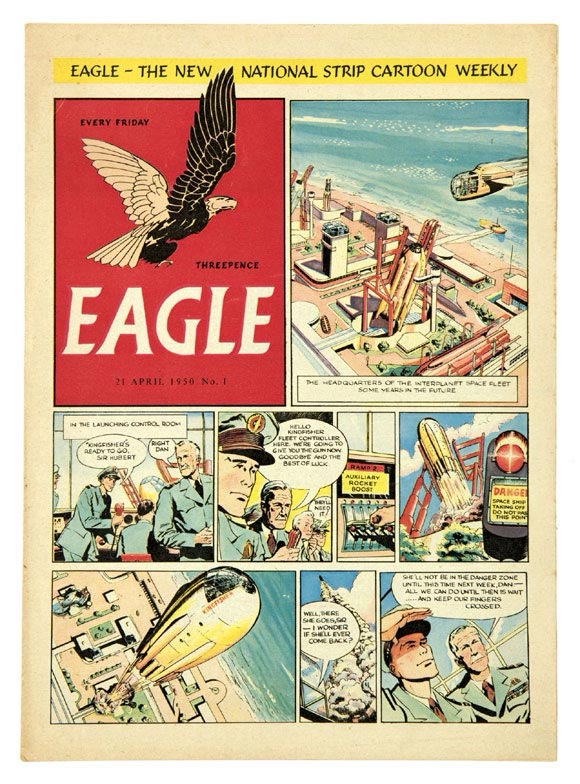
In the British Library, Eagle No. 1 has its own large hard bound edition, as well as being in the binding with the whole volume for 1950. The cover and second page are the “Dan Dare” story. “P.C.49” is on page 3, from the famous radio series by Alan Stranks. There is a detective prose serial by Chad Varah, and a “Captain Pugwash” cartoon strip. Guidance on how to stand playing cricket, a prose piece about spies, by Bernard Newman. Prof Brittain explaining in a comic how radar works, a western story in colour over two pages called “Seth and Shorty – Cowboys”
The centrespread has a beautiful cutaway image of the Class 18000 gas turbine powered locomotive, due to be tested in the Western Region of British Railways, a “new Skippy the Kangaroo” comic strip, by Danet, Dubrisay and Genestre (unrelated to the TV adventure series, which was launched later). “Heroes of the Clouds”, a historical comic about Brian and Dick Nicholson, a comic strip about hedgehogs, a real life mystery, some adverts, how to make a model racing car, with a very small diesel engine, an editorial page, and a Cowboy prose story. The last three pages are comics, “Rob Conway a cadet in an adventure”, “Tommy Walls the Wonderboy”, who when he makes a W sign with his fingers, can fly, and has super strength, but this is “presented by” Walls Ice Cream in beautiful full colour.
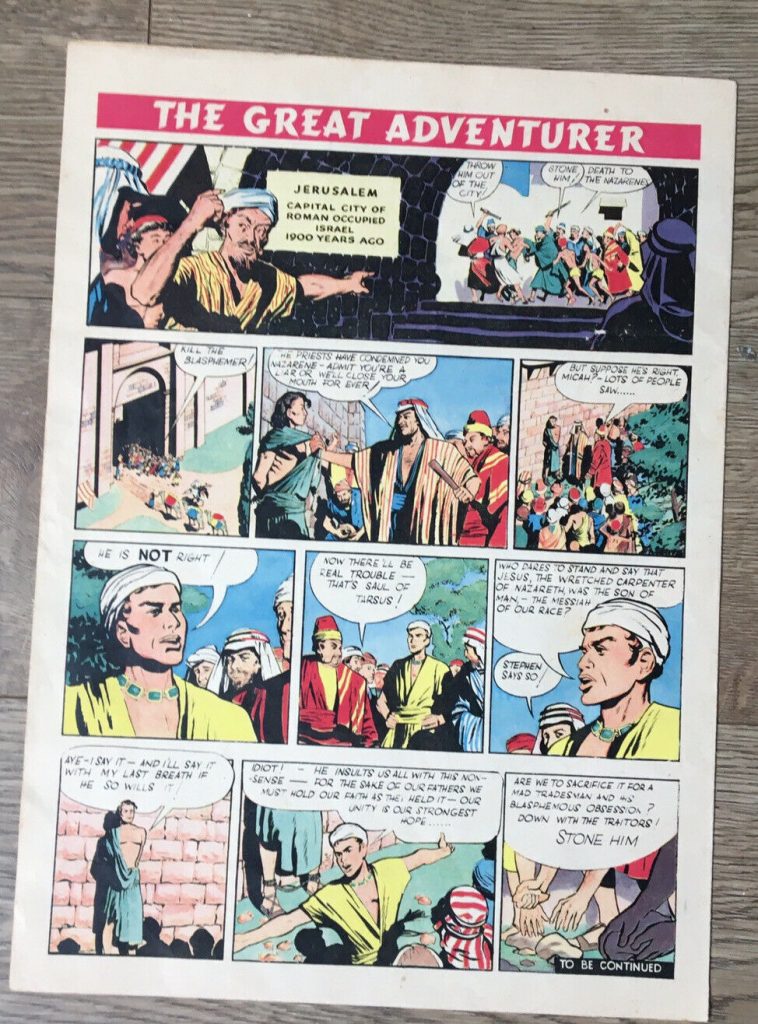
The back page comic is “The Great Adventurer”, the story of Saul of Tarsus who would be known as St. Paul the Apostle. Which is a Christian story and while we do see him stone Stephen, who was speaking of Jesus, that is the story, for Saul was a persecutor of Christians who went on to convert to the religion himself, and be recorded as a proponent for the religion. The story was written and painted by Frank Hampson and his team, possibly including Jocelyn Thomas, Greta Edwards (nee Tomlinson) and Joan Porter. Reverend Chad Varah, who later founded The Samaritans, would get involved with the story by the fifth issue and take over writing duties at a later stage.
This was the first of Eagle’s Bible stories, and it was written from a place of respect and desire to portray christianity well, and they found a popularity that has seen some of them reprinted in the 21st Century. “Ridicule” indeed.
• A Sensual Cesspool of Iniquity is available from Limit Break Comics and will be on sale at Dublin Comic Con, as well as on Amazon.co.uk (Affiliate Link) | Amazon.com | Amazon.ie
The Irish National Archive Records and links for the mentioned documents are as follows
• Richard J. M. MacCarthy, April 15th, 1950 to Minister for Justice. NAI JUS 90/102/138 Folder 1 of 3
• Gen. Sean MacEoin 18th April 1950 to Richard J. M. McCarthy. NAI JUS 90/102/138 Folder 1 of 3
head downthetubes for…
• Rare EAGLE first issue “pay copy” reveals editorial cost of creating the legendary British comic
• Bible Comics in Britain – and Beyond
• The Eagle at 66: A Boy’s Eye View
Published in 2016, this article by artist David Slinn explains the enormous impact the Eagle made on its debut in April 1950. Not least later on, leading to his own career in publishing; initially, as a freelance lettering artist on Eagle and its companion papers, while eventually contributing illustrations to the Hulton Press titles and other children’s publications
• Whatever Happened to Eagle’s “Skippy the Kangaroo”?
Not to be confused with the TV show of the 1960s (or its associated comics), “Skippy the Kangaroo” was an odd little humour strip that ran in the first volume of Eagle, and has been dismissed by some fans of the comic as something of a disappointment, its creators something of a mystery to comic fans.
- About the Author
- Latest Posts

John is the founder of downthetubes, launched in 1998. He is a comics and magazine editor, writer, and Press Officer for the Lakes International Comic Art Festival. He also runs Crucible Comic Press.
Working in British comics publishing since the 1980s, his credits include editor of titles such as Doctor Who Magazine and Overkill for Marvel UK, Babylon 5 Magazine, Star Trek Magazine, and its successor, Star Trek Explorer, and more. He also edited the comics anthology STRIP Magazine and edited several audio comics for ROK Comics; and has edited several comic collections and graphic novels, including volumes of “Charley’s War” and “Dan Dare”, and Hancock: The Lad Himself, by Stephen Walsh and Keith Page.
He’s the writer of comics such as Pilgrim: Secrets and Lies for B7 Comics; “Crucible”, a creator-owned project with 2000AD artist Smuzz; and “Death Duty” and “Skow Dogs”, with Dave Hailwood.
Categories: Books, British Comics, Comics, Creating Comics, downthetubes Comics News, downthetubes News, Other Worlds
 6000 Not Out: A Chat with Commando cover artist Keith Burns
  Crowdfunding Spotlight: The Arts of Eddie Campbell
  Two New Books from Alan Clark, firmly focused on British Comics “Golden Age”
  A Snapshot of TV History: The Art of Peter Firmin