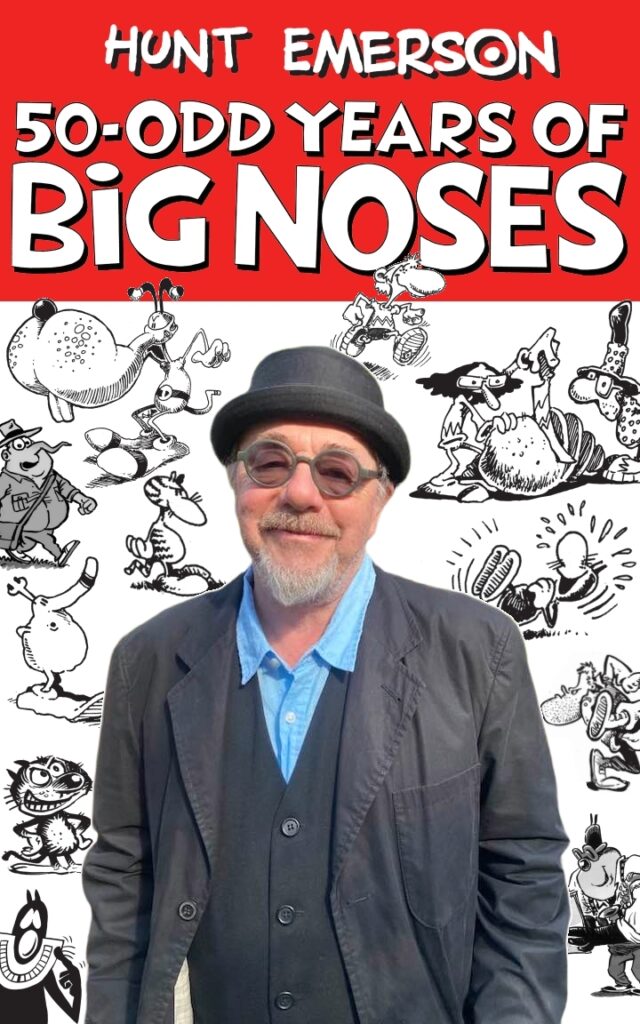
Rory Milne talks to Hunt Emerson about the new book, 50-Odd Years Of Big Noses…
How do you celebrate a career in comics that spans more than five decades? That’s what I asked the amazingly prolific and highly amusing master of underground comics Hunt Emerson. It’s no mean feat, but somehow we squeezed everything from Mr. Spoonbiscuit and Calculus Cat to Phenomenomix and Max Zillion into a book called 50-Odd Years Of Big Noses. Now all we need to do is to get the thing funded. Hunt is calm and collected while I have a mild panic attack.
downthetubes: Hi Hunt, how’s your blood pressure?
Hunt: My blood pressure?
downthetubes: From running the campaign for the book! How would you say it’s going, and can you recommend anything for my nerves?
Hunt: Hah! Well the campaign is going probably as well as can be expected, but I’m a born pessimist when it comes to these things. As for the nerves, hmm. Do you like a drink?
downthetubes: I gave that up years ago. Maybe asking some questions will help. How is 50-Odd Years Of Big Noses comparing to your previous campaigns?
Hunt: Well it’s probably much the same. I mean, we were asking for more money last time. But I’m not despairing because things tend to happen quite quickly in the last few days. So I’m kind of hoping that might be the case here.
downthetubes: Any thoughts on the overnight success that the campaign had early on?
Hunt: I think some people knew it was going to be happening and they just jumped in there when it was first announced. That’s tended to be the way. There’s a big rush and then a lull, and then right at the end there are people who have been holding off that eventually decide to back it.
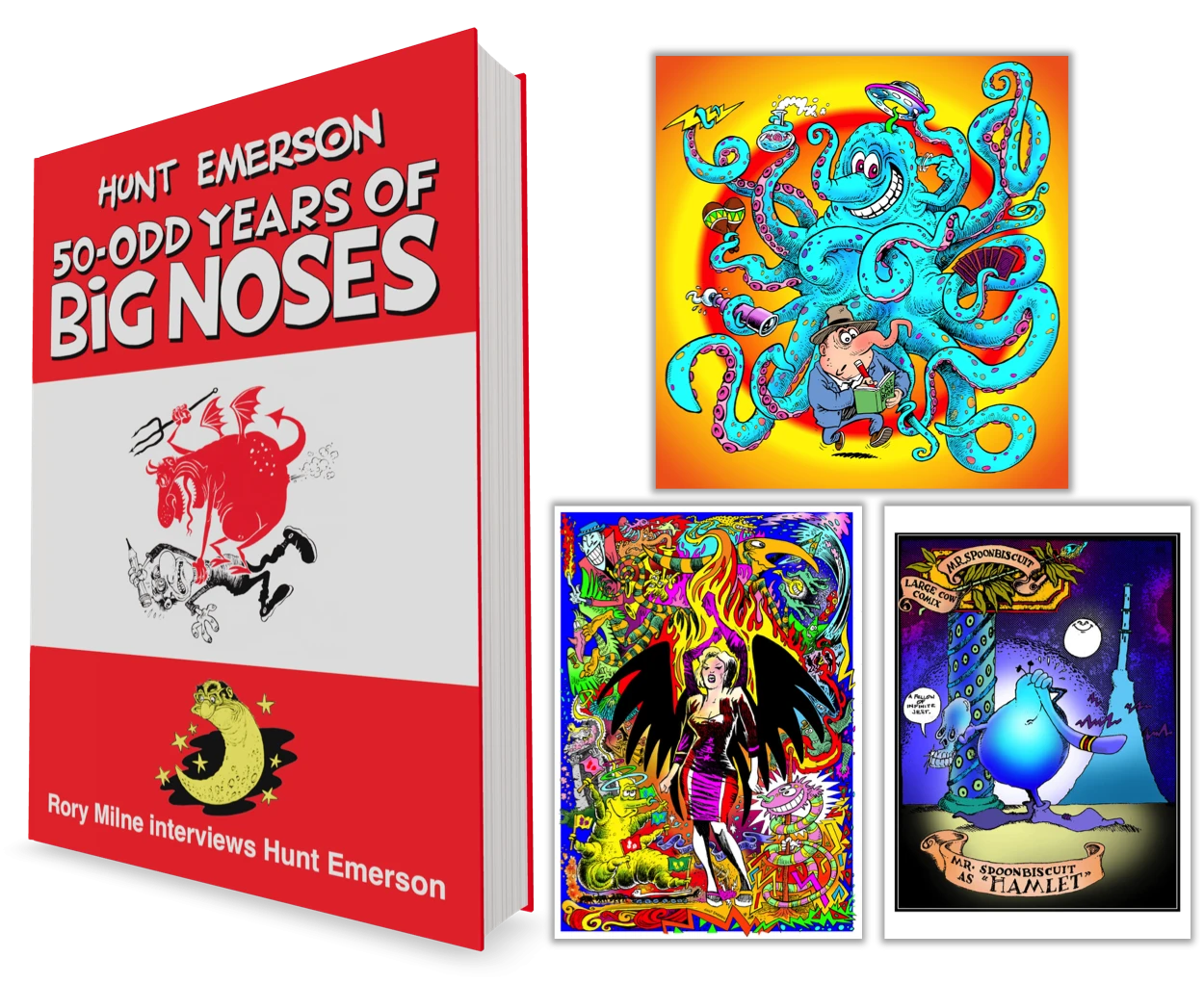
I just wish somebody would buy one of the cartoons on the campaign add-ons list! They’re all hand painted illustrations from Fiesta that they had on their letters page, they were done pre-digital. The joke was that they were supposed to illustrate readers’ letters about their fantasies, but then that wasn’t the case! I thought people would have a laugh at them and pick them up, but that hasn’t happened.
downthetubes: You need a patron to buy all your artwork.
Hunt: Well the Firkin strip that has sold was probably bought by a guy in Portugal who’s kind of a patron. He’s bought quite a lot of artwork from me and commissioned pieces as well.
downthetubes: It would be interesting to walk around his house, he probably has your artwork on every wall.
Hunt: I have a feeling his wife wouldn’t allow that! He has two or three daughters as well, so the artwork is probably in his private archives.
downthetubes: Ok, well since we’re plugging. What can fans of popular strips like Firkin expect from the book, apart from inner peace and lifelong prosperity of course?
Hunt: Of course! Well the book has some Firkin, and Phenomenomix. Calculus Cat has a section. Max Zillion has a section as well.
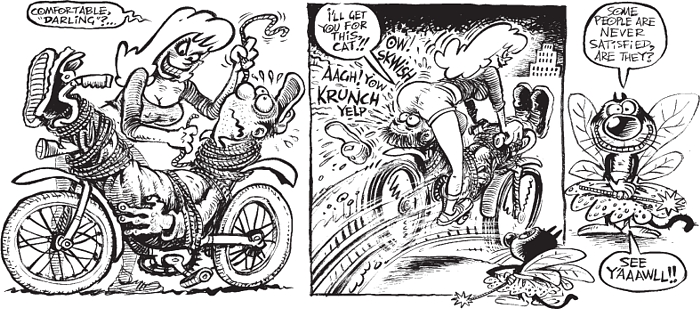
downthetubes: I seem to remember there being a discussion in the book about Firkin running on all four paws but walking on two feet, and how he’s not really a cat!
Hunt: Yeah. He started off much more feline in the early days, but he became more of a little character running around the place. Then as time went on and we introduced the two human characters Firkin started to take less of a part in the stories and was more in the background making rude comments and screwing things up for people!
downthetubes: He became the punch line in the last panel.
Hunt: Yes. Tym Manley was such a great writer. We did Firkin for two months short of 40 years, and then they shut the magazine down. Tym was coming up with these stories every month, and for the other strips we did as well. But with Firkin in particular, those final frames with him saying: “See Y’all”, that was a little stroke of genius. That gave us a way out of every strip, and that was Tym’s idea.
downthetubes: So remind me why Firkin started out as more feline and ended up standing on two feet like a person.
Hunt: That was really because I was learning to draw the character. Fiesta asked me to do it. I think they had an office cat called Firkin or something like that, and I think there was a cartoon of a cat that had appeared once or twice in the magazine early on. But they asked if we could do Firkin The Cat, which was originally called The Firkin Version. The editor at the time came up with that name. I remember I made the heading a bit smaller at one point to give myself a bit more space, and he went up the wall because I wasn’t allowed to do that! I had to keep the same heading. That all changed when Ross Gilfillan took over; he was the best editor.
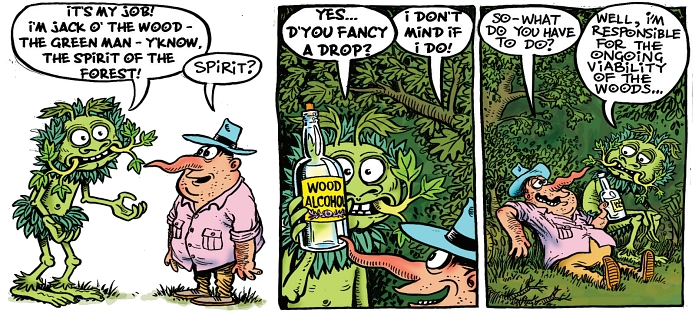
downthetubes: There’s also stuff about Phenomenomix in the book.
Hunt: Yep! There’s six pages of Phenomenomix to give examples of that, and there’s some text in there. The Big Noses book has turned out to be a career overview, it’s not really meant to be like that. It’s a lot more scattered, which is fine. That’s what I wanted really.
downthetubes: I think it’s what fans of yours would expect. But there’s also out-of-print strips, never published work and long forgotten characters in there.
Hunt: Yes, there’s Mee & Yow for a start. There are people in Birmingham that ask me if I still do that, because that’s what they remember. They’re not really aware of anything I’ve done since then, but they certainly remember Mee & Yow!
downthetubes: They maybe think it’s a newspaper strip that’s run for 50-odd years.
Hunt: It could have been if I’d been able to consistently write that sort of thing, but I get bored very quickly doing that. I would have also had to have done a lot more study on the Black Country accent! It was a long time ago that I did those, but looking back at them now it was a bit of a cheek really!
downthetubes: I’m sure no offence was taken, but on that note, what if Robert Crumb and other people we talk about in the book sue?
Hunt: I shall fight them with every ounce of my being! Seriously though, the story about Crumb taking his first comic out to the streets in a pram to sell them is an old one. He did it for about ten minutes or something.
There was a very good biography of his life recently called Crumb – A Cartoonist’s Life, it’s by Dan Nadel. It’s kind of like the definitive version. It’s got that story with the pram, and it’s sort of grown in the telling. They were selling them at a street festival when it first came out, but they didn’t have to struggle with that one. Once it got out on the streets it was selling hand over fist.
I can’t say that I know Robert Crumb. I’ve met him three or four times and spent a little time with him. I’ve played some music with him. But he’s not the kind of person you get to know unless he wants to know you. Gilbert Shelton is a different matter. Gilbert and I get on very well. He’s still working. His hands are a bit shaky and he has assistants that work with him. But they’re still producing Fat Freddy’s Cat strips. There’s one a month or something. Gilbert has always worked with assistants, right from the start when he was in Austin, Texas working on the student magazine.
When I lived in Paris for six months in 1989 I got to know some cartoonists there. There was one guy who was inking some of the Firkin strips for me, and other strips like Arseover Tit. That was because he needed the work, and because I was on holiday. I didn’t want to spend all my time drawing comics! God rest his soul, Pierre Ouin.
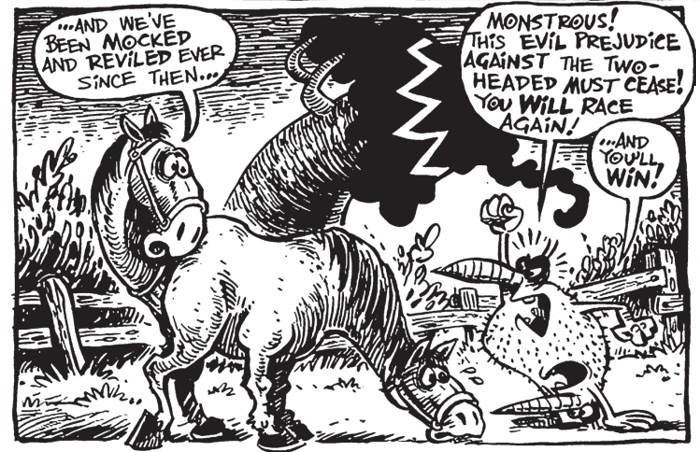
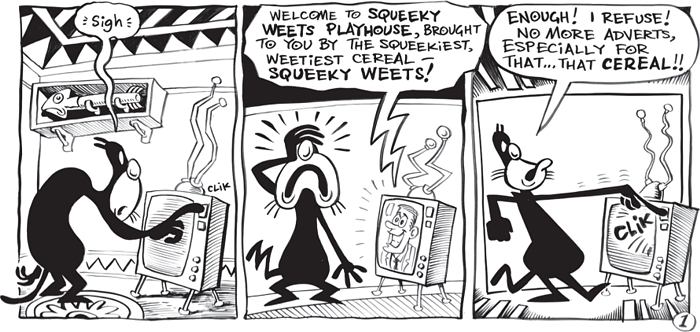
downthetubes: I suppose your style has changed quite a lot over the last 50-odd years, and of course some projects were madly rushed.
Hunt: Yes, absolutely. Quite a few of the Calculus Cat strips were, and some Firkin strips as well, because I was knocking out so much stuff. I was drawing them with brush and ink, and it’s a very intense sort of medium.
I much later used fibre tip pens for Goodbye God, and for that one it was done because I wasn’t being paid enough to spend more time on it. It was a case of finding a fast way of doing what was appropriate for the job. I always tell young comics artists that the most important part of a comic is the story. The artists get the kudos, but without a good story you might as well not bother.
downthetubes: We talk in the book about some of the mentoring you’ve done. Why do you think you haven’t ended up a soulless capitalist?
Hunt: Because I’m a hippy! I don’t like teaching, but inevitably after 50 years you get asked to do things. So I’ve done things like drawing street maps of my local area Handsworth showing where the traffic hotspots are and that sort of thing. I got involved with a project called Shujaaz because I was invited to go over to Nairobi to do it. That was completely out of the blue. Then DF House Comics came from my community. A guy I knew was working in the drug rehab place, and he asked me to come along and do some workshops.
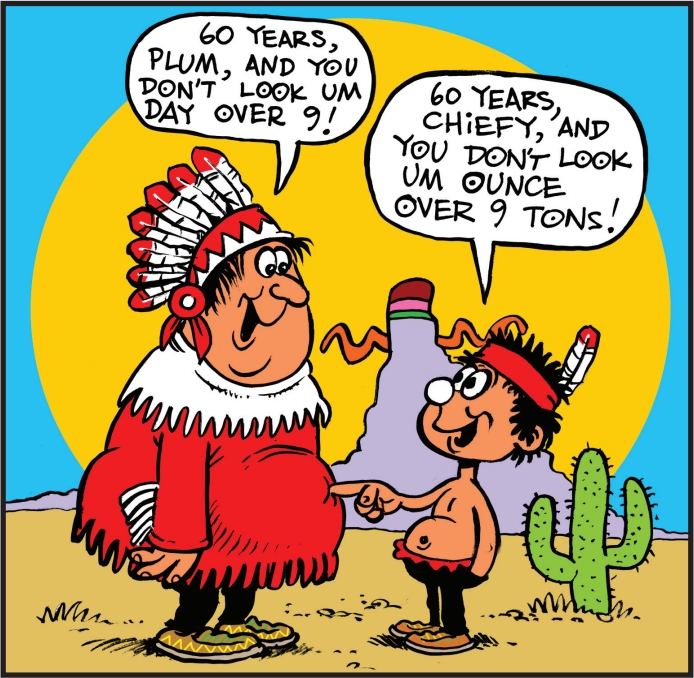
Nobody in Handsworth sees The Beano, although it’s still popular with kids. I got one of the kids in my street into it, and I got a couple of my nephews in as well. It’s called nepotism! Then Fortean Times. My wife sees Fortean Times, but nobody else around me does. A lot of people don’t read anything to be honest.
Fortean Times has built up its own community. Forteana – weird stuff – is very much more popular than it used to be, there are all sorts of TV programs and so on that are related to phenomena. The people who have published Fortean Times over the years have all really liked the magazine. If it was any other magazine it would have been wound up because it doesn’t really pay its way in the world, but the various publishers always gave it leeway cos they wanted to read the magazine!
downthetubes: Interesting. Well besides Fortean Times, Alan Moore and The Beat are both in the book.
Hunt: Yes. Well I was involved with The Beat when they first started in 1980, again that was because of friends and neighbours. There were people I knew who were promoting gigs, and The Beat became part of that world. So when they needed some graphics I was the person who could do that sort of thing. I worked with them for the first two albums, and since then I’ve done some bits of merchandising.
Dave Wakeling has a band in America he calls The English Beat, and in 2016 he got me involved with an album he was doing. I did all the work for that. It was a big job for me. There were lots of graphics and bits of animation, and all sorts of things. It’s a great album!
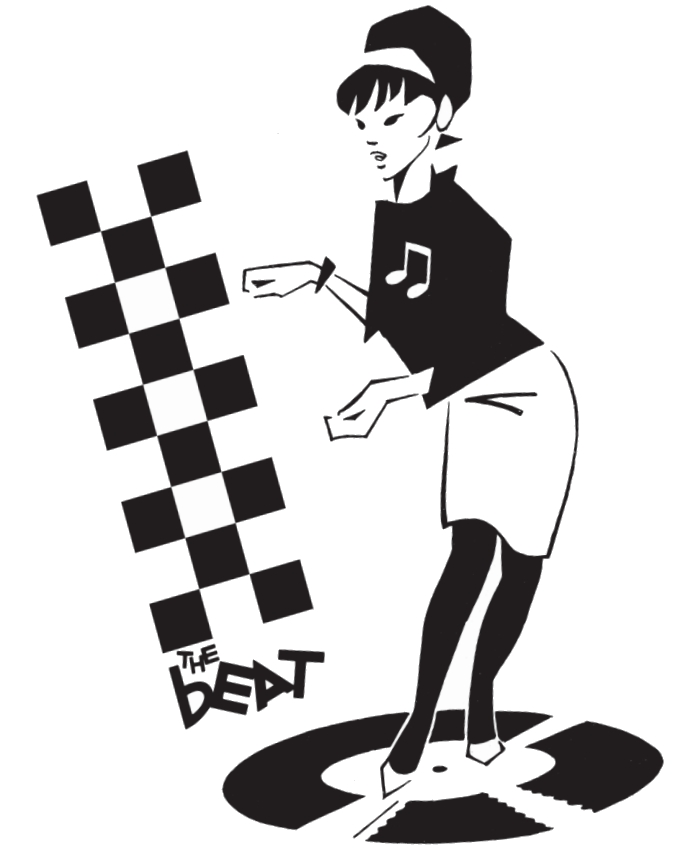
downthetubes: The Beat Girl is in the book too. I remember you explaining that she was based on a real person.
Hunt: Yes, there’s the whole story about Brigitte Bond, whose photograph we based the original Beat Girl on. She turned out to be a trans woman, and we never knew that. But it’s all become part of pop music folklore now. So I’ve got a little footnote in pop music history.
downthetubes: You’ve also got a footnote in Alan Moore’s career.
Hunt: Yes, well I know Alan, but we’ve never been very close. We haven’t spent a lot of time together. I worked with him because it became possible, but I didn’t have the same close relationship with him as other people have. I get on fine with him when I meet him. He’s a very unique person as you no doubt know.
downthetubes: He’s a true original. But remind me how you met him.
Hunt: There was the comics ‘world’ in the Eighties, and we used to meet at the comics marts at the Westminster Hall. That was where Paul Gravett and Escape magazine came from. Alan Moore, Eddie Campbell, Ed Pinsent, Phil Eliott, and so on – they were all part of that. I would be there and I would chat with them, but I didn’t socialise with them afterwards. I was always going off with the Knockabout crew. They had children, so they had to get home and make dinner. It would probably have been a better idea if I had hung on at the pub, but that wasn’t the way it happened.
downthetubes: I can’t imagine what a group of comic creators in a pub would be like!
Hunt: Oh they all moan about money the whole time. The collective noun is a “whinge” of cartoonists!
downthetubes: So Alan just happened to be on the scene at the same time as you.
Hunt: Well he was getting published in Warrior, it was the beginning of his career. Then that developed, and now he’s gone through all of that and out the other end. But because Knockabout was publishing books we were able to ask him to write for us, and I got to do a story with him in Tales Of The Old Testament. I think Tony Bennett mentioned that it was more by default. We had a certain number of artists and a certain number of writers, and we paired them up. At the end of that there was only me and Alan left.
downthetubes: I remember you saying in the book that you took a few liberties with his script.
Hunt: Yes I did. The thing was that I’ve never seen The Wizard Of Oz all the way through, and the story he wrote involved The Wizard Of Oz, so I changed that. I think people know that if they’re going to work with me then I’m going to be in charge of the drawings.
Something I’ve always hated doing is drawing other people’s characters, but sometimes you have to do it. The guy I work with on The Beano – Nigel Auchterlounie – is a brilliant writer, but he’s also a cartoonist. So when I get a script from him half the work is done for me already. The scripts don’t have finished drawings; they just have thumbnails for each panel. Things like the character placement are there, and that sort of thing. It just makes the strips easy to do.
downthetubes: So what sort of script did you get from Alan Moore?
Hunt: He sent me piles of type! He went into great detail about what was going on in every frame, what people were wearing and what was in the background.
downthetubes: So not just words to put into bubbles?
Hunt: No, no, not with Alan. He would talk about the psychological backgrounds to what the characters were thinking at the time, and that sort of thing.
downthetubes: No wonder you had to adapt it!
Hunt: Well it was only six or eight pages.
downthetubes: I don’t know how you fitted a sheaf of paper into that little space.
Hunt: Oh that’s just what Alan always does. It wasn’t just our strip, that’s the way he works. Kevin O’Neil did the same thing when he was working with Alan. The strips would be wide ranging, and then Kevin did what he did with them, and very successfully as well.
downthetubes: So getting back to the campaign for the book, Mark Stafford has just leant his support, and in his indubitable style he called you “a national bleedin’ treasure”!
Hunt: Well with a name like Hunt I’ve been called all sorts of things! But people like you keep calling me the Dean of British Undergound Comics, Godfather Of British Underground, the Grandfather Of British Underground, even. How about the Dook of Earl of British U/G Comics? I like that.
downthetubes: And quite rightly so. Now we just need to get the last bit of funding in place for the book so that people can find out how you earned those accolades.
The Zoop campaign for 50-Odd Years Of Big Noses can be found at the link below, all pledges are very much appreciated.
Go on, you know you want to!
Our thanks to Hunt Emerson and Rory Milne for this special interview
- About the Author
- Latest Posts

One of many guest posts for downthetubes.
Categories: British Comics, British Comics - Books, Comic Art, Comic Creator Interviews, Comics, Creating Comics, Crowd Funding Projects, downthetubes Comics News, downthetubes News, Features