Review by Tim Robins
So, I went to see a film about a young boy with incredible talents who grew up to worry young children and bring chaos to those around him. No, not the new Michael Jackson biopic, but Akira – the 1988 anime that has now been released in 4K at cinemas, on IMAX and 4K Ultra HD BluRay.
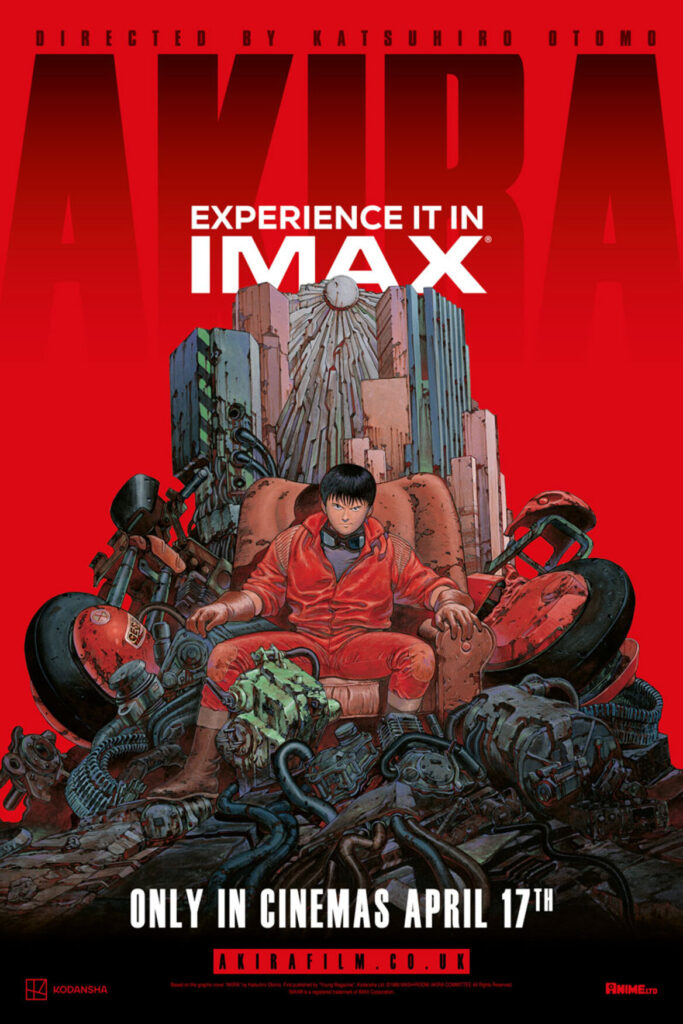
Akira is based on a manga of the same name serialised over 120 chapters (1982-90) in Japan’sYoung Magazine, subsequently republished in English by Marvel, Dark Horse, and Kodansha. (The English-language rights to Akira are currently held by Kodansha Comics, who re-released the manga from 2009 to 2011 through Random House. Kodansha’s version is largely identical to the Dark Horse version).
The manga was created by Katsuhiro Otomo, its writer and illustrator, who also illustrated, directed and co-wrote (with Izo Hashimoto) the anime. The anime was finished before the manga ended and also reworks much of the middle chapters of the manga. Akira the manga and Akira the anime are probably best appreciated as their own thing.

Otomo’s love of American movies can be seen in the way the anime reworks ideas and imagery from films as disparate as The Warriors (1979) and, particularly in the film’s climax, 2001: A Space Odyssey (1968). Otomo contributed to manga’s ‘New Wave’ (not to be confused with science fiction’s New Wave in the 1960s and 70s)which embraced so-called ‘hard science fiction’. So, Akira is set in a post-apocalyptic ‘neo-Tokyo’, a city devastated by a psychic energy weapon.
For the anime, Blade Runner is a particular inspiration. The neon lit Neo-Tokyo contains an enormous, golden ziggurat and important establishing shots open with an ominous base note.
There are also moments that locate Akira within the body-horror genre, particularly when a young boy, Tetsuo, merges with a metal arm of his own creation. The terrifying sequence was developed after Otomo had a conversation with the surrealist animator, Jan Švankmajer.
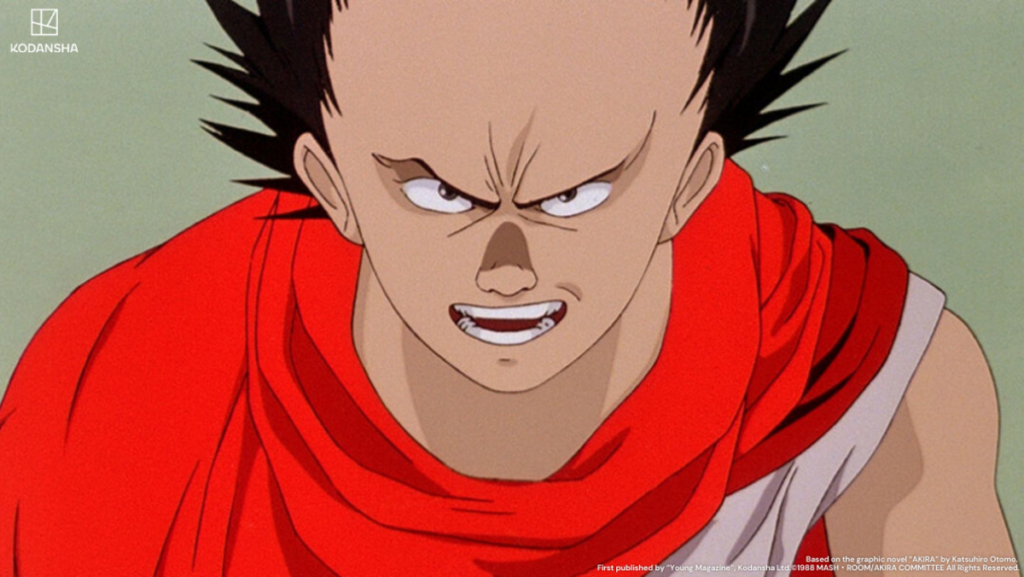
The New Wave manga genre also moved stories from traditional romantic themes to explore boys’ love for one another. If Akira has a single focus, it is the tragic relationship between two, young male juvenile delinquents. Shotaro Kaneda and his younger ‘brother’, Tetsuo Shima. Kaneda is the leader of a Bōsōzoku motorcycle gang, ‘The Capsules’, to which the much put upon Tetsuo belongs. The gang spend their time making out with groupies and fighting other gangs, notably, ‘The Clowns’.
The Capsules gang are inextricably drawn into the machinations of the city’s scientific-governmental-military complex. Unknowingly, Tetsuo, is the victim of an experiment to once again unleash humanity’s innate psychic powers.
Kaneda finds himself torn between the chaotic and increasingly bizarre world of wizened but well-meaning psychic children, his brotherly love for Tetsuo and his alliance with Kei, a young woman resistance fighter against the totalitarian government. There is a West Side Story vibe going on between two characters living in different worlds.
Trying to keep things together, and failing, are the military minded Colonel Shikishima of the Japan Self-Defense Forces and head of research, Doctor Ōnishi. Only they, and their experimental-child subjects, are aware of the nature of Akira, the power that devastated Tokyo and, if unleashed, will do so again.
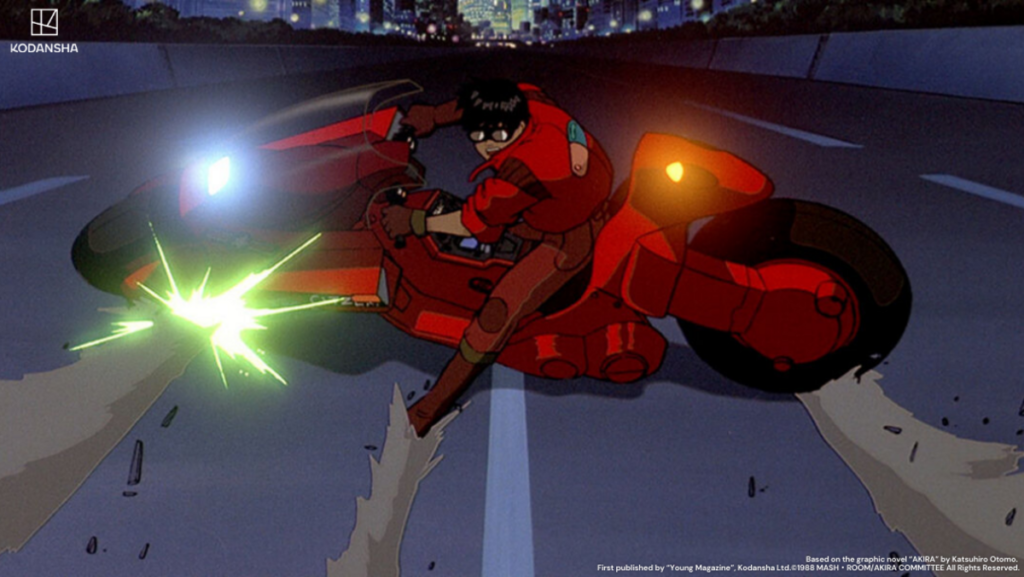
Despite, or perhaps because of, shortening the manga, Akira’s plot is incredibly dense. When I watched the film in the Eighties, my impression was of a film filled with motorbike chases and grotesque horror. Kaneda turning his motorcycle by skidding it sideways along a stretch of road remains totally cool and absolutely iconic. Since Akira’s first cinema release, Kaneda’s move may well be the most homaged scene in animation history.
Watching Akira again, I was struck by the large amount of time given to elements of wider city life, gang culture, corporate-governmental politics and characters’ personal ambitions. It is left to us to keep track of this. There’s a really well staged shot of a deposed, high ranking official popping pills while creeping down an ally, but it was slightly spoiled because I couldn’t remember who he was. Lady Miyako, leader of an Akira worshipping cult, gets particularly short shrift.
That I didn’t lose track of more characters is a testament to the fantastic drawing on display. Akira exists in a world where characters are drawn in a style less comedically cartoonish than today’s One Piece or Naruto, both currently available on BBC iPlayer. In an anime where a person’s character is not characterised by the colour of their hair, attention to facial expressions and body language are all important.
For me, design is one of the main attractions of Akira. The anime certainly shows the influence of the ligne claire (“clear line”) style, exemplified by Herge’s Tintin. In the years following Akira’s release, Otomo would be decorated as a Chevalier (2005), then Officier (2014), of the French Ordre des Arts et des Letteres. In 2015, he would receive the Grand Prix de la ville d’Angouleme, the first manga artist to receive the award.
As for Akira’s tone – my goodness, it is serious. The anime certainly captures the ‘hard bitten’, ‘science noir’ style of cyber punk. There are only a couple of humorous lines, and even they are sarcastic. I’ve noted “where’s the friggin baby from” as the funniest line in the film! Akira is nothing if not dour.
In the UK, Akira is rated 15. It contains an attempt to rape a young woman and scenes of bloody violence, so much blood and violence. There is also drug use. The ‘young’ subjects of Doctor Ōnishi’s psychic experiments are shrunken and prematurely aged by the drugs they are given to repress their powers. I wouldn’t even chance showing this film to children.
A scene where gigantic toys, including a stuffed teddy bear are used as avatars to terrorise Tetsuo remains terrifying. They bleed a white fluid (milk) echoing the later colour of Akira’s expanding powers. Ironically, for a film unsuitable for children, Akira is precisely about the power of children. Colonel Shikishima, is left to stare at the sunset.
The film, released by Toho in Japan, again engages with the horrors of the atomic bomb unleashed by America on Hiroshima and Nagasaki at the end of World War Two. It is surely not coincidental that the film begins and ends with a vast, ever expanding hemisphere of energy, or that Akira is encountered in what looks like glowing capsules containing radiation.
Responsibly handling the great power unleashed by science should be handled responsibly is, of course, a theme of Gojira (1954). In Akira, the matter is handled by a distinctly Japanese take on Kaneda and Tetsuo’s love for each other. Tetsuo is a threat because he does not respect his place in the social hierarchy. He refuses to accept that, as the youngest of the gang, his role includes being ridiculed and bullied. Tetsuo’s wilful defiance, his desire to be top of the pack, can only exist in a different society, or, in fact, a different universe.
Thanks to Jason McFee, for pointing out the way Akira drew on the craze for biker gangs – Bōsōzoku – who would cruise city highways in groups of up to 100 bikers. The Bōsōzoku would jump toll booths, smash cars and beat up disapproving bystanders. For a while, they were the prevailing form of youth delinquency in Japan with gang membership peaking at around 42,510 members in 1982 – as noted, the same year the manga began to be published.
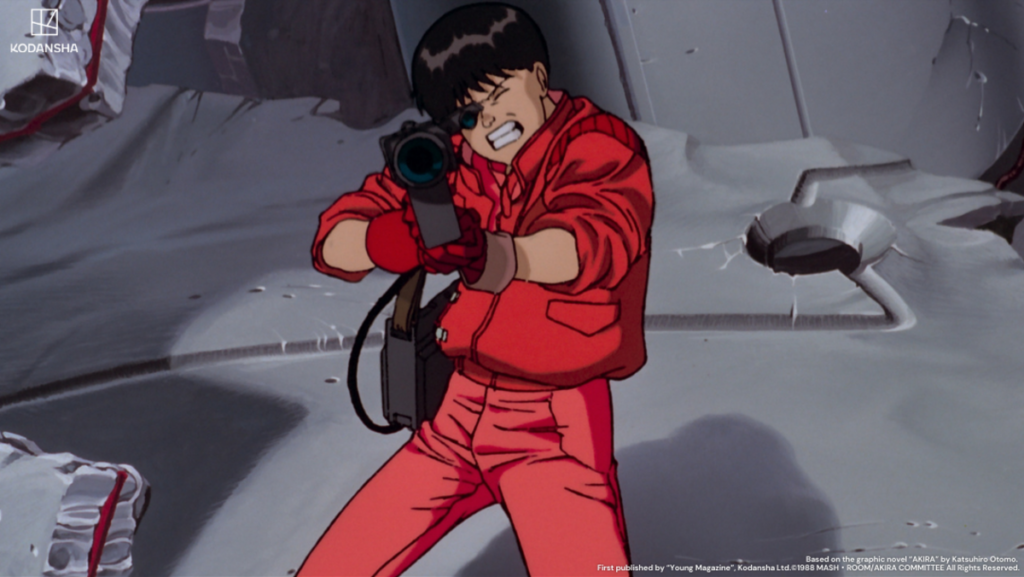
Watching Akira after so many decades was a conflicting experience. I am on the verge of saying the anime is to be admired more than enjoyed. I did tire of the recurring motif of rocks and other debris floating off the ground.
Some of the animation is a little jerky, despite the fact the film was animated with an astonishing 12 cels a second and 24 cels a second. The effort spent on ‘in-betweening’ can be seen in scenes of Tetsuo’s body morphing to gigantic proportions. The strobing that accompanies fewer in-between cells is used to amusing effect when Kaneda is goofing around, his hands jumping around as he waves them.
A lot of my pleasure was in the technical details, including the use of parallax, the character design and the colouring, including shadow work. And the musical score is top notch. Akira draws on the Indonesian Gamela tradition, which predominantly uses percussion instruments such as metallophones struck with mallets, and hand drums. The music gives scenes of city based action a haunting lyricism that belies the violence we are watching and gives the conflicts a ritualistic quality – tradition and spirituality mingle with the neon technological dystopia. Choral work comes in as Tetsuo becomes more god-like.
Some of Akira’s importance lies in its place in history. In America, the manga was translated, coloured (by the esteemed Steve Oliff) and published under Marvel’s Epic imprint. It was probably the one of the first manga many of my English-speaking generation in the West had ever read, and comes from a time when publishers tried to make manga read from front to back and right to left. A more contemporary and sympathetic, black and white treatment can be found in a 35th Anniversary Box Set from Kodansha.
As for the anime, it still bursts with energy. The work demands to be respected, admired and, yes, enjoyed. Kaneda’s motorcycle remains simultaneously the hottest thing and coolest machine on two wheels.
Yet Akira, as mentioned above, is a deeply serious affair. Never has the line, attributed to the Marxist and Italian Communist Party leader, Antonio Gramsci, seemed more appropriate, “The old world is dying, and the new world struggles to be born: now is the time of monsters.” (Although he actually said, “In this interregnum a great variety of morbid symptoms appear.”)
Now I’m off to buy a red leather reproduction of Kaneda’s biker jacket, with The Capsule’s pill logo on the back. It may be a symptom of old age, but I reckon I’ll look totally rad!
Tim Robins
• Akira is online at akirafilm.co.uk
Head downthetubes for…
• Akira 35th Anniversary Box Set (AmazonUK Affiliate Link)
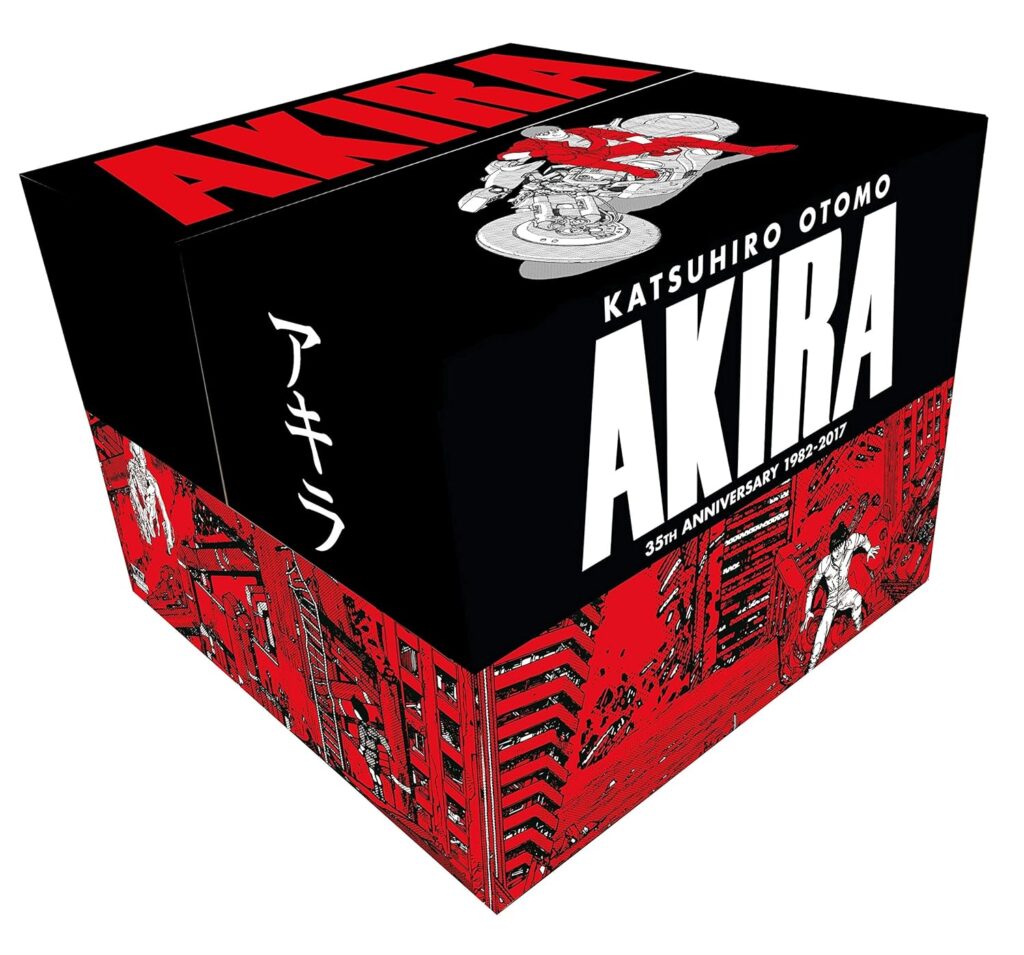
In 1982, Kodansha published the first chapter of Akira, a dystopian saga set in Neo-Tokyo, a city recovering from thermonuclear attack where the streets have been ceded to motorcycle gangs and the rich and powerful run dangerous experiments on destructive, supernatural powers that they cannot control.
An all-new, complete 35th anniversary hardcover box set of one of the most acclaimed and influential comics of all time was released in 2017 by Kodansha, with the original Japanese art and right-to-left reading format for the first time.
The science fiction epic that changed anime and manga forever is presented in six beautiful hardcover volumes, plus the hardcover Akira Club art book and an exclusive patch with the iconic pill design.
• The Impact of Akira: The Film that Changed Everything
• Jan Svankmajer: Conspirator of Pleasure
• Three Decades of Akira Slide Homages
- About the Author
- Latest Posts

A freelance journalist and Doctor Who fanzine editor since 1978, Tim Robins has written on comics, films, books and TV programmes for a wide range of publications including Starburst, Interzone, Primetime and TV Guide.
His brief flirtation with comics includes ghost inking a 2000AD strip and co-writing a Doctor Who strip with Mike Collins. Since 1990 he worked at the University of Glamorgan where he was a Senior Lecturer in Cultural and Media Studies and the social sciences. Academically, he has published on the animation industry in Wales and approaches to social memory. He claims to be a card carrying member of the Politically Correct, a secret cadre bent on ruling the entire world and all human thought.
Categories: Animation, Comics, Features, Film, Other Worlds, Reviews
 In Review: Asterix & Obelix – The Big Fight
  In Review: Dog Man (U)
  In Review: Spider-Man – Across the Spider-Verse