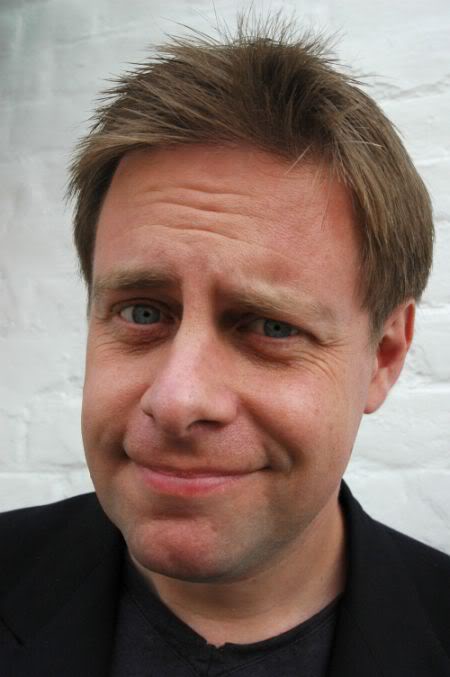
Matt Badham conducted the following interview with novelist, comics and TV writer Paul Cornell in 2008, as research material for an article about Captain Britain that subsequently appeared in the Judge Dredd Megazine. Although various quotes were used in that article, this is the first time that the full transcript has seen the light of day (a highly edited version did previously appear in Tripwire magazine).
Matt Badham for downthetubes: Before taking on Captain Britain and MI-13 for Marvel Comics , were you actually a fan of the character?
Paul Cornell: Oh, yes, enormously. I had every collection that had ever been released up to that point, which wasn’t many. One of my earliest comics memories was that one Christmas my parents got me a Captain Britain annual, which had the origin story and some Gil Kane Captain Marvel in the back, if I remember correctly. (I may be recalling that wrong). And I’ve loved him since then.
I think that the very earliest Captain Britain stories are some of [artist] Herb Trimpe’s best comics work. There’s something really involved and exciting about his art on the title. And I don’t think that Chris Claremont does a bad job at all with the story. I was also obviously a fan of the Alan Moore Fury stuff, but Jamie Delano as well, you know, all the different approaches… and Dave Thorpe, who I think is sadly neglected.

downtheutbes: Everyone seems to focus on the Alan Moore stuff.
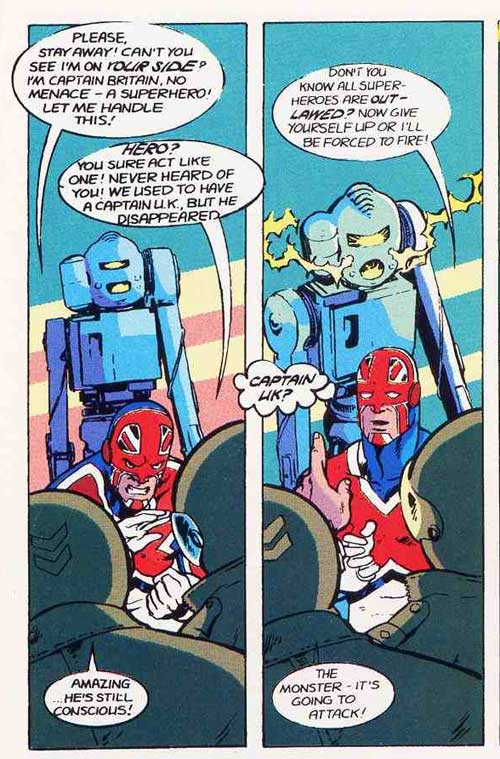
Paul: Alan Moore and Alan Davis do loom hugely over the title. So much so that the only thing to do when I took over was to move it out of their sphere of influence, because a character that is being influenced by previous versions to an undue degree is not a living character.
I tried to do what I think Ed Brubaker has done spectacularly on Captain America, which is to find what would work for the character now and move it out of the shadow of previous interpretations.
downthetubes: I think you’ve answered my next three questions without me having to ask them. I was going to ask how you felt about filling big shoes by following creators like Claremont, Davis and Moore, who have all previously handled the character.
Paul: I am not. I am simply not filling those big shoes. I am making my own shoes.
downthetubes: Your Captain Britain has undergone a dramatic re-birth and reinvention. Please tell us about that.
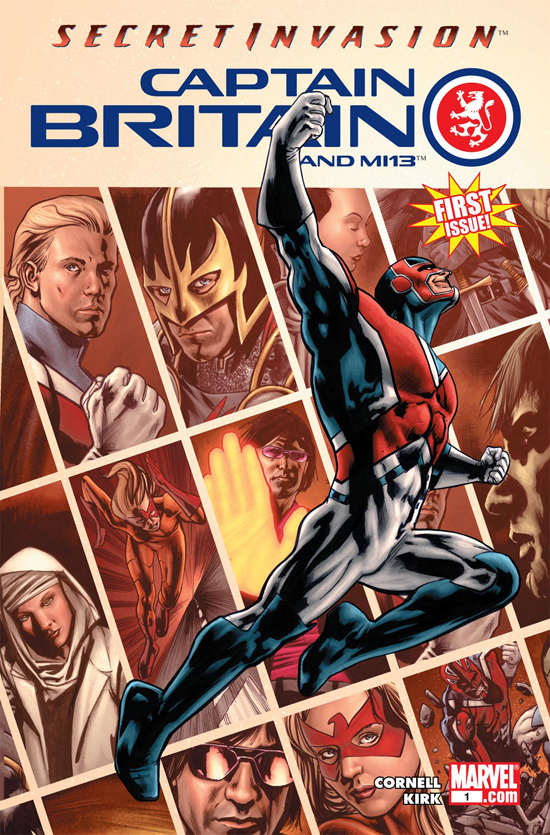
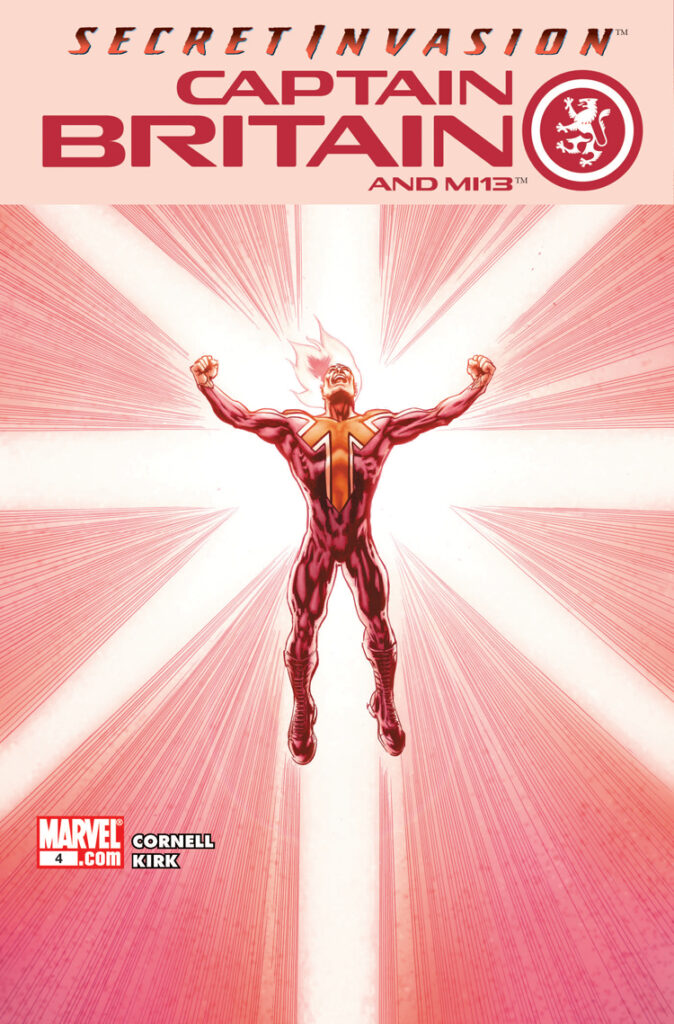
Paul: Let’s go into the details. For a start, the [Alan] Davis costume is a lovely piece of comic art. It’s a brilliant piece of design. But I think that it says to people, Excalibur. To be precise, whimsical, fluffy, jolly, lovely, warming, heartfelt Excalibur.
I’m enjoying the classic Excalibur collections and, indeed, read the comic when I was younger, but I do think it is from a previous era of comics, where a whimsical, ‘We’re all in this together gang’ feeling was the norm. These days, we have a smaller audience and a much more focussed comic shop audience. This is the move from the whole world getting comics in their newsagents to fans getting comics from comic shops. Comics are much more action-oriented. I wanted to change the costume.
There’d been a halfway house, leaving the old costume, but putting pouches around the belt, which had been developed by various other artists. But I wanted it to be the new creative team that defined the character now, rather than being in the shadow of previous creators.
Also, I didn’t want readers to be reminded of Excalibur all the time. And because [MI-13 artist] Leonard [Kirk] does wonderful facial expressions, I wanted it to be a costume where we could see all the ‘acting’. And Cap’s mask really limited what… even the eye sockets were blank. You need that costume to be drawn in a slightly cartoony way to express enough emotion out of it. If you think of a standard Alan Davis-shot of Cap’s face when he’s surprised, it’s quite cartoony because that’s the way to get the emotion. With Leonard Kirk’s more photo-realistic art, you don’t get the emotion that Leonard is capable of if Cap is masked.
downthetubes: Because the features are obscured?
Paul: Absolutely.
downthetubes: You mentioned that you’re aware, as a writer, of the audience being more exclusive/fannish.
Paul: Yeah. And this is true of all comics I think. Would Justice League International, (laughs), would that sell nowadays? I don’t think so. The warm bath Excalibur with lots of in-jokes and appearances by staff members and reaching out to the fans every single moment; I think that’s a wonderful way to run a comic book but I don’t think it would sell today. I think most comic creators do write with this in mind, but some of them consciously and some of them unconsciously. Myself, I’d like to be on the newsstands. We’re not and that’s nobody’s fault. It’s just the way the world is now.
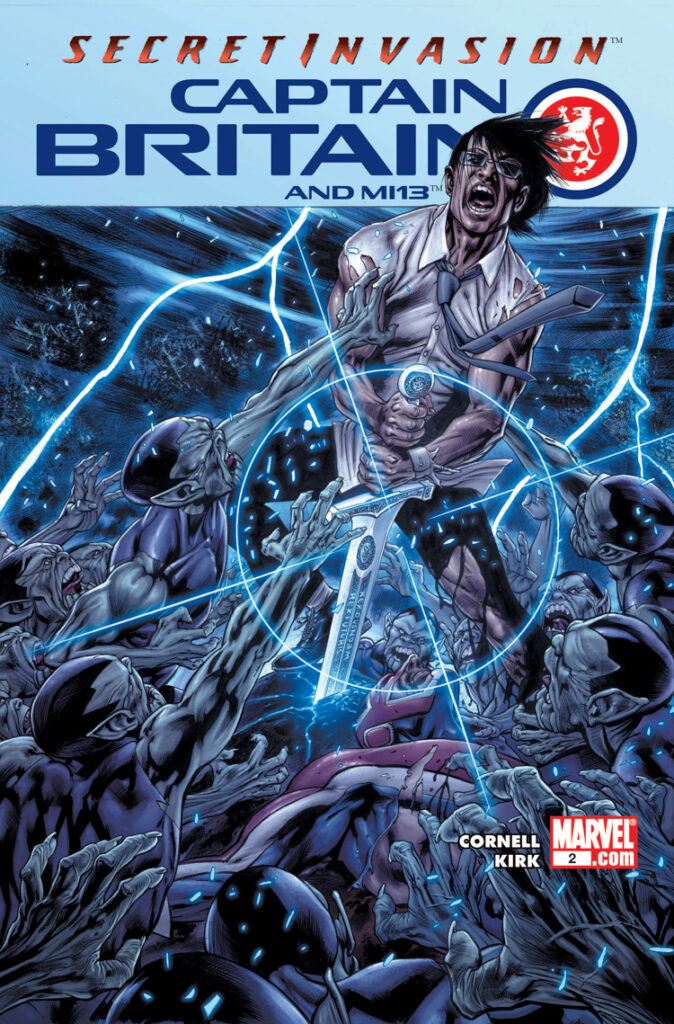
downthetubes: When I was reading the comic, I got a sense that it was a post-Ultimates book. Do you agree?
Paul: In that I’ve read Ultimates and it’s somewhere in the mix. The Ultimates is very well written and it delights in its bullishness. It delights in pushing boundaries.
downthetubes: The Hulk eating people…
Paul: I think that we are one notch less ruthless, and when Pete Wisdom wants to be ruthless it’s to come as a stark reminder; and it’s set against an effort to bring heroism back into the book, which is brought in by Cap, who is magically created.
He is Marvel’s Captain Marvel.
Cap was picked because he is the best of British folk against Pete, who tries his damnedest to make sure that everyone survives and to be good, but feels that, and I think this was best summed up in the anime, Samurai Seven, ‘You must be prepared to take upon you the sin of killing.’ Pete feels that he is the one who has to take onto his conscience doing the nasty stuff.
I wanted for Cap and Pete to be friends, because in the past they’ve always played out this conflict through a series of huge dramatic arguments, and I wanted this conflict played out with the two of them trying to understand what the other has to do.
It could be said that Pete has co-opted Cap into his world. Cap is actually more pure and more pristine than that. Pete’s doing his best. He’s not lying to anybody. He’s trying to put these big iconic British superheroes into an intelligence setting and it’s working so far, but there are tensions and that’s where we get the meat of the conflict.
downthetubes: The character of Captain Britain does actually refer to those tensions in the book, when he talks about the fact that he’s killing Skrulls because the Earth is at war with the Skrull Empire, but after the war he won’t carry on killing. It strikes me that this is a theme in a lot of your writing, right back to your work with the Doctor Who New Adventures range of novels for Virgin Publishing – the plight of the morally upright person who is finally forced into a position where they have no alternative but to do bad things to save the day.
Paul: Absolutely, because loving Doctor Who and that being the centre of my writing world, you learn more and more that the thing to do is to put your characters through the biggest emotional hell possible. If you’ve got the Doctor who is, from a certain angle, that morally upright person, you have to do that to him. That’s where the drama is. That’s where you’re going to naturally go. The gravity of writing takes you there.
The same is true for Captain Britain, who in the old series was almost ridiculously upstanding. That was one of the things that, again, Excalibur kind of gravitated to, because he was an upstanding hero and because he had to be drawn in a cartoony way to express emotion, then he becomes a bit of a buffoon almost automatically. I wanted to get the buffoonery out of him. And to do that, he’s got to be a little more accepting of stark realities while remaining the hero. So we’ve got those lovely grating edges and some nice friction there.
downthetubes: He’s a reluctant soldier.
Paul: I wouldn’t say reluctant. Reluctant during the Skrull War. He’s, I think, certain that Pete won’t ask him to do anything that he wouldn’t want to do. And if Pete did ask him, then Brian could just refuse.
That’s where we are at the moment. Brian might find out certain things that Pete does to clear up round the edges of what happens and that’s going to be interesting. I’m trying not to spoil the end of my current arc.
downthetubes: Just to segue off into something that’s related. How much fun are you having writing Pete Wisdom?
Paul: Tremendous fun. Pete is my Mary-Sue.
downthetubes: That’s a fan fiction term isn’t it?
Paul: Yeah. A Mary-Sue is a character who’s there to represent the author. Having said that, they all are to some extent.
downthetubes: They’re different facets of you?
Paul: Absolutely. I think that’s the best way to write a team book. One of my favourite things in comics is the moment when a character’s behaviour just writes itself. You gain an insight into an old, established character; often it happens with writers for Batman… that’s what I like. I like to give my characters those moments.
Pete has been neglected in recent years. He’s a little bit of a fallow field to play with. He’s such an everyman, but he’s got this big burden of guilt that he deals with in an almost unique way, by keeping on moving into the future and not being defined by that guilt. But he also always makes sure that nobody else has to do the bad stuff. That it’s always him. He’s sort of the negative version of Peter Parker. If Peter suddenly thought that the way to do things was to just to shoot the Green Goblin.
Again, the desire to create a pristine, shiny team of superheroes; I think that Pete would love to do that. It’s his aspiration as opposed to where he always ends up.
downthetubes: Again, it’s the fundamentally good man who is forced by circumstances to do some bad things for the greater good.
Paul: As a socialist, I’m an interventionist. It’s all been completely twisted round in modern politics… It used to be the Right that wanted to stay at home and the Left that wanted to, you know, help the Spanish. Pete also represents my desire to get on with the future and not be held back by the past. On a national level.
One of my complaints about Britain is how it’s always looking backwards. It’s still defined by one world cup and two world wars. To which the German football fans might justifiably reply, ‘Sorry, what!?!’
downthetubes: And do you get irritated by things like the scapegoating of youth?
Paul: Very much so.
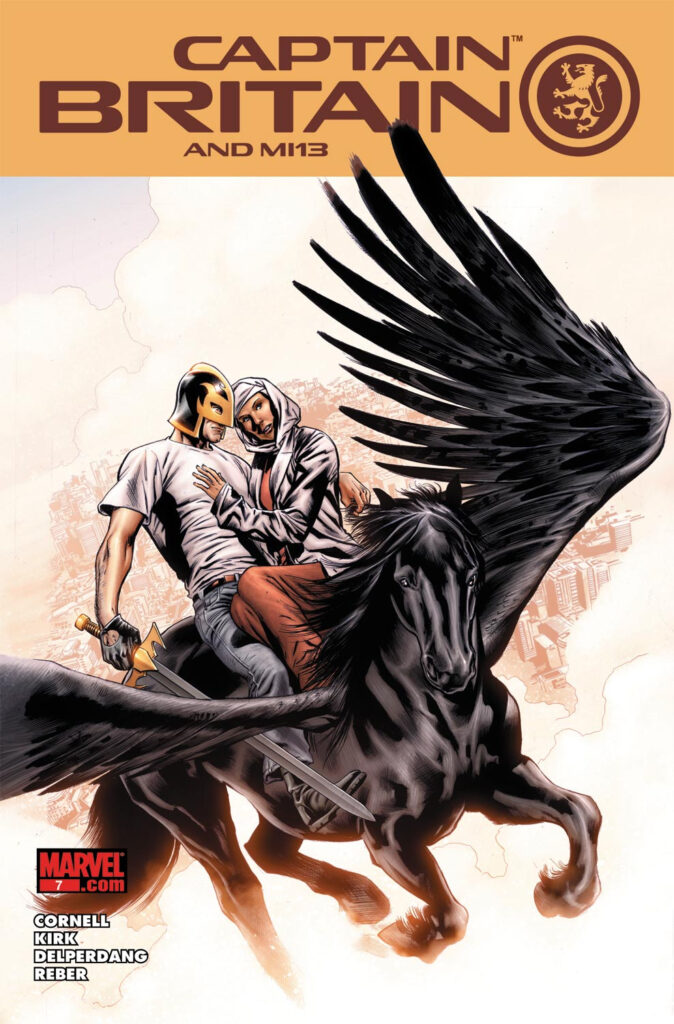
downthetubes: The interesting thing about the book is that on one level it’s about well-choreographed superhero slugfests, but on another it’s quite issue-based and quite politically-chraged.
Paul: Absolutely. Giving Fasia Excalibur was really important to me.
downthetubes: This is Fasia Hussain, the character of the young Muslim doctor.
Paul: Because what it represents is unconditional acceptance. If you can draw Excalibur, then you are British. And strangely enough, that hasn’t been controversial in the slightest, which I’m quite pleased about.
downthetubes: Do you think that shows that people are generally more sensible than they’re usually given credit for?
Paul: I always think that, given the chance, they can be. Anyway, what I try and do is what all the best superhero books do. I try and write modern Greek and Roman myths that actually reflect things that are going on right now. Much as every body of mythology talks about what is happening right now, in terms of when it was created. The Ultimates did this very well. And everything that Stan Lee ever did was literally just about looking out of his window. His Marvel comic body of work, which is all about New York, is just extraordinary. The fact that Peter Parker still, all these decades later, represents to us something iconic about being a certain age.
downthetubes: It resonates, doesn’t it?
Paul: It does. That’s what we’re after. That feeling of things resonating. That’s why I wanted to have a superhero team that have a different relationship with officialdom than they do in the United States. We could have, over here, a superhero team that was officially sponsored and accepted, but were not regarded as slightly priggish as they are in America post-The Initiative and all that. You don’t have to be a rebel over here to be cool necessarily.
I also wanted a team that was part of the whole military structure and the political structure. Apart from anything else it’s really cool to have a bunch of heroes on a mission with a bunch of soldiers helping them. It’s Jon Pertwee Doctor Who, really.
downthetubes: I wanted to go back to the issue of cultural identity. Fasia Hussain is interesting character in her own right, but her inclusion in the comic, to me, says something specific about Britishness.
Paul: I think so. You’ve got people from all different aspects of Britain in there. People assume that Brian’s nobility, but he’s not. He’s got some inherited wealth that was acquired during his superhero run. It’s Jaq that’s nobility and her voice… well, I’d like her to speak rather more ‘40s than she can, because her speech habits will have changed during that long life of hers. And when you’re young again you find your speech habits being knocked back and forth. That’s where our speech habits evolve anyway, so I assume that when she became young again there was a huge in-flux of modern vernacular.
And also there’s something that feels wrong about a character being too Lady Penelope [the posh secret agent from the 1960s puppet adventure series, Thunderbirds] in modern comics, so I’ve had to try and rein that back. So we’ve got her from the nobility, we’ve got Fasia from the Pakistani community.
This is the other awkward thing that I wish we didn’t have in Britain: we don’t have Italian-American, we don’t have Pakistani-British. We still call such folk Pakistanis, which doesn’t work and says a lot about us. She is a Pakistani-Brit. We have Dane, who’s an American, but he’s been over here so long… and I think Eric is kind of like that too, in that I don’t believe he has any British speech habits left. I think that he’s entirely American. And of course, Pete, who is what you might call working class. His family are from Wiltshire, but I think that he’s lived in London for a long time. I always think that he talks a little like Michael Caine. This is why I always have him pointing. Michael Caine points at things. It’s a kind of stew.
downthetubes: Like society.
Paul: Yeah, and I do recall… I love Knights of Pendragon, but one of the things that I disliked about it was that they were forever having people point at Captain Britain and go,”‘You’re a fascist, wearing the flag etc, etc.’ And he would have to patiently explain that he wasn’t and that he represented all that was best about Britain, yadda, yadda. This is sub-text.
downthetubes: But there has been, certainly in my childhood and up until fairly recently (I’m 35), a big nervousness about the Union Flag because of its appropriation by the Far Right.
Paul: I think it’s changing a little. Thanks to football, we are actually flying the flag a bit more.
downthetubes: Do you think that’s healthy?
Paul: Yes, it is.
downthetubes: What’s your take on the potentially blurred line between patriotism, nationalism and racism?
Paul: I think that only the English feel uncomfortable about patriotism.
downthetubes: Do you think we’re bad at assimilation, basically?
Paul: Yeah, exactly. When you’ve got assimilation, patriotism actually becomes something wonderful.
downthetubes: Because people belong?
Paul: Yes, absolutely. It not only makes people belong, it allows them to belong. Over here we have never asked immigrant populations to embrace the flag and we sometimes get out the flag and use it to beat them with. I think that if we started to embrace the flag, we could perhaps ask them nicely to as well. It’s one of those things that is rooted so deeply in us that it may never happen.
downthetubes: Do you think this is part of being an island nation?
Paul: I think so. The Japanese have almost exactly the same problem. I always equate Japan and Britain hugely.
I think that we are very similar peoples actually. In all the good ways as well as some of the bad ways. I think the more we hide the flag away the more we’re going to be scared of it. We’ve got to get it out there and show it. For a start, it implicitly references immigration. That first integrated flag with the various different crosses on it. I would never have a Cap costume that didn’t have the flag on it.
downthetubes: Do you feel sometimes, certainly, an awareness of your politics… that we’ve been discussing… do you feel they’re a bit misunderstood?
Paul: I’m very easily misunderstood, because I’m a bit of a mix.
downthetubes: Aren’t most people?
Paul: Yes, especially, in the last decade, where things have been turned round to such a degree. I’m New Labour and I think that a lot of people who claim to be old Labour, it’s kind of like, ‘What have the Romans done for us?’ You know, apart from the minimum wage and the Bank of England and all these things are things that Labour would heartily agree with. It’s almost a fetish saying there’s a difference between the two. It’s a meaningless bit of in-fighting.
I think the Third Way economically, to say there are certain things that private enterprise does really well and there are certain things that should only be run by central government, is the only sane plan.
Old-fashioned socialism, that is to say everything should be nationalised, doesn’t work and letting the free market loose doesn’t work. I’m very much what you’d call a moderate, in those terms.
downthetubes: And presumably, for you, New Labour got that balance right?
Paul: Yeah, absolutely.
downthetubes: What was this about Conservative leader David Cameron in Captain Britain and MI13?
Paul: I was really sorry I couldn’t put him in.
downthetubes: Did the lawyers get on to you?
Paul: I was going to treat him nicely. Basically, he was going to be meeting with Dracula, who was going to say, ‘If you do this small thing for me, then I will use my influence in Britain to get you elected.’ And we’d have Cameron going to him, ‘Yes, yes, I will think about your proposal. That sounds great.’ And then going home and immediately calling MI-13. But the lawyers said that even for a couple of pages the hint that a real figure might be doing something bad wasn’t allowable.
The only way that we could have Gordon Brown in there [in an early issue] was that he was being thoroughly heroic. That applies to the use of all real figures in Marvel really.
downthetubes: Are you slightly disappointed?
Paul: Yeah. But, you know, it’s nobody’s fault. It’s just the way things are.

downthetubes: How important has Leonard Kirk been to the book’s success?
Paul: Hugely. Three people run the book really. Me, Leonard and Nick Lowe, the Editor. We have these demented plotting sessions and conversations. It’s a great way to do things, because we can change things between us. Not like a TV show where you’ve got layer upon layer of people to check stuff with. Nick has really been a powerful force in terms of plotting, in terms of shaping where we’re going. And that’s great. We form a plotting unit.
Leonard is a great artist; he’s got fantastic, what they call acting in comics, he can create terrific drama through expressions. It means that I can pull back from descriptive dialogue. He will re-plot a page if he has something better in mind and we now know each other well enough that I can just let him because his version is always better.
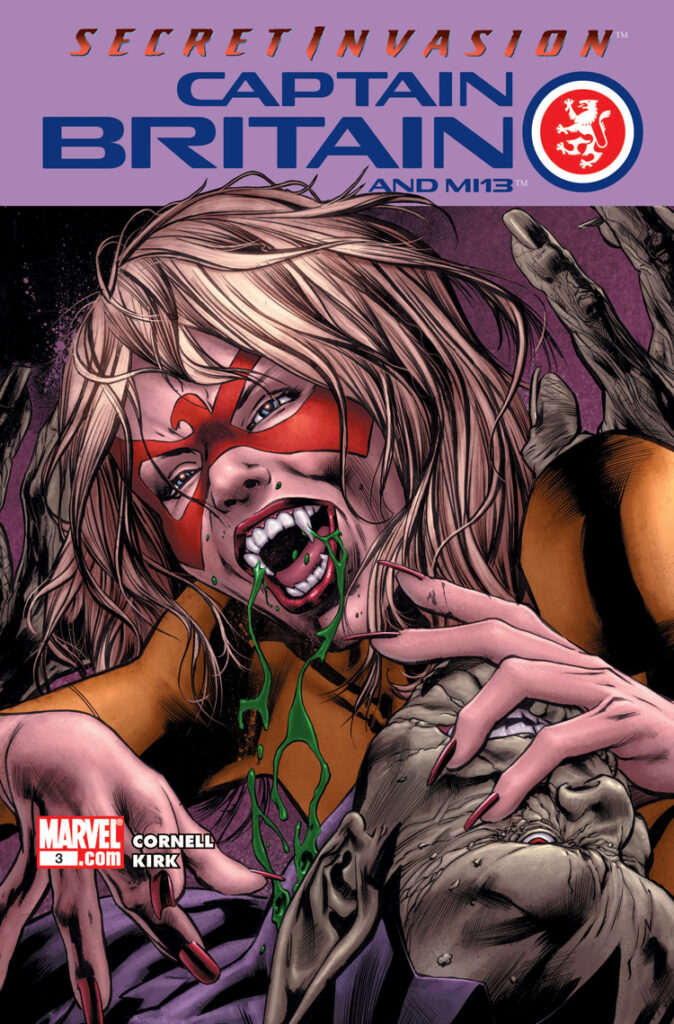
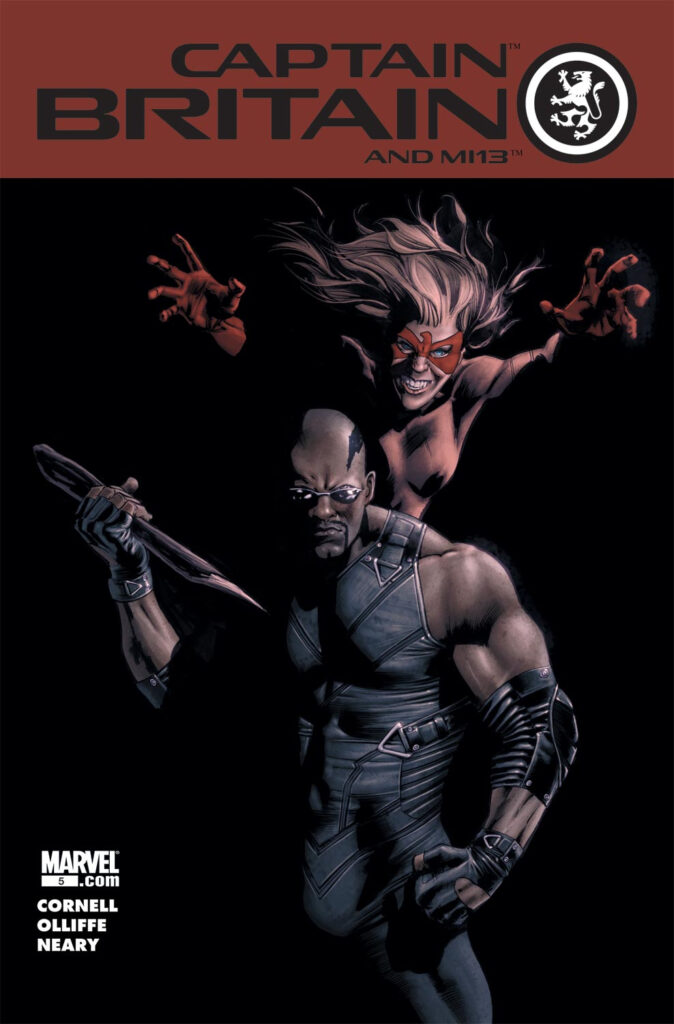
When I had a Blade versus Spitfire fight scene page to write, I thought that there was no point at all in me writing a silent fight scene for the page, so I just asked Leonard to have them fight. He knew what both characters wanted and he knew where they were going to end up, and then the next page is back on script. What I said to him was, ‘You choreograph that.’ What he provided was a page composed of 16 panels. Now I would never have given an artist that, because that would be seen as insanely demanding, but it’s a great scene! And this is the level of trust that’s developed between us. It’s lovely.
downthetubes: Are you, Leonard and Nick starting to get that ‘musicians in a band’ feel?
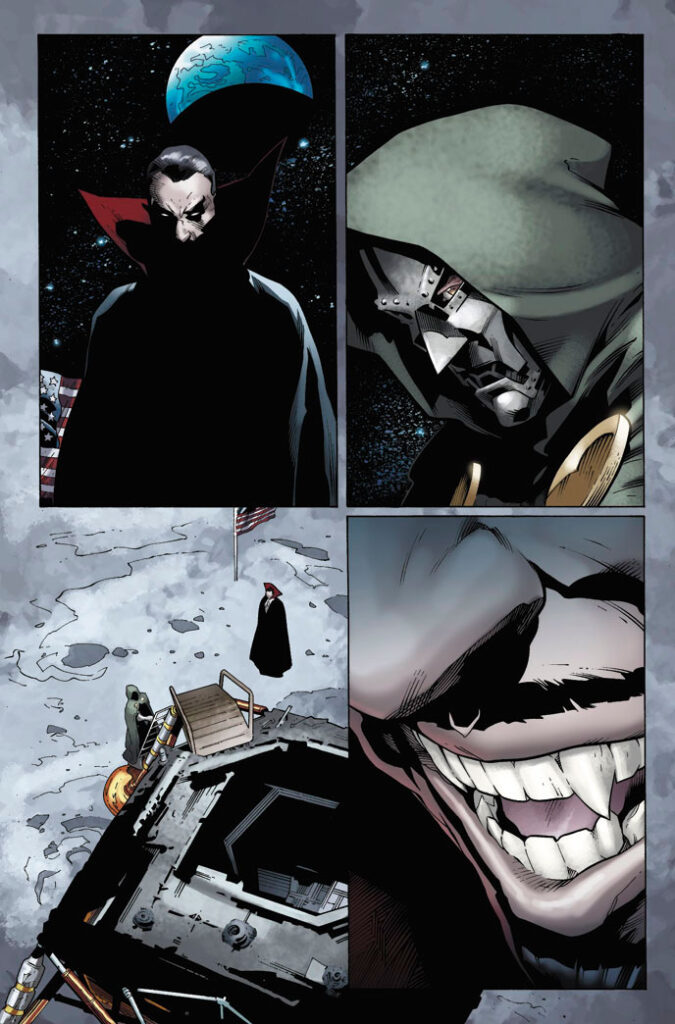
Paul: What Nick does is, I throw all the ideas at him, including the bad ones, and he cherry-picks. It’s like I’ve got a safety net. So when I suggest Dracula on the Moon, he says, ‘Great!’ It’s lovely. I can really go to the edge imaginatively, but he’s there to catch me if I fall over.
downthetubes: How much fun are you having the superhero slugfests? Although, you mentioned that you’re deferring on those more and more to Leonard.
Paul: Well, only in terms of the actual dynamics. I love superhero fight scenes. I love X-Men-style fight scenes where it’s about cooperation. It’s about doing them in terms of emotional content.
The next issue that I’ve got to write, I’m thinking it might be very nearly silent because we’ve got some huge emotional trauma going on but I think it can almost all be put over without speech. The trouble is that will make it read fast and I want it to read slow, so it might be a case of some long, low, flat panels that will slow the reader down. It’s going to be interesting, the next one.
downthetubes: You scripted quite a lot of comics before Captain Britain and MI-13, but I get the impression that writing this book has taught, and is teaching you, some new tricks.
Paul: I think I’m still learning about comic book scriptwriting, but you don’t ever stop. I learnt a lot on “Xtinct” [a theological dinosaur strip for the Judge Dredd Megazine; as bonkers as it sounds! – Ed], because I gave D’Israeli some insane page descriptions. I was up to ten panels a page on some of that and he managed to do everything I asked in a really cool way, but comparing script to panels I found myself thinking that I could have asked him to achieve the effects he achieved in better ways.
I’ve been really lucky with people I’ve worked with. I really liked the work of Mark Brooks on that issue of Young Avengers Presents I did.
downthetubes: Do you prefer photo-realistic art or cartoony art? Or is it kind of an apples and oranges question?
Paul: It is, yeah. I will try and write to suit whatever is there. And more cartoony isn’t seen as good these days, but I think that kind of comic art can actually be much more emotionally expressive. Like Scott Pilgrim. The storytelling in that is over the moon. It’s horses for courses really.
Dracula and Doctor Doom feature on this interior page from Captain Britain and MI13 #10
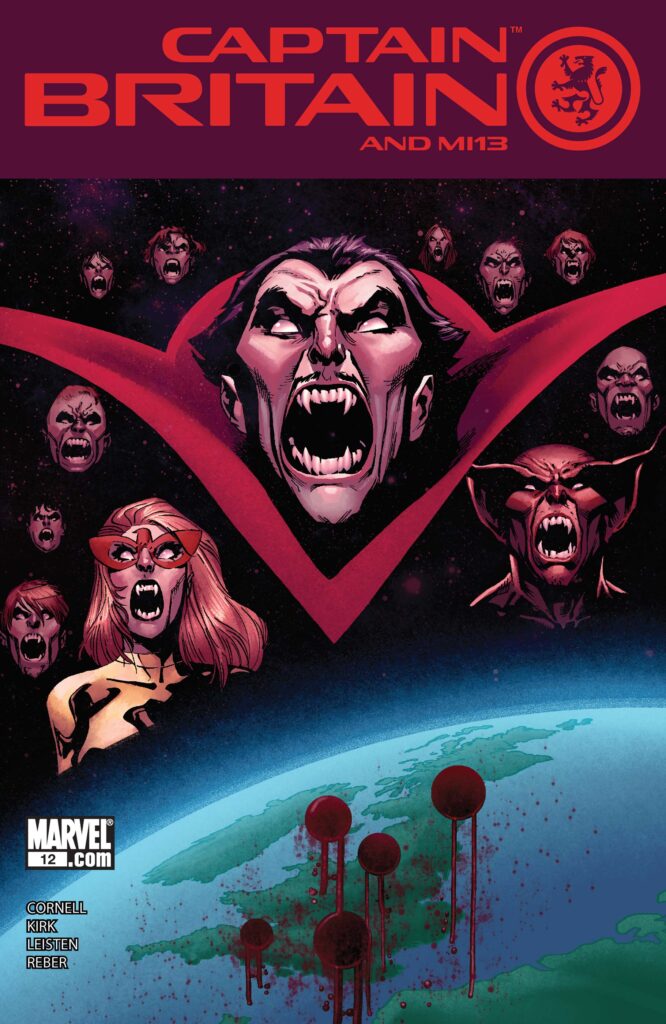
downthetubes: Which other heroes are going to guest in Captain Britain and MI-13? This special is out in February/March and with that in mind, what’s next for Cap and MI-13?
Paul: We’re talking about the Dracula arc, which is six issues, beginning with issue 10. It’s tied into Dark Reign, the next Marvel event. I’m not sure if it’s going to be a crossover or just accept the new status quo. Dracula has put the forces together to take Britain over either overtly or covertly. It’s about trying to be in charge of the night, as it were, the supernatural beings that were let loose by Pete. And his first step toward this creates diplomatic problems, and it should be noted that he has a castle on the Moon now, because it’s very hard to launch a military action against anything on the Moon without annoying lots of other countries. His first action is to come straight at MI-13 and attack them all in ways about which they are weakest.
The first issue of the arc is hopefully like… it’s an espionage game. It’s Dracula versus Pete for six issues with a lot of the pawns getting hurt.
downthetubes: And lots of action?
Paul: Yeah, yeah. We’ll be going into Spitfire’s central problem about her family. We’ll learn about the Black Knight’s curse. We should have the ebony blades in the first issue of this. And by the end of it, we’ll have put the team through Hell and Pete will have faced his inner demons yet again, as well as his external demons.
downthetubes: I got the feeling, reading it, that the gloves are off. A fairly major character died early on in the series… well, major to me. He died and I cared.
Paul: There are two more traumatic things coming up relatively soon. Hopefully by the end of it, the team will have really bonded. We’ve got a whole bunch of supernatural super-villains coming up, working with Dracula.
Also, I wanted to do Dracula well. He is a military leader and he’s going to make a really good military attack. He’s a major European leader and he is, to a large degree, a racist.
He hasn’t ever really got past from when he was fighting off the Muslim hordes in Serbia. Britain under him would be rather a different place…
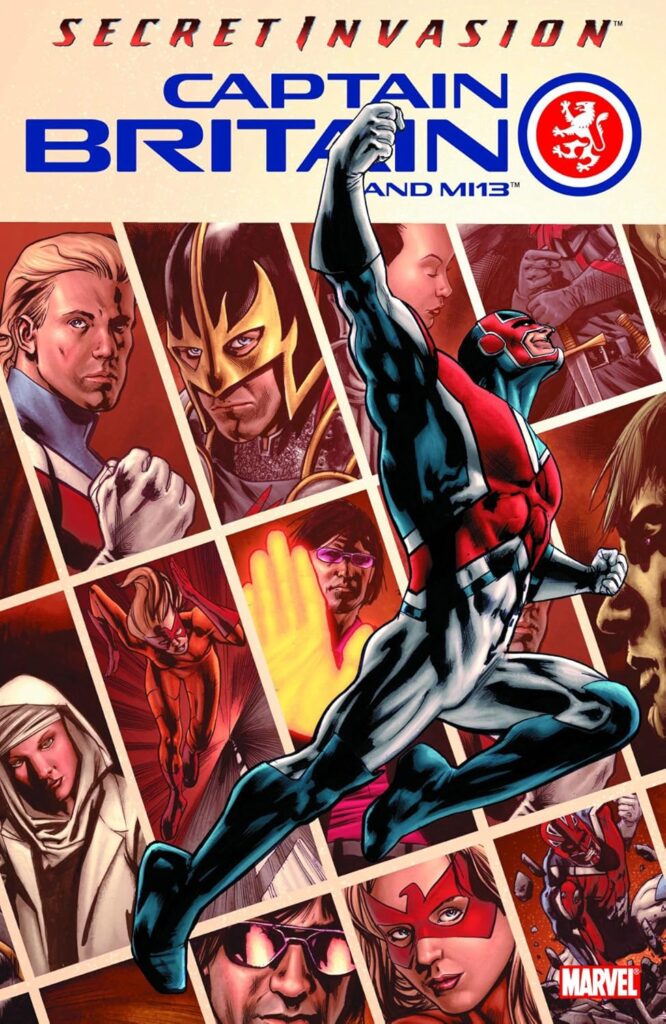
Captain Britain and MI13 is now available in collected form via all good comic shops and online retailers
• For more on Paul and his work, please visit paulcornell.com
• Captain Britain And MI:13 Volume 1: Secret Invasion (AmazonUK Affiliate Link)
The Skrull Invasion isn’t restricted to the US! When the Skrull Invasion hits England, only Captain Britain and MI: 13 stand in their way. Can they find out what the Skrulls are after before it’s too late? Collects Captain Britain and MI: 13 #1-6
This interview was first published on 22nd December 2009. Questions by Matt Badham; Interview copy-edited by Matt Badham, Paul Cornell and John Freeman
All Captain Britain and MI13 images © Marvel Comics
- About the Author
- Latest Posts

Matt Badham is a freelance writer. His work has appeared in the Judge Dredd Megazine, 2000AD and Big Issue in the North.