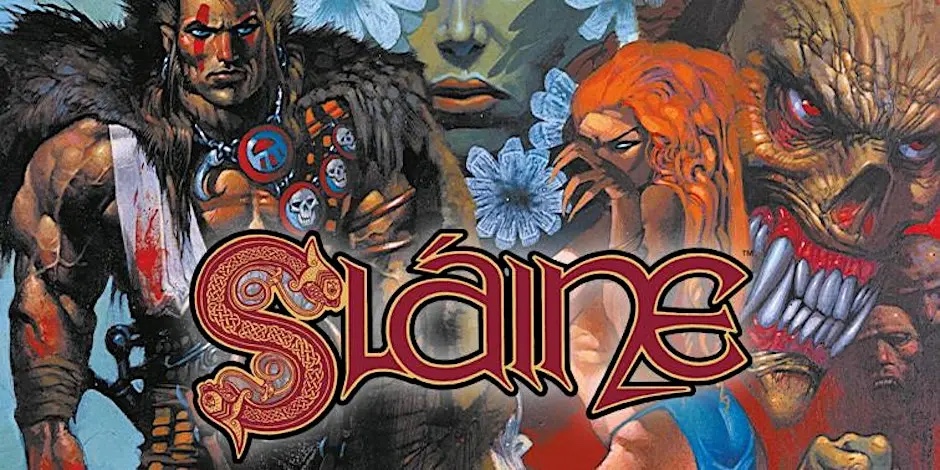
Matt Badham chats with Jason Buck, who has adapted Pat Mills’ 2000AD-delivered tale, Sláine: The Horned God to the stage – a story of ancient Celtic heroes and villains, monsters and magic, dragons and demons, and goddesses and gods…
Jason Buck has been a performer most of his adult life, including gurning, comedy and sword swallowing, but his passion lies in stories. “There’s nothing like getting lost in a story, the pictures in your head are better than film,” the prize winning storyteller says.
Jason has also written and published seven illustrated collections of stories, including Stories from the Towers of Stone and Steel and Jack in the Blood, the latter inspired by testing on Jason’s ancestral DNA.
A teller of tall tales, a weaver of whimsies and a fashioner of fables, Jason draws on traditional favourites and new ideas. His stories are told in the oldest and best ways – as live performances for modern audiences.
Based in the West Midlands of England, as well as a global online audience, Jason has performed across the UK and mainland Europe, blending traditional and contemporary motifs, vocal sound effects and pure, unadulterated fantasy.
I was interested to discover in our pre-interview chat that you have a background in business, which to me (and I recognise this is a prejudice) is often staid and boring, whereas storytelling in my head is more freewheeling and anarchic.
Jason Buck: Well, working at start-ups or as a consultant for big companies, the thing that I always did best was understanding our audience and having an awareness of behavioural psychology! I was trying to understand our customers and clients, and what they wanted and needed. We were designing solutions and a lot of that involved workshops, presentations and standing up and talking to people. And I was the one that would get wheeled out to give these presentations and talks, which was the part of the work I naturally enjoyed.
There’s an obvious link there to the work you do now.
JB: Yes. Sitting down and sorting out spreadsheets and data was the part of the work that came less naturally to me.
What is storytelling in terms of the context of the work you do now?
JB: What I do is usually referred to as performance storytelling.
Performance storytelling?
JB: It’s somewhere between being a bard and being a stand-up. You’re standing in front of an audience and telling them stories, which could be anything from modern stories to myths and legends to horror to socially relevant, true-life tales of adversity; almost anything really.
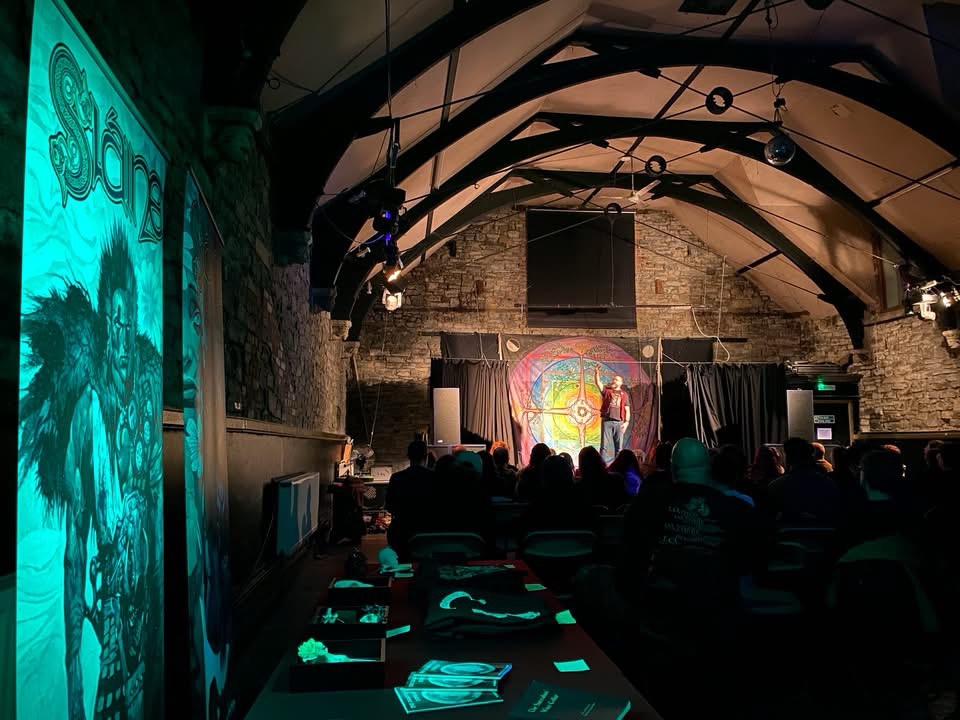
The reaction I get from adults who come to see me is that they don’t know what to expect but then, often, they become really immersed in my stories. In fact, they often say that they can ‘see’ the story or talk about being inside of it. My job is all about conjuring up images for my audience and making the storytelling experience as immersive as I can.
When you talk about it, you sound passionate and also somewhat empowered. It also sounds like quite a ‘high-wire’ act. Just you and the story.
JB: Yes. One person. Minimal props if at all – and minimal lighting and technical support. Sometimes none at all!
How did you first get into storytelling?
JB: In the 1990s I went to a storytelling festival in Wales that was in the grounds of a castle and I had a magical experience. There were 2000 people there from all over the world and it was full of big tents, with loads of performances. That was an inspiration.
However, I’ve also played Dungeons and Dragons since I was 13, always preferring to be the Dungeon Master [the player who curates the experience for other players, arbitrates the rules and oversees the ‘story’/adventure that the players get inveigled in]. That has always been much more about storytelling than dice rolling for me and I have certainly heard other storytellers refer to those types of games as collaborative storytelling experiences.
I think that’s where I cut my teeth as a storyteller and found my love of storytelling. Funnily enough, I used to delve into comics a lot to get ideas and inspiration for the games I ran as a dungeon master!
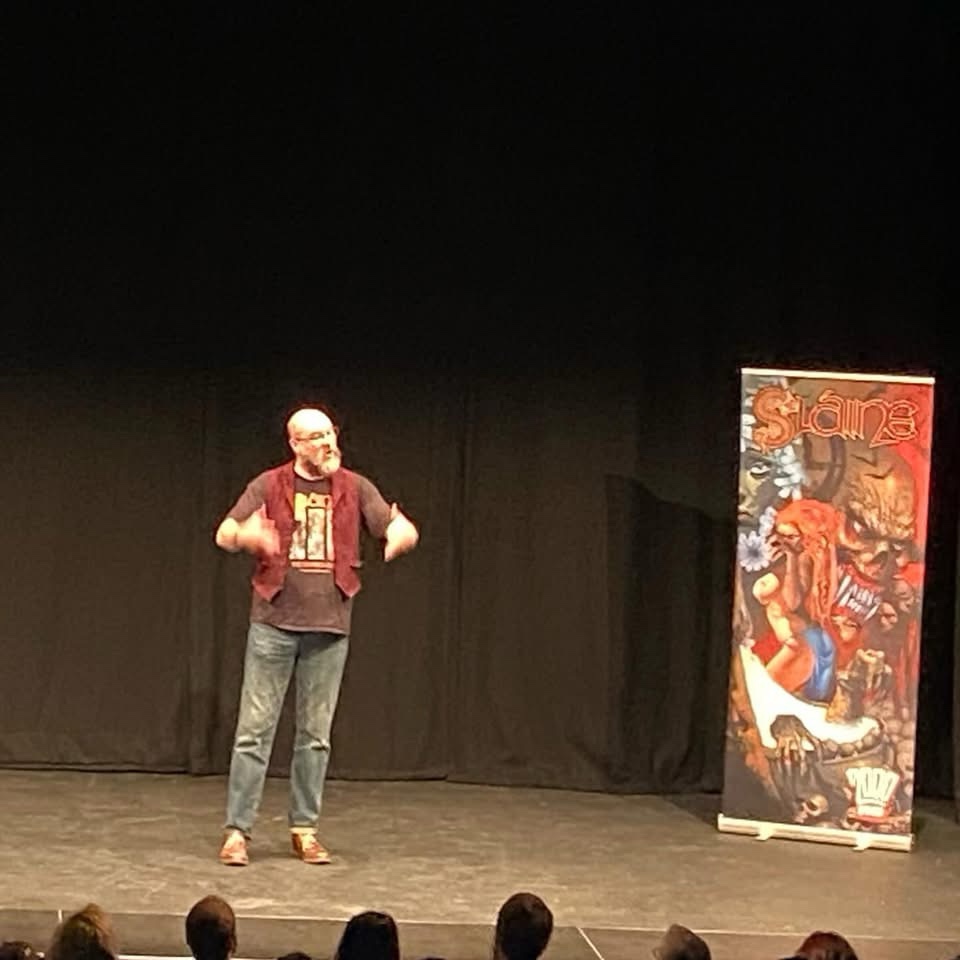
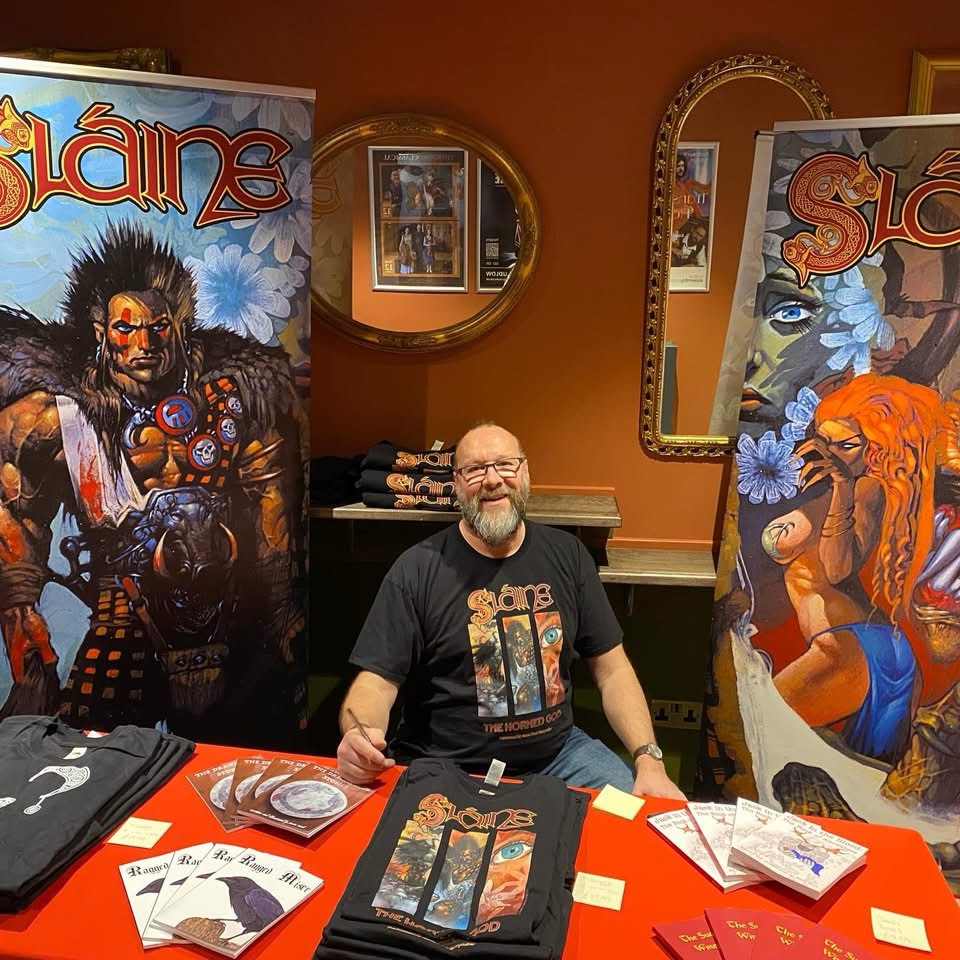
And now, in a kind of full circle moment, you’ve been putting one of those comics, a highly sophisticated piece of visual storytelling with gorgeous art as a significant component, on stage. Except, of course, you haven’t got Simon Bisley’s visuals to help you tell the story.
JB: There will be people who come to the show who know the original comic strip, and those who don’t. My job, as someone who is familiar with the original and as a storyteller, is to evoke the story and its essence with language and physicality. I’m not going to attempt to mimic the artwork, for example, with elements such as costume because that would be ludicrous.
So, in personifying Sláine himself, I use language and physicality – but it’s obviously apparent that I have a middle-aged dad body, not the body of a Celtic hero! Instead, I use language and description to paint a picture of what’s happening, combining the words of Pat Mills’ script with my own.
Have you got a practical example you can share?
JB: At the beginning the art zooms in on an ancient Ukko (Sláine’s Dwarven sidekick) who seems to be at the end of his life, writing Sláine’s chronicle and the story of the Horned God. As well as using Pat’s dialogue I paint a picture with words to make up for the absence of the artwork, saying that we are in a time that was not a time, a place that is not a place, in a room in an ancient castle where Ukko sits writing. And I describe that environment.
The Horned God is, like lots of 2000AD stories, narratively dense. And beyond that, you also have to describe the general milieu, which is fantastical, and all the characters as you introduce them…
The idea is mind-blowing, at least to me (but then I’m not a storyteller).
JB: It’s a combination of describing those elements in a way that quickly anchors them in audience members’ minds while also doing justice to Simon Bisley’s visuals. The thing about storytelling is that you only need a certain amount of description because people will bring their imaginations to the experience and fill things in. What I do is about judging how much description is enough.
In what ways were Rebellion, who own 2000AD and Sláine, involved in the process of adaptation?
JB: Rebellion consulted on the script and had script approval. I also worked with Pat Mills.
Pat has a fiery and formidable reputation as someone who is known for speaking his mind.
JB: He was really helpful! I put the script together by going through the Horned God and adapting it with any necessary embellishments [as previously mentioned]. Then I had a long Zoom session with Pat, who was in Spain. He was understanding of the fact that it was impossible to get all of the Horned God into a two-hour adaptation and told me to cut it where I needed to.
We also discussed the basis Sláine has in myth and legend, and how Pat’s distillation of ancient Celtic myths fits into the storytelling cycle. These myths would have previously been told by storytellers and also kept alive by historians and bards. I’ve also had feedback from audience members, and from Pat and Rebellion that has helped me tweak the show.
Tell us about that.
JB: There was a whole conversation about how Sláine would sound, with my assumption being that he would have a Scottish or Irish accent. Anyway, it turns out that Angie Kincaid (co-creator of Sláine) and Pat based him on a bloke who worked down the road from them on a building site who was fit, but not Terminator-like.
That guy spoke with an English (Southeastern) working class accent. What I eventually settled on for Sláine was a slightly more theatrical version of my own voice for the moments where he speaks
I’m amazed you don’t get extreme stage fright. A whole show. Two hours. Just you. A lot on your shoulders.
JB: What works for me as a performer is to build a rapport with the audience, which I start doing as soon as they enter. As they come into the space, I’ll be there and chat to them a little bit. Often, there are audience members who have seen me before and want to come and speak to me. It’s not a traditional theatrical experience where it would be unusual to break the fourth wall.
The audience and how it responds affects how the performance pans out, sometimes with a certain amount of ad-libbing. However, I am careful to keep the core elements of the story as well as certain catch phrases, and to be careful about the accuracy of place names and character names!
It sounds like a wonderfully communal experience in a world that is somewhat atomised.
JB: I’ve had people tell me that they think storytelling should be available on prescription! I certainly find that I build emotional connections with my audience through storytelling. Then there are different types of storytelling [that are perhaps relevant to mention here].
There’s reminiscence storytelling with people who aren’t professional storytellers, which gives people an opportunity to put their own personal stories out there. There are also examples of storytelling as a specific therapeutic activity, perhaps working with people with cognitive or memory issues and empowering them to tell stories.
The thing is, storytelling is just something that humans naturally do whether they’re talking about a film they saw or their day at work or their family. We are all storytellers.
Jason, thanks for talking to downthetubes about this project. Good luck with the continuing tour
• Follow Jason Buckon Facebook | Instagram | Threads
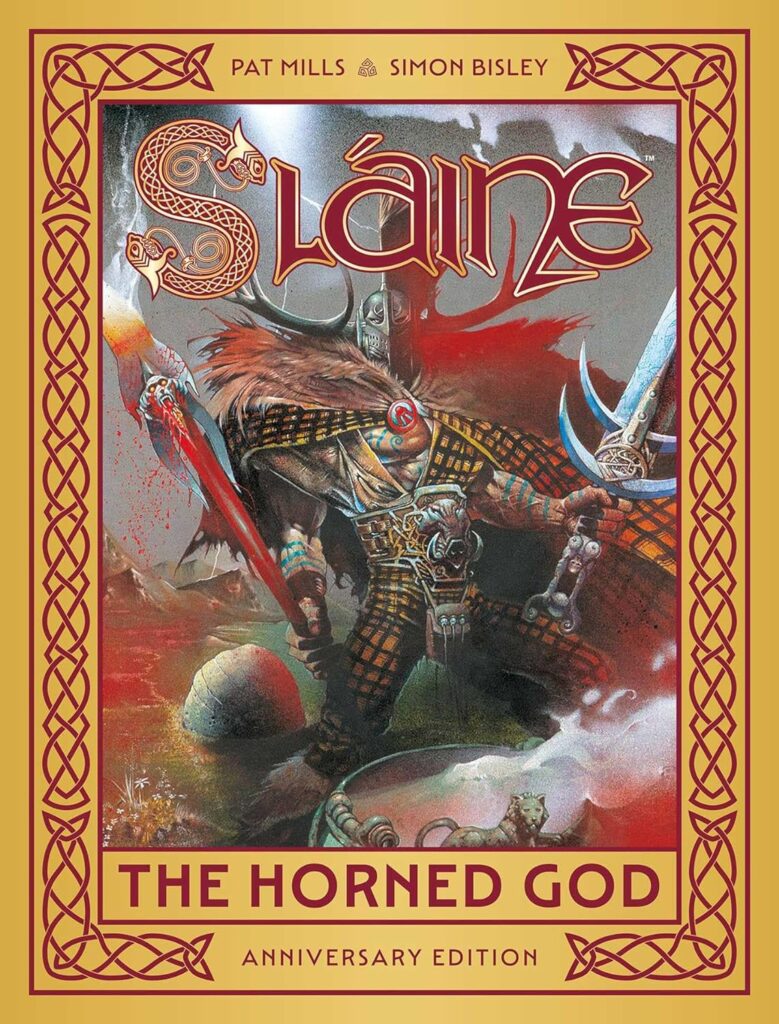
• Slaine: The Horned God – Anniversary Edition is available direct from 2000AD here | AmazonUK (Affiliate Link) | UKBookshop.org Affiliate Link | ISBN: 978-1837861934
Sláine: The Horned God returned to print in a massively oversized edition just in time for the 35th anniversary of the ground-breaking and industry-altering story. Written by the character’s co-creator, Pat Mills, and featuring fully-painted art the likes of which had never before been seen in the pages of 2000AD.
The Horned God is the definitive Sláine storyline. Its appearance in the pages of 2000AD marked a creative high-point for the comic, and the work inspired artists for generations with its incredible painted scenes of epic battles evoking the work of Frank Frazetta.
This anniversary edition has been rescanned from the original film, and printed at a size that more closely matches the actual artwork, so now you can become fully entranced by the art and story of the greatest Sláine epic.
‘Sláine: The Horned God’ Tour – Upcoming Dates
Future dates here in the 2000AD website
June 2026
- 18th June: The Old Cold Store, Nottingham: BUY TICKETS
- 25 – 28 June, Solskin Pagan & Heathen Festival, Peak District: BUY TICKETS
August 2026
- 28 – 31 August, Celtfest, West Wales: BUY TICKETS
September 2026
- 4th September: Bredgar & Wormshill Light Railway, Kent: BUY TICKETS
- 19th September: Duncarron Medieval Village, Falkirk: BUY TICKETS
October 2026
- 22nd Oct: Quay Arts, Isle of Wight: BUY TICKETS
November 2026
- November 17th: Temperance Café Bar, Leamington: BUY TICKETS
April 2027
- 2nd April 2027: Cotswold Playhouse, Gloucestershire: BUY TICKETS
Future dates for Slaine: The Horned God feature here in the 2000AD website
- About the Author
- Latest Posts

Matt Badham is a freelance writer. His work has appeared in the Judge Dredd Megazine, 2000AD and Big Issue in the North.
Categories: 2000AD, British Comics, Comics, downthetubes Comics News, downthetubes News, Features, Other Worlds
 5 Space Opera Comics
  Creating Comics: An Interview with Dan Abnett
  In Memoriam: Comic Artist Adam Terence Stone
  Bones & Betrayals: A Chat with Andi Ewington, Erica Marks and Calum Alexander Watt