Review by Tim Robins
Survivors of a deadly pandemic traverse a post-apocalyptic landscape to find the origin of a mysterious radio transmission…
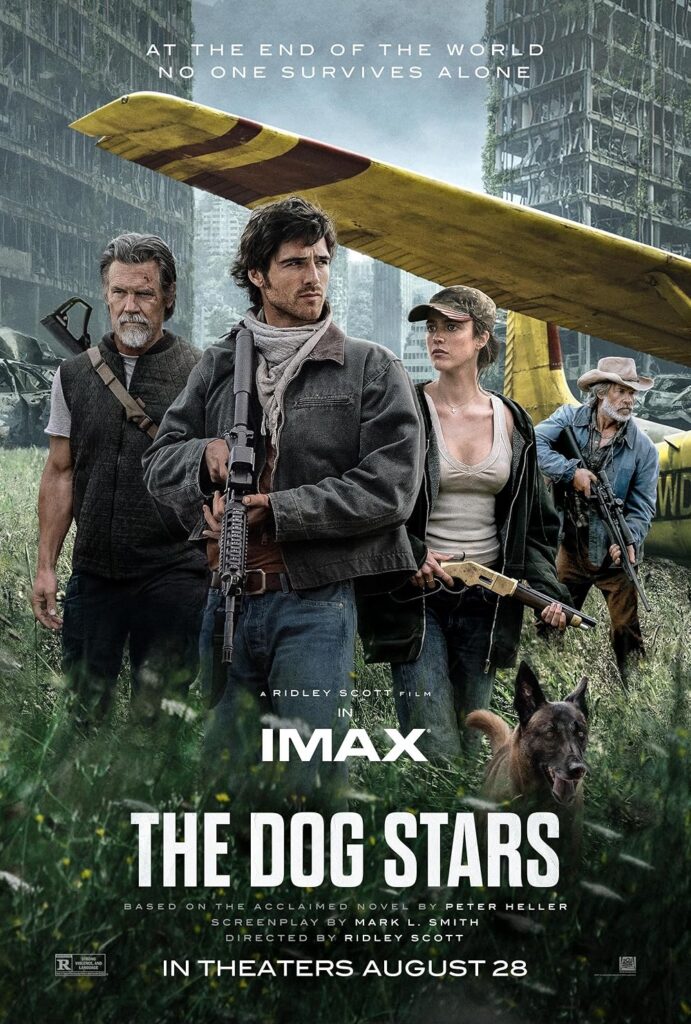
The Dog Stars is hogwash but beautifully directed by Ridley Scott, whose reputation is the only reason I went to see this film. The director built his reputation on artful portrayals of dystopias, Aliens and Blade Runner. The Dogs Stars is another dystopia, albeit one soaked in the misty landscape and the equally misty imaginings of American pastoralism, but with moments of ransacking by unruly mobs thrown in for good measure. I disliked it from the start.
The film is an adaptation of a novel of the same name by Peter Heller, centred on an aviator called Hig, who has a beloved dog, Jasper. The title refers to the southern constellation of Canis Major, although it takes on other connotations as the story progresses. The book is written in the staccato interior monologue of its central character, “Hig”, a name as blunt and abrupt as Heller’s prose style. (By the way, I also disliked the novel from the start).
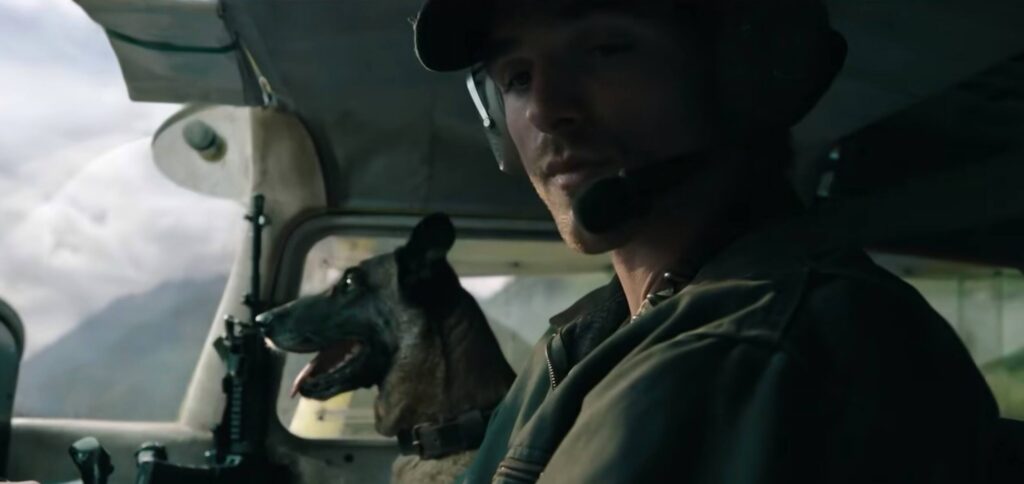
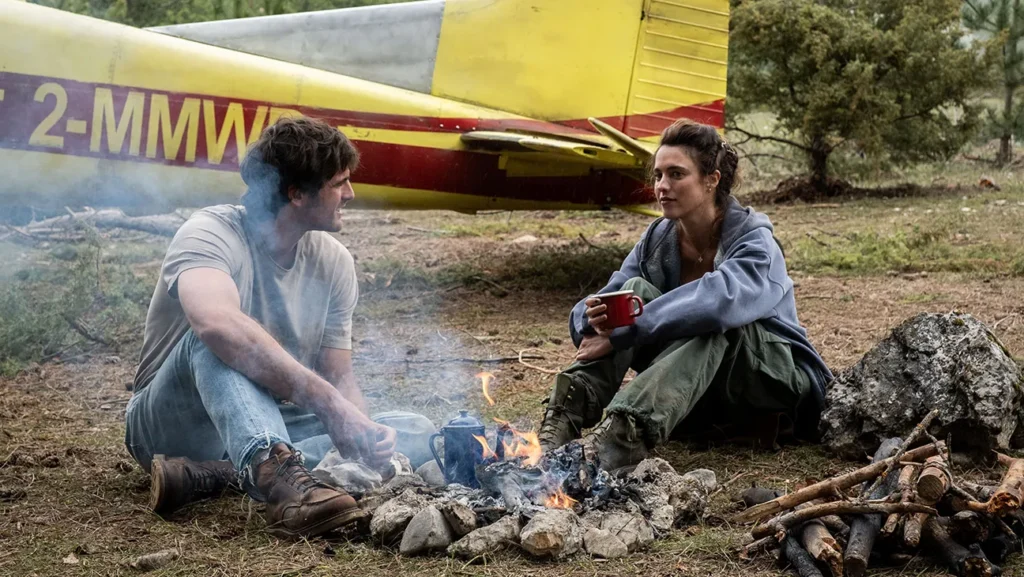
There have been an awful lot of post-apocalyptic movies (The Postman, 1997, and No Blade of Grass, 1970) spring immediately to mind); and I’m not sure this one adds anything much we haven’t seen over the decades. There’s certainly a lot of scenery porn, with Hig flying his tiny plane among the mountains of Colorado, which is breathtakingly lovely – even if we are actually looking at the Alps and other locations such as Bosco Macchia Grande and Cansiglio (the film was mostly shot in Italy). Audiences also get to ogle the hills and valleys of Hig’s backside, as he repairs his plane aided by a young woman, Cima.
Jacob Elordi plays Hig, who has a jaw so square, he surely must have auditioned for Superman at one point in his career. Josh Brolin plays the ornery Bangley, who loves firing off explosives (See what the author did there?); guns, rockets and mortar shells and such. Margaret Qualley, most recently of The Substance (2024), plays the winsome Cima and Guy Pearce plays her father, “Pops”.
My God! Pearce is unrecognisable in this movie. Has that much time passed? It seems like only yesterday that my mother was pointing at Neighbours and saying, “He can get a job, so why can’t you?” Well, it was The Eighties and, as I pointed out, Neighbours was fiction. And the job of ‘actor’ didn’t enter either of our minds.
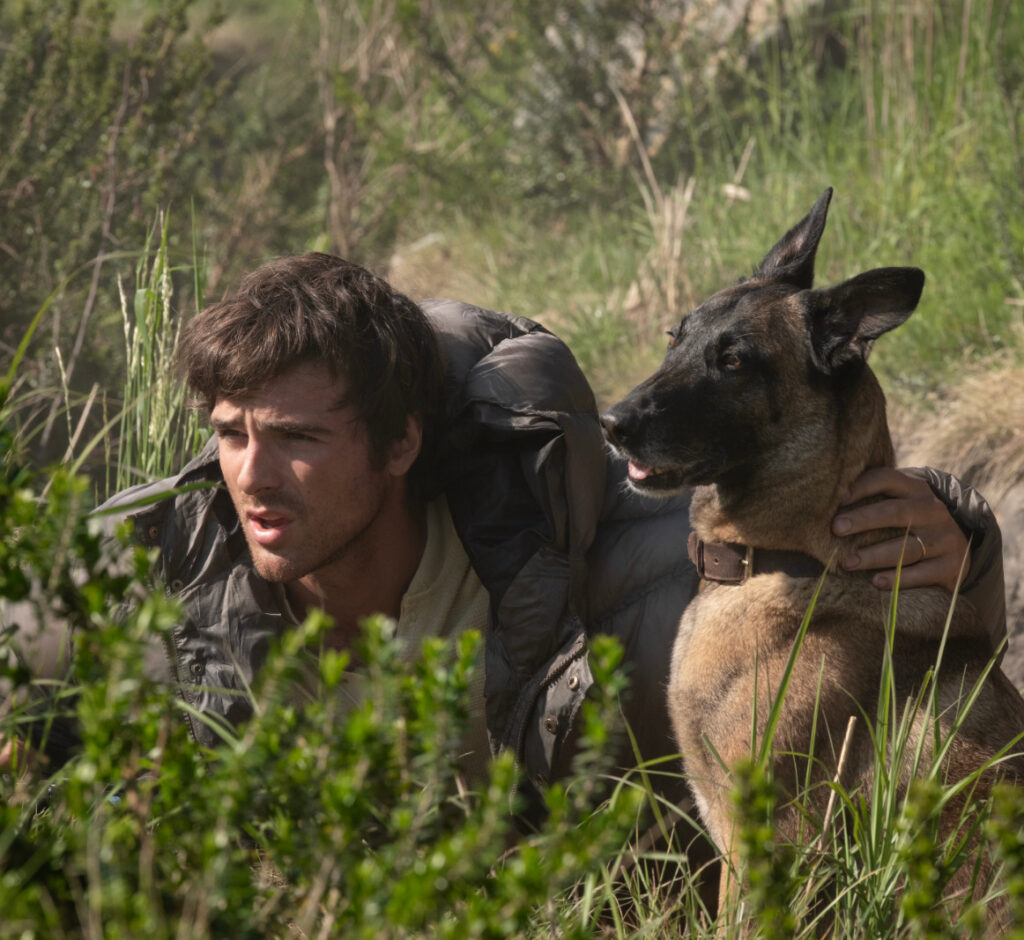
The Dog Stars is heavy with a sense of longing for a world I’ve never longed for. It plays into a particularly American dream world, a rural idyll where strangers can be shot on sight. Colorado is just left of the centre of the American heartland, with all the word heart entails.
All Hig’s restless flying has a point. He has an unfulfilled longing for home that sees him travelling point to point, in search of something he can’t pin down.
The former signs of civilisation exist largely as cautionary tales. Denver is a ruin, populated by scavengers and a group called the Reavers, who bring further destruction in their wake. Tantalisingly, Hig is drawn to a radio signal from out of ‘Grand Junction’.
Following the signal and driven by his lonely heart, leads Hig to a bizarre third act encounter with remnants of the past. How bizarre? Well, here’s how British reviewer Mark Kermode described it, commenting on a sequence in the film’s “Third Act”…
“It’s like we were watching a film in one screen, and we came out of it and went to the bathroom and went back in to a different screen in which they are not showing the same film, they’re actually showing this surrealist mash up of The Shining and Don’t Worry Darling!”
Actually, this part of the Third Act has a clear place in post-apocalyptic cinema. It reminded me of The Eternals in Zardoz (1974) and, particularly, the scenes in A Boy and his Dog (1975), where a warped character of society survives in ‘The Downunder’, located beneath a post-apocalyptic wasteland. Such scenarios are lessons. They ask, “How badly do you want this?” Hig’s answer? Not at all.
As a genre, the American Pastoral is profoundly ideological. Technology becomes associated with an invasive, godless or even Satanic intervention into an America conceived in terms of a Garden of Eden. It is not at all surprising that The Dog Stars’ model community is a group of Mennonites (there actually is a Mennonite community in Colorado).
In the film, the Mennonites stand for an older way of being. Their inclusion here plays with the idea that so-called ‘Closed Religious Groups’ are protected from viruses, thanks to their separation from wider society. The films’ group doesn’t reject medical intervention but are representatives of an older way of life. The outlying characters, Hig included, are integrated into their society thanks to a square dance.
In the end, it was I who felt I’d been played. Scott does his work well. It was only later, that I began fretting that the various threatening groups, one with bows, arrows and axes, were a little too close to being “Indians” in a game with Cowboys and Homestedders. Even The Reavers, with shaven heads, pale skins and head to toe tattoos are seen dancing and whooping among flames (I mistook the first two I saw to be the Island Boys!).
It’s not a coincidence that connotations of religiosity colonialisation lie in the heartland of the American Pastoral. Also, Post Covid-19 , I couldn’t help but wish the film dealt with the story’s flu pandemic with a little more clarity. In the novel, the flu is described unhelpfully as more contagious than AIDS. Newsflash, AIDS refers to a set of symptoms that are not in themselves contagious.
In interview, Scott has drawn attention to his “eye” for a good picture, his speed in directing and his background in advertising seen as contributing to his and his peers’ brand, spanking new style of film making. The Dog Stars is a testament to all of that. But beyond “buy more stuff”, adverts have nothing progressive to say. And neither does this film.
Tim Robins
The Dog Stars is in cinemas now
Head downthetubes for…
• The Dog Stars by Peter Heller (AmazonUK Affiliate Link)
Hig, bereaved and traumatised after global disaster, has three things to live for – his dog Jasper, his aggressive but helpful neighbour, and his Cessna aeroplane. He’s just about surviving, so long as he only takes his beloved plane for short journeys, and saves his remaining fuel.
But, just once, he picks up a message from another pilot, and eventually the temptation to find out who else is still alive becomes irresistible. So he takes his plane over the horizon, knowing that he won’t have enough fuel to get back. What follows is scarier and more life-affirming than he could have imagined. And his story, The Dog Stars, is a book unlike any you have ever read.
Mayo and Kermode’s Take: Mark Kermode reviews The Dog Stars
- About the Author
- Latest Posts

A freelance journalist and Doctor Who fanzine editor since 1978, Tim Robins has written on comics, films, books and TV programmes for a wide range of publications including Starburst, Interzone, Primetime and TV Guide.
His brief flirtation with comics includes ghost inking a 2000AD strip and co-writing a Doctor Who strip with Mike Collins. Since 1990 he worked at the University of Glamorgan where he was a Senior Lecturer in Cultural and Media Studies and the social sciences. Academically, he has published on the animation industry in Wales and approaches to social memory. He claims to be a card carrying member of the Politically Correct, a secret cadre bent on ruling the entire world and all human thought.
Categories: Features, Film, Other Worlds, Reviews
 In Review: Coyote vs Acme
  In Review: Teenage Sex and Death at Camp Miasma
  In Review: The End of Oak Street
  Spider-Man: Brand New Screen
“It’s like we were watching a film in one screen, and we came out of it and went to the bathroom and went back in to a different screen in which they are not showing the same film”
The promo trailers are all also tonally different eg “we will find the truth” one with the population countdown