Review by Tim Robins
CAUTION: This review includes descriptions of scenes in the film which may offend. Your choice to read on is entirely your own.
The Film: Censored for more than half a century, Ken Russell’s visionary masterpiece returns to the big screen fully restored in 4K and cut to Russell’s direction – the first publicly released version of the film as intended by the filmmaker.
Unveiled at the 79th Cannes Film Festival, the definitive version arrives 55 years after the film’s original release. Starring Oliver Reed and Vanessa Redgrave, Ken Russell’s The Devils remains a landmark exploration of religious persecution, hysteria and institutional corruption.
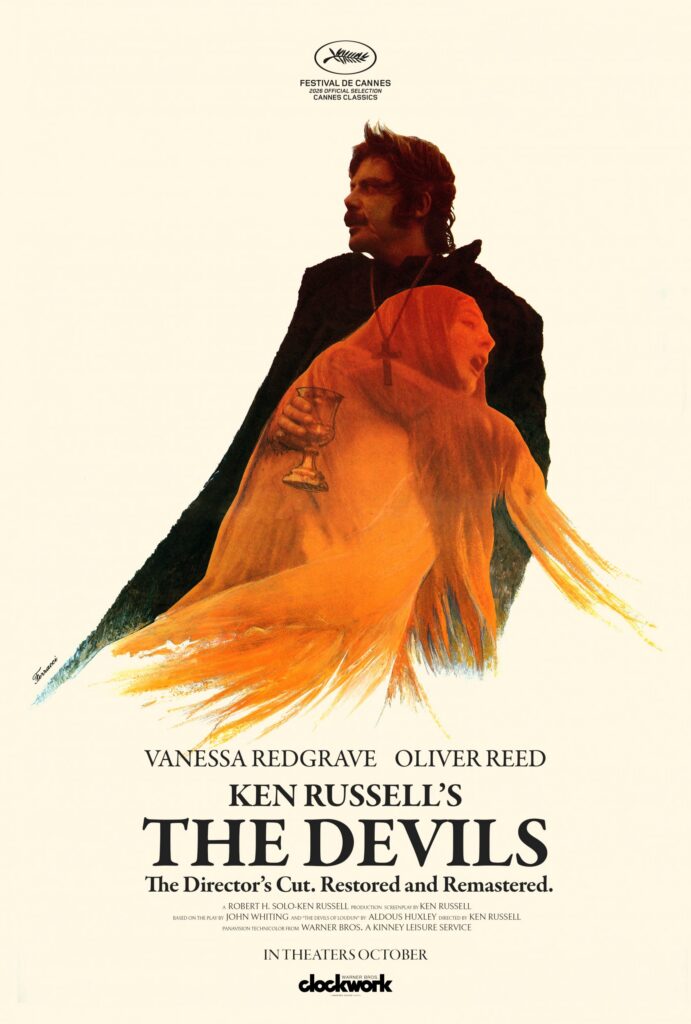
Reviewers don’t tell you what to think, but they can suggest ways you might behave. In the case of Ken Russell’s The Devils, currently restored in 4K and enjoying a brief run in select cinemas, my suggestion is simple: stop reading this review and rush out to see it right away.
Going into the packed cinema (Duke’s at Komedia, Brighton), I didn’t know what to expect. I am sure I’ve seen some of Russell’s other works; maybe Women in Love (1969) and Tommy (1975), certainly his campy adaptation of Bram Stoker’s The Lair of the White Worm, which stars a young Peter Capaldi in a kilt, no less. phwoar!. But nothing prepared me for The Devils giddying narrative, fevered performances and stunning costume and set designs.
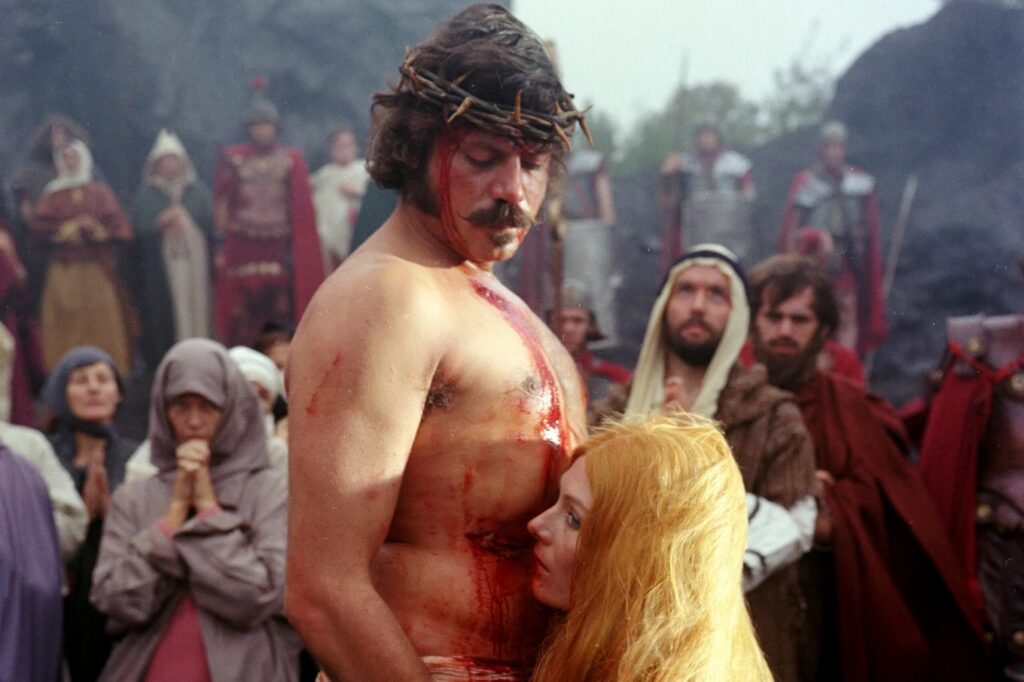
Set in 17th century France, the film pits Oliver Reed, playing the historical figure of priest Urbaine Grandier, against allegations that he is The Devil incarnate madeby the sexually tormented Jeanne de Agnes (Venessa Redgrave), the abbess of a convent belonging to the Order of Saint Ursula in the small city of Loudon. When the promiscuous Grandier falls in love with, and secretly marries, young Madeleine de Brou (Gemma Jones), the abbess accuses her of being a sacrilegious fornicator – which Grandier and de Brou certainly are, at least in the eyes of the Catholic Church.
Alas, all this sanctimonious finger pointing plays into the hands of the infamous ‘Red Cardinal’, Cardinal Richelieu (Christopher Logue), keen to help King Louis XIII (Graham Armitage) consolidate power over France’s independent fortified cities. Soon, Grandier is facing the forces of Baron Jean de Laubardemont (Dudley Sutton), hell bent on tearing down Loudon’s fortifications, and inquisitor Father Pierre Barre (Michael Gothard), a professional exorcist.
Summoned to expel the devil and all his works, Barre instead creates a hell on Earth as more and more nuns are compelled to confess to, and provide evidence of, being possessed. An orgy of writhing, naked nuns ensues, each sacrilegious act perversely demonstrating the purity of their souls, now being tormented by devils. In the face of this dangerous nonsense, Grandier must play a game of theological chess with his inquisitors to avoid being tortured and burnt at the stake.
Russell’s film is based on The Devils of Loudon, Aldous Huxley’s novelistic account of actual events, and is set against the King’s land grab and the persecution of protestant Huguenots for whom Loudon was something of a sanctuary. Over the following century, their number would decline from from 10 to one per cent of France’s population. Many fled overseas. Indeed, the Huguenots have been described as England’s first refugees. It is not known how many arrived here on small boats.
There have been a number of works inspired by the events at Loudon, besides Huxley’s book and Russell’s film, including: The Polish movie Mother Joan of the Angels from 1961, was based on a novella by Jarosław Iwaszkiewicz, John Whiting‘s 1961 theatre play The Devils, commissioned by Sir Peter Hall for the Royal Shakespeare Company, was based on Aldous Huxley’s book. And an opera from Krzysztof Penderecki‘s The Devils of Loudun (Die Teufel von Loudun), which premiered at the Hamburg State Opera, was based on Huxley’s novel and Whiting’s play.
Russell was approached by United Artists to make a film based on a Whiting’s stage adaptation; however, Russell’s screenplay mainly drew on Huxley’s novel
When the studio read the script, they dropped the project. Eventually, it was picked up by Warner Brothers who also distributed the film. Frankly, I am surprised the film was made at all. I’ll leave it up to your imagination what an enclosed order of nuns on heat gets up to. Just kidding. More detail follows…
The most infamous sequence in the film, known as “The Rape of Christ”, includes shots of a priest, Father Mignon, staring down from a balcony and masturbating at the sight of frenzied, naked nuns sexually molest an altarpiece of Christ on the Cross.
In another sequence, Sister Jeanne is shown masturbating with the charred femur of Grandier. Of course, it’s all done in the best possible taste. No, no it isn’t. The sequence shows Redgrave fellating the bone which resembles nothing less than a pair cock and balls. And a black one at that.
Russell considered himself a devout Catholic and, at the time, “secure in his faith”. Working on The Devils, helped change that. “When I first read the story, I was knocked out by it,” the director would explain to fan and film critic Mark Kermode in an interview for Video Watchdog (No. 35, published in 1996) titled “The Devil Himself: Ken Russell”.
“It was just so shocking, and I wanted others to be knocked out by it, too. I felt I had to make it.”
“Knocked out” is one way of describing the reaction of the British Board of Film Censorship, as it was called back then. A fascinating article from BFI/Sight & Sound details some of the issues the board had with the film and between board members.
“In the board’s records, disparate voices across the first half of 1971 tell a story of increasing panic up to and beyond the film’s certification,” the article notes. “Alongside the director and the censors were production company Warner Bros plus a cluster of voices representing a version of ‘public opinion’.”
Reflecting on BBFC’s response, Kermode argues that watching the film, in any form, is weirdly viscerally powerful… “It was like people were hit so hard by it that they kind of lost all… rational sense”
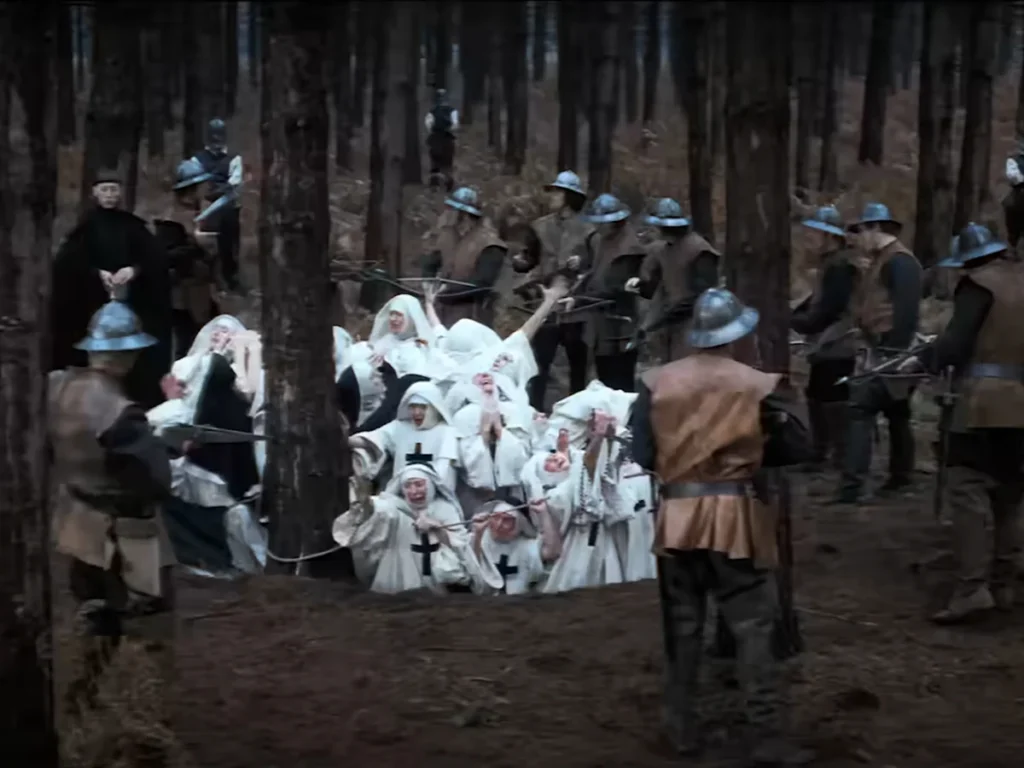
The Devils was eventually given an ‘X’ certificate (no one under 18 years of age admitted). Nevertheless, seventeen councils across Britain would refuse the film a license to be screened – and, later in the same decade, a similar fate would befall Monty Python’s Life of Brian (1979).
In America, cuts reduced the film’s running time to 108 minutes (the restoration runs to 115). But the running time doesn’t reveal their impact on the film as a whole. In particular, Russell felt that the cuts for America so disrupted the film’s story that they made it “disjointed and incomprehensible”.
Perhaps the cruelest cuts were delivered by critics. Giving the film zero points, Roger Ebert, who died in 2013, wrote a review of what can only be called sustained sarcasm.
“A burning at the stake, an afternoon in the rack, headscrews, a douche with boiling water, nails into hands, induced vomiting, ripped tongues, dead babies, human target practice, possession by devils, rape, transvestism, nude orgies in the nunnery. Put them all together and they spell Committed Art…” he sneered.
“I left the Cinema Theater feeling like a new, a different, and, yes, a better person”. Ebert continued. “The poisons of our political system had been drained from me. I entered the theater as an unwitting participant in the atrocities of our time. But believe me, that’s all behind me now”.
I hope Ebert’s piece was more a response more to exaggerated political claims being made for the film, rather than the film itself. If not, the review appears to be the work of an imbecile. Of course, critics are entitled to their opinions, it is just a pity they had such a wide and prestigious platform from which to express them.
If Russell was stabbed in the face, others had his back. He was awarded Best Director at the 33rd Venice International Film Festival, and from the US National Board of Review. Ironically, the latter was founded, in 1909, under the name the New York Board of Motion Picture Censorship to review films and create a “white list” of uncontroversial movies for exhibitors, addressing concerns over violent or inappropriate content.
By the 1970s, the organisation had changed its name and become a private group of film enthusiasts moving beyond censorship to become a “leading voice” in evaluating cinematic quality. And it is film enthusiasts, led by writer, animation director, producer, storyboard artist and lecturer in film and animation Dave King, who, over time, have challenged the heavy hands of Hollywood and national censors. Instead, by laying healing hands on film, they have resurrected it in 4K glory.
Introducing The Devils at the BFI London Film Festival, Mark Kermode recalled first learning of the film’s cut scenes. Interviewing Russell for Sight & Sound magazine, Kermode had been instructed to ask the director about the film’s missing material. Little did he know what was in store.
Ken told the Kermode “well, you know John Travelian [head honcho of the British Board of Film Censors] … had asked for a lot of things to be reduced… But there’s this one sequence in the middle of the film that Travelian just told me had to come out in its entirety. And I think it was some of the best work I ever did”. That sequence was, of course, the aforementioned “Rape of Christ,” which Russell went on to describe it in vivid detail.
“It just sounded so amazing.” Kermode says, “And I said, “Ken, we’ll find that missing material.” He said, “You won’t.” And I said, “Why?” He said, “”Because it’s gone. It’s lost. It’s probably been destroyed.” And I, being young and foolish, said, “No, Ken, we will find it.”
And find Kermode did. “In 2000, I was making a documentary, Hell on Earth, about ‘The Devils’ and was directed to Warner in the UK. I was introduced to this guy, Tim Everette, who is the kind of magician in all this story … he said, ‘actually I think the ‘Devils’ stuff is here in the UK.”
Searching the store Kermode noticed an unlabelled can, Everette opened it later and phoned him excitedly saying that ‘The Rape of Christ’ had been found. Kermode was standing in Mothercare when he took the call. Eventually, the pair helped give birth to a “beta” assembly of the film. It was shown in 2004. It took over two more decades for Warner to finally release the current restoration.
Watching The Devils, I shed a nostalgic tear for a time before studios fed us stories of tweedledum and tweedledee droids and a regressive galaxy of a long, long time ago yet not far enough away in which ‘Glup Shittos’ embody unthinkingly racist stereotypes.
I was only eleven back in 1971, but a few years later BBC2 introduced my burgeoning teen tastes to the erotic qualities of British and European Cinema. More mainstream films were dipped in cynicism from The Planet of the Apes, 1968, (on re-release) to Network (1976). Now, in 2026, I guess watching The Devils brings out the angry film snob in me, an aspect of myself that I honestly didn’t think existed.
The Devils is a serious work, but also funny, a dark, dark satire. One of the many times the audience laughed out loud sees Grandier burst into a room where a woman is being ‘cured’ of the plague. The cure seems worse than the plague itself. Grandier is outraged, then he spots a stuffed crocodile hidden under the covers. With a cry of “What fresh lunacy is this?”, he chucks the animal out of the nearest window, later to pick it up off the street and use it as a sword to defend himself when his opponents ambush him.
And the scene is funnier once you know that it’s true. Crocodiles and alligators were indeed used by apothecary’s. Huxley, quoting from William Shakespear’s Romeo and Julliet, points to Romeo’s description of the contents of an apothecary’s shop: “a tortoise hung, An alligator stuff’d, and other skins, Of ill-shap’d fishes…” .
As Huxley notes, this description is echoed by Sir Samuel Garth’s satirical, 1699 poem, “The Dispensary”: Aloft in rows large poppy heads were strung, And, near, a scaly alligator hung”.
Some scenes in The Devils have become funnier thanks to the passage of time. I hadn’t realised how much the film inspired the humour of Monty Python, and in particular, Monty Python and the Holy Grail (1975). We are even treated to a “bring out your dead!” moment. There’s a scene, too, in which King Louis XIII turns up (in thin disguise) at the mass exorcism and mischievously waves around a small, golden box, said to contain the blood of Christ and to be capable of banishing the Devil himself. In the event, the ‘weapon’ turns out to have the awesomely hopeless power of the Holy Hand Grenade of Antioch.
But it was the film’s opening sequence nearly blew me off my chair. It involves an absurd, courtly Masque paying homage to/making fun of Botticelli’s painting ‘The Birth of Venus’. Alarmingly, we realise Venus Anadyomene, naked and standing on a giant scallop shell, is being performed by The King (Graham Armitage).
For me, the sequence is obviously recalled in Terry Gilliam’s 1988 masterpiece The Adventures of Baron Munchausen, with Uma Thurman as Venus. The difference between the two takes on the paintingis significant, and it’s not that Thurman is considerably more beautiful than Armitage. Where Gilliam’s lens zooms in, immersing us in the transgressive power of fantasy against authoritarian rationality, Russell’s lens pulls back to reveal fantasy as just another dance, another mask, of power.
I was surprised that the cast keep their heads above water, even as The Devils descends into the depths of madness. Reed is a revelation. Sporting what must surely be the most powerfully seductive moustache in cinema history, he plays Grandier as a beguiling, cocksure Rake who justifies his womanising by dizzying displays of theological reasoning.
Grandier even has a redemption arc, of sorts. Having knocked up a young woman, he dismisses her back to her family. But, on meeting the young Madeleine, he genuinely falls in love. Although their marriage is only in the eyes of God and cannot be recognised by the church, Grandier remains committed to his Faith.
Vanessa Redgrave, who receives top billing, is a startling figure. We are introduced to her character, des Anges, as she walks towards us, flanked by nuns, her body weirdly crooked with her head twisted onto one shoulder. In life, the abbess had a curvature of the spine. We first meet her limping towards us along a corridor lined by praying nuns. I felt like crying out, “For God’s sake! Get back!” as she entered the foreground. There is an intentionally grotesque otherness about her.
The actress delivers a tremendously physical performance, her body buckling beneath the ghastly ministrations of those who would rid her of her demons. A revolting enema drives out one. The book tells us it is Asmodeus, who is deemed to have taken residence in her lower belly.
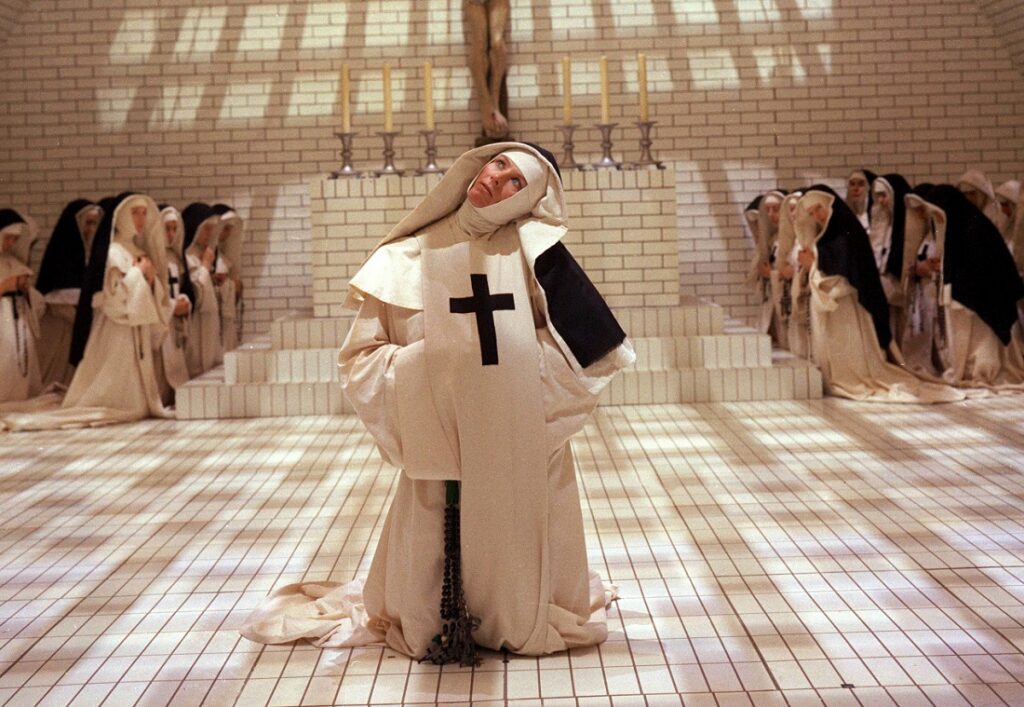
The costumes, designed by Shirely Russell, powerfully define the characters. For example, Father Mignon is played with great solemnity by actor Murray Melvin, but Mignon’s black attire and slim physique give the character the silhouette of a pawn on a chess board. Standing on white stairs against white walls, he pauses, as if waiting to make his move.
Derek Jarman’s set designs are extraordinary. He took his cue from the likes of Metropolis, to create the monumental exteriors at Pinewood. The Ursuline monastery is decorated almost entirely in small, white tiles. Simply put, it looks like the world’s biggest public toilet.
Apparently, Jarman was inspired in his approach by a line in Huxley’s book describing Agnes’s colonic irrigation as “an experience that was equivalent to, more or less, of a rape in a public lavatory”. I hope it is not too out of order to suggest there may also have been a nod and a wink to gay men’s experience of using public toilets to meet and have sex with men.
Russell viewed The Devils as his one political film. “To me it was about brainwashing, about the state taking over.”
Today, the raving nonsense of Witch-Hunter Barre, and the various absurd interpretations of empirical evidence made me anxious about the way religious and secular superstition still have a grip on people’s minds. As the events of the Covid pandemic showed, these kinds of “knowledges” could kill us all. The words ofthe enlightened poet, Alexandra Pope, written around 1731, still have a force. “presume not God to scan; The proper study of mankind is man”.
What The Devils means is for you to decide. Placing it in its historical context, points of reference include a crisis in the Christian Faith and the sexual revolution. Kermode points to the fact that, in 1966, the cover of Time magazine carried the question, “Is God Dead?”. But, in the 1970s, Christianity was fighting back, sometimes creatively, sometimes censoriously. In Britain, two evangelical Christians, shocked by permissive material in the media, formed the Nationwide Festival of Light. It culminated in a couple of mass rallies in London’s Trafalgar Square and Hyde Park in the September of 1971.
Kermode sees The Devils and, later, The Exorcist (1973), as companion pieces, arising from the questioning of faith. But they have different answers. The Exorcist asserts the existence of demons and the, albeit waning, power of the Church. The Devils has none of that. Not for one moment do we believe the nuns were possessed and, truth be told, neither did some observers back in the 17th Century.
The Devils also needs to be seen in relation to aspects of what was known as ‘the sexual revolution’ which, aided by the creation of the contraceptive pill, involved aquestioning of sexual mores and championing ‘free love’ (particularly for men). In France, Sexual and political liberation joined forces during the events of May, 1968. They were ignited when students opposed rules that forbid members of the opposite sex entering each others’ dormatories. Hurling paving stones and Molotov cocktails, the students became trebuchet of desire. And then, after escalating to a General Strike brining France close to a revolution.
The Devils clearly recognises the relationship between the State and Church and the way their power represses and twists sexuality. In this, the film is of its time, that time being the Sixties/Seventies. Alas, the notion of power repressing sexuality was decisively ended by French intellectual, Miche Foucault. Instead, his introductory volume to his The History of Sexuality argued that power was actually implicated in or knowledge of sex. He wrote, “The question I would like to pose is not, Why are we repressed? but rather, Why do we say, with so much passion and so much resentment… that we are repressed?”.
His answer? “There is no escaping from power, that it is always-already present constituting that very thing which one attempts to counter it with.” So there.
In comparison to Foucault’s stentorian pronouncements, The Devils now looks rather quaint.
For me, The Devils is a film better experienced than interpreted. Russell mustered the best that Britain had to offer, including the cinematography of David Watkin and an unnerving, jarring, percussive score by Peter Maxwell Davies…
The supporting cast are first rate. Even if they didn’t speak a word, their faces, often shot in extreme close-up manage to evoke the 17th century (although Gothard’s round glasses are anachronistic). The perfomers manage to look centuries old yet of their time. Critics noted the resemblance between Gothard’s Barre and John Lennon, although his character becomes more frenzied as the film progresses.
The Devils will stay with you. It is a tour de force. Yes, there’s some gore, including tongue torture, while anther is later ripped in its entirety from a person’s head. Yes, there’s an abundance of naked flesh. Yes, there’s brutality and cruelty, particularly during the exorcism scenes. You may want to look away, but the Russell’s direction draws you into the specatcle.
My favourite scene comes near the end. We watch Anges, walking along a narrow road that stretches to the horizon. Here and there, on either side of the road, we see the bodies of executed prisoners, their bones sprawling across the wheels on which they were broken.
Held high on poles, the wheels resemble a field of grotesque daisies, heads hammered like nails. The wheels also resemble the faces of clocks their spokes marking the passage of time, their arms formed by the broken, skeletal arms of the prisoners. It’s a scene that might have been painted by Dali. Is Mother Anges walking into the future? Does she carry her madness with her, towards us in the here and now?
Tim Robins
Head downthetubes for…
• BFI: Ken Russell’s The Devils (includes upcoming performance information in the UK)
• BFI: “My one political film”: Ken Russell on The Devils
• Facebook: Free Ken Russell’s The Devils
• Sight and Sound (bfi.org.uk): “Sick & kinky”: The BBFC and Ken Russell’s The Devils
• historic-uk.com: The Huguenots – England’s First Refugees – Historic UK
• About The National Board of Review – National Board of Review
• RCP Museum: sir Samuel Garth’s poem, ‘The Dispensary’
• indiewire.com: Why ‘The Devils’ Sets Are So Unusual
• The Poetry Foundation: An Essay on Man: Epistle
Thanks to Paul Wallis for giving me a copy of Huxley’s The Devils Of Loudon. Thanks also to the creative talents who brought us this marvellous reconstruction of Russell’s film. This review is dedicated to Justin Richards RIP and Craig Yoe, who is very much alive.
- About the Author
- Latest Posts

A freelance journalist and Doctor Who fanzine editor since 1978, Tim Robins has written on comics, films, books and TV programmes for a wide range of publications including Starburst, Interzone, Primetime and TV Guide.
His brief flirtation with comics includes ghost inking a 2000AD strip and co-writing a Doctor Who strip with Mike Collins. Since 1990 he worked at the University of Glamorgan where he was a Senior Lecturer in Cultural and Media Studies and the social sciences. Academically, he has published on the animation industry in Wales and approaches to social memory. He claims to be a card carrying member of the Politically Correct, a secret cadre bent on ruling the entire world and all human thought.
Categories: downthetubes News, Features, Film, Other Worlds, Reviews
 In Review: Resident Evil
 In Review: The End of Oak Street
 In Review: Spider-Man: Brand New Day
 In Review: The Odyssey
Leave a Reply