Damien Dessane ponders some secrets within the pages of Hergé’s Tintin adventure The Shooting Star, and uncovers things you may have missed…
The strip examples in this feature are used with the permission of Delphine Maubert (Tintinimaginatio) for education/information purposes.
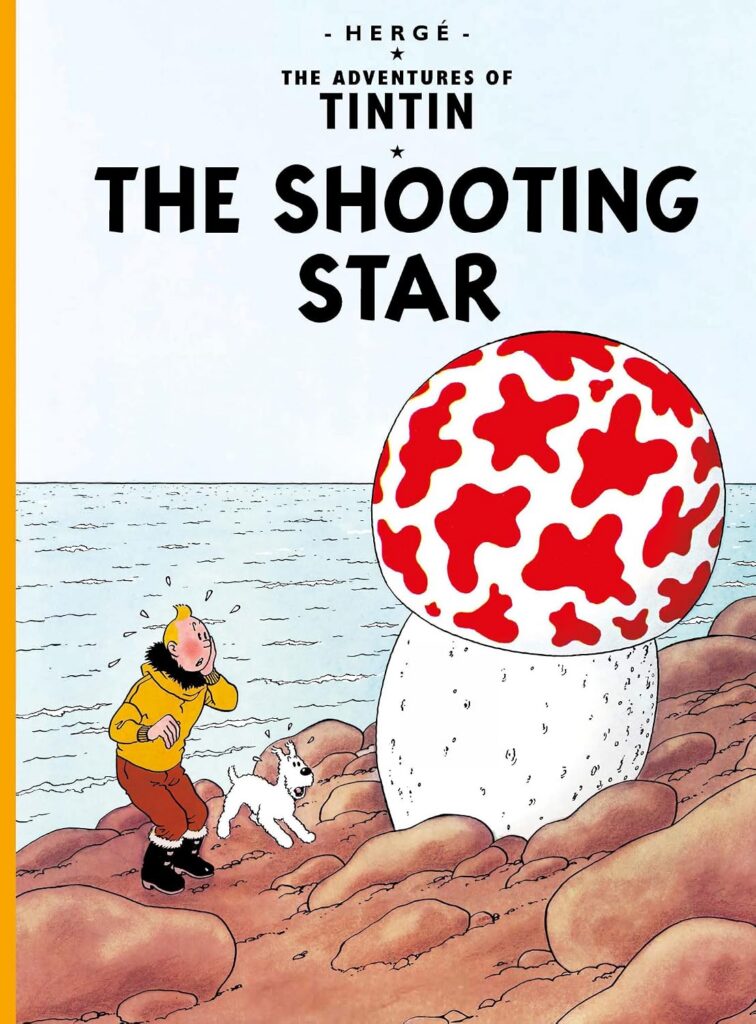
The Shooting Star was the first colour album of the Tintin series, published in 1942. Against a backdrop of scientific concern regarding the apocalypse that nuclear weapons would represent during World War Two, this Tintin adventure highlights scientific research, rather than capitalist interests.
In The Shooting Star, a new star appears in the Big Dipper; Tintin goes to the observatory where he meets Professor Decimus Phostle (Hyppolite Calys in French). The latter tells him that it is a gigantic meteorite about to collide with Earth, thus bringing about the apocalypse.
As with Red Rackham’s Treasure, covered here, there are numerous hidden references in the story, some of them religious…
Professor Decimus Phostle and the Apocalypse
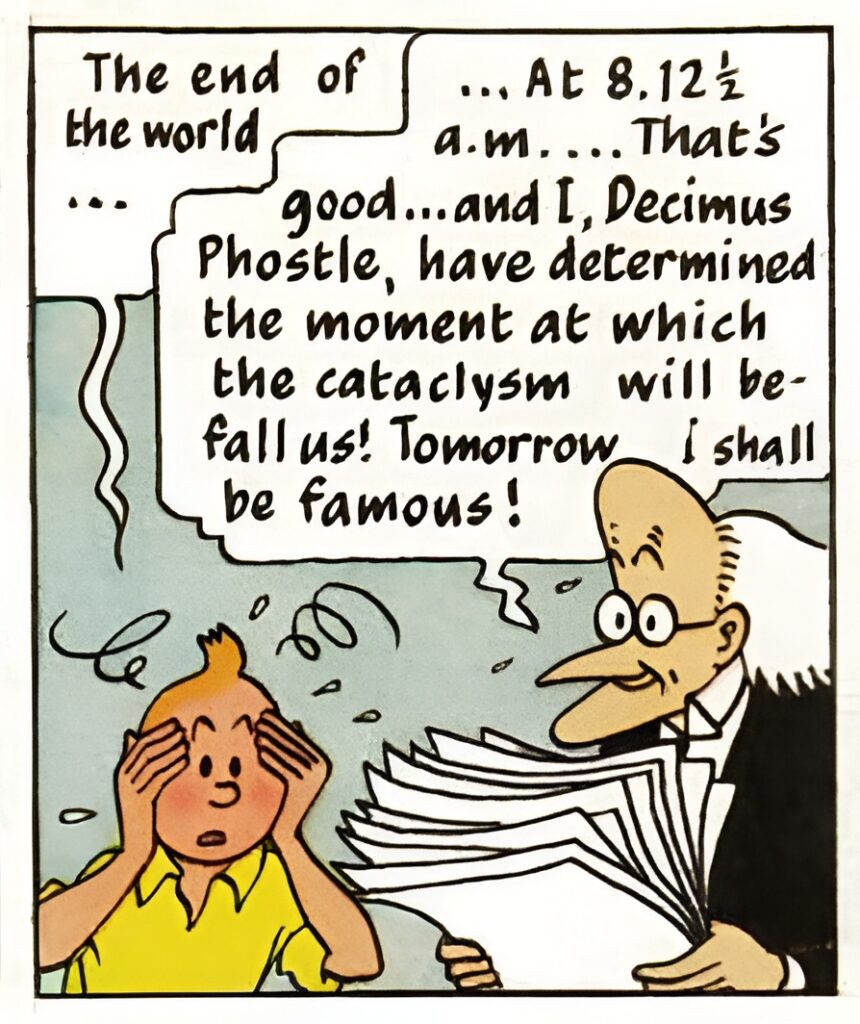
The end of the world is predicted for next morning, at 8 hours 12 minutes, a reference to St John Apocalypse, Book of the Revelation 8:12.
The fourth angel sounded his trumpet, and a third of the sun was struck, a third of the moon, and a third of the stars, so that a third of them turned dark. A third of the day was without light, and also a third of the night.
Scientists and their neckties
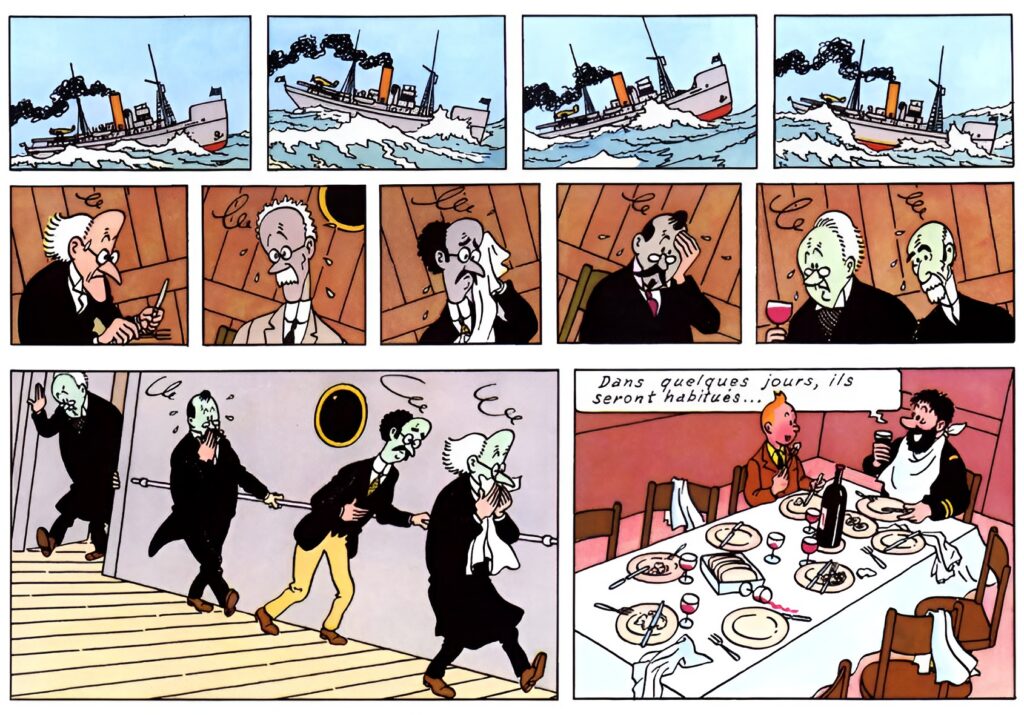
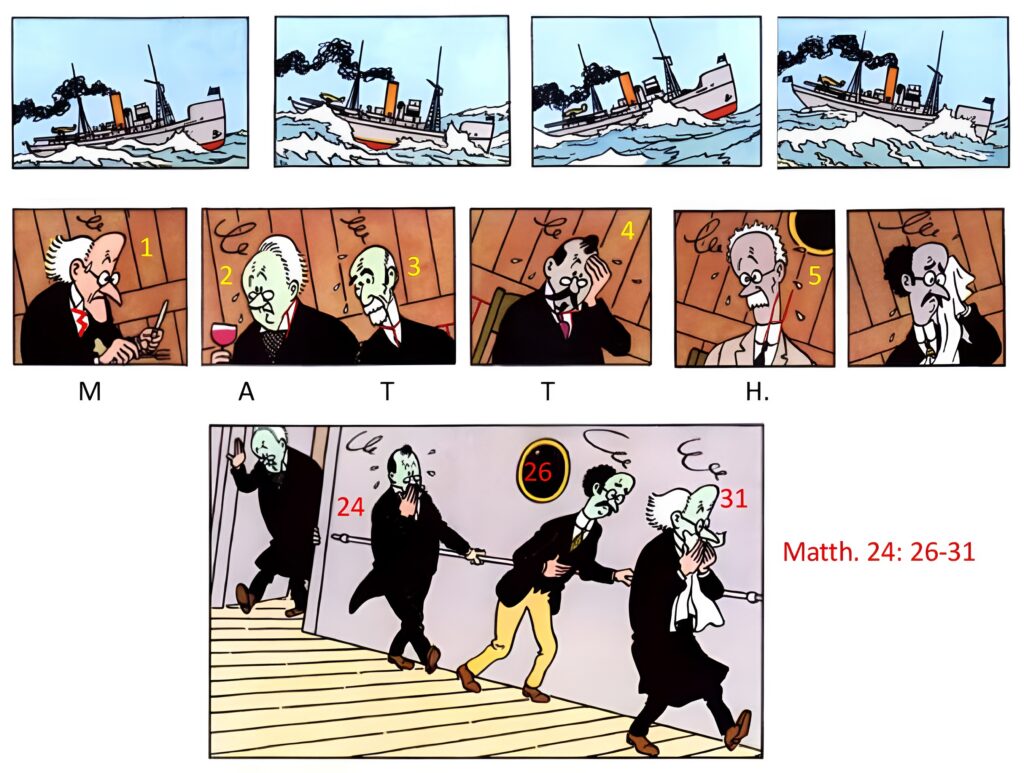
In a scene on board shop, on the way to find the meteor, the scientists’ ties, arranged in increasing order of the number of sweat droplets, spell the word MATTH. (Matthew the Evangelist), and the three scientists, as they exit, indicate with the dizziness symbol and their number of sweat droplets the verses of that gospel.
The three scientists who go out onto the deck near the railing have a dizziness symbol of two or three swirls, indicating the reference to Matthew 24:26-31.
Matthew 24 : 26-31. So if anyone tells you, ‘There he is, out in the wilderness,’ do not go out; or, ‘Here he is, in the inner rooms,’ do not believe it. For as lightning that comes from the east is visible even in the west, so will be the coming of the Son of Man. Wherever there is a carcass, there the vultures will gather. Immediately after the distress of those days the sun will be darkened, and the moon will not give its light; the stars will fall from the sky, and the heavenly bodies will be shaken. Then will appear the sign of the Son of Man in heaven. And then all the peoples of the earth will mourn when they see the Son of Man coming on the clouds of heaven, with power and great glory. And he will send his angels with a loud trumpet call, and they will gather his elect from the four winds, from one end of the heavens to the other.
The Elect from the Four Winds
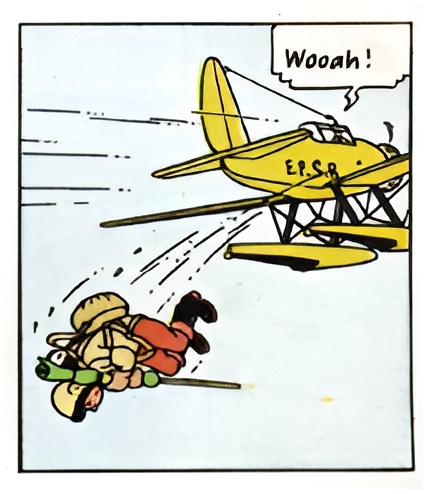

The Meteorite and Beaufort island
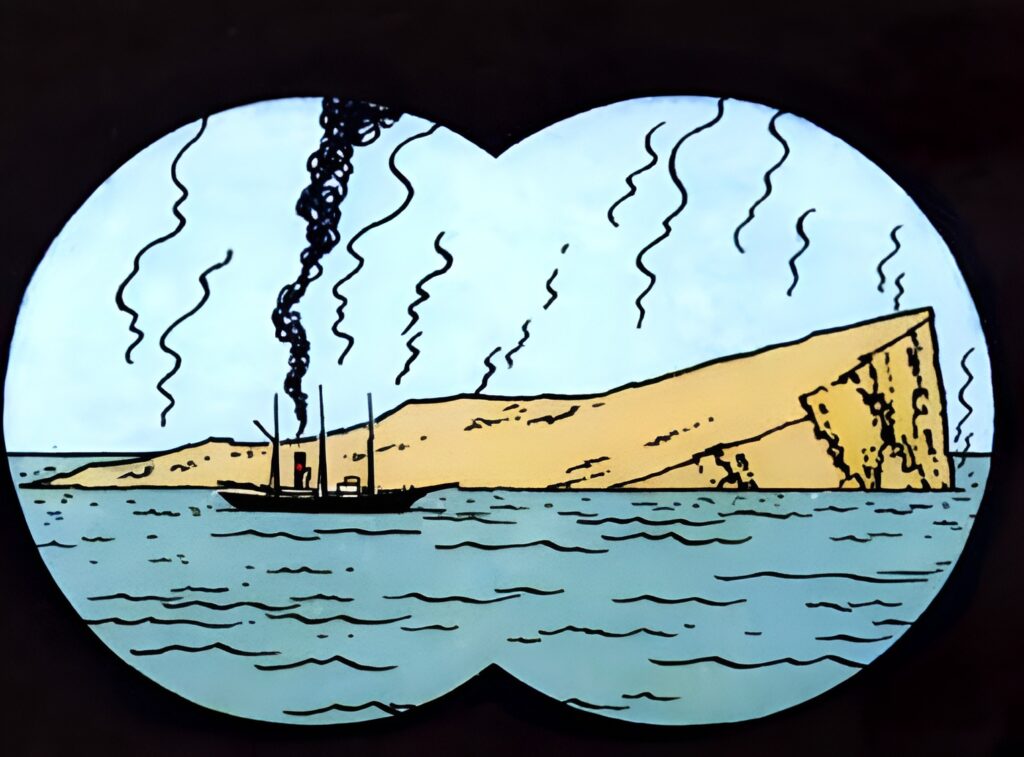
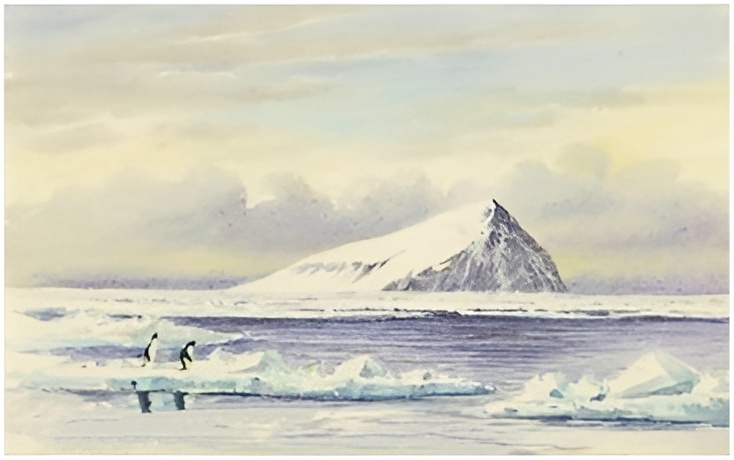
Sir Francis Beaufort (1774–1857) is known for having developed a wind force scale called the “Beaufort Scale” and for creating the Beaufort cipher: a subtraction-based encryption similar to the Vigenère cipher, which is an addition-based encryption. According to this encryption method, the Beaufort cipher, the encrypted message (C) = Key (K) – Plaintext (P).
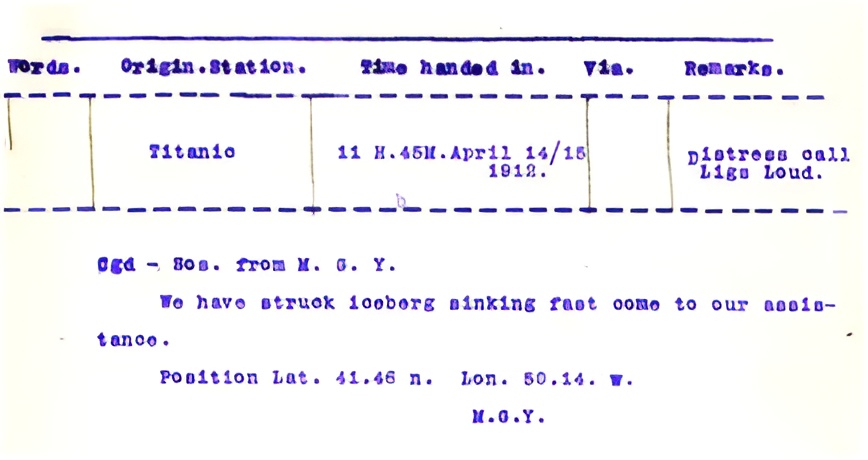
Telegrams of the (Vil) Naranda (Cithara in the English version) and the Titanic

The Cypher’s Key
Captain Haddock asks Tintin how he knew the telegram was a fake. Tintin, after a sleepless night, faints while revealing the decryption key.
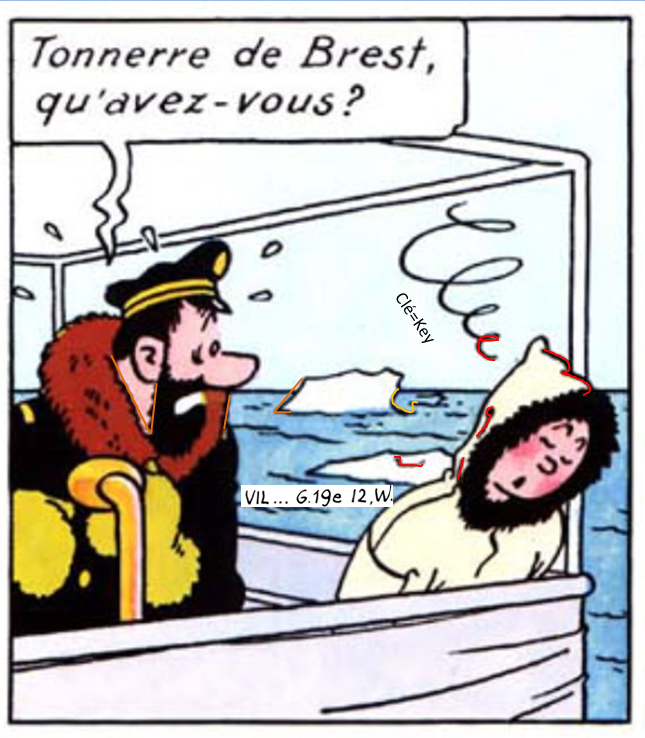
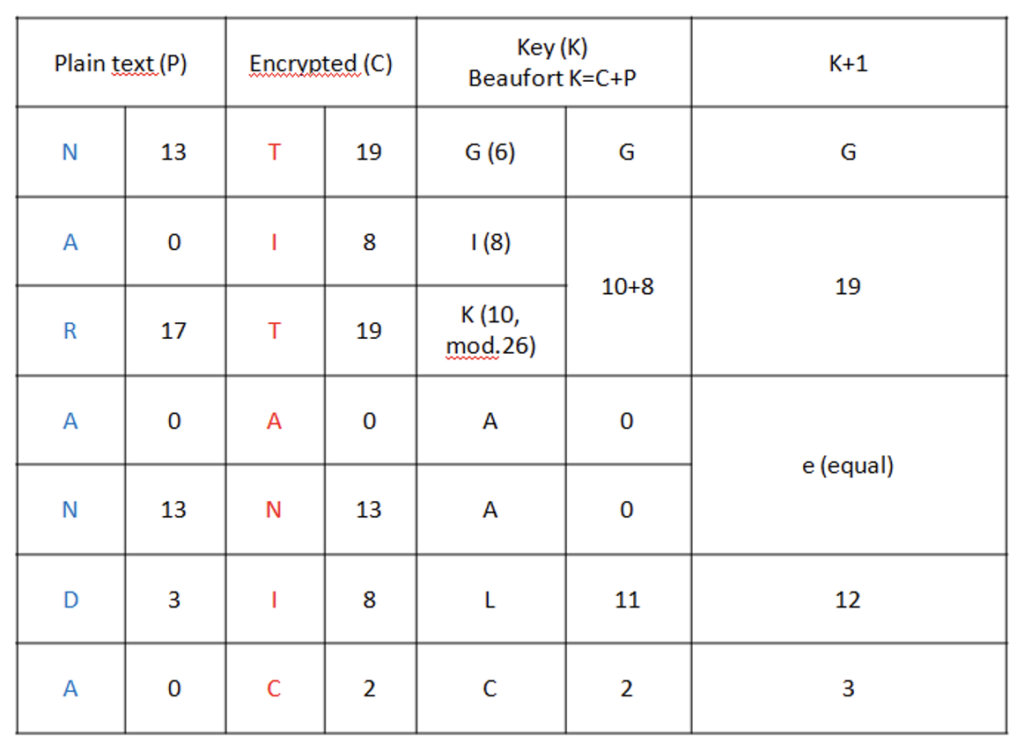
Titanic is the encrypted name of Naranda, with the key G19e12,3 (the tilted W for West) using the Beaufort cipher.
Captain Haddock of the RMS Olympic
Captain Herbert Haddock, at the time of the Titanic disaster, was sailing on the RMS Olympic, of the same company (White Star Line), about 500 nautical miles to the southwest. Informed of the disaster, Captain Haddock immediately changed course and headed at full power toward the wreck site.
In The Shooting Star, Captain Archibald Haddock makes a similar decision by diverting the Aurora toward the coordinates of the distressed ship Vilnaranda.
Conclusion
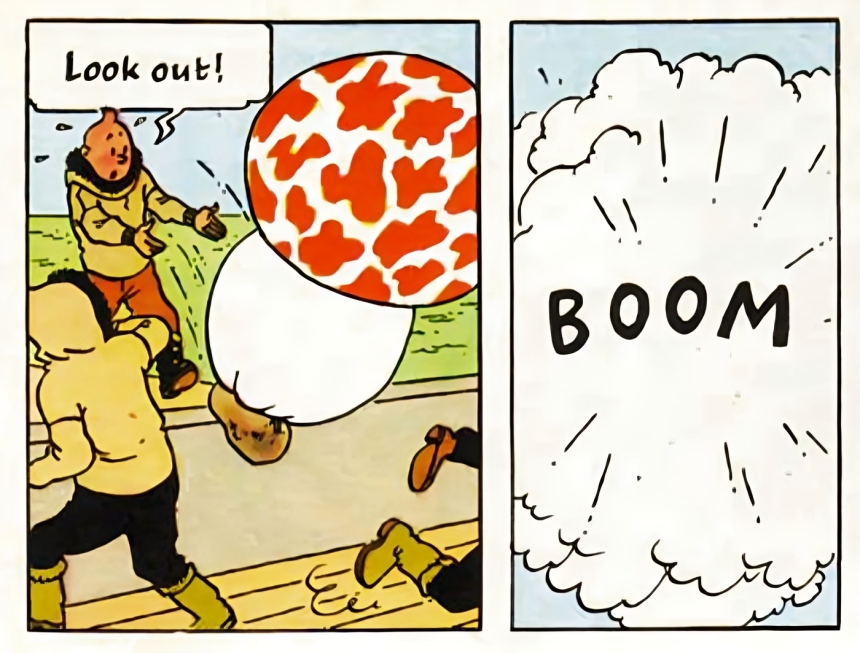
The sinking of the Titanic was a civilisational shock, because it brutally confronted the Western world with its own illusions: the belief in infallible progress, the apparent solidity of its social order, and the power of its technology. Tintin brings back a stone from the meteorite on which grows a poisonous (nuclear?) mushroom that explodes.
In the early 1940s, the prospect of the development and use of nuclear weapons worried scientists. The meteorite in The Shooting Star, from which poisonous mushrooms grow, is a kind of warning about the apocalyptic dangers that nuclear energy would represent if it fell into the wrong hands.
Damien Dessane
Damien Dessane was born in France. He lived in several countries before settling down on the Aegean coast of Turkey. He likes to understand the intention of artists in their works. He has published a new interpretation of the Lady and the Unicorn, Dürer’s master pieces, Da Vinci Madonna of the Rocks, Van Eyck’s Rolin’s Madonna and recently Poussin’s Et in Arcadia Ego.
• Read Damian’s other Tintin feature: Tintin and the Treasure of the Gospels
Damien dives deep into Hergé’s Tintin adventure Red Rackham’s Treasure, and uncovers some secrets you may have missed…
• The Official Tintin Website: tintin.com
• The Shooting Star is available from all good bookshops | ISBN: 978-1405206211 | AmazonUK Affiliate Link
A huge fireball comes hurtling towards Earth from space!Tintin, the world’s most famous travelling reporter, voyages to the Arctic Ocean with Captain Haddock to find the meteorite in the stormy Arctic Ocean, but a valuable metal is contained in the meteorite and his attempts to reach it are met with relentless sabotage!
Further Reading…
Pease note, some of books featured here are in French…
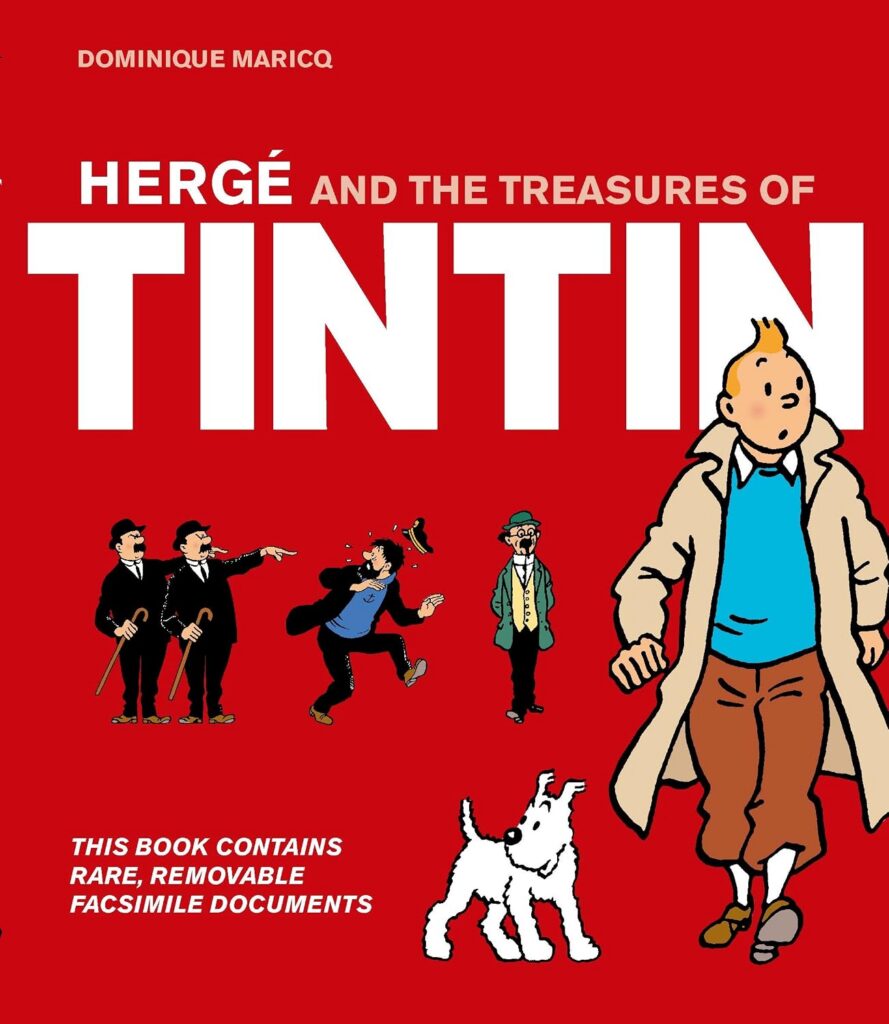
• Hergé and the Treasures of Tintin by Dominique Maricq
Hergé & The Treasures of Tintin looks at the influences on Hergé and the backgrounds to the stories of Tintin and how they were produced. Integrated with over 180 illustrations and around 20 beautifully reproduced facsimile documents, the book explains how Georges Rémi became Hergé, how his private life and interests influenced his work, how the young journalist Tintin was developed and what sparked the delightful characters of Captain Haddock, Snowy, Professor Calculus, the Thom(p)sons, Chang and Bianca Castafiore.
Plus there are special information boxes on many of the numerous other individuals who appeared in the Tintin stories.
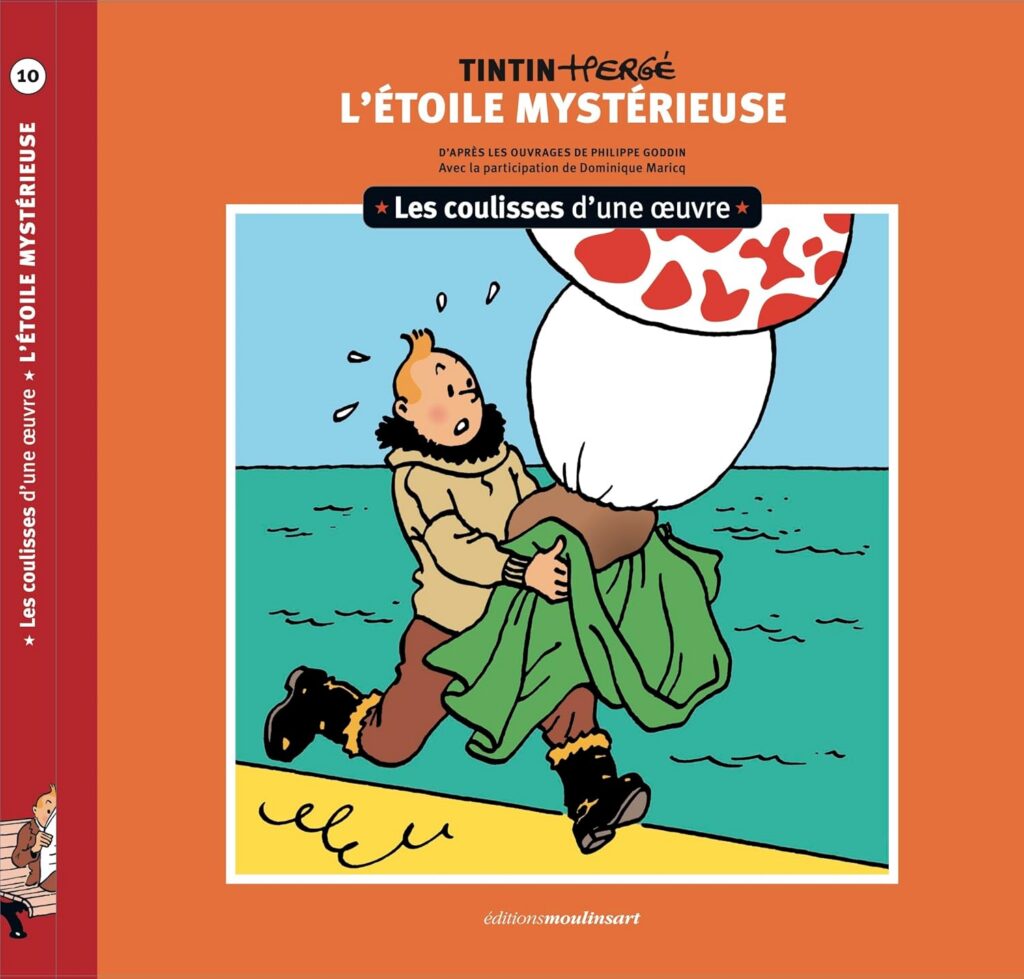
• Les coulisses d’une œuvre – 10: L’Étoile mystérieuse by Philippe Goddin and Dominique Maricq, one in the Les coulisses d’une œuvre series is available here from AmazonUK (Affiliate Link)
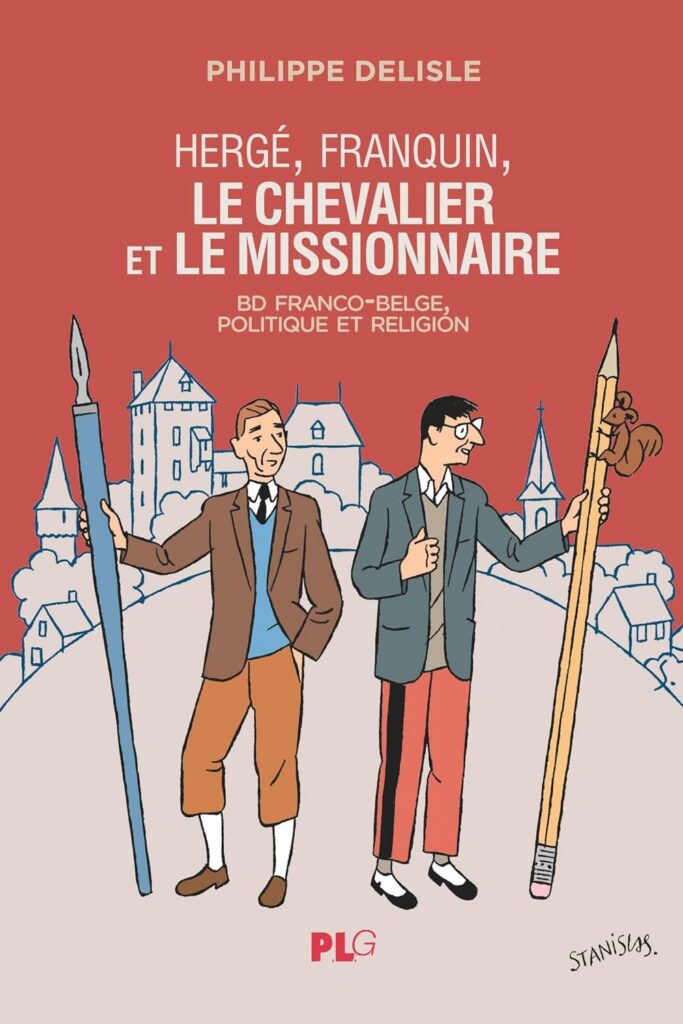

• Hergé, Franquin, le chevalier et le missionnaire by Philippe Delisle
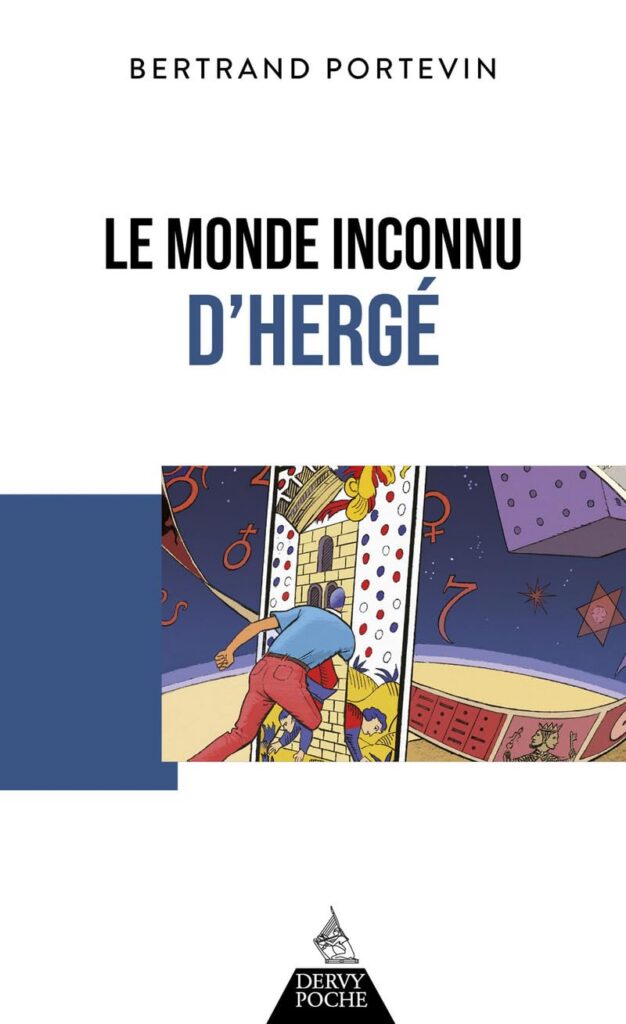
• Le Monde Inconnu D’Herge by Bertrand Portevin
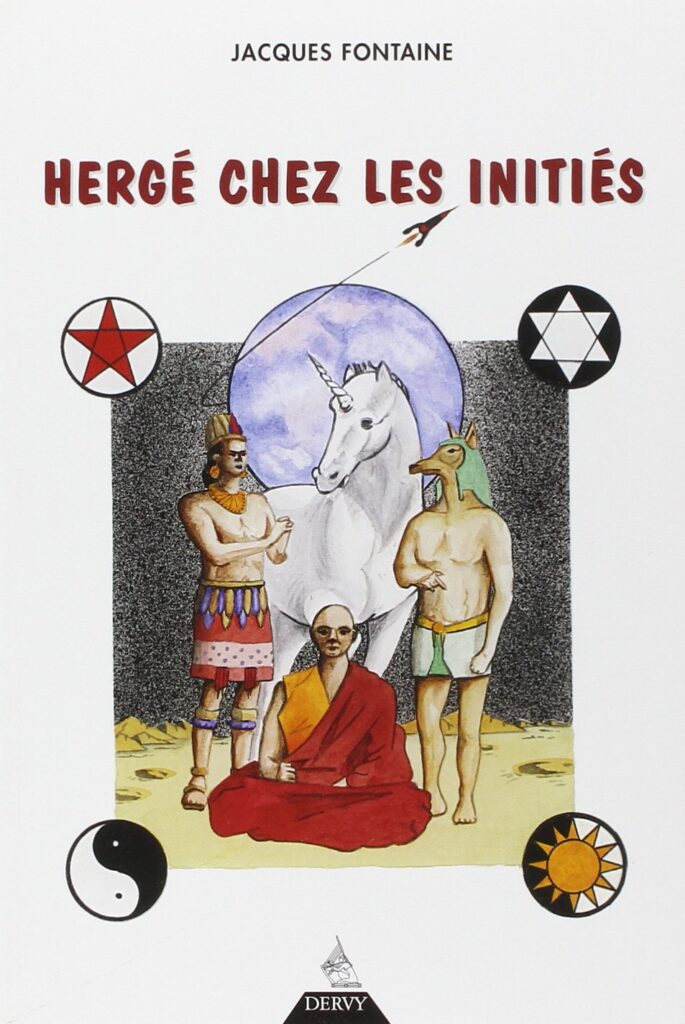
• Hergé chez les initiés by Jacques Fontaine
• Hergé, fils de tintin by Benoit Peeters
- About the Author
- Latest Posts

One of many guest posts for downthetubes.
Categories: Comics, Comics Studies, Creating Comics, downthetubes Comics News, Features, International Comic News