Review by Russell Cook
The shaft of white light that suddenly appeared above my desk was blinding. I stopped typing and wasn’t sure whether to cover my eyes or ears as the simultaneous deafening organ music erupted within the four walls of my study. As I sat back trying to adjust to this strange shift in my own spacial awareness, a booming yet strangely calming voice took hold in my subconscious. “Book reviewer, I have news of a very important task. There are times when it is necessary to publish and review a book comprising six-page turning stories that are connected by an overall theme”.
Recovering my composure, I meekly asked: “That’s all rather lovely, but I’m snowed under with other work at the moment –”
“I have chosen you!” cut in the voice.
“Ah, I see, go on,” I replied.
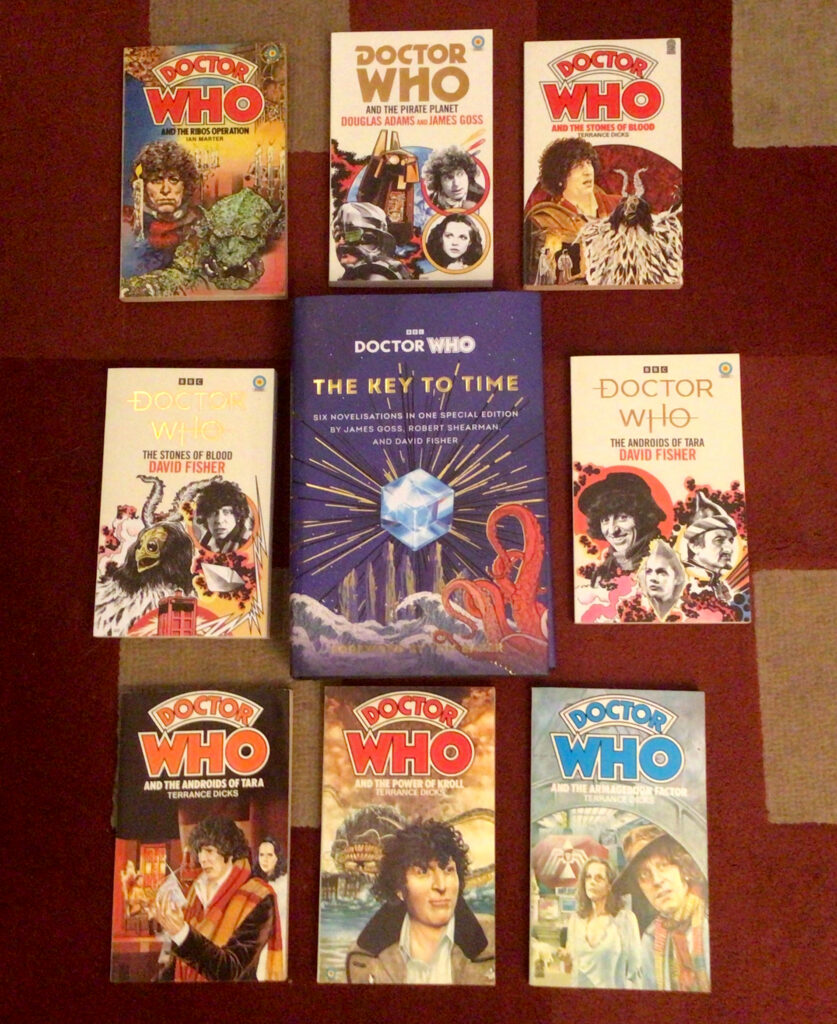
“You have reviewed Doctor Who books in the past, so you have heard of the Doctor Who : The Key to Timestories?” asked the voice. “Indeed I have sir, a great series of books published simultaneously in WH Allen hardbacks and Target paperbacks in 1979 and 1980, novelisations by Ian Marter and Terrance Dicks – well five of them were; one got lost in a financial time vortex for a few decades before hitchhiking onto the Target bandwagon in 2021.”
“Thank you… that is what I wanted to know,” said the voice sarcastically, before continuing. “as I said, the stories have been gathered together in an impressive 805-page hardback volume with new interpretations of the quest to find the six segments of The Key to Time.”
The voice went on: “it is up to you to give your opinions of the tales in a positive and honest way, you will receive your copy of the book imminently… and remember – it has to be an entertaining review, no cheap gags or cheeky classic series references.”
“Oh, right, couldn’t I just …”
“No!” said the voice seemingly fading into the distance “Beware the stupid gag, beware!”
The light faded, the organ music stopped and as it did so, I heard a thud on the mat by the front door. There was a large Jiffy bag, my name on the front clearly tracked and traced. All as predicted by the distant voice clearly on friendly terms with publishers and publicists everywhere.
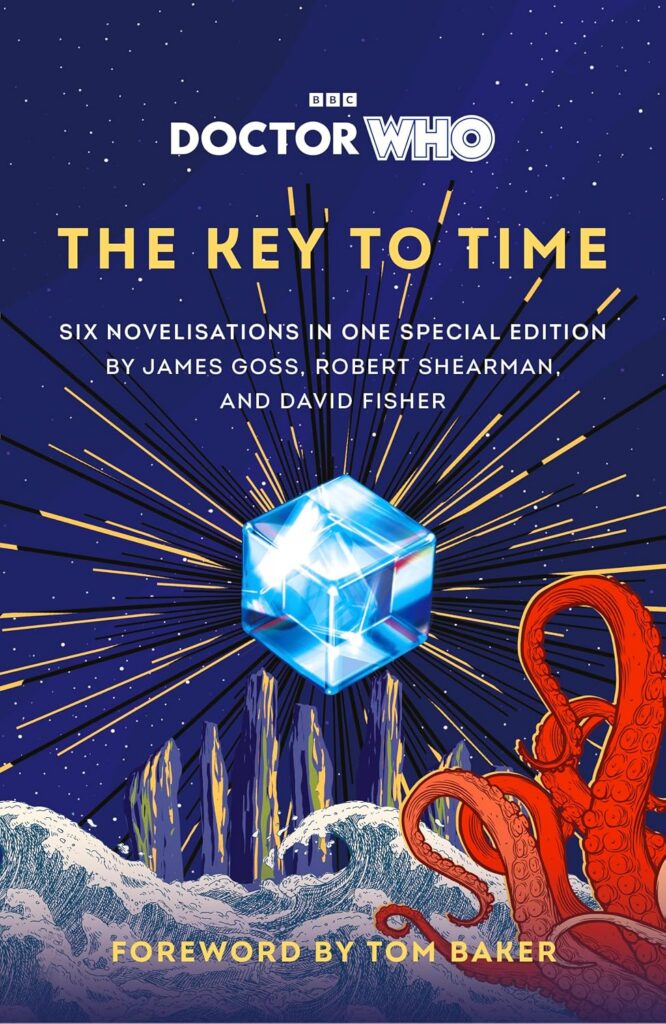
The Key to Time hardback immediately drags the reader in with the vibrant front cover. The front consists of the assembled cube surrounded by the energy of this most sacred of objects. Beneath it sit the roaring waves of Delta Magna and the tentacles of a not so small squid are reaching out perhaps triggering the release of the cube into the six segments that occupy the back cover as they head off to take on their disguises that the Doctor and Romana must track down in their attempt to stop the universe from descending into eternal chaos.
Opening the pages of the volume and the reader is straight into the story. In the prelude the shadowy figures of the Pantheon of the Gods summon the man in white to discuss the need to restore the balance of the universe. How? The Key to Time! We are off.
Enter the Doctor learning of the quest – his very own Odyssey – and he meets Fred, sorry Romana, who thinks she has been put in charge of the search for the six segments by the President of Gallifrey, although that might not be the case. The Doctor her assistant? Off to Ribos, and James Goss’ reimagining of Robert Holmes’ rich and eloquent story is told from the viewpoint of all the major characters, which adds to atmosphere of the adventure taking place on the snow covered planet. It is an excellent start to this galaxy crossing search.
All six stories are prefaced by the intriguing interludes featuring characters in various guises from the tales, including one who doesn’t feature in the actual quest. Perhaps he was taking a break from prison life and reruns of The Clangers… moving on. It all adds to the interlinked theme and works well.
James Goss tackles The Pirate Planet, the novelisation originally published in 2021, time to enjoy again the psychotic Captain, his doting assistant Mr Fibuli, all looked after by the Nurse who is not all that she seems.
David Fisher originally produced his adaptations of his stories The Stones of Blood and The Androids of Tara for AudioGO, the CDs released in 2011. They were published as Target books in 2022, having been tweaked into prose form by his son Nick. David’s versions are a worthy regeneration of Terrance Dicks’ novelisations of thirty-one years earlier. It’s good to revisit Vivien Fay, the chilling blood sucking stone like Ogri not to mention the gloriously eccentric archaeologist Professor Amelia Rumford, the best companion to the Doctor that never was.
On Tara, the mischievous Count Grendel is hell bent on outwitting the Doctor resulting in a Robin Hood style sword fight to rival Errol Flynn and Basil Rathbone, a long way from The Prisoner of Zenda.
The Power of Kroll is often regarded as a Robert Holmes script that lacks his written trademark wit and style. It was a rushed commission, with the writer producing the four scripts in ten days. Despite this, there is much to relish in the original and thanks to Robert Shearman’s reimagining we now enjoy the search for the fifth segment taking place on Delta Magna from the point of view of the giant squid Kroll in all its vibrant green glory. It works and brings the story to life. The characters take centre stage: Romana comes into her own and Rohm-Dutt becomes a Holmes double act, thanks to the creation of Junior, his son! Read on and wish Kroll all the best with Shirley.
The Armageddon Factor. I know, it’s a tough call. As for the television serial there is not a lot to recommend. Actually, there is nothing to recommend, apart from William Squire’s portrayal of the Shadow. The print version of that character is genuinely chilling, and Goss doesn’t hold back – and the Shadow’s encounters with the Doctor are superb on the printed page. Looking at another franchise, even the Dementors would give this interpretation of death a wide birth. It’s clear that this reworking of the six-part finale was helped by earlier drafts of the scripts by the writers Bob Baker and Dave Martin.
At the time the Doctor Who Production Office located in Threshold House was also in a state of eternal chaos, Producer Graham Williams was becoming adjusted to working with new Script Editor Douglas Adams, who had just taken over from Anthony Read who had worked in close collaboration with the aforementioned Williams on the overall Key to Time concept. Then there was the Producer’s conflict with series star Tom Baker who was demanding casting, script and director approval if he was to continue in the role. Plenty to think about, which resulted in a six-part story that was the climax to the linked twenty-six part series, but comes across as lackluster and disappointing when on screen in early 1979.
All praise to James Goss for pushing all the baggage aside and offer an exciting, coherent and genuinely page turning conclusion to the search. Not easy, it works the cube is complete. As for Drax… well.
So, draw the curtains, light a fire, get a mug of sweet tea and a plate of sausage sandwiches and dive in. Relive this sixteenth season of Doctor Who from forty-eight years ago that made the winter of discontent so much easier to bear.
Russell Cook
• Doctor Who: The Key to Time by by James Goss, Robert Shearman, David Fisher (Authors), Tom Baker (Foreword) is published by BBC Books at £25.00 and available from all good bookshops | AmazonUK Affiliate Link
James Goss is a Sunday Times Bestselling author who has written several Doctor Who books, including being Douglas Adams’ literal ghost writer, as well as adapting The Giggle for the Target range. He’s written extensively for audio, working on projects for Audible, BBC Sounds and Big Finish. He’s also written the Daleks! cartoon series for BBC Studios.
David Fisher was approached by script editor Anthony Read to write for Doctor Who and the result was the 100th story, The Stones of Blood, transmitted in 1978. As well as The Stones of Blood, he also contributed The Androids of Tara, The Creature from the Pit and The Leisure Hive to Doctor Who. The first two stories were novelised by Terrance Dicks, but Fisher decided to pen the latter two himself for the Target range.
Robert Shearman is an award-winning writer for television, radio and the stage, as well as several acclaimed short story collections, the first of which won him a World Fantasy Award, and Doctor Who audio scripts for Big Finish Productions.
- About the Author
- Latest Posts

One of many guest posts for downthetubes.
Categories: Books, Doctor Who, Other Worlds, Science Fiction, Television
 New book, “Written by Terrance Dicks”, out later this month
 David Brilliance’s TARDIS Treasury out now
 Herne Books offer new Doctor Who works exploring show’s many themes
 In Memoriam: Doctor Who Author and Editor Justin Richards
Leave a Reply