Damien Dessane dives deep into Hergé’s Tintin adventure Red Rackham’s Treasure, and uncovers some secrets you may have missed…
The strip examples in this feature are used with the permission of Delphine Maubert (Tintinimaginatio) for education/information purposes.
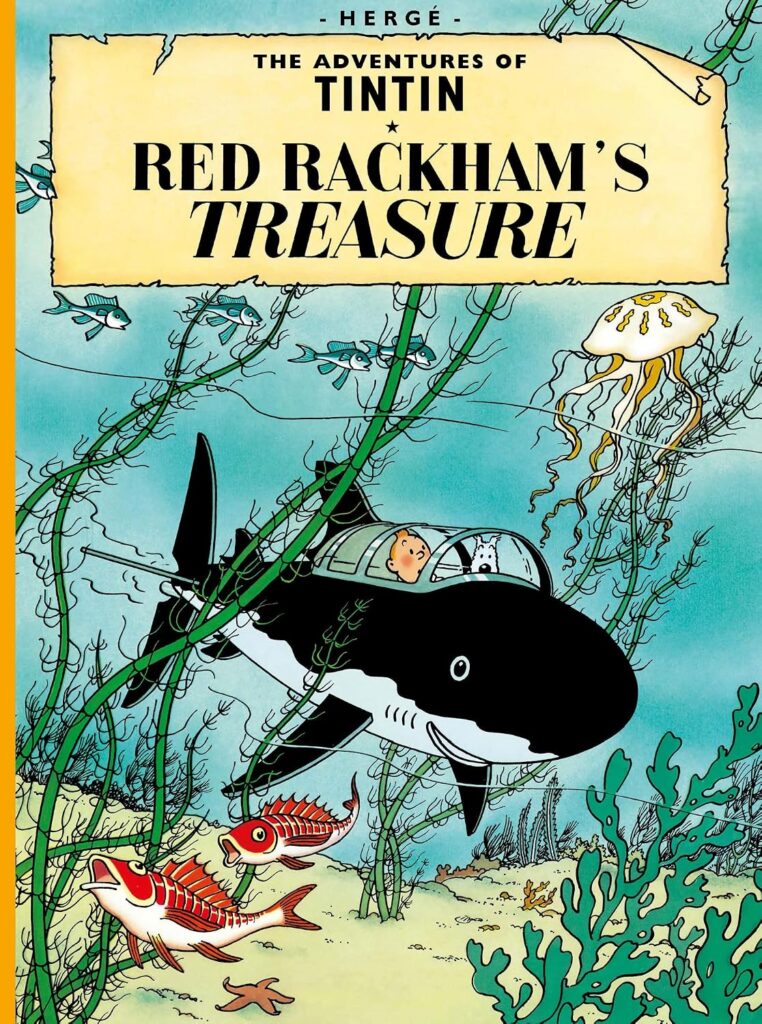
Beneath its seemingly innocent surface, Hergé’s work exhibits notable complexity. It reflects his mindset: his Catholic Faith, his interest in esotericism and cryptology, and his political outlook bordering on anti-capitalism. In Red Rackham’s Treasure, the pursuit of the treasure is interwoven with Gospel references, emphasising that money should not be an end in itself but serve just purposes, and that the author, through his art, seeks not material wealth but the capacity to engage and inspire his audience. These concealed allusions function, in effect, as Hergé’s testament, revealing the values and insights he deemed essential to transmit in accordance with his Faith…
Hergé, German Occupation and ‘Le Soir Volé’
Hergé (Georges Remi) began drawing in 1926, before he was 20 years old, a scout named Totor, the character who would later inspire Tintin. “The Adventures of Tintin” were published in a Catholic youth newspaper, Le Petit Vingtième, until Belgium was invaded by the Nazis in 1940. The Germans shut down the Catholic publication for young readers. After temporarily taking refuge in France, in the Puy-de-Dôme region, Hergé returned to Brussels following King Leopold III’s call to “resume work,” which he did by agreeing to provide his drawings to the newspaper Le Soir, which then came to be nicknamed “Le Soir volé” (“The Stolen Soir”) because it was under Nazi control
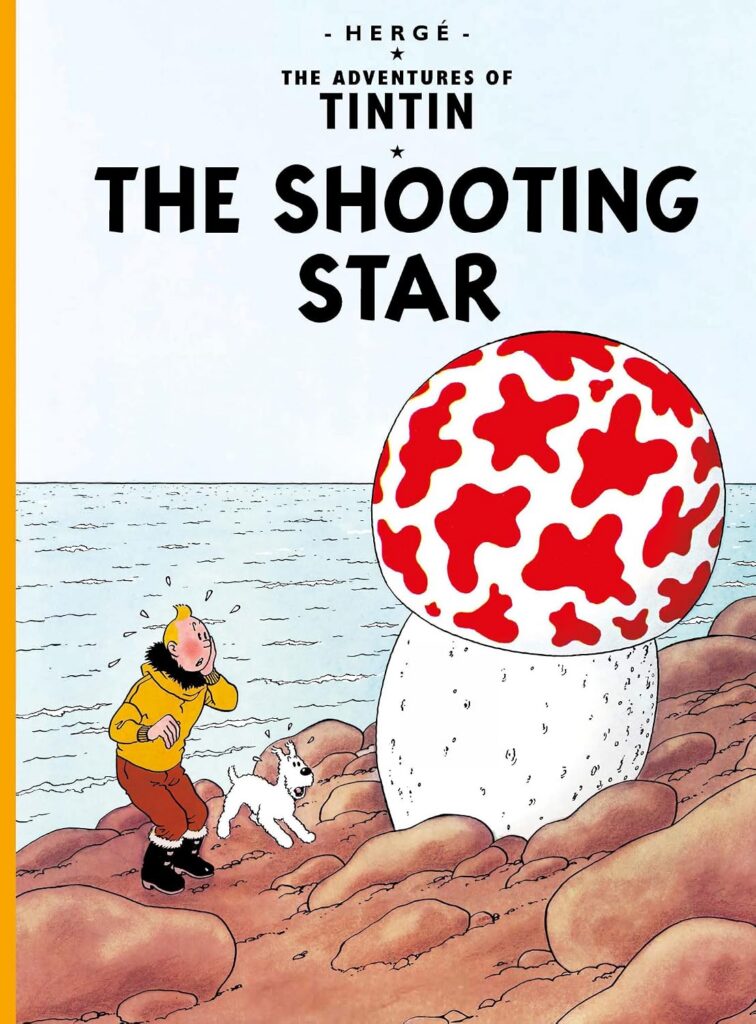
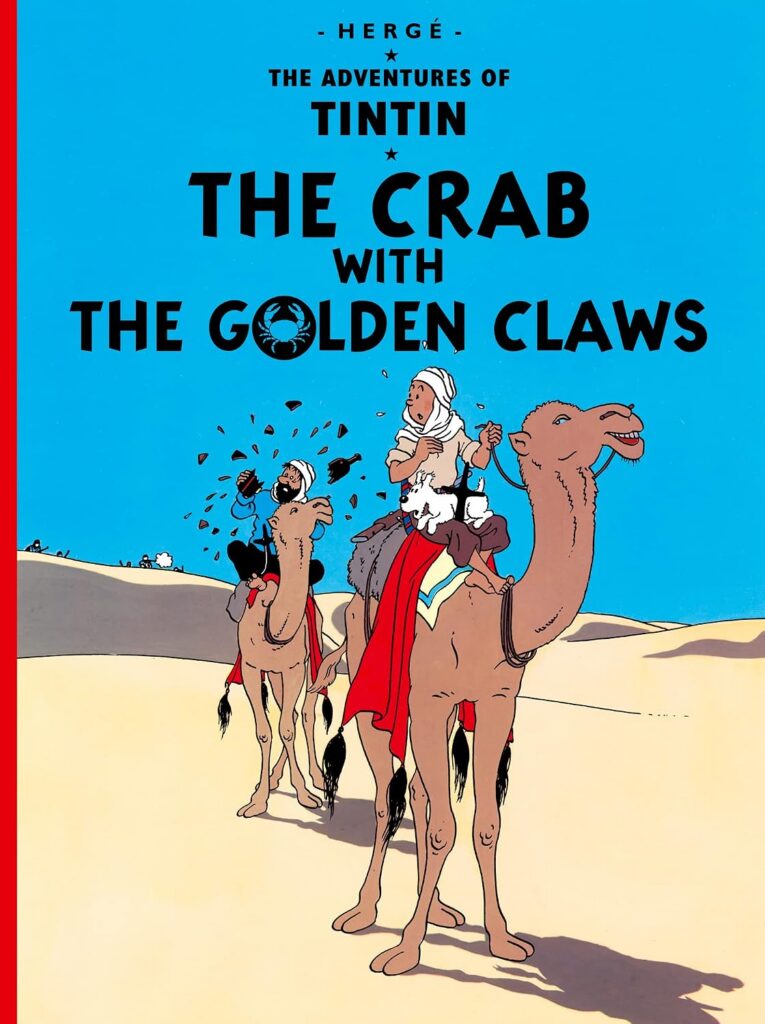
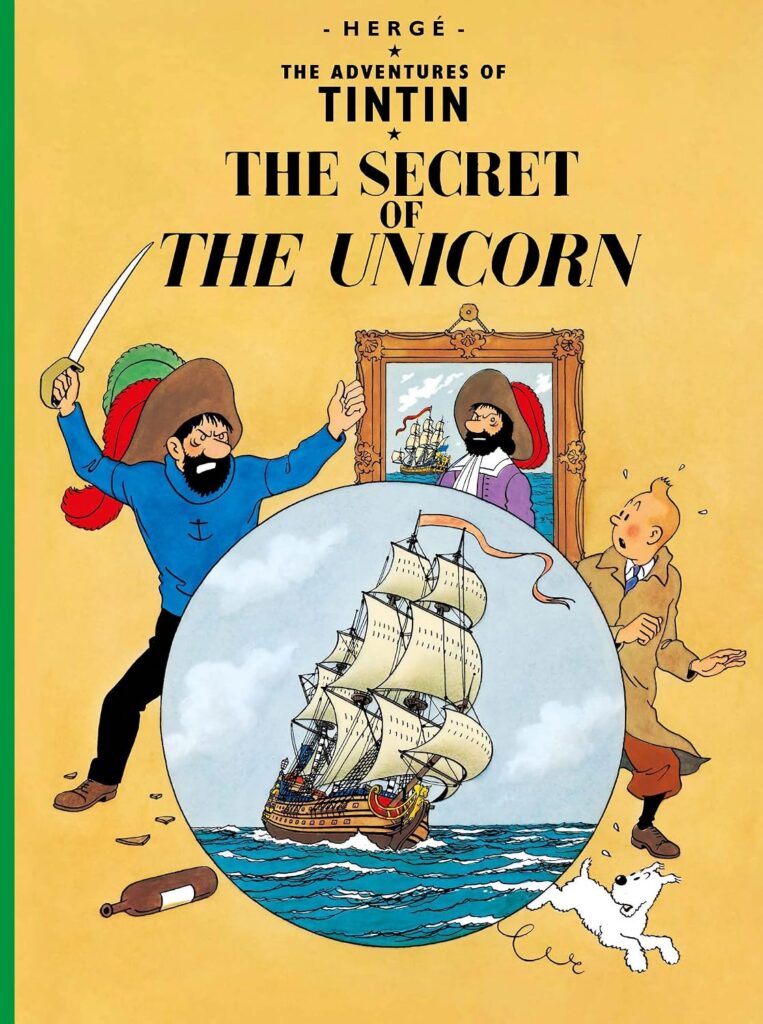
During his years at “Le Soir volé”, Hergé published four albums: The Crab with the Golden Claws (1941), The Shooting Star (1942), and the double album, The Secret of the Unicorn and Red Rackham’s Treasure (1943 – 44)
After the war, public opinion criticised him for having worked for the Germans, which caused him a long period of depression. However, if we examine these four albums, we notice that two of them depict the seizure of a ship by sinister characters: Allan Thompson for the Karaboudjan and Red Rackham for The Unicorn, just as the Nazis had seized the country and the newspaper he worked for. The other albums clearly evoke the Apocalypse: The Shooting Star and, as we will discover, the double albums.
Moreover, in Hergé, Franquin, le chevalier et le missionnaire, Philippe Delisle shows that in Tintin’ albums, before World War Two and the rise of Nazism, the “villains” who were generally Anglo-Saxon, capitalist, and Protestant, are then German or Italian. For example, in The Black Island (1938), Tintin confronts the German doctor Müller, and in King Ottokar’s Sceptre (1939), the character of Müsstler (a combination of Mussolini and Hitler) appears, referencing negatively the Anschluss and the Nazi regime’s actions in Eastern Europe. Hergé, therefore, was not pro-Nazi, not before the war, nor during the occupation. Opposing openly the German regime would have been very dangerous, especially in a newspaper controlled by the Nazis, yet he managed to express a form of resistance.
In Hergé’s work, the “villain” is never portrayed as Catholic. Villains are consistently depicted as Anglo-Saxon capitalists (Protestant), Greeks (Orthodox, e.g. Papadopoulos), Muslims (e.g., Ben Salaad), or Jews (e.g., Bohlwinkel). In the case of the latter, this should not be interpreted as anti-Semitism, but rather as a critique of capitalism.
In the Bible, the stories of the Apocalypse are linked to invasions and colonization: the Assyrians in the book of Isaiah, and the Romans in the book of Saint John. Like Saint John, Hergé could not openly name the occupiers, so he used graphic, mathematical, and narrative strategies to convey his pious messages and his opposition to the invaders. Hergé was not a collaborator; he was, in a sense, a whistleblower.
Tintin and Cryptology
Beneath Hergé’s “ligne claire” style lays a surprisingly complex body of work. His fascination with the paranormal and with C.G. Jung’s analytical psychology is evident throughout the albums. While firmly rooted in his Catholic faith, Hergé frequently explores fantastical themes, including black magic and cryptozoology, featuring creatures such as yetis (Tintin in Tibet), unicorns (The Secret of the Unicorn), and dragons (The Blue Lotus).
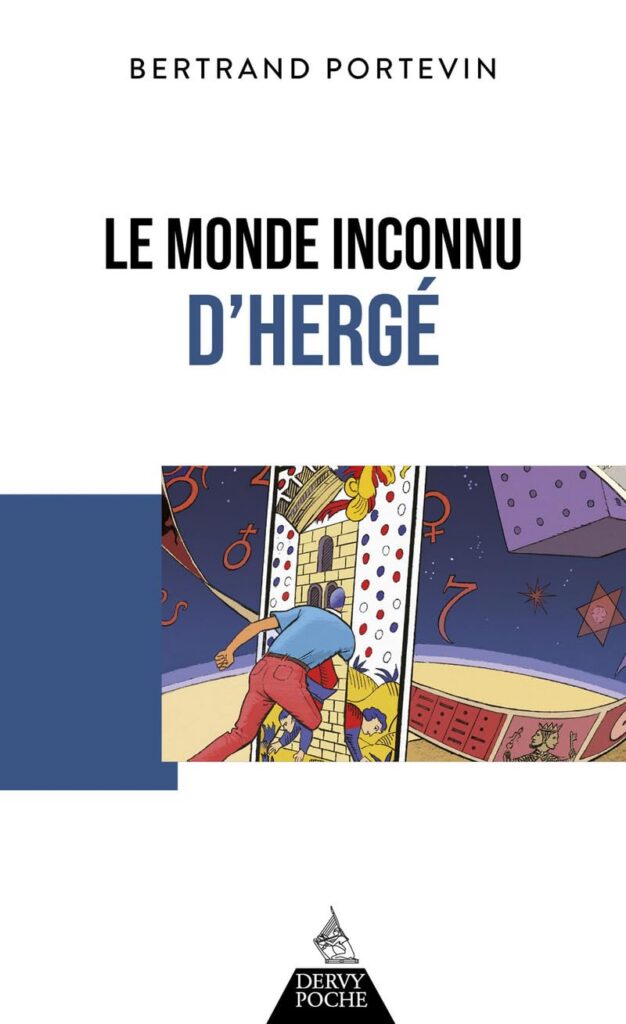
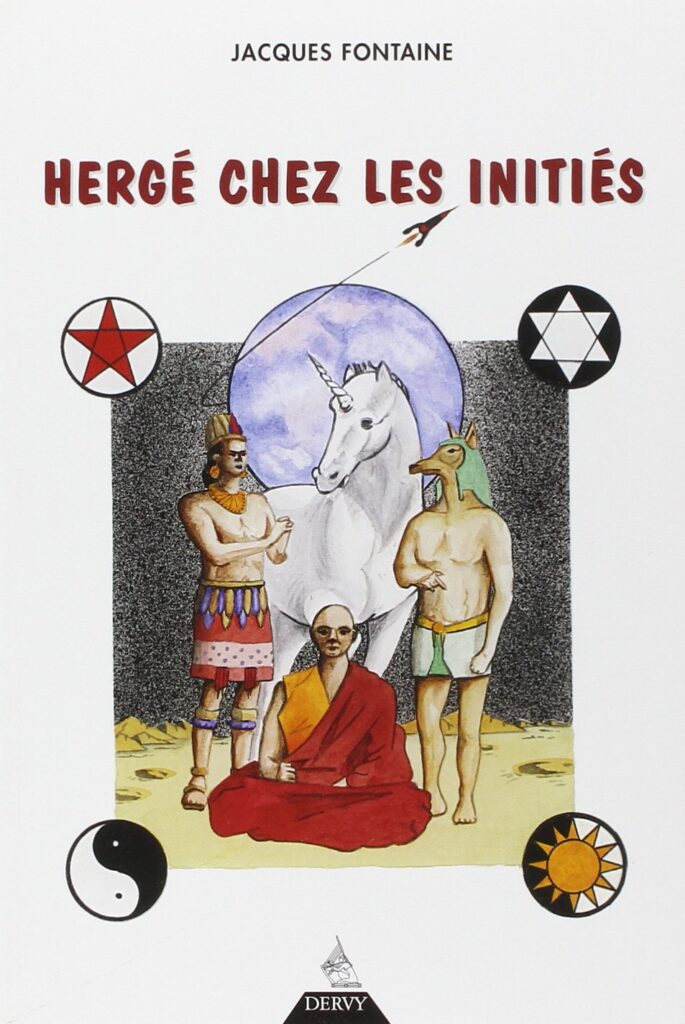
Authors Bernard Portevin (in Le Monde Inconnu D’Herge) and Jacques Fontaine (in Hergé chez les initiés) analyse certain albums as works of esoteric initiation. For example, Bernard Portevin demonstrates that, beginning with Cigars of the Pharaoh in 1934, the Rider-Waite Tarot cards influenced the covers of the albums. A notable example is card number 10, the Wheel of Fortune, reflected in the cover of The Secret of the Unicorn.
Cryptology also plays a significant role in Hergé’s work. In The Blue Lotus, for instance, the “villains” communicate using a code reminiscent of George Sand’s letters (see pages 1 and 19 of the album). The Crab with the Golden Claws alludes to Edgar Allan Poe’s The Gold-Bug (1843), which revolves around a cryptographic puzzle. Hergé also drew on classical ciphers: the Gronsfeld cipher, popularised by Jules Verne in La Jangada (1881, also known in English as “Eight Hundred Leagues on the Amazon”), and its variant, the Beaufort cipher. The latter appears in The Shooting Star, where the meteorite is a symbolic replica of Beaufort Island in Antarctica.
Hergé’s fascination with secret codes appears in many albums: in The Secret of the Unicorn, three parchments must be overlaid to reveal the geographic coordinates of Treasure Island (p. 61); in Prisoners of the Sun, a ship communicates using signal flags (pp. 3 and 5); and in The Red Sea Sharks, a sailor employs a heliograph to send messages to another vessel (p. 59). Hergé weaves cryptography seamlessly into his adventurous narratives, adding layers of mystery and intellectual engagement for the reader.
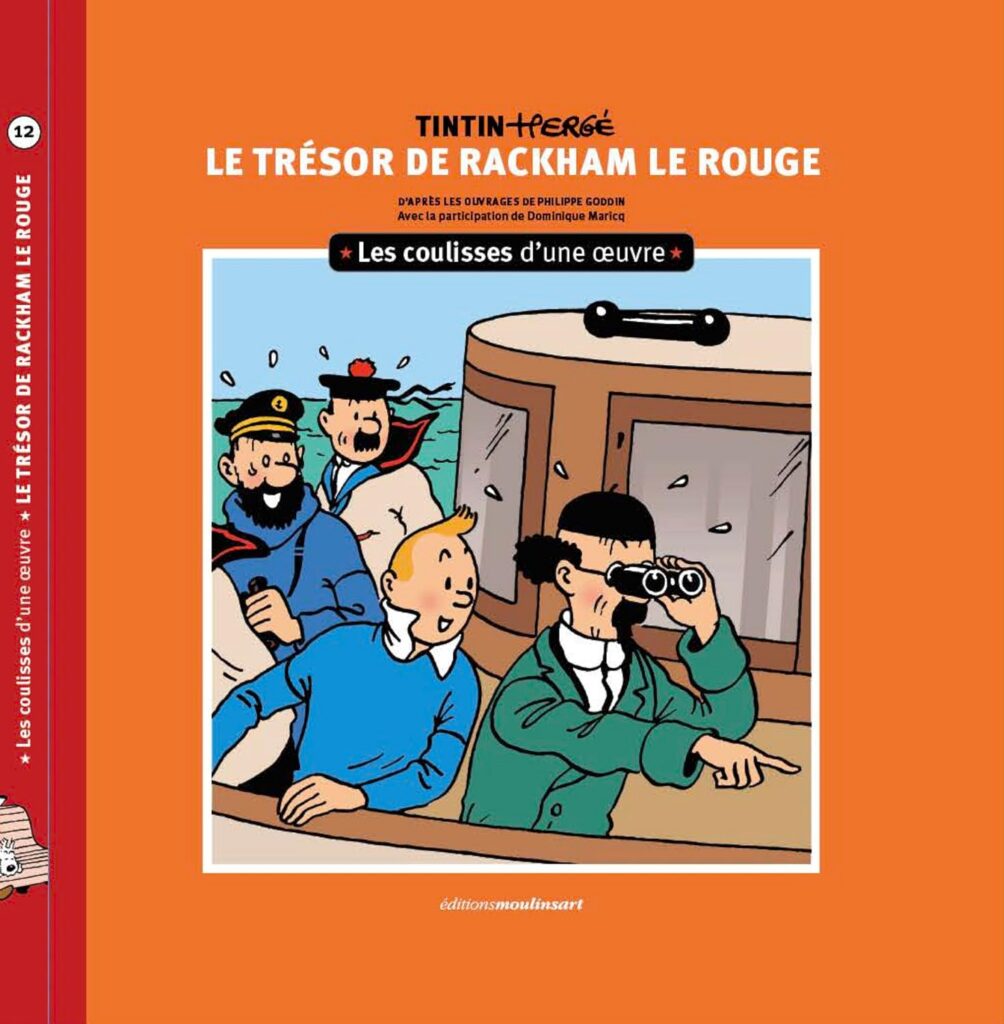
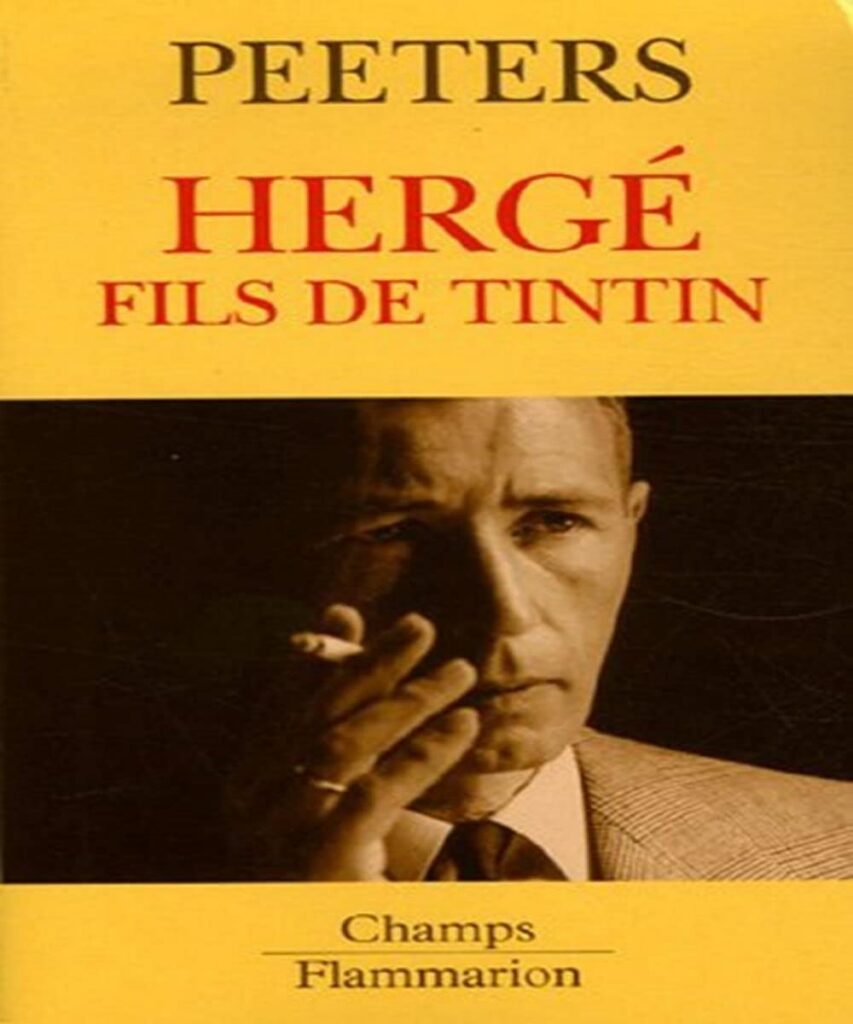
Red Rackham’s Treasure, published as a colour album in 1944 and compiling the strips that appeared in the stolen newspaper Le Soir (documented in Les coulisses d’une œuvre – 12: Le Trésor de Rackham le Rouge by Philippe Goddin and Dominique Maricq), is a treasure hunt that began in The Secret of the Unicorn. Professor Calculus makes his first appearance in this album. According to Benoit Peeters, writing in Herge, fils de tintin, the professor represents the Holy Spirit, completing the Trinity alongside the Father, Captain Haddock, and the Son, Tintin.
The adventure also explores another trinity: that of the three brothers (the three sons of Haddock’s ancestor, the chevalier-corsair), who, when united, illuminate the Cross of the Eagle symbolising the message of the Gospels.
This article explains how that message is conveyed through five hidden biblical references within the adventures of Red Rackham’s Treasure…
Book of Revelation (Apocalypse) of St. John 14:09–13
The Cross of the Eagle (that of Saint John the Theologian) and the coordinates of the island of Sir Francis Haddock: Latitude N 20°37’42, Longitude W 70°52’15 (Paris meridian). The position of Tintin’s ship is given precisely by Captain Haddock on page 23, strip C2. By taking the difference between the Paris meridian and the Greenwich meridian (2°20’14), we obtain 71°02’29 (Greenwich) + 2°20’14 = 73°22’43 (Paris).
If we calculate the distance separating Tintin’s ship from the position indicated by the parchments, we get 73°22’43 – 70°52’15 = 2°30’28, which corresponds to 140.913 nautical miles. This distance refers to the Apocalypse of St. John 14:09–13:
Then another angel, a third one, followed them, saying with a loud voice, ‘If anyone worships the beast and his image, and receives a mark on his forehead or on his hand, he also will drink of the wine of the wrath of God, which is mixed in full strength in the cup of His anger; and he will be tormented with fire and brimstone in the presence of the holy angels and in the presence of the Lamb. And the smoke of their torment goes up forever and ever; they have no rest day and night, those who worship the beast and his image, and whoever receives the mark of his name.’ Here is the perseverance of the saints who keep the commandments of God and their faith in Jesus. And I heard a voice from heaven, saying, ‘Write, “Blessed are the dead who die in the Lord from now on!”’ ‘Yes,’ says the Spirit, ‘so that they may rest from their labors, for their deeds follow with them.
Interpretation: The three parchments find a symbolic parallel in this passage from Revelation, where the third angel pronounces judgment upon those who worship the beast, while offering the promise of salvation to those who remain steadfast in their fidelity to Christ. Within Hergé’s narrative, this functions as a moral allegory: material treasure and worldly wealth are ultimately secondary. Their true significance lies not in possession, but in the ethical and spiritual use to which they are put. In this way, Hergé transforms the quest for gold into a meditation on stewardship; warning that riches become destructive when pursued as ends in themselves, yet can serve the good when ordered toward higher purposes.
Gospel according to Matthew 17:24–27 (St Peter’s fish)
Several references to St Peter are made in the album. Captain Haddock points at the sea with his finger talking about Saint Peter (basilica) (French version: page 23, strip A1; English version: Westminster Abbey). The fish with a round dot on its tail above the treasure chest (page 45, strip C1) is a John Dory (St Peter’s fish, Zeus faber). The shark swallows the treasure chest (page 46, strip A2). Then, dazed by alcohol, the shark knocks itself out (page 47, strip B2), and Thomson and Thompson recover the chest from the shark’s stomach (page 47, strip A2). Captain Haddock, Tintin, Snowy and Professor Calculus sit at a table trying to open the chest:
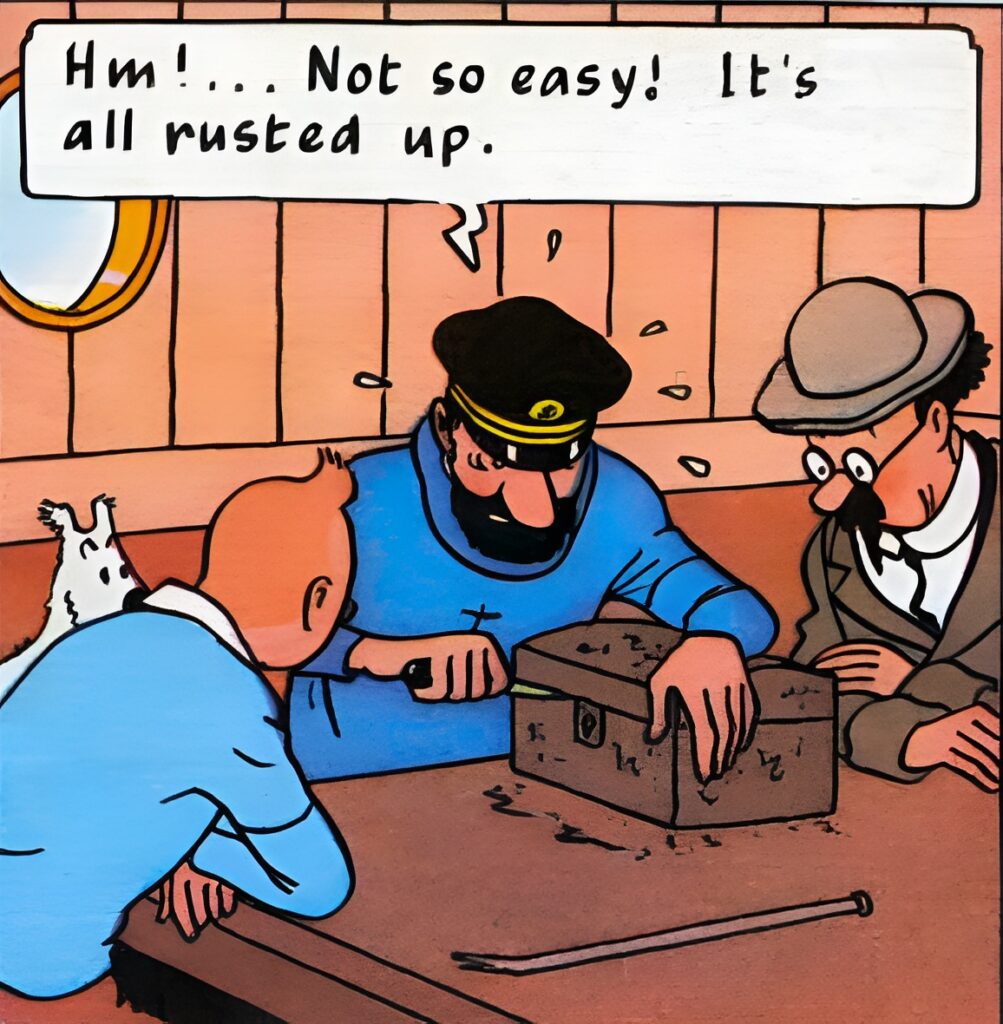
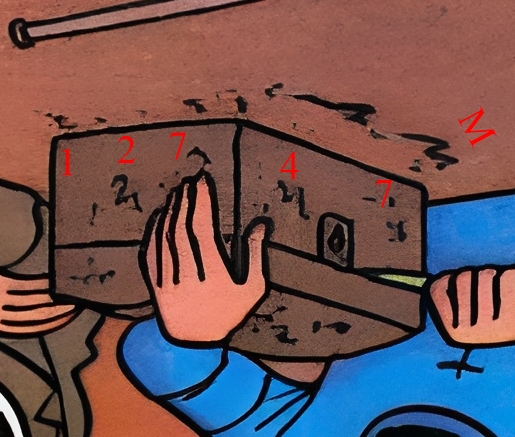
Professor Calculus and Haddock point to two numbers with their fingers: 1 and 7 for the chapter number. The letter “M” is clearly visible on the table indicating Matthew’s gospel. The other number 2, 4 and another 7 refer to the verses of Matthew 17:24-27 :
On their arrival in Capernaum, the collectors of the Temple tax came to Peter and asked him, “Doesn’t your teacher pay the Temple tax?” “Yes, he does,” Peter replied. Then he went into the house. But before he had a chance to speak, Jesus asked him, “What do you think, Peter? Do kings tax their own people or the people they have conquered?” “They tax the people they have conquered,” Peter replied. “Well, then,” Jesus said, “the citizens are free! However, we don’t want to offend them, so go down to the lake and throw in a line. Open the mouth of the first fish you catch, and you will find a large silver coin. Take it and pay the tax for both of us.”
Interpretation: In Red Rackham’s Treasure, Hergé draws a subtle analogy between the Gospel story and Tintin’s quest. The miracle of the silver coin found in the fish illustrates how Jesus could create money at will, yet chooses to provide it only when necessary. Similarly, Tintin and his friends are guided to use Haddock’s treasure responsibly, for purposes that are truly needed rather than for mere personal gain.
Gospel according to John 15: 7-16
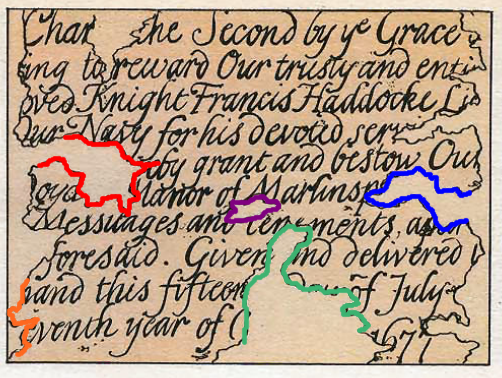
Text of the donation: “Charles the Second (Louis the XIV in the French version) by ye Grace (decid)ing to reward Our trusty and entir(ely) (l)oved Knight Francis Haddock Li(eutenant of) Our Navy for his devoted serv(ice). (We her)eby grant and bestow Our Royal Manor of Marlinspike, Messuages and Tenements upon (the) foresaid. Given and delivered in hand this fifteen(th day) of July, (forty s)eventh year of C(oronation) 1677 (1684 in the French version)”.
(A ‘messuage’ is a house with its immediate attached land/outbuildings. A tenement is a property capable of being held (land, shops, cottages, fields, etc.).
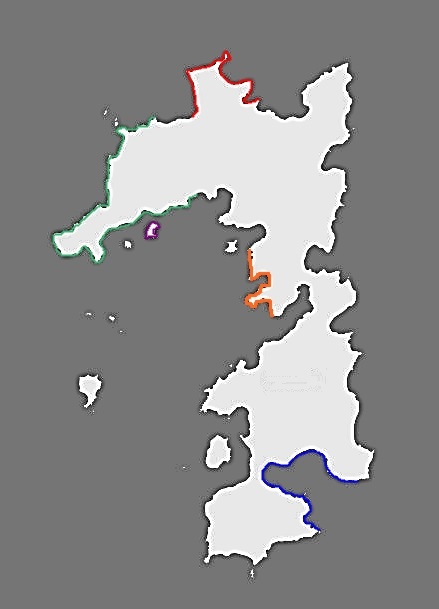
The text of the donation with the date of 15.07.16(77) and the torn parchment itself point at the biblical reference of the Gospel according to John 15: 7-16:
If you abide in Me, and My words abide in you, you will ask what you desire, and it shall be done for you. By this My Father is glorified, that you bear much fruit; so you will be My disciples. “As the Father loved Me, I also have loved you; abide in My love. If you keep My commandments, you will abide in My love, just as I have kept My Father’s commandments and abide in His love. “These things I have spoken to you, that My joy may remain in you, and that your joy may be full. This is My commandment, that you love one another as I have loved you. Greater love has no one than this, than to lay down one’s life for his friends. You are My friends if you do whatever I command you. No longer do I call you servants, for a servant does not know what his master is doing; but I have called you friends, for all things that I heard from My Father I have made known to you. You did not choose Me, but I chose you and appointed you that you should go and bear fruit, and that your fruit should remain, that whatever you ask the Father in My name He may give you.
Interpretation: One of the most striking passages of the Fourth Gospel. After the Last Supper, Christ explains the importance of behavior that aligns with His person and His word. The “fruit” here refers to the future results of the disciples’ deeds, which Jesus calls His friends. Having expressed His love for them, Christ declares the greatest commandment of the Gospels: “Love one another as I have loved you.”
The passage concludes with advice for those whose deeds are commendable: they need only ask to receive what they desire, once again emphasising the importance of righteous actions over the pursuit of wealth.
St Paul letters to the Corinthians
a) 1 Corinthians 9:8–15
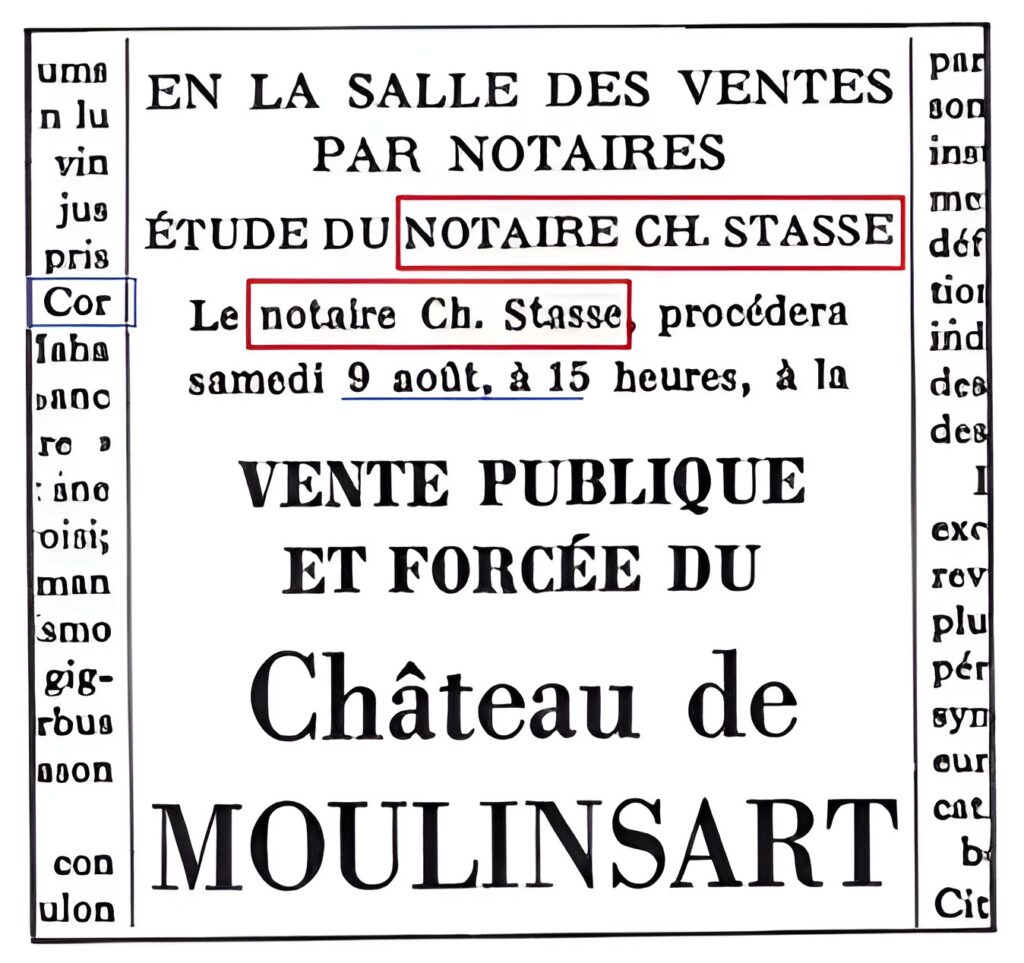
In the left margin of the announcement, a hyphen is used when a word is split, as in “gig-”; however, “Cor” is not treated this way, as it is not a word on its own. Underlined in blue (Cor 9 August 15.00) is the reference to the First Letter of St. Paul to the Corinthians 9:8–15:
I do not say this by human authority; God’s law also says the same thing. It is written in the law of Moses: “When an ox is working in the grain, do not cover its mouth to keep it from eating.” When God said this, was he thinking only about oxen? No. He was really talking about us. Yes, that Scripture was written for us, because it goes on to say: “The one who plows and the one who works in the grain should hope to get some of the grain for their work.” Since we planted spiritual seed among you, is it too much if we should harvest material things? If others have the right to get something from you, surely we have this right, too. But we do not use it. No, we put up with everything ourselves so that we will not keep anyone from believing the Good News of Christ. Surely you know that those who work at the Temple get their food from the Temple, and those who serve at the altar get part of what is offered at the altar. In the same way, the Lord has commanded that those who tell the Good News should get their living from this work.
Interpretation: Hergé here seems to justify the earnings he receives from his work. Since his intention is to spread just values, his material reward is deserved.
b) 2 Corinthians 12: 11-15
Framed in red twice on the announcement, the title “Notaire Ch.” is an anagram of “A Corinthe” (To Corinth). The name Stasse (a surname that does not exist) can be broken down into three pairs of letters: ST:AS-SE.
If we consider a simple letter-to-number code:
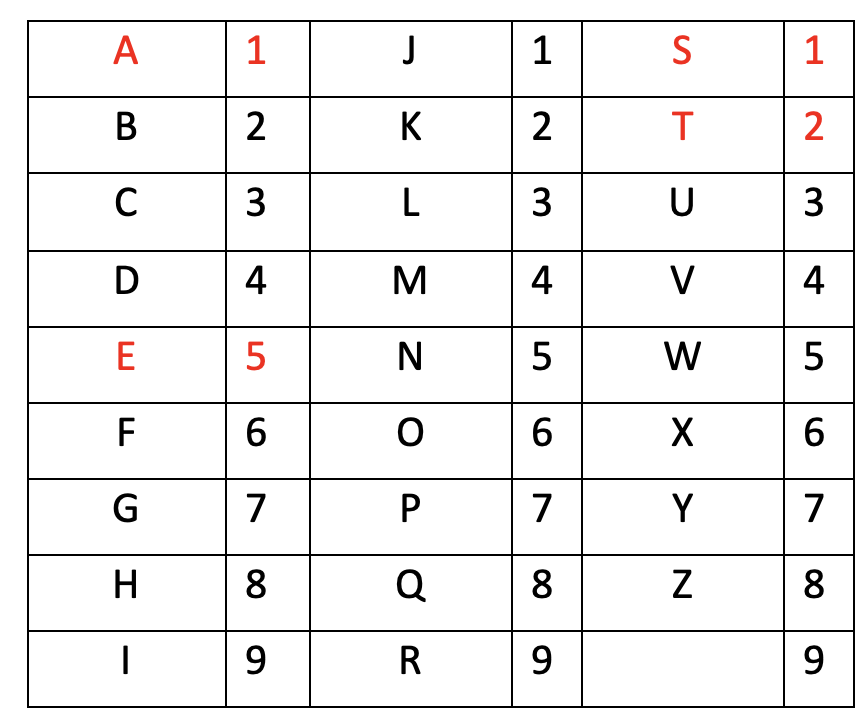
The substitution gives the reference to 2 Corinthians 12: 11-15 :
I have been a fool! You forced me to it, for I ought to have been commended by you. For I was not at all inferior to these super-apostles, even though I am nothing. The signs of a true apostle were performed among you with utmost patience, with signs and wonders and mighty works. For in what were you less favored than the rest of the churches, except that I myself did not burden you? Forgive me this wrong!
Here for the third time I am ready to come to you. And I will not be a burden, for I seek not what is yours but you. For children are not obligated to save up for their parents, but parents for their children. I will most gladly spend and be spent for your souls. If I love you more, am I to be loved less?
Interpretation: Hergé emphasises the purpose of his work, which is not to sell his albums but rather to convey a message.
Conclusion
Hidden biblical references in Red Rackham’s Treasure explain the message Hergé wanted to communicate to his readers. This treasure-hunting story emphasises individual gain, which, from a Catholic perspective, is troubling. Money should be rightfully earned by serving the community, which is not the case in The Treasure of Red Rackham. In any case, according to the Gospel writings, God judges the faithful by their deeds, not by their wealth. Hergé reminds us that altruism, solidarity, and generosity always take precedence in Tintin’s world, as in a devout life.
Through these hidden references, Hergé also expresses his own relationship with money and justifies his financial resources. By citing St. Paul’s First Letter to the Corinthians (9:11): “If we have sown spiritual benefits among you, is it a great thing if we reap your material benefits?”, he explains that his merit comes from his spiritual work through his comics, which sow spiritual benefits among his readers.
The parable of Saint Peter’s fish (in the Gospel according to Matthew 17:24–27) offers a particularly illuminating parallel. On pages 36–37, Captain Haddock, echoing Peter, casts a hook and retrieves Tintin and Snowy from Professor Calculus’s fish-shaped submarine. Just as the silver coin in the Gospel signifies divine provision, Tintin and Snowy here embody a comparable sign of providence, fashioned by their author: Hergé.
Damien Dessane
Damien Dessane was born in France. He lived in several countries before settling down on the Aegean coast of Turkey. He likes to understand the intention of artists in their works. He has published a new interpretation of the Lady and the Unicorn, Dürer’s master pieces, Da Vinci Madonna of the Rocks, Van Eyck’s Rolin’s Madonna and recently Poussin’s Et in Arcadia Ego.
• Check Out “Secrets from The Shooting Star” here
• The Official Tintin Website: tintin.com
• Red Rackham’s Treasure is available from all good bookshops | ISBN: 978-1405206235 | AmazonUK Affiliate Link
In Red Rackham’s Treasure (1944, official guide here), sequel to The Secret of the Unicorn (1943), Tintin and the Thom(p)sons accompany Captain Haddock on a journey in the footsteps of the Captain’s illustrious ancestor, Sir Francis Haddock. The parchments discovered in the previous adventure are in fact a treasure map pointing the way to the hidden gold and jewels of a notorious pirate, Red Rackham. A new character, named Professor Cuthbert Calculus, will prove invaluable in the search for the lost treasure; by the end of the adventure Calculus will also help Captain Haddock to acquire his family’s ancestral home, Marlinspike Hall. This story is full of twists, turns and surprises, not least the moment when Professor Calculus demonstrates a new type of machine for underwater exploration…
Further Reading
Pease note, some of books featured here are in French…
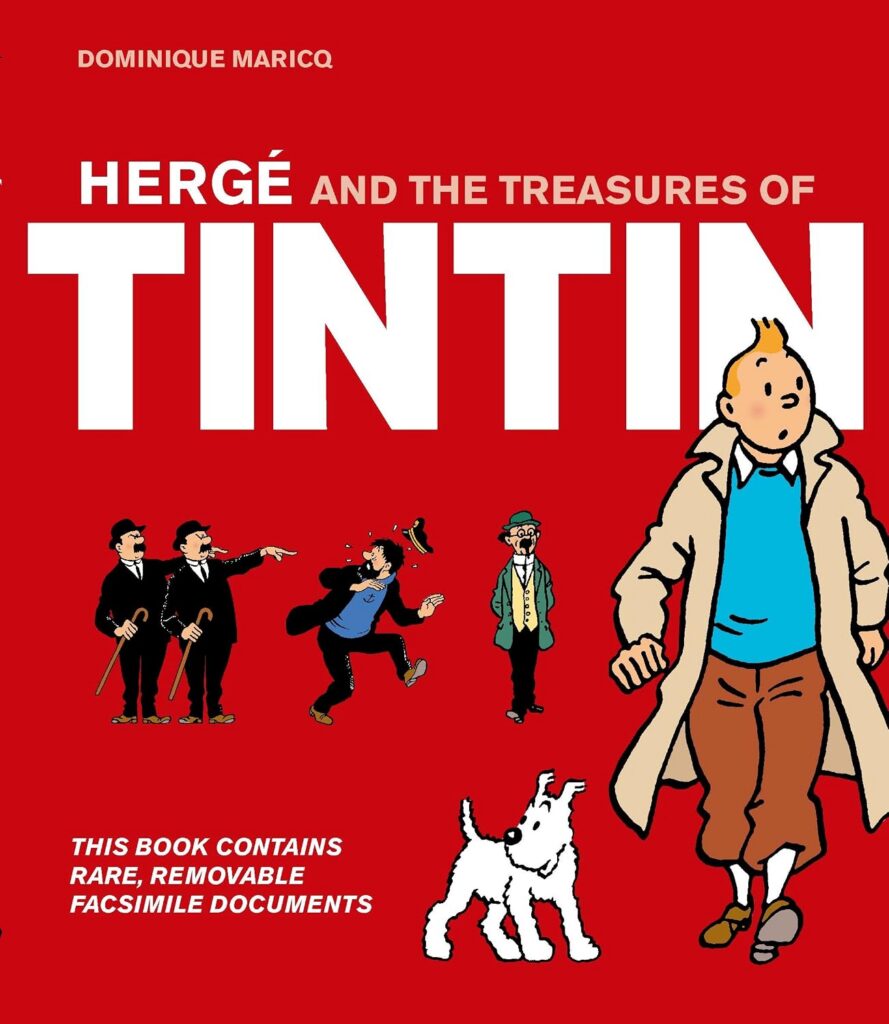
• Hergé and the Treasures of Tintin by Dominique Maricq
Hergé & The Treasures of Tintin looks at the influences on Hergé and the backgrounds to the stories of Tintin and how they were produced. Integrated with over 180 illustrations and around 20 beautifully reproduced facsimile documents, the book explains how Georges Rémi became Hergé, how his private life and interests influenced his work, how the young journalist Tintin was developed and what sparked the delightful characters of Captain Haddock, Snowy, Professor Calculus, the Thom(p)sons, Chang and Bianca Castafiore.
Plus there are special information boxes on many of the numerous other individuals who appeared in the Tintin stories.
• À la recherche du trésor de Rackham by Dominique Maricq (available from French bookshops). One in the Les coulisses d’une œuvre series
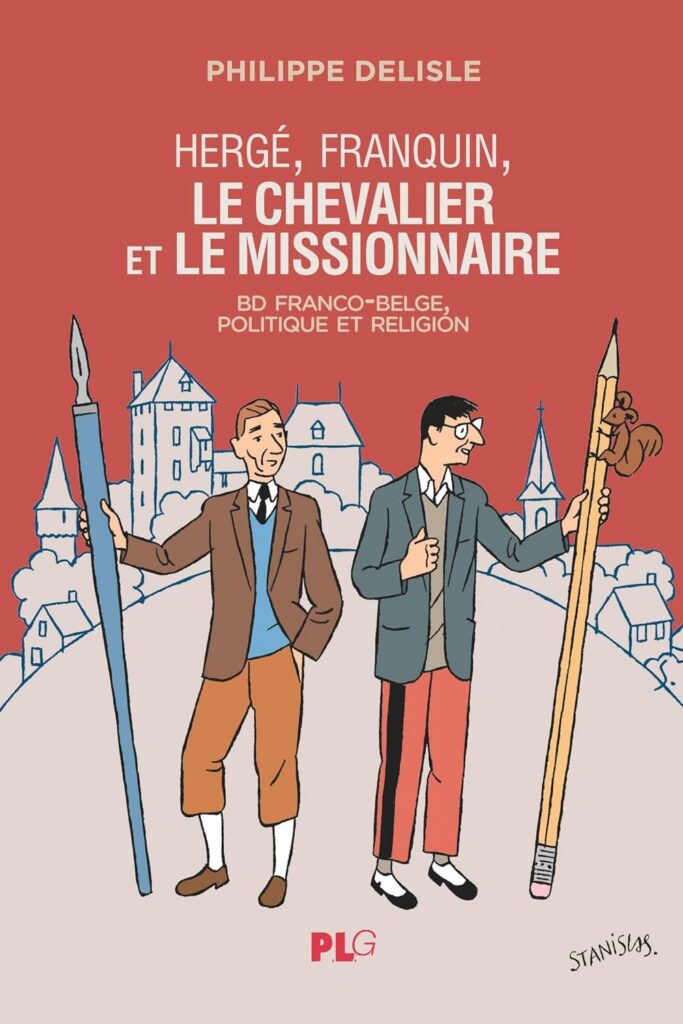
• Hergé, Franquin, le chevalier et le missionnaire by Philippe Delisle
• Le Monde Inconnu D’Herge by Bertrand Portevin
• Hergé chez les initiés by Jacques Fontaine
• Hergé, fils de tintin by Benoit Peeters
And Finally…
Check out this limited and numbered resin sculpture of Professor Calculus’ submarine originally created by Hergé for Red Rackham’s Treasure, published by Moulinsart, released in 2009! One was offered at auction by Catawiki in 2026


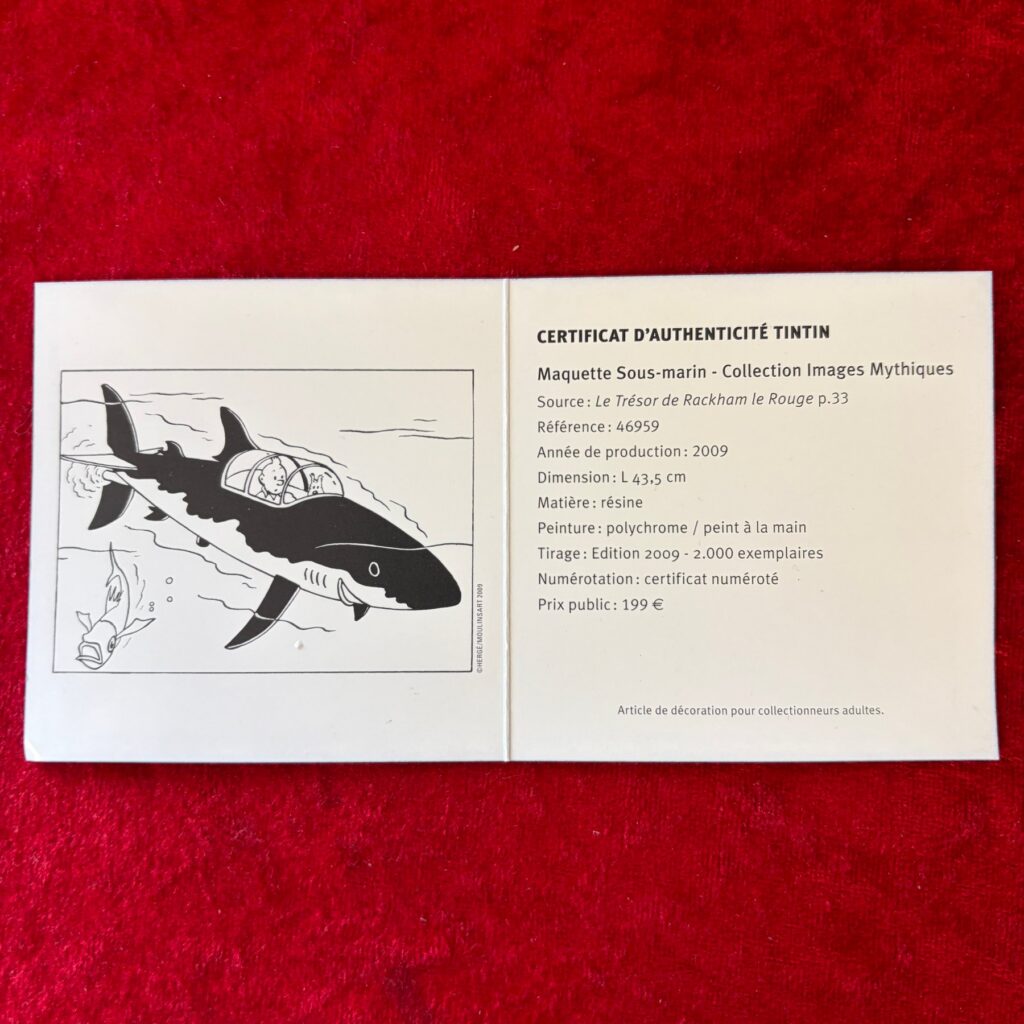
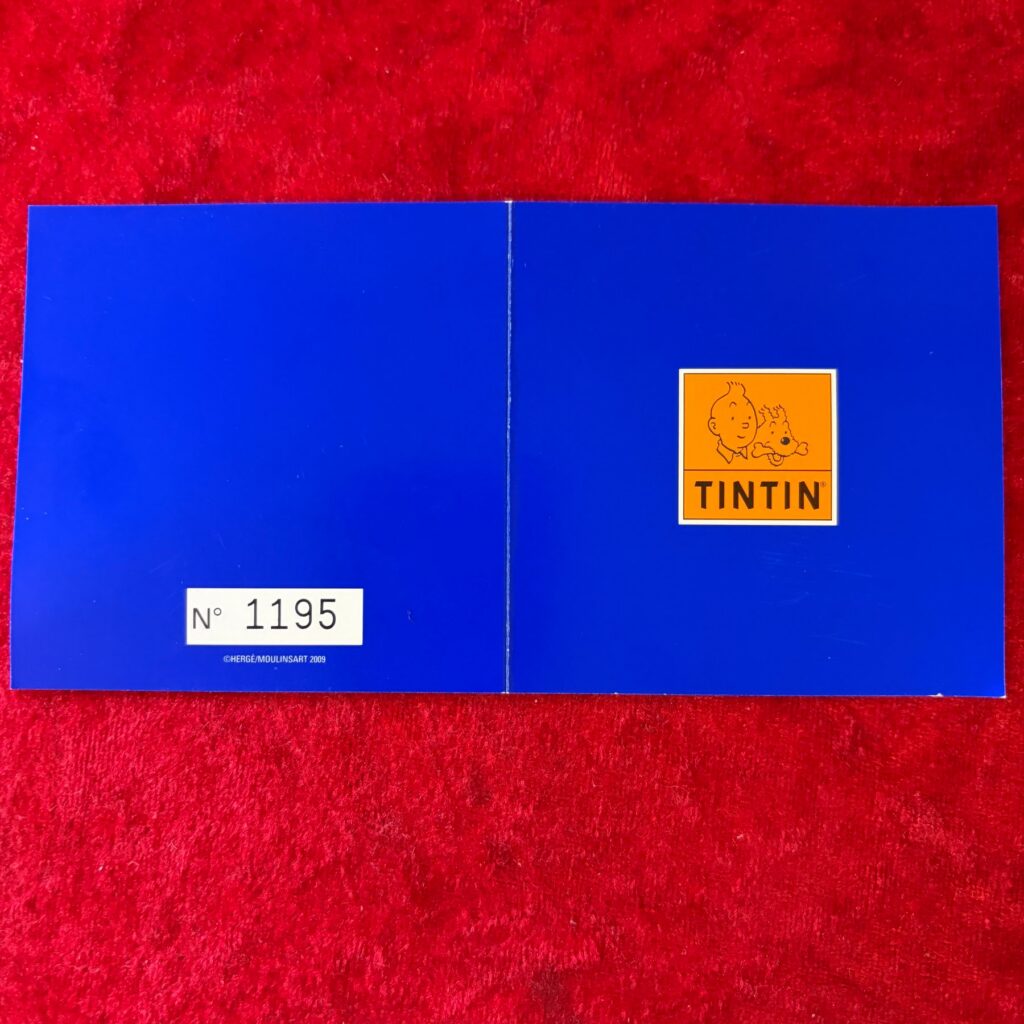


Tintin © Hergé / Tintinimaginatio – 2026
- About the Author
- Latest Posts

One of many guest posts for downthetubes.
Categories: Comics, Comics Studies, Creating Comics, Features
 The Adventures of Tintin: ‘The Shooting Star” Decoded
  In Review: A Sensual Cesspool of Iniquity by James Bacon
  In Pictures and Review: Comics in focus at The National Library of Ireland
  In Review: Irish Conflict in Comics in the 20th Century
I’m not going to say I’m fully convinced – especially not by that flipped map as presented here, but I did find the article fascinating.
Dear Stupidactingsmart, Thank you for your comment. It is indeed fascinating that Hergé found a way to express its concerns with the subject of the album. In the case of the ‘Rackham’s Treasure’, Hergé wanted to contrast the quest for material wealth with the ‘real’ spirituality.
The parchment of Haddock’s will is not damaged in a random manner. The shapes are those of Patmos island’s contour in order to cleverly indicate which biblical reference is mentioned. The red shape is unmistakenly similar. I dont know which map Hergé used to trace (in French: décalquer, hence the mirror image) the contour that is why the shapes may be a little bit different.
Thank you for taking the time to read the article!
All the best
Damien Dessane