Article by Bryson Johnson
Comic books have long reflected the evolution of societal culture. If you are interested in how tastes, sentiments, and the geopolitical landscape have changed over the last century, look no further than the humble comic book.
Whether nations are at war, economies are in recession, or society is flourishing, comics provide a unique commentary on the human experience – capturing our motivations, our hopes, and our fears. From the “Space Race” and the rise of communism to the anxieties of the Atomic Age, these stories have consistently put a mirror to society. Even as populations have become more technologically focused, reflective, and at times cynical, comics have remained a vital means of escapism that documents our collective conscience at a specific point in time.
Bryson Johnson, co-owner of Comics Heaven and specialist consultant at Stanley Gibbons Baldwin’s, has compiled a shortlist of the American comics that defined the decades to explain exactly why these issues remain so poignant today.
1930s: The Genesis of the Myth
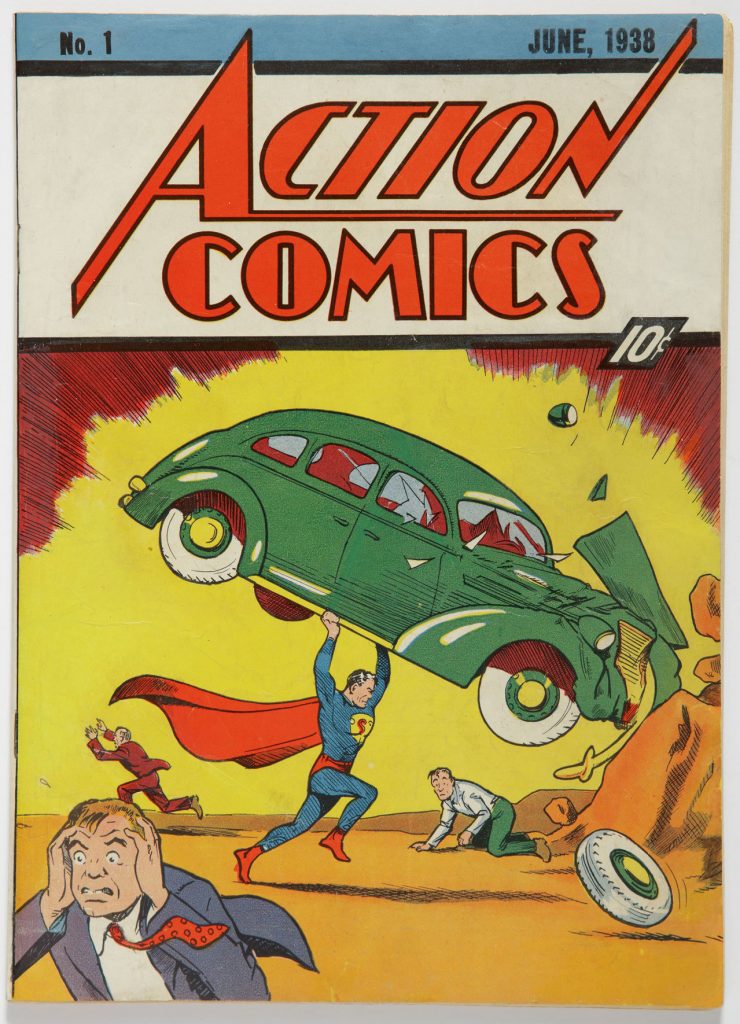
Action Comics #1 (1938)
Published by DC Comics
“Superman”, just one of the stories in this comic, was the creation of Jerry Siegel and Joe Shuster
The debut of Superman marked the “Big Bang” of the superhero genre. Created by Jerry Siegel and Joe Shuster the character was a radical new concept – an alien with a moral compass aligned with the common man. This first issue established the visual grammar of the superhero – the cape, the secret identity, and the impossible strength – that remains the industry standard nearly a century later.
Culturally, this issue maps America’s transition out of the Great Depression. Superman was initially a “Champion of the Oppressed,” fighting corrupt politicians and slumlords rather than intergalactic villains. He represented the “New Deal” era’s hope for a powerful force that could set a broken system right. Siegel and Shuster infused the character with the immigrant experience, an outsider who adopts a new identity to better his adopted home.
This milestone shifted pop culture from the cynicism of “hard-boiled” pulp toward a new, idealistic mythology. It proved that the public was hungry for hope, creating a blueprint for a genre that would eventually dominate global cinema and literature.
1940s: Art and the Moral Panic
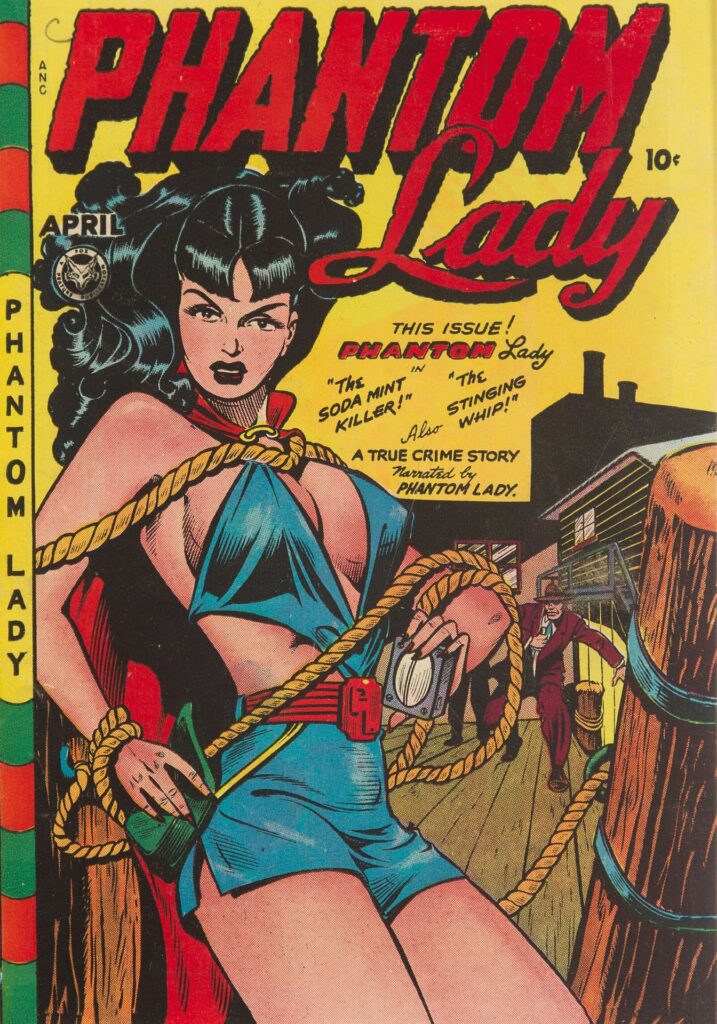
Phantom Lady #17 (1948)
Published by Fox Comics
Cover by Matt Baker
Writer: Ruth Roche Pencils and Inks: Matt Baker
Phantom Lady created by an unknown writer and artist Arthur F. Peddy, first appearing in Police Comics #1 (August, 1941), published by Quality Comics
Phantom Lady #17 sits at the intersection of postwar artistic achievement and the mid-century moral panic. It is famous for its “headlights” cover art by Matt Baker, the first prominent African American artist in the industry. Baker was a master of “Good Girl Art,” and his rendering of the heroine trapped in a spotlight became a masterpiece of the era’s pulp aesthetic.
However, this artistic confidence inadvertently triggered a national controversy. In the 1950s, psychiatrist Dr. Fredric Wertham used this specific cover as “Exhibit A” in his crusade against comics, arguing they caused juvenile delinquency. His efforts led directly to the 1954 Senate Subcommittee hearings and the creation of the Comics Code Authority (CCA) – a self-censorship body that sanitised the medium for decades.
Culturally, this issue maps the moment America pivoted from the permissive freedom of the 1940s toward strict social conservatism. It remains a symbol of the struggle between artistic expression and institutional censorship, standing as a testament to Baker’s talent in an era of immense racial and social barriers.
Further Reading…
• Bleeding Cool: The Notoriety of Matt Baker’s Legendary Phantom Lady #17 from Fox by Mark Siefert
1950s: The Great Divide
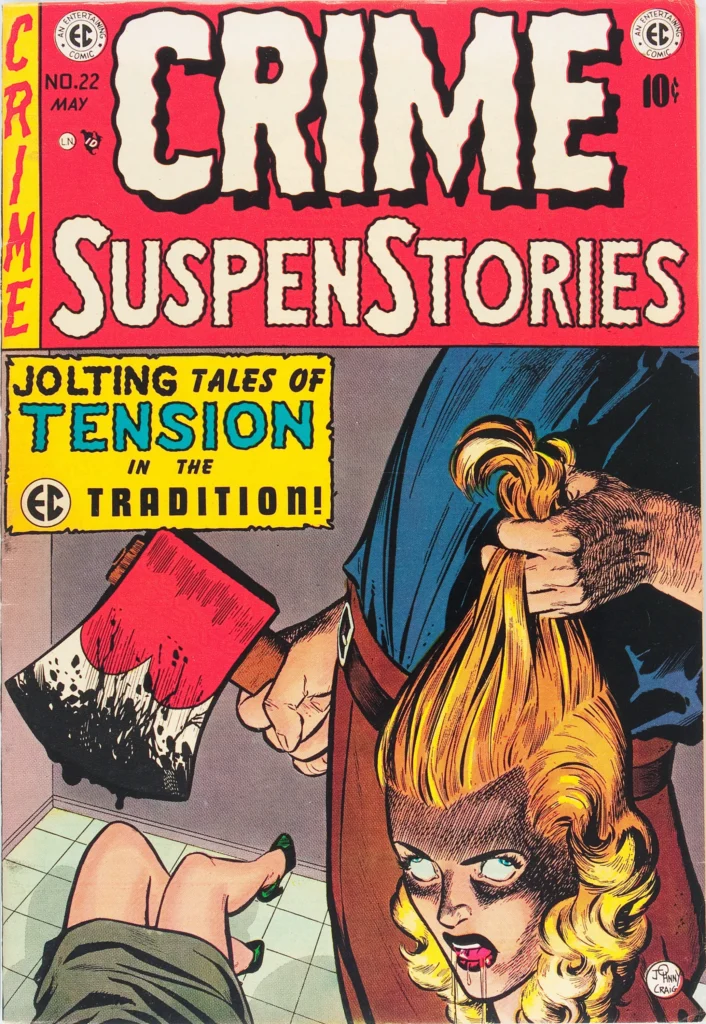
Crime SuspenStories #22 (1954)
Published by EC Comics
Cover: Johnny Craig
Features five stories written by Al Feldstein and Bill Gaines, with interior art from notable creators such as Jack Kamen, Joe Orlando, Bernie Krigstein and Reed Crandall.
Crime SuspenStories #22 represents the most significant turning point in comic book history. During the height of the 1950s “Red Scare,” the industry was brought to its knees by political pressure. This issue’s grisly cover of a severed head was held up in the Senate as proof that comics were “poisoning” the youth, forcing a total pivot from gritty realism to sanitised fantasy.
EC Comics was the gold standard for storytelling at the time, but this firestorm led to the draconian Comics Code Authority. The resulting regulations effectively banned “Horror” and “Terror” from titles and prohibited any negative depictions of authority figures. It was a move that valued conformity over artistic freedom, stunting the medium’s growth as a serious literary form for nearly thirty years.
This milestone provides a necessary contrast to the idealism of superheroes. It shows that the history of comics is not just a story of heroes, but a story of rebellion and the hard-fought right to tell difficult, adult stories in a conservative society.
1960s: The Rise of the Teenager
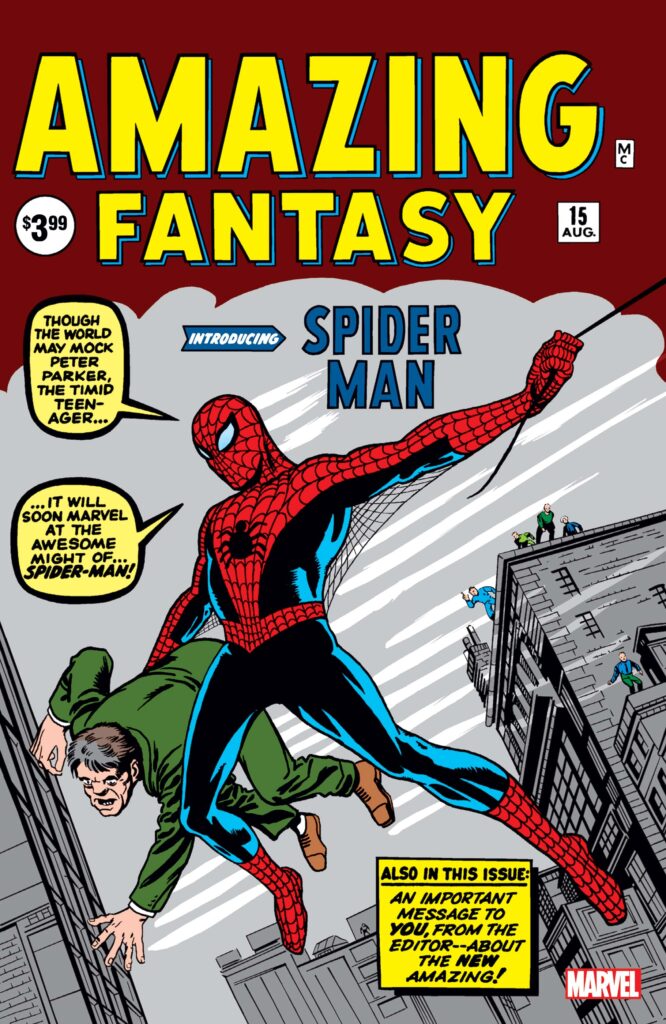
Amazing Fantasy #15 (1962)
Published by Marvel Comics
Cover by Jack Kirby (Pencils) and Steve Ditko (Inks)
“Spider-Man” Writer: Stan Lee: Art: Steve Ditko Colour: Stan Goldberg Letterer: Artie Simek
Also includes the stories “The Bell-Ringer!”, “Man in the Mummy Case!” and “There Are Martians among Us!”
This issue redefined the hero for the Space Age by introducing Peter Parker. Before Spider-Man, adolescents were relegated to the role of the “sidekick.” Stan Lee and Steve Ditko shattered that dynamic by placing a socially awkward, insecure high school student at the center of the narrative, mirroring the rise of a distinct “youth culture” in post-war America.
Peter Parker was the first “Relatable Hero,” dealing with bullying, financial instability, and “existential angst” rather than just cosmic threats. By imbuing a superhero with the real-world problems of its audience, Marvel tapped into a burgeoning counter-culture sentiment that began to question perfectionism and traditional authority figures.
The closing mantra, “With great power there must also come great responsibility!”, served as a moral compass for a generation entering an era of unprecedented social change. It introduced internal conflict and the “human cost” of heroism, moving the medium away from simple binary morality toward complex psychological realism.
Further Reading
1970s: The End of Optimism
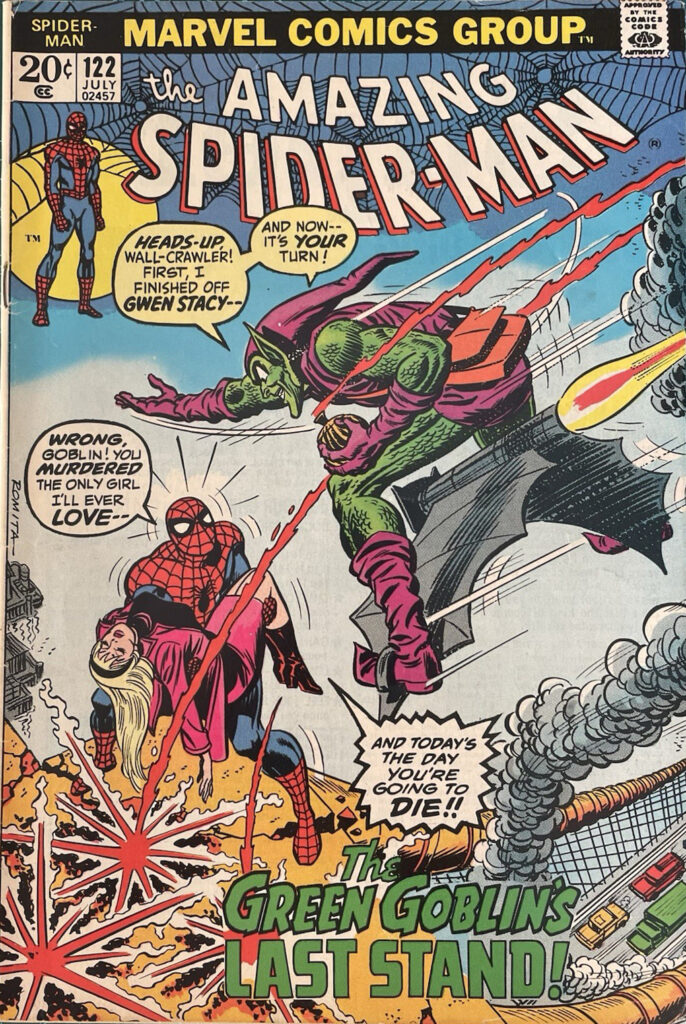
Amazing Spider-Man #122 (1973)
Published by Marvel Comics
Writer: Gerry Conway Pencils: Gil Kane Inks: John Romita Sr. & Tony Mortellaro Colour: Dave Hunt Letterer: Artie Simek
Amazing Spider-Man #122 effectively ended the “Silver Age” of comics and ushered in the grittier Bronze Age. Following the death of Gwen Stacy, this issue saw Peter Parker consumed by a raw, uncharacteristic rage. It subverted the “no-kill” rule of superheroes, pushing Peter to a psychological breaking point that reflected the disillusionment of post-Vietnam, Watergate-era America.
Culturally, this issue maps a loss of American optimism. The death of an innocent character like Gwen Stacy signaled to the audience that the world was no longer safe and that even beloved characters could be lost forever. It replaced the “happily ever after” tropes of the 1960s with a sense of permanent consequence and “villainous karma.”
The issue concluded with a transformative moment for Mary Jane Watson, who evolved from a “party girl” into a complex, supportive partner. This shift toward deeper character realism and emotional weight proved that comics had grown up alongside their audience, reflecting a more cynical and mature society.
1980s: The Post-Modern Deconstruction
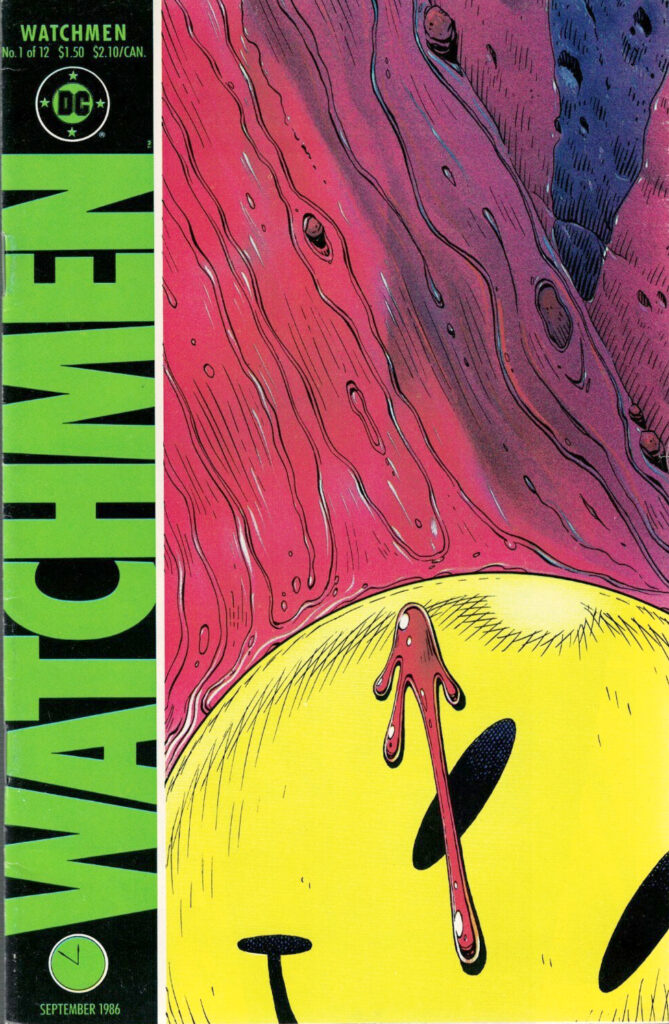
Watchmen #1 (1986)
Publisher: DC Comics
Writer: Alan Moore Artist: Dave Gibbons Colourist: John Higgins Letterer: Dave Gibbons
Watchmen #1 represents the “death of the superhero” as a moral icon and the birth of the Post-Modern Era. Alan Moore and Dave Gibbons took the archetypes defined in the 1930s and subjected them to the harsh light of 1980s sociopolitical reality. By asking “Who watches the watchmen?”, it challenged the very sanity of the costumed hero.
The story maps the height of Cold War nihilism and the “Doomsday Clock” anxiety of the Reagan-Thatcher era. It presented heroes as deeply flawed, often traumatised individuals living on the brink of nuclear annihilation. It reflected a public that no longer believed in the “shining city on a hill” or the uncomplicated virtue of those in power.
Technically, this issue transformed comics into “Graphic Novels.” Its non-linear storytelling and “meta” elements demanded a level of literary engagement previously reserved for high-brow prose. It ended the “innocence” of the industry, ensuring that superheroes would forever be a lens through which we examine our own darkest impulses.
2000s: The Survivalist Narrative
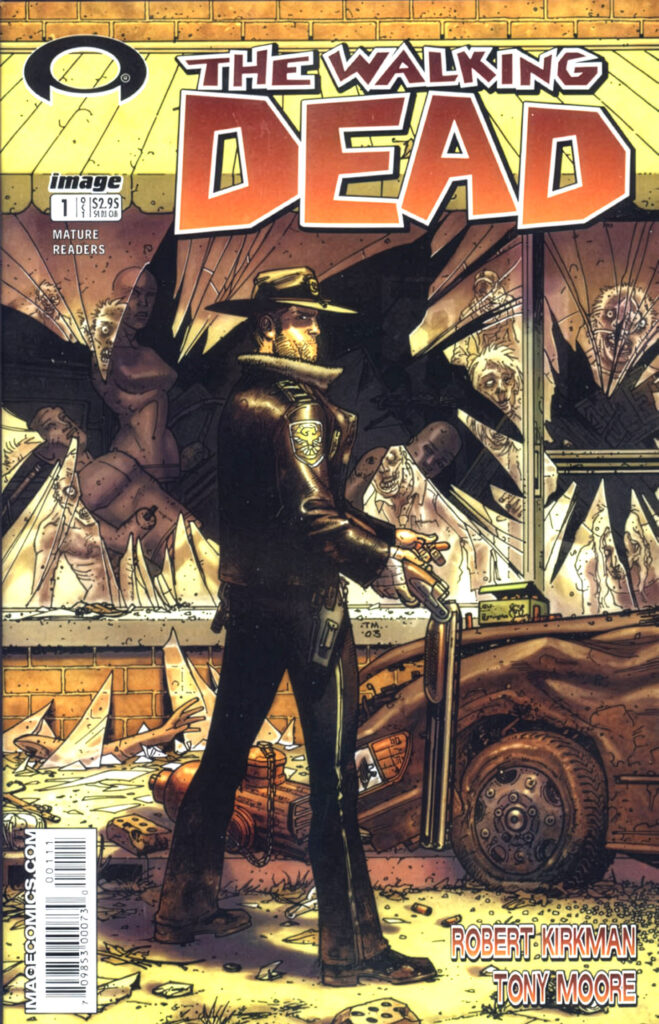
The Walking Dead #1 (2003)
Published by: Image Comics
Writer: Robert Kirkman Artist: Tony Moore
The Walking Dead #1 redefined the zombie genre, turning it into a profound exploration of the human condition. Debuting just two years after 9/11, it tapped into a collective anxiety about the fragility of civilisation. It asked a question films never had the time for: “What happens after the credits roll?”
Culturally, it mapped the birth of the modern “survivalist” narrative. By grounding the apocalypse in gritty, black-and-white realism, the creators made the struggle for survival feel painfully earnest. It suggested that in a world without law, the living are often far more dangerous than the dead, a sentiment that resonated deeply in a post-9/11 world.
This issue also stands as a monument to the power of independent publishing. It proved that a creator-owned, non-superhero title could dominate a market historically controlled by Marvel and DC. Its success paved the way for the “Prestige TV” era, proving that readers were hungry for dark, serialised storytelling where morality is never black and white.
2010s: Identity and Intersectionality
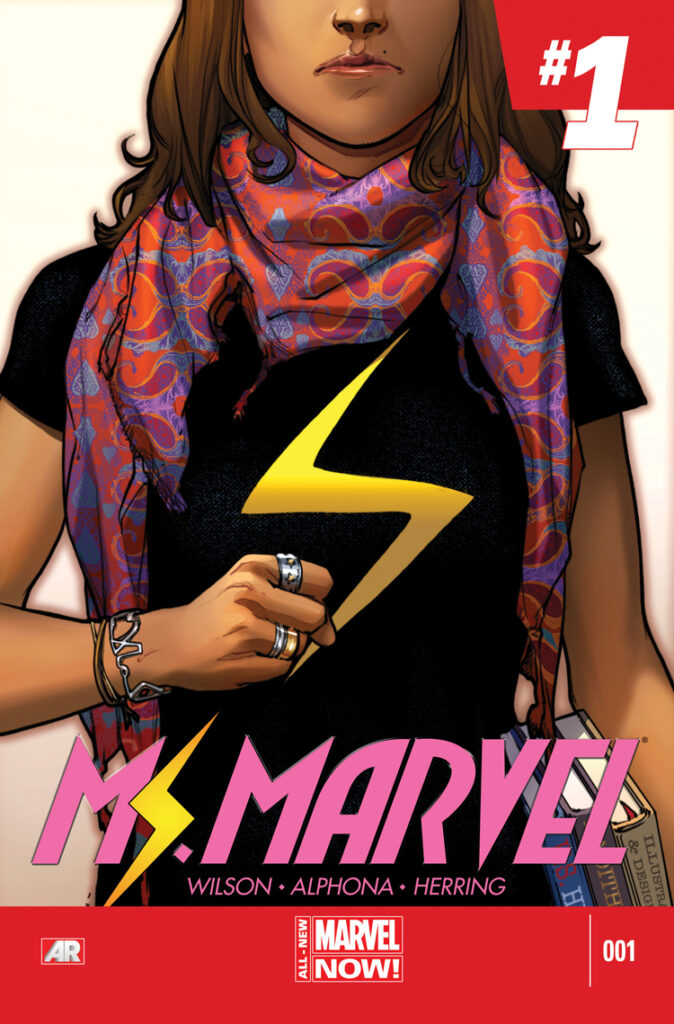
Ms. Marvel #1 (2014)
Published by: Marvel Comics
Main Cover: Sara Pichelli Coloured by Justin Ponsor (Variant Cover Information)
Writer: G. Willow Wilson Artist: Adrian Alphona Colourist: Ian Herring
While the MCU dominated global box offices, the comics of the 2010s underwent a shift toward identity and intersectionality. Ms. Marvel #1 introduced Kamala Khan, a Pakistani-American teenager from Jersey City. It was a radical departure from the “white male” default, focusing on her faith and immigrant background as much as her superpowers.
This issue maps the emergence of the “Digital Generation.” Kamala was a “fan-girl” who wrote superhero fan fiction, representing a generation that grew up with the internet, where fandom is a community and identity is fluid. It proved that the “Modern Myth” was universal, that a girl in a hijab could be just as relatable to a global audience as a billionaire in a metal suit.
Its success paved the way for a new, “Inclusive Age” of heroes. By reaching a significantly more diverse and younger audience, Ms. Marvel mapped the trajectory for the entire industry’s future. It signaled that the mask could, and should, be worn by anyone.
Conclusion: The Legacy in Your Hands
As we look back at these ten milestones, it becomes clear that a comic book is never just a “comic book.” It is a time capsule, a high-resolution snapshot of the fears, hopes, and values of the era that produced it. From the pulp rebellion of the 1940s to the complex survivalism of the 2000s, these issues have survived as the primary source material for our modern cultural identity.
For the collector, these books represent something more than historical curiosity, they are tangible connections to the moments that changed how we see the world. At Stanley Gibbons Baldwin’s, we understand that the value of these items lies in their story. As we move further into a digital age, the physical weight of these “paper myths” only becomes more precious. Whether you are a seasoned investor or a new enthusiast, we invite you to explore these pillars of history, because to own a piece of this list is to own a piece of the human story itself.
Bryson Johnson
Stanley Gibbons Baldwin’s recently completed the first sale from the Northern Collection, the biggest European stockpile of comics ever discovered, which includes many keys from the decades. Stay tuned to Stanley Gibbon’s Baldwin’s comics department, for more sales from this incredible collection.
Our thanks to Byron Johnson and Stanley Gibbons Baldwin’s for supplying this feature
- About the Author
- Latest Posts

One of many guest posts for downthetubes.
Categories: Comics, Creating Comics, Features, Flashback Corner
 Flashback Corner: The Lance McLane newspaper strip
  Who remembers Buster’s “Galaxus, The Thing from Outer Space?
  2000AD’s first French outing unearthed?
  Short Lived British Comics: Marvel UK’s “Lady Lovely Locks and the Pixietails”
Reportedly, Gaines was challenged by the sub-committee to state how the severed head cover could possibly be worse. Bill replied that the head could be held higher, to show blood dripping from the neck (murmurs from the assembly). The irony was that Craig had drawn it like that originally, and Gaines had made him change it!
Ahem. 1990s?
Death of Superman maybe, to mark the growth of “The Event comic”?
No mention, either, of Showcase # 4 with the revival of the Flash and the beginning of the Silver Age. This was a momentous comic book as it re-established the costume hero that had fallen out of favour after World War two. It also ushered in the Marvel era too. Hugely important comic history event.
Replying here to Rik and Gerald’s comments in this thread: I love these lists, but as ever, when there is so much to choose from they’re inevitably going to be selective, constrained by length. Your suggestions are appreciated!
Very true, John, and I didn’t want to dismiss any of the author’s choices for my own preferences (personally, I’d rate the Marvel Knights imprint as hugely influential for 2000s, for instance). But why no 1990s at all? It wasn’t such a bad decade, was it?