Next week sees the auction of one of pop artist Roy Lichtenstein‘s controversial artworks, “Anxious Girl“, by Christie’s, as part of their 20th Century Evening Sale on Monday 18th May 2026, during New York’s Spring Marquee Week of Sales.
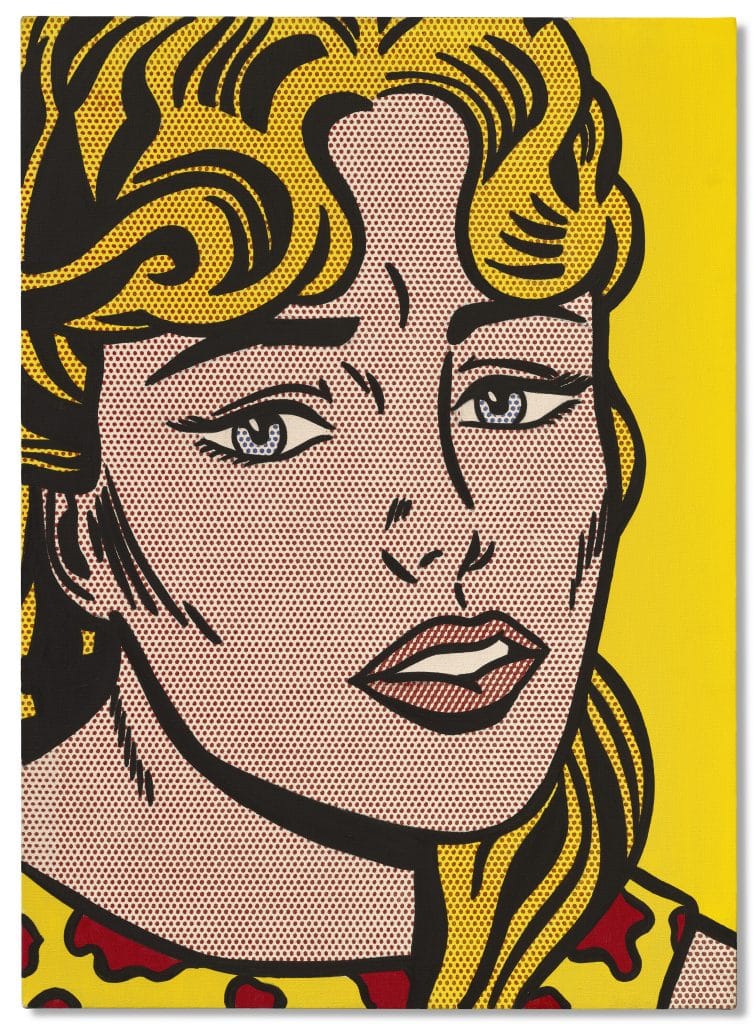
Formerly in the collection of art world legends Horace and Holly Solomon, the painting has been held in the same esteemed private collection for more than thirty years and has never before been seen in public.
For art collectors, “Anxious Girl” sits among a rarefied group of paintings that is considered constitute the most prized works in existence by the iconic American artist, who died in 1997, and “stands as “an unequivocal masterpiece” of the Pop era. It is estimated to realise $40 – 60 million.
“Anxious Girl” features a young woman with blonde curls, piercing blue eyes, and skin pigmented via a field of Ben-Day dots, a method invented in the late 19th century and made famous by Lichtenstein. In visual style, the dots mimic the mechanical process originally developed to give tonal variation to early newspapers, yet in this work there is no printing or screening involved – each was meticulously applied by the artist’s hand. A furrowed brow on her forehead conveys a sense of unease, of questioning.
Roy Lichtenstein began incorporating comic strips into his paintings, framing the gesture as a form of ironic appropriation. As Min Chen notes on ArtNet in 2023, reporting on the documentary WHAAM! BLAM! Roy Lichtenstein and the Art of Appropriation, his use of cartoons and comics was meant to recontextualise a form of mass media, if not to examine the bounds of high and low aesthetics.
“The closer my work is to the original,” Lichtenstein explained in 1972, “the more threatening and critical the content.”
“The comic artists and illustrators whose works have served as fodder for Lichtenstein’s canvases, however, have a different word for all of it,” Min Chen notes.”Theft.”
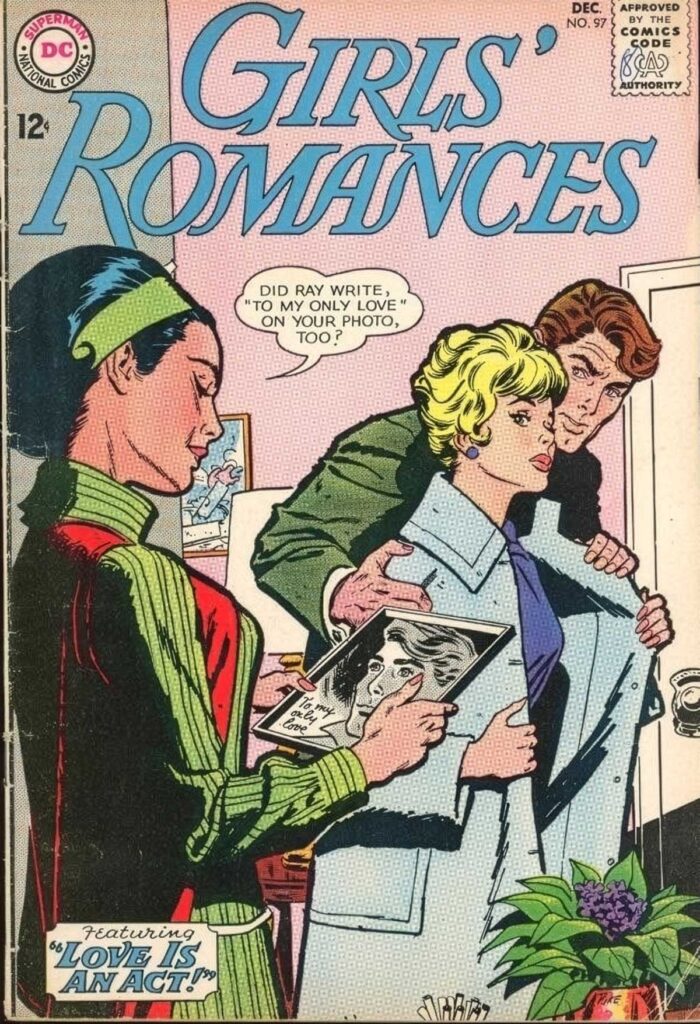
Chen’s comments echo the views of many comic fans, comic creators and art historians who share a different view of Lichtenstein’s “exceptional” work. In the case of “Anxious Girl”, the “inspiration” behind the painting is the opening page of “Too Much to Ask!” a 1963 comic strip, and, indeed, copies it almost directly – although, in the original image, Jan is pictured in between the pair of men, and her forehead bears no crease.
The original strip credited by the Grand Comics Database to Mike Sekowsky (pencils) and Bernard Sachs (inks), published in the DC Comics series Girls’ Romances (#97), in which the heroine is torn between two male suitors. It has also been attributed by art historian David Barasolou to Tony Abruzzo.
In the story, Jan has loved Stewart for many years, although everyone, including Stewart, thinks he is too old for her. When she finally agrees to date someone her own age, she realises that her love for Stewart was never real.
While Roy Lichtenstein’s original art might set you back a few million pounds, you can pick up a copy of Girls’ Romances on eBay for around £200.
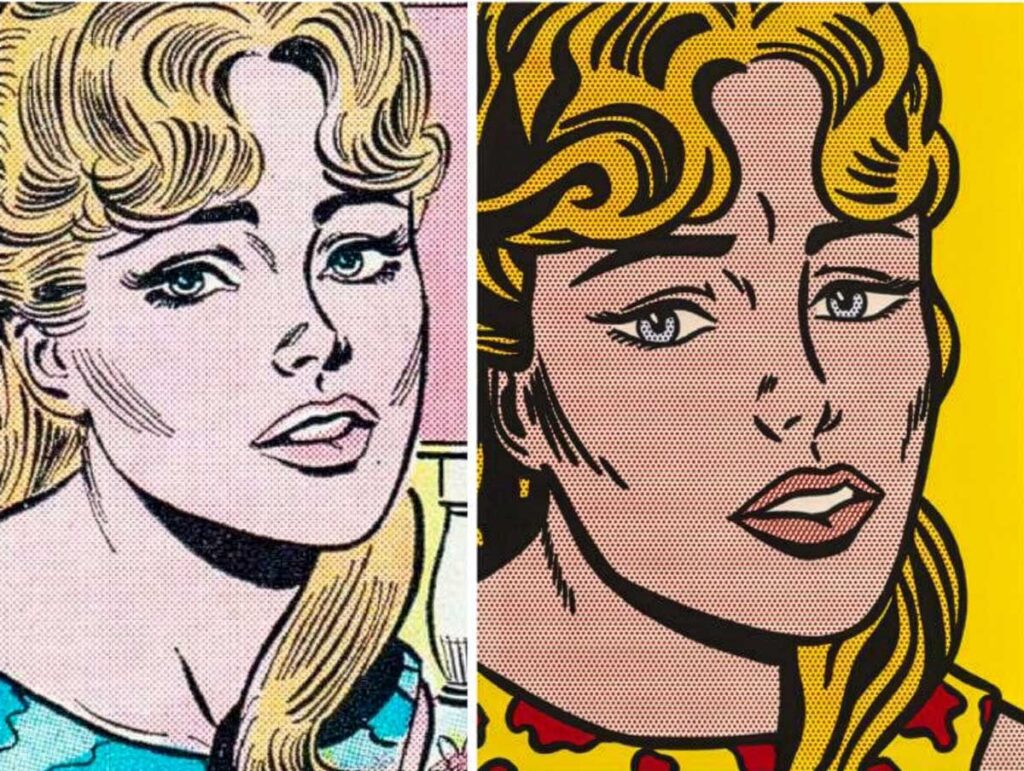
In their profile of Mike Sekowsky, the comics encyclopaedia Lambiek notes Sekowsky was a popular choice for Roy Lichtenstein to lift images from. Panels by him from the Girl Romances series inspired other Lichtenstein’s paintings, including” “It Is… With Me!” (1963) and “Happy Tears” (1964), while images from the twelfth issue of Justice League of America were the source for “Mad Scientist” (1963) and “Eccentric Mad Scientist” (1965).
Art historian and comic book collector David Barsalou is one of Lichtenstein’s major critics, his years-long research project, Deconstructing Roy Lichtenstein, detailing how the pop artist’s paintings are nearly identical to his comic book sources.
Described by LIFE magazine in 1963 as the “Worst Artist in the U.S.” Lichtenstein’s work continues to elicit strong reactions from both his fans and his detractors – who include Watchmen artist Dave Gibbons – almost 60 years later.
The art world gives the criticism short shrift, echoing perhaps, Lichtenstein’s own dismissal of the comics form, indicating in one interview that he had never been particularly interested in a sequence of images as in the comics, “although I have done a few linked-panel cartoons.
“There was one five-panel series that got broken up. I thought of it as two diptychs and a single painting in the middle linking them up. It was a five-panel sequence, but a sort of mysterious sequence as though you had walked into the middle of a soap opera. Although you couldn’t really figure out what was going on, the story had a cohesiveness.”
Sara Friedlander, Chairman of Post-War and Contemporary Art, Christie’s, remarks: “’Anxious Girl‘ is a best-in-class example of Roy Lichtenstein, from 1964, the pinnacle of his career. Compositionally, the painting showcases the artist’s singular ability to distill complex visual cues into three core elements—line, colour, and form – and formally employ them into conveying deep human emotion through timeless love stories and comic book-inspired imagery.
“‘Anxious Girl’ is the quintessential Pop portrait, a veritable icon of twentieth century art and we are delighted to bring it to market this spring at Christie’s New York.”
“Anxious Girl” is among a highly prized group of Lichtenstein’s most celebrated works from the 1960s: paintings featuring lovelorn young women inspired by mass-produced comics. The earliest of this group is considered to be “The Engagement Ring” from 1961, but the most sophisticated and desirable were made during 1963-1965.
“Anxious Girl” is one of only ten paintings from this short time period that feature an individual woman as the sole subject in a tightly cropped frame, investigating both the psychology and beauty of the female form.
The last time a masterpiece painting of the exceptionally rare Girl series came to auction was more than a decade ago; Lichtenstein’s “Nurse” sold at Christie’s New York in November 2015 for $95 million and established the current record price for the artist.
“Anxious Girl” was first acquired by Horace and Holly Solomon, important collectors and early champions of Pop Art. Active figures in New York’s art scene in the 1960s, the couple’s apartment came to be filled with canonical works by Andy Warhol, Roy Lichtenstein, James Rosenquist, and Claus Oldenburg. In 1966, Holly Solomon commissioned Andy Warhol to produce his now famous nine-paneled portrait of her and in doing so immortalised her reputation as the “Princess of Pop.” This persona was further developed with more portraits of her by leading artists of the era, including Robert Mapplethorpe, Richard Artschwager, Robert Rauschenberg and Roy Lichtenstein – among them, Lichtenstein’s masterpiece “I…I’m Sorry”, featuring a distressed young woman in tears, painted just one year after “Anxious Girl”. Formerly owned by Ms. Solomon, the 1965 painting now resides in the collection of The Broad in Los Angeles.
Signed and dated ‘rf Lichtenstein ’64’ (on the reverse) | Magna and graphite on canvas | 36 x 26 in (91.4 x 66 cm) | Painted in 1964
• Find a copy of Girls’ Romances #97 on eBay
• The Roy Lichtenstein Foundation
The Roy Lichtenstein Foundation has contributed a lead gift of over $2,000,000 to help the Archives of American Art in its newly launched Digital Transformation Initiative
• An Interview with Roy Lichtenstein discussing his inspiration
Also on downthetubes…
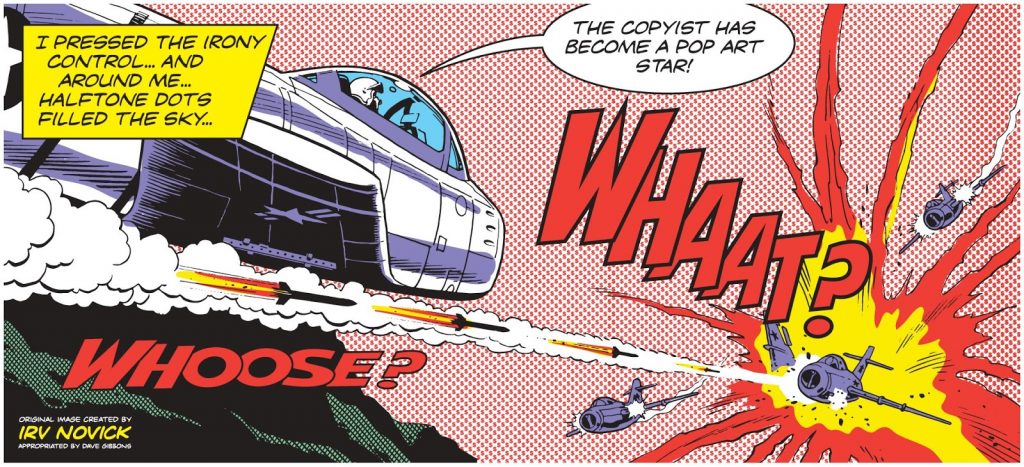
• Dave Gibbons ‘Whaat’ art challenges Lichtenstein’s dubious ‘legacy’
In 2013, Watchmen artist and co-creator Dave Gibbons was interviewed about the Pop Art painting ‘WHAAM!’ by Roy Lichtenstein
• Whaam! : The Aeronautical Perspective by Jeremy Briggs
While comics fans can look at this Lichtenstein work and get annoyed at the perceived injustice of the piece, Jeremy looks at it from another perspective, an aeronautical perspective. Unfortunately for the pro-Lichtenstein lobby, from this perspective, ‘Whaam!’ simply makes no sense…
- About the Author
- Latest Posts

John is the founder of downthetubes, launched in 1998. He is a comics and magazine editor, writer, and Press Officer for the Lakes International Comic Art Festival. He also runs Crucible Comic Press.
Working in British comics publishing since the 1980s, his credits include editor of titles such as Doctor Who Magazine and Overkill for Marvel UK, Babylon 5 Magazine, Star Trek Magazine, and its successor, Star Trek Explorer, and more. He also edited the comics anthology STRIP Magazine and edited several audio comics for ROK Comics; and has edited several comic collections and graphic novels, including volumes of “Charley’s War” and “Dan Dare”, and Hancock: The Lad Himself, by Stephen Walsh and Keith Page.
He’s the writer of comics such as Pilgrim: Secrets and Lies for B7 Comics; “Crucible”, a creator-owned project with 2000AD artist Smuzz; and “Death Duty” and “Skow Dogs”, with Dave Hailwood.
Categories: Art and Illustration, Auctions, Comics, Creating Comics, downthetubes Comics News, downthetubes News, Events, Other Worlds, US Comics
 More Leo Baxendale “Super Comic” artwork surfaces?
  Comics Abroad: A Visit to the Cartoon Art Museum, San Francisco
I don’t think people would have minded about his “homages” so much if he’d actually credited the artist, or at least the source. And perhaps used some of his money to support the comics industry. But no, it was all about his personal selfish gain from the work of better artists.