Review by Tim Robins
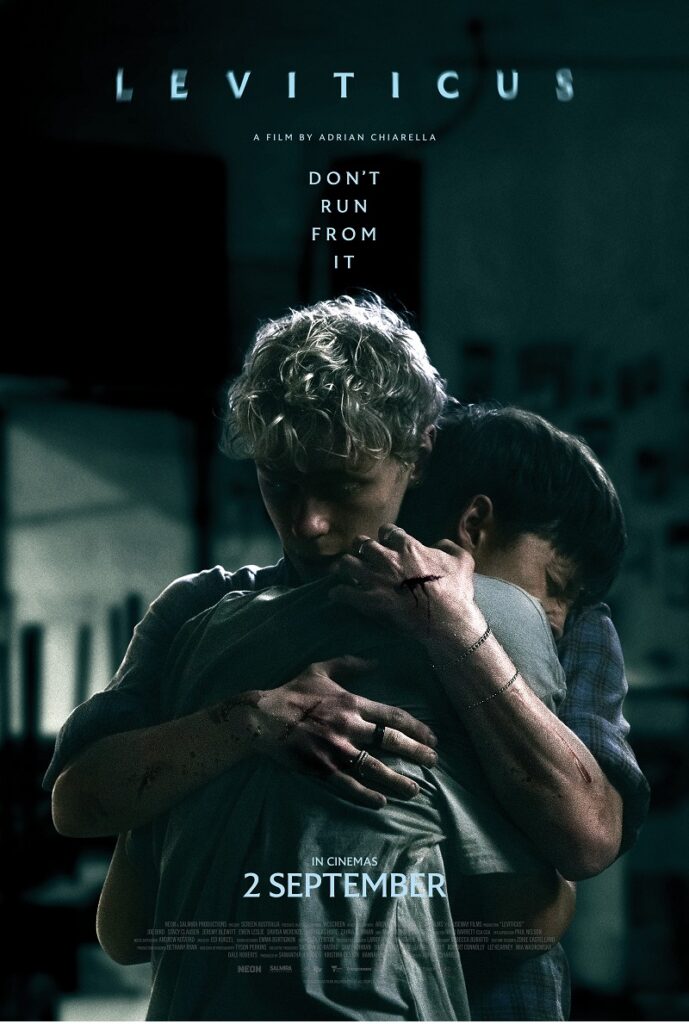
Two teenage boys must escape a violent entity that takes the form of the person they desire most – each other…
“Ere Babylon was dust,
The Magus Zoroaster, my dead child,
Met his own image walking in the garden.
That apparition, sole of men, he saw.
For know there are two worlds of life and death:
One that which thou beholdest; but the other
Is underneath the grave, where do inhabit
The shadows of all forms that think and live
Till death unite them and they part no more….”
(Percy Shelly, Prometheus Unbound, 1820).
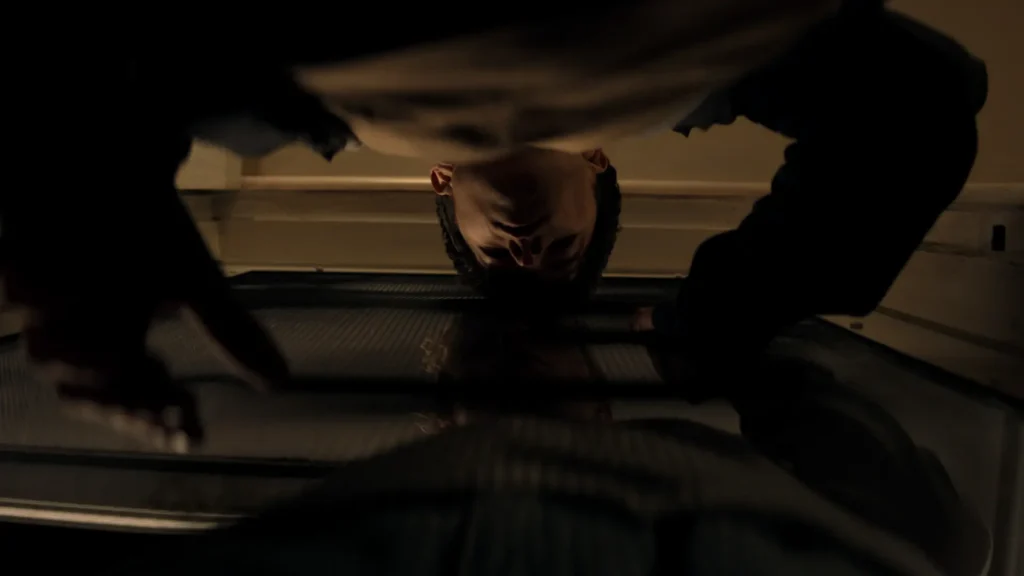
Leviticus (2026) straddles the line between gay cinema and the horror genre. The film draws on the idea of the Doppelgänger (double-walker), except the menacing ‘double’ takes the form not of themselves, but the one they love the most.
The story is a blend of horror and gay romance, so you know things won’t end well for its young men in love. I’ve seen the film described as a “coming of age movie”, but I wasn’t at all sure its characters were going to live that long.

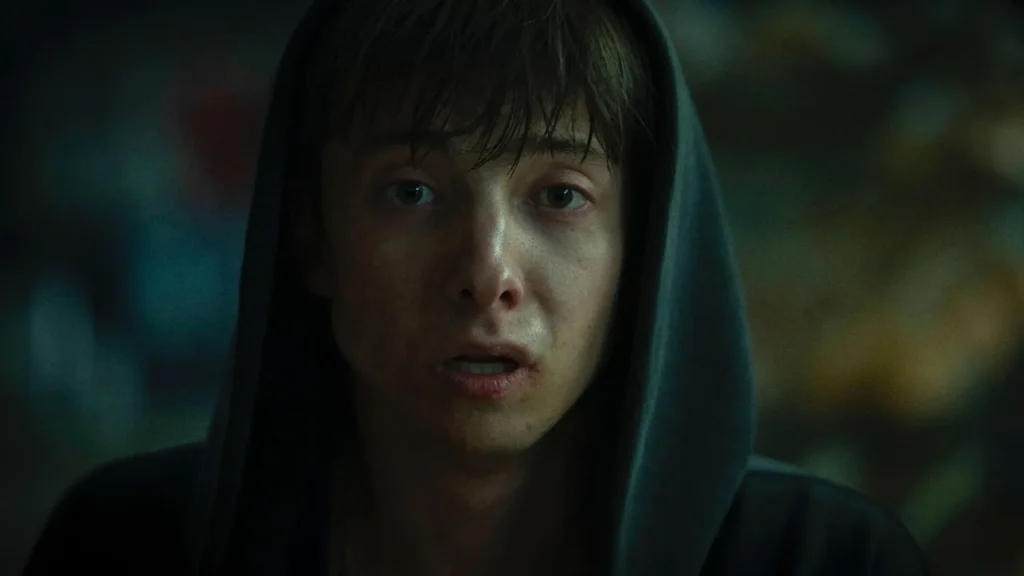
Leviticus is written and directed by Adrian Chiarella, and is his first feature length film. Set and filmed on location in Australia, the story follows the fate of three young men whose love is shattered when they are subject to an exorcism performed by a travelling “deliverance healer” (Nicholas Hope). Membership of the local church provides a cloying sense of community for young Naim and his mother who have recently moved into the area.
The film stars Joe Bird (It Follows) as Naim, Mia Wasikowska as his mother, Arlene and Stacy Clausen, of the 2023 comedy horror series Comedy Fun Park, plays Naim’s love interest, Ryan. Naim and Ryan come to grief when Naim sees Ryan snogging another boy, Hunter (Jeremy Blewitt), the pastor’s son.
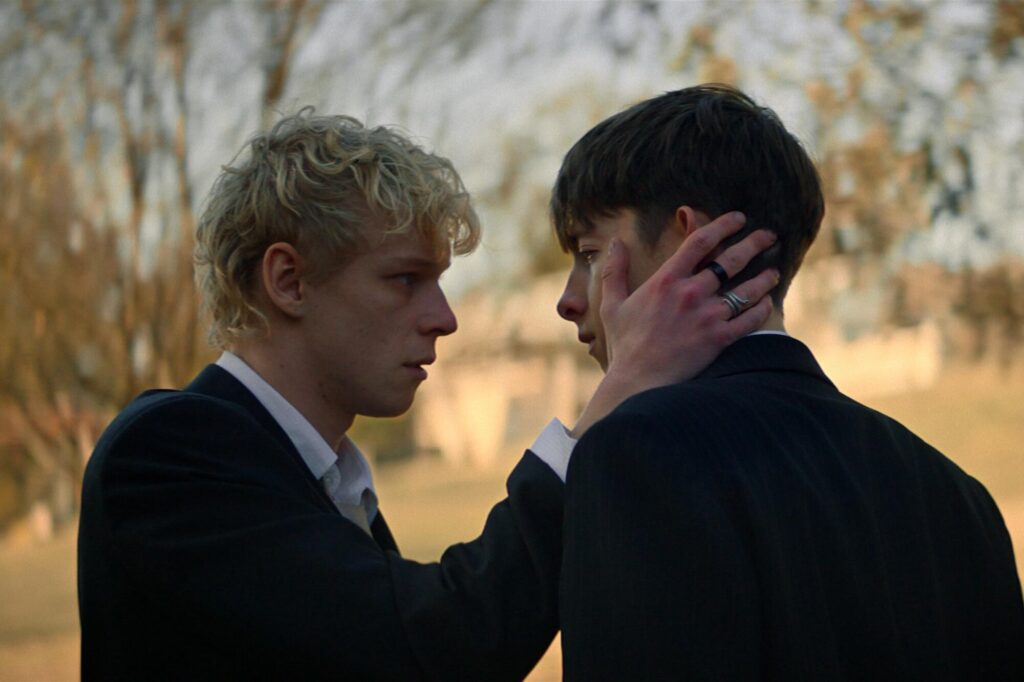
Motivated by feelings of rejection, Naim tells on the pair to Hunter’s father. An exorcism follows, but far from being delivered from their sinful urges, the pair become spiritually split in two, each stalked by a murderous spirit that resembles the other. Naim seeks help from the police, but they break his trust and inform his mother about his homosexual feelings. It’s not long before Naim is offered up by his mother for “deliverance”.
The cast’s performances are excellent throughout. Although Wasikowska’s role as a God fearing mother is similar to that of Carrie’s mother (Carrie, 1976), the actress sets aside sturm und drang, replacing it with a fiercely calm conviction. But I didn’t expect her motivations which, when revealed, casts her in a very cold light indeed.
Bird’s Nain is a powerfully emotional performance conveying passion and fear in equal measure. Clausan delivers on the film’s premise that the person standing in front of you may be your lover or your killer. And we don’t know either, making for incredibly tense scenes whenever we see Nain, Clausan or Blewitt together.
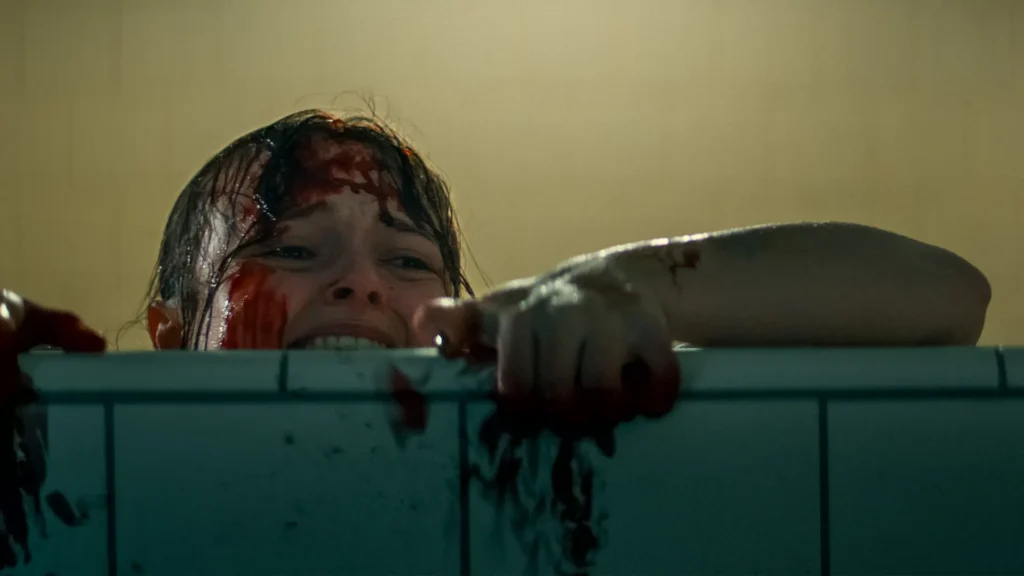
Laviticus wears its heart on its celluloid sleeve. In part, the film is about the destructive force of social prohibitions and prejudices against gay love that leaves queer youth alone and afraid. Homosexuality isn’t just the love that dare not speak its name, it is the love that dare not show its face. The evil spirits also serve to dramatise internalised homophobia, the young men are literally attacking themselves while the exorcism refers to the discredited practice of so-called “Conversion Therapy”.
The film’s title refers to the Bible’s “Holiness Code” in the Old Testament book of Leviticus, that is often cited as God condemning gay sex, i.e., “You shall not lie with a male as with a woman; it is an abomination.” (Chapter 18 verse 22) and “If a man lies with a male as with a woman, both of them have committed an abomination; they shall be put to death; their blood is upon them.” (Chapter 20 verse 13).
I’m not a theologian, but I don’t need to be to know that Leviticus is open to interpretation. I mean, why is God cool about lesbians rather than gay men? Certainly not in this film, if its opening scenes are anything to go by. Personally, my fall back position comes from The Merchant of Venice, to wit, “The devil can cite Scripture for his purpose”. Leviticus is too often cited as support for those with devilry on their minds.
Director Chiarella has Asian horror and contemporary films such as It Follows (2014) and The Witch (2015) as inspirations, but the air of encroaching, invasive menace is reminiscent of the ghost stories of M.R.James. Australian cinema has its own history of creating uneasy atmospheres in which characters confront the limits of rationality.
My knowledge of Australian horror tends to be from the 1970s when films such as Wake in Fright (1971), The Last Wave (1977) and The Shout (1978) were screened on the BBC. So I’m embarrassed to say I was waiting for Naim to consult an aboriginal medicine man to dream him some salvation. That doesn’t happen. Instead, we get more modern jump scares.
That said, the direction does create a hazy, dreamlike atmosphere. Chiarella often uses a short depth of field,casting backgrounds into a blur out of which characters sometimes walk. Keeping much of the background out of focus serves to further isolate the young men who remain in the foreground and therefore in focus.
Violence takes many forms, including play fighting between Naim and Ryan (there’s nothing like men wrestling to coveney their love for one another), sadomasochism in which Ryan calls on Hunter to throw rocks at him, and a scene in which a gang of fellow schoolmates set out to armed to makeshift clubs to “queer bash” our protagonists. When all this isn’t happening, the young gay men are beating themselves up.
Leviticus itself has an air of vulnerability about it. It doesn’t need elaborate interpretation, it simply tells it as it is, drawing on the director’s own experiences. And it’s not a film I felt the desire or the need to negatively criticise.
Sure, the film’s “law” , the rules of horror it creates for itself, could have been explored more consistently and I guess I really wanted the story to be expanded beyond its small cast. But, in the end, Leviticus has a heartbreaking intimacy that a wider canvas would surely lose.
Tim Robins
Leviticus is in cinemas now, and is due to be released on Blu-Ray on 16th November 2026 (AmazonUK Affiliate Link)
Head downthetubes for…
• Slant: Interview: Adrian Chiarella on Grounding the Horror of His Coming-of-Age Film ‘Leviticus’
The Australian director discusses why horror was the right vessel for his commentary
• For Your Reference: Podcast Interview with “Leviticus” Director, Adrian Chiarella & Actor, Joe Bird
- About the Author
- Latest Posts

A freelance journalist and Doctor Who fanzine editor since 1978, Tim Robins has written on comics, films, books and TV programmes for a wide range of publications including Starburst, Interzone, Primetime and TV Guide.
His brief flirtation with comics includes ghost inking a 2000AD strip and co-writing a Doctor Who strip with Mike Collins. Since 1990 he worked at the University of Glamorgan where he was a Senior Lecturer in Cultural and Media Studies and the social sciences. Academically, he has published on the animation industry in Wales and approaches to social memory. He claims to be a card carrying member of the Politically Correct, a secret cadre bent on ruling the entire world and all human thought.
Categories: Features, Film, Other Worlds, Reviews
 In Review: Avengers: Endgame Encore
  In Review: Hope
  In Review: Resident Evil
  In Review: Raiders of the Lost Ark