Review by Tim Robins
WARNING: THIS REVIEW INCLUDES NOTES ON ADULT THEMES
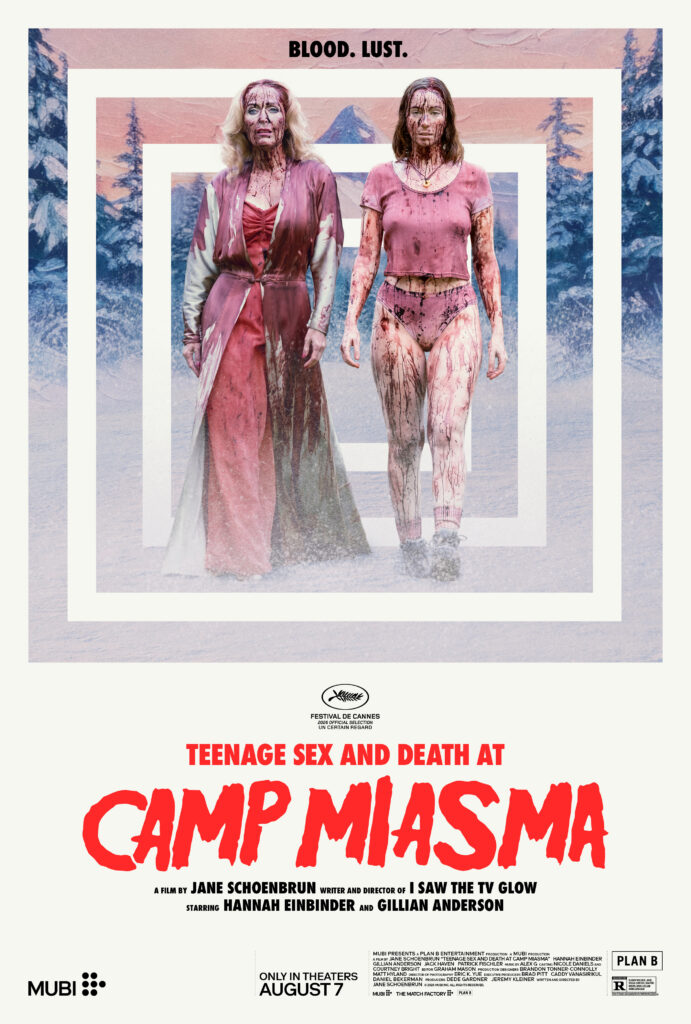
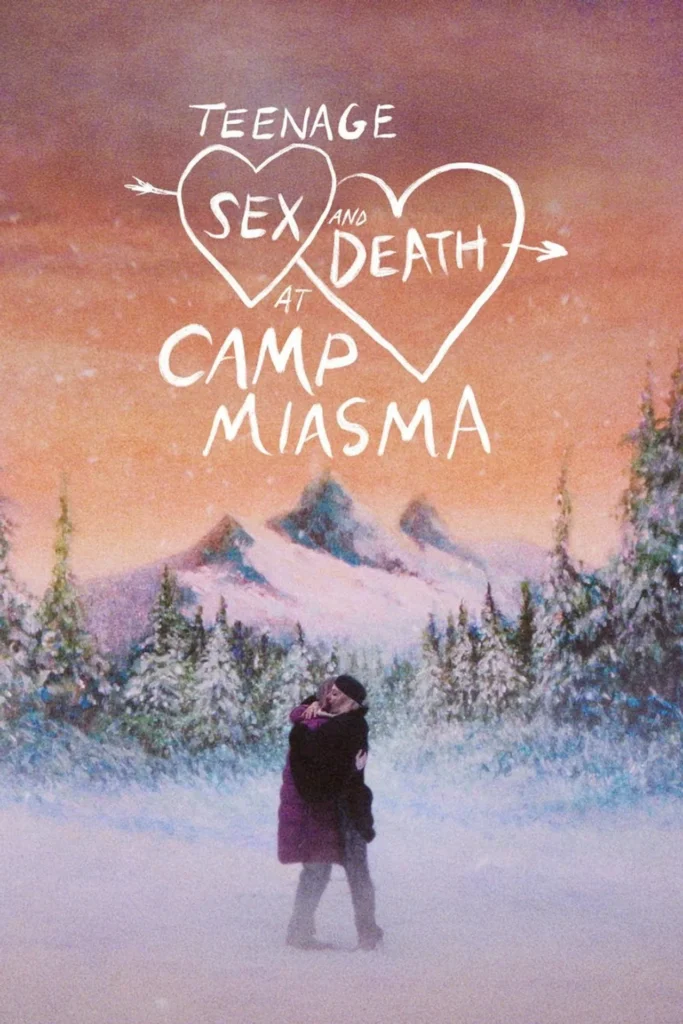
I don’t know who the teenagers of the title are, because Teenage Sex and Death at Camp Miasma focuses on a passionate, transgressive, romance between adults Hannah Einbinder (of TV comedy Hacks fame) and Gillian Anderson, who surely needs no introduction.
Jane Schoenbrum, director of the previously reviewed I saw the TV Glow, returns to weave another tale of lives lived out through the products of popular culture. In doing so, lines between fiction and reality are again blurred in a way that is entertainingly “knowing” rather than dryly formulaic (if only Schoenbrum had got to direct The End of Oak Street!).
Teenage Sex and Death at Camp Miasma involves the lives and fantasies of two unruly readers – director Kris, played by Einbinder and a film star, Billy Presley, played by Anderson. Together, the pair bend the tropes of the Slasher genre, and the Camp Miasma films, in particular, to their own purposes and desires. Eventually, the distinction between the Miasma movies and reality is turned on its head in ways I’m still trying to grasp.
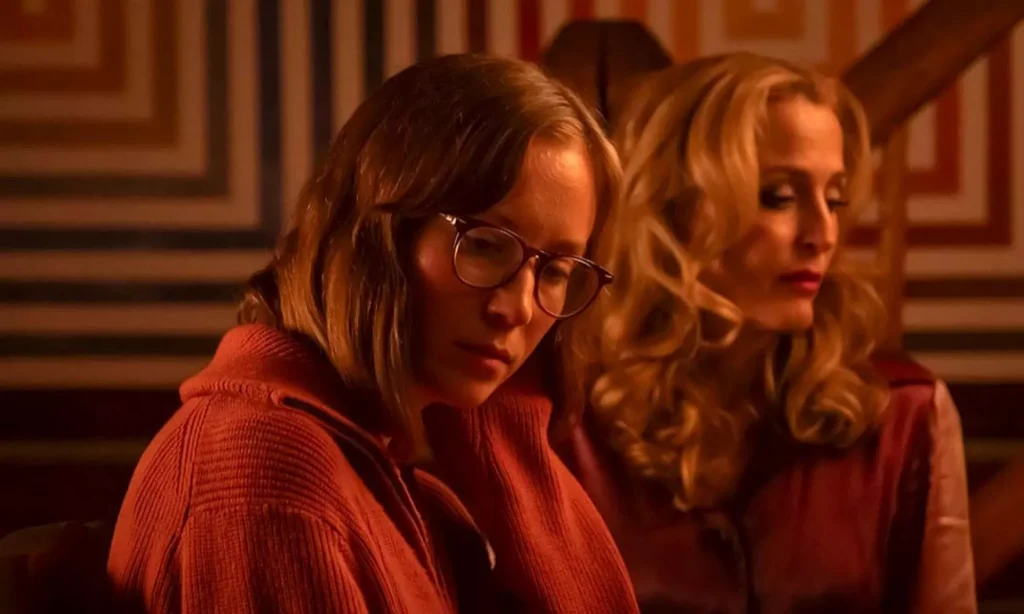
Einbinder is perfectly cast as Kris, whose own horror flicks would seem to reflect her repressed, somewhat distant relation to herself and her characters. We are told that critics describe Kris’s Sundance winning debut as Psycho told from the perspective of the shower curtain.
Zoom calls reveal the mundane desires of Kris’s vacuous film producers, all hoping her wayward talent can revive the “Zombie” Camp Miasma IP. But, when Einbinder pitches the idea that we are all in the killer’s movies and it is he who has the final cut, the producers back away. It’s fair to say Kris’s pitch hasn’t struck the right, populist chord.
Researching the franchise, Kris tracks down Presley, the first film’s final girl, to its abandoned summer camp used as the film’s location. “How did you come to choose to live at the abandoned camp from the first film?” Kris asks in a guileless but fun-for-the-audience moment.
In the makeshift camp cinema, Presley passes the days by watching her own performance as a young camp counsellor in the movie. Particularly significant for Presley, is a scene in which a gauche young man mechanically makes love to her. That is until a double penetration scene in which both characters are penetrated by the killer’s phallic spear.
Yes, the film goes there and to other places with nods to Sunset Boulevard (1950) and Peeping Tom (1960) along the way. And yes, there is a climax at the climax. This is a film where I can imagine people leaving the cinema, if they haven’t already walked out on this review. I must admit, I never expected to hear Anderson talking about the magic of masturbation.
There’s a cleverness to Schoenbrum’s work that I can’t help but enjoy. For example, the name of Camp Miasma’s serial killer is “Little Death”. Ho ho. “Le Petite Mort” (little death) was used by the late French scholar Roland Barthes, who used the term jouissance to signify the erotic pleasure of becoming lost in a picture, film, novel or other text.
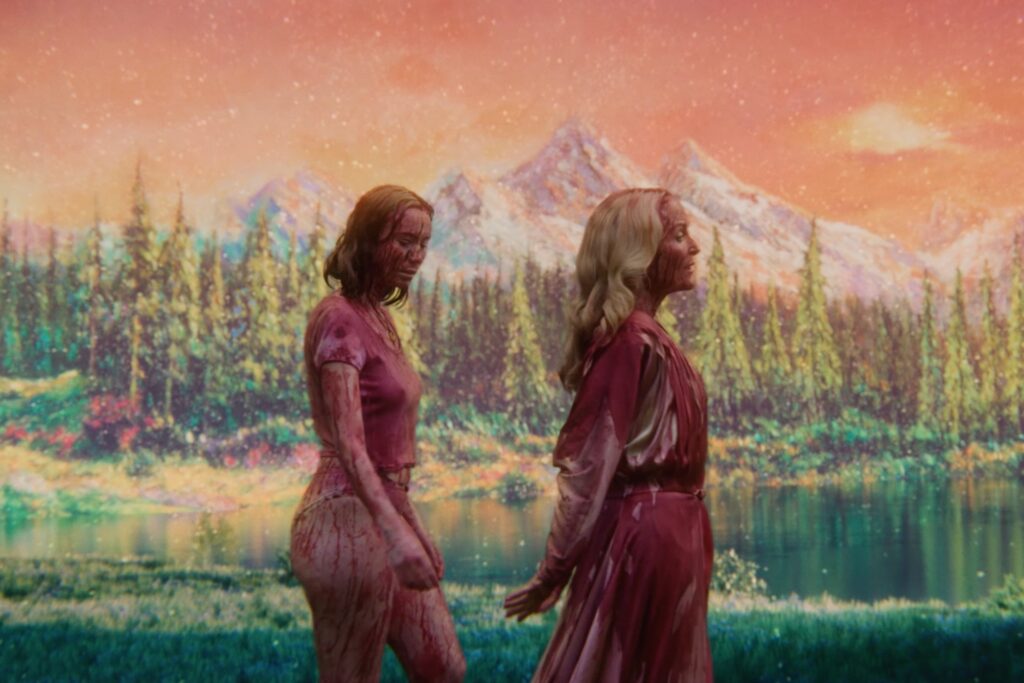
Jouissance literally means orgasm, connoting the, also French word, jouir i.e. “to come”. And yes, the faces of the female French students did, appropriately, blush when I explored the concept in a lecture. In a sense, it is at the moment of climax that we come undone, i.e. set free from the bindings of dominant culture that seeks to tie us to specific identities.
Meanwhile, we learn “Little Death’ lives through a dark hole at the bottom of the lake. I’m sure this alludes to the psychoanalytic theory of another Frenchman, Jaques Lacan. It is significant that Kris writes ‘Desire’, a key Lacanian concept, in big, comforting letters on a note pad. I suspect the black hole at the bottom of the lake represents the lack or absence that the theorist sees as existing at the heart of desire and identity. It is significant, but I was too busy enjoying the film to think much more on that.
Thankfully, a knowledge of French structuralist and post structuralist theory isn’t a requirement to enjoy this film. However, it is implicitly political. Much like a warmly glowing cabin interior, the film offers, albeit brief, escape from the current attempt to define sexual identity by binding it to the dubious determinism of biological bits and bobs. I can’t begin to discuss how deliberately misguided this is.
We learn Kris has researched the intersection of queerness and images of monstrosity. Little Death is one such monstrosity, born, we are told, of two hermaphrodite parents. We are told that the child was allocated two beds at camp: one in the girls’ quarters, the other in the boys’. After being drowned by boys at the camp, he rose from the dead as a queer Jason Voorhees.
I suspect Schoenbrum is, at the very least, one of my favourite directors working today. There’s a joie de vivrethat permeates her work. This includes the film’s music by Alex G. There are popular, poignant needle drops, but I particularly enjoyed the percussion such as eerie, mechanical background rumblings that recall the soundtracks of David Lynch movies. In Lynchian fashion, Little Death hides his face behind a clunky mask that resembles something from the camp’s tannoy system. Ironically, Little Death themselves (sic) is silent, perhaps a sign of their existence outside the binary subject positions of language.
There’s lots to enjoy here, from the extravagant gore worthy of a Monty Python film to the celebration of popular culture through candy wrappers. When Kris and Presley lie together it is on a blanket of junk food wrappers. Are we supposed to see them as a pair of Pop-Tarts?
To add to my enjoyment, I saw the film with my friend, Piper, in the garden of Preston Manor, Brighton, courtesy of Picturehouse and Ribena (!?). The locale was certainly appropriate for a cabin in the woods movie. The screen had been put up in front of the garden’s fir trees. Beyond their silhouette, it was possible to hear the distant rumbling of trains and the swish of traffic, all far enough away to be of no help at all if a killer struck.
Frankly, the screening was a welcome escape from the tensions caused by those driven by absurd fears and rigid gender identities arising from today’s barely concealed transphobia. The film’s exploration of sexuality and fantasy was certainly impactful.
That night, I dreamt my bed was surrounded by dwarves in wizarding hats led by a hideous woman-thing with a megaphone for a face. I was afraid I would wake up to find JK Rowling looming over my bed, demanding to inspect my private parts before I could go to the toilet. Terrifying. Truely, terrifying.
Tim Robins
Head downthetubes for…
• NPR: Jane Schoenbrun talks about their new film Teenage Sex and Death at Camp Miasma
NPR’s Danielle Kurtzleben talks with filmmaker Jane Schoenbrun about remakes, and their new film
• Little White Lies: Hannah Einbinder: “No divas allowed, you know what I mean?”
The co-lead of Teenage Sex and Death at Camp Miasma lays out her vision of a cinema that is provocative, joyful and kind.
- About the Author
- Latest Posts

A freelance journalist and Doctor Who fanzine editor since 1978, Tim Robins has written on comics, films, books and TV programmes for a wide range of publications including Starburst, Interzone, Primetime and TV Guide.
His brief flirtation with comics includes ghost inking a 2000AD strip and co-writing a Doctor Who strip with Mike Collins. Since 1990 he worked at the University of Glamorgan where he was a Senior Lecturer in Cultural and Media Studies and the social sciences. Academically, he has published on the animation industry in Wales and approaches to social memory. He claims to be a card carrying member of the Politically Correct, a secret cadre bent on ruling the entire world and all human thought.
Categories: Features, Film, Other Worlds, Reviews
 In Review: Avengers: Endgame Encore
  In Review: Hope
  In Review: Resident Evil
  In Review: Raiders of the Lost Ark