Historian Brian M. Puaca at the Christopher Newport University in the United States is working on related projects on comic book censorship and burnings after 1945 – and is seeking information on post war comic censorship here in the UK.
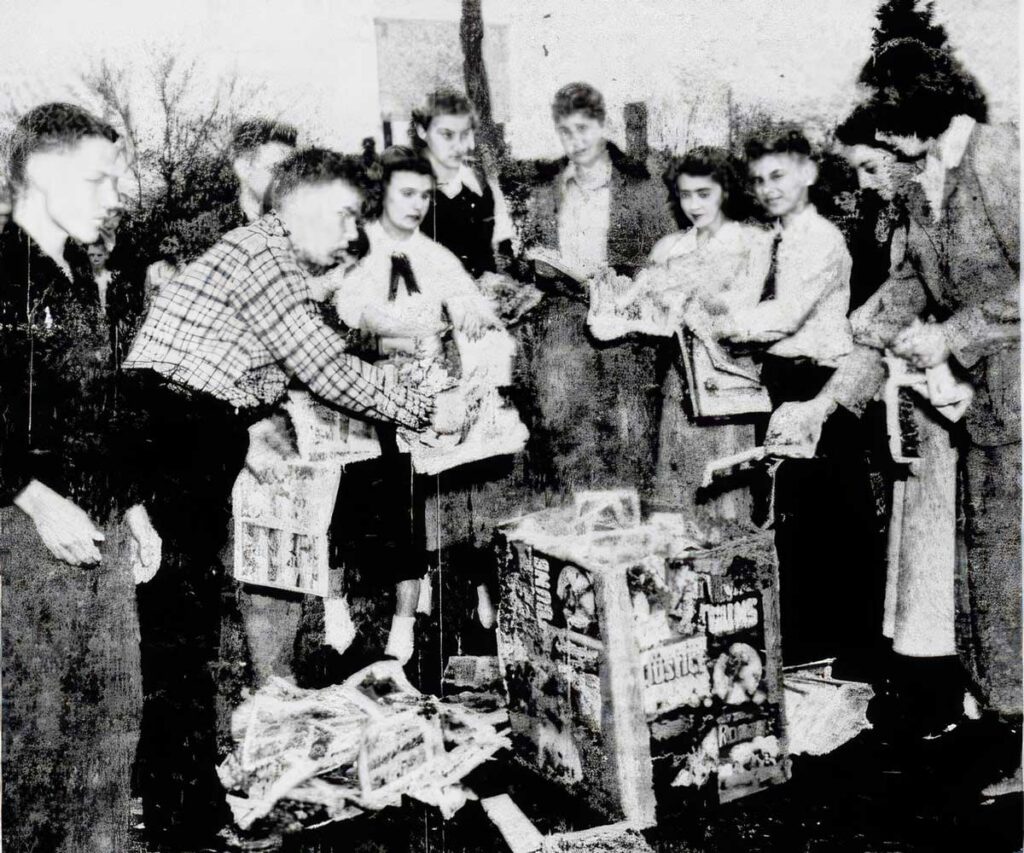
Public comic book burnings were a widespread phenomenon in the United States between 1945 and 1955, driven by post-World War Two moral panics, anti-communist fears, and concerns over juvenile delinquency.
Brian has launched an informative American-focused digital humanities project that maps and documents dozens of burnings, and he’s now working on a European site.
“My work on that brought me to your excellent 2015 post on horror comics and moral panic in mid-1950s Britain,” he tells us, but he’s seeking additional source material, or suggestions, as he continues working on this project.
“So far, I have identified almost a dozen European comics burnings – East and mostly West – but none in Britain,” he says. “I’d appreciate any advice on additional material, even if it only relates to larger concerns about comic books at the time.”
While newspapers of the period did report on book burnings in the US, it seems that although there were concerns about horror comics, British rivals for pocket money purchases such as EAGLE and Lion, and the passing of the The Harmful Publications Act (Children and Young Persons) in 1955 appear to have taken the wind out of the sails of more strident protest here in the UK, discussion on the matter more the province of reasoned debate. There is reported horror, too, at the very idea of book burning, so soon after Nazi activity in Germany during both before and during World War Two. One contemporary commentator even made comparison with Papal burnings of rival religions’ works.
In the early 1960s, there were secretive actions taken against “sexy books” held by libraries, newspapers reporting irritated lenders borrowing “offensive” works, ripping out and burning offensive pages – but there does not appear to be the level of vehemence stirred up by right wing politicians toward works they did not care for… or was there? Do any downthetubes readers remember?

Please contact Brian Puaca at bpuaca@cnu.edu with any information you may have to help his research
• Check out Brian’s Comic Book Burnings Site
Brian M. Puaca is an historian whose research focuses on modern German history. His book, Learning Democracy: Education Reform in West Germany, 1945-1965, received the New Scholar’s Award from the American Educational Research Association (Division F).
He has also published articles and chapters on school reform, textbooks, democratisation, and memory. He is currently working on a new project exploring youth culture, censorship, and comic book burnings in 1950s West Germany.
Head downthetubes for… US comic censorship
• Comic Book Legal Defense Fund: History of Comics Censorship
• Free Speech Center: Comic Book Censorship 1948-1955
From 1948 through the mid-‘50s, America saw widespread efforts to limit political speech and popular culture. The former was fuelled by the Red Scare and fear of Communist infiltration. The latter stemmed from public concerns about morality and potential influences on children. Comic books were among the earliest targets.
• PS Artbooks: The Comic Book Burnings of the 1940s: A Cultural Firestorm
Head downthetubes for… British and Irish comic censorship
For anyone interested in the history of comic censorship in the UK, Dave Dustin created this YouTube video in 2022, taking a look at all the British anti-comics propaganda. All the way from the books Juniors and Children’s Comics by George Pumphrey to the booklets Lure Of The Comics, Comics And Your Children, and British Comics An Appraisal, to the 1956 conference From Comics To Classics… and everything inbetween

• downthetubes: The Comics That Shook 1950s Britain discovered in the National Archives
Britain’s National Archives is a wonderful repository for many odd things, but you might be forgiven for wondering just what a number of horror comics might be doing lurking in its catalogue. It was certainly a surprise to researcher Emily Stidston, who found a number of them attached to official 1950s government correspondence – Prime Minister’s papers to be precise…
• downthetubes: Documenting the Role of the British Press in the Post War Anti-Comic Campaign
A look at how comics were vilified in the 1940s and 50s in the UK
• The Leprechaun, and the Irish War on Comics – by James Bacon
• Eagle Censored? Investigating bizarre claims during Ireland’s 1950s war on comics – by James Bacon
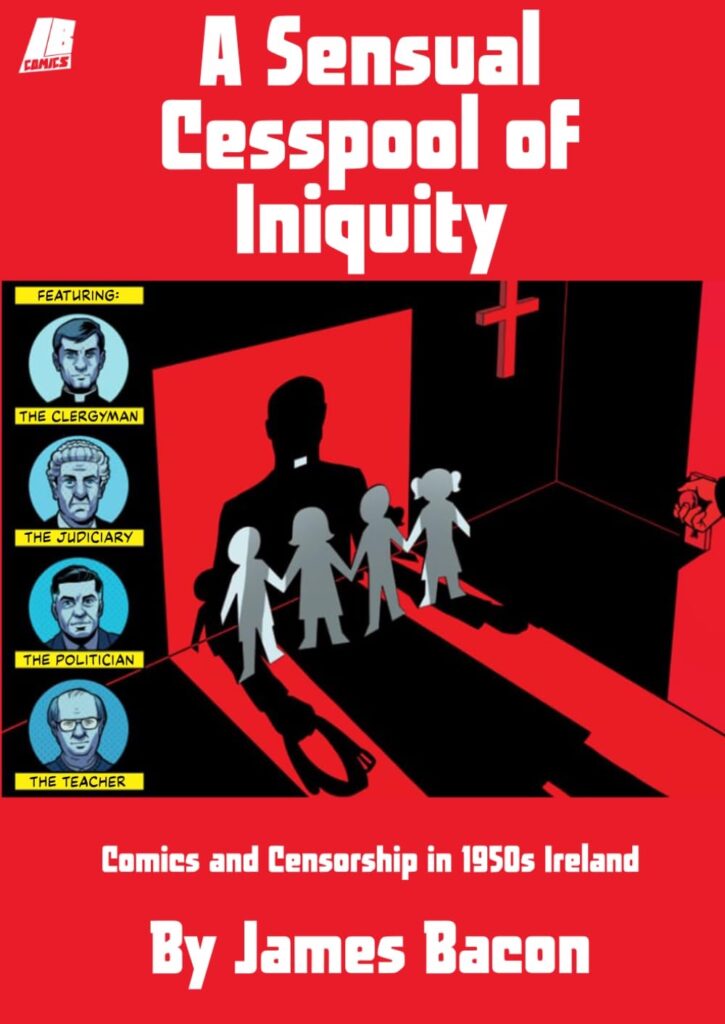
• A Sensual Cesspool of Iniquity is available from Limit Break Comics – James Bacon’s book documenting comics censorship in Ireland – as well as on Amazon.co.uk (Affiliate Link) | Amazon.com | Amazon.ie
• Read David Ferguson’s review of James’ book here on downthetubes
• Pulp Demons: International Dimensions of the Postwar Anti-comics Campaign edited by John A. Lent has more information on the Comics Campaign Council. The book offers essays on the censorship of violence and political comment in comics in the US in the 40s and 50s which sparked similar campaigns in other countries.
• You could also try tracking down the brilliant Haunt of Fears by Martin Barker. His book explores the British 1950s anti-comics campaign by asking some rather different questions. Who were the people at the heart of the anti-comics campaign? Why and how did the British Communist Party come to play a central role, and yet end up attacking a group of comics which were “on their side”?
• Over on his Blimey! It’s Another Blog About Comics, Lew Stringer has a feature on some of the newspaper headlines of 1954 about the “horror” of “horror comics”, and another great item here – “The year Britain got the Horrors over Horror Comics”
- About the Author
- Latest Posts

John is the founder of downthetubes, launched in 1998. He is a comics and magazine editor, writer, and Press Officer for the Lakes International Comic Art Festival. He also runs Crucible Comic Press.
Working in British comics publishing since the 1980s, his credits include editor of titles such as Doctor Who Magazine and Overkill for Marvel UK, Babylon 5 Magazine, Star Trek Magazine, and its successor, Star Trek Explorer, and more. He also edited the comics anthology STRIP Magazine and edited several audio comics for ROK Comics; and has edited several comic collections and graphic novels, including volumes of “Charley’s War” and “Dan Dare”, and Hancock: The Lad Himself, by Stephen Walsh and Keith Page.
He’s the writer of comics such as Pilgrim: Secrets and Lies for B7 Comics; “Crucible”, a creator-owned project with 2000AD artist Smuzz; and “Death Duty” and “Skow Dogs”, with Dave Hailwood.
Categories: British Comics, Comics, Creating Comics, downthetubes Comics News, downthetubes News, US Comics
Related Articles
-
 British Captain Britain Fans celebrate 50 Years with a special not-for-profit comic
-
 On This Day, in 1972, Britain welcomed the arrival of The Mighty World of Marvel
-
 Tube Surfing: A Comic That Never Was, Corgi Comic Cars, UK Kickstarters and a Bendy Dalek!
-
 Documenting the Role of the British Press in the Post War Anti-Comic Campaign
Leave a Reply